Dec 31, 2025

AI Innovations in Voice Commerce Solutions
Voice commerce is no longer sci-fi. It’s expanding fast and reshaping how enterprises handle buying journeys, customer calls, and payments. Globally, the voice commerce market was valued at roughly $42.75 billion in 2023 and is projected to grow to about $186.28 billion by 2030, at a CAGR of 24.6 percent, indicating that voice-driven transactions are moving beyond experimentation into a serious business infrastructure.
Yet many enterprises still struggle with friction in traditional digital channels. Customers drop off carts, support costs climb, and call centers get swamped during peak seasons. Voice commerce addresses these issues by turning spoken language into seamless commerce actions, making interactions more natural, intuitive, and scalable.
In this blog, you’ll learn why voice commerce is gaining ground, how AI innovations are transforming it, what outcomes enterprises can expect, the challenges to tackle, and how to evaluate platforms.
Key Takeaways
Voice commerce is now an enterprise-ready channel that drives transactions, compliance, and customer trust across key industries.
AI-powered capabilities make voice interactions accurate, scalable, and suitable for revenue-critical workflows.
Enterprises gain higher conversions, lower costs, and faster transaction completion through voice commerce.
Platform selection must prioritize compliance, integration depth, scalability, and operational control.
CubeRoot enables secure, multilingual, and scalable voice commerce tailored for Indian enterprise needs.
What Are Voice Commerce Solutions and How Do They Work?
Voice commerce solutions turn spoken conversations into complete commercial actions that directly impact your revenue and operations. Instead of treating voice as a support channel, you use it as an execution layer where discovery, validation, and transactions happen in one flow.
Below is how voice commerce solutions function in an enterprise environment.
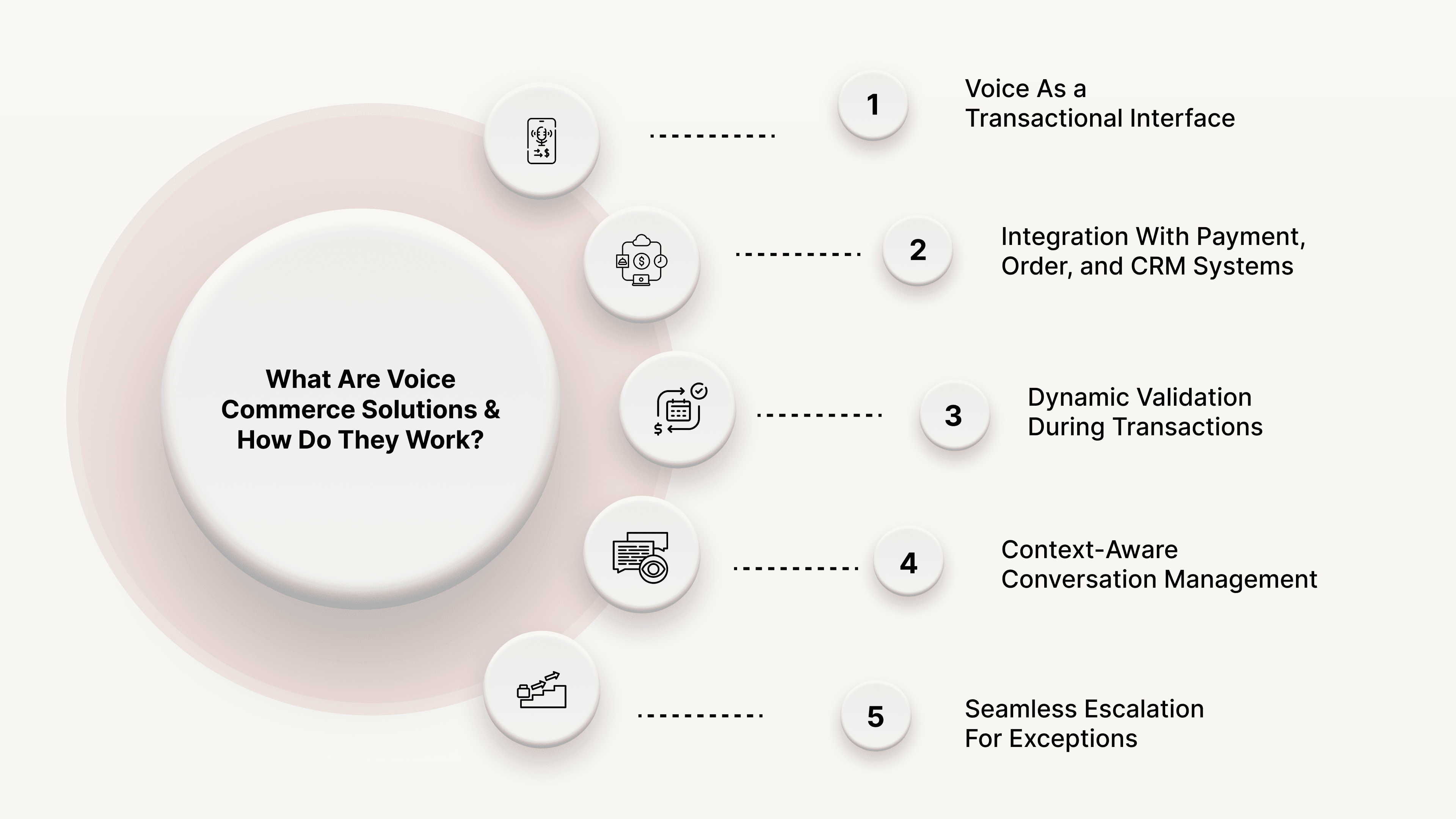
Voice As a Transactional Interface: You allow customers to complete actions like placing orders, confirming deliveries, or approving payments through natural conversation, without switching to apps or forms.
Integration With Payment, Order, and CRM Systems: You connect voice interactions directly to your commerce stack so customer data, transaction status, and payment outcomes update instantly across systems.
Dynamic Validation During Transactions: You verify details like identity, order accuracy, or eligibility in real time, reducing errors before they reach downstream teams.
Context-Aware Conversation Management: You maintain continuity across questions and responses so customers can complete multi-step actions without repeating information.
Also Read: Automated Calling System for Businesses
Once the fundamentals of how voice commerce solutions operate are clear, it becomes important to examine the AI innovations that make these solutions scalable, intelligent, and enterprise-ready.
Top 5 AI Innovations Powering Modern Voice Commerce Solutions
Voice commerce has moved beyond basic automation because AI systems now operate as full-stack interaction engines rather than isolated features. For organizations handling regulated workflows, multilingual audiences, and revenue-linked interactions, these innovations ensure voice channels remain accurate, resilient, and commercially dependable.
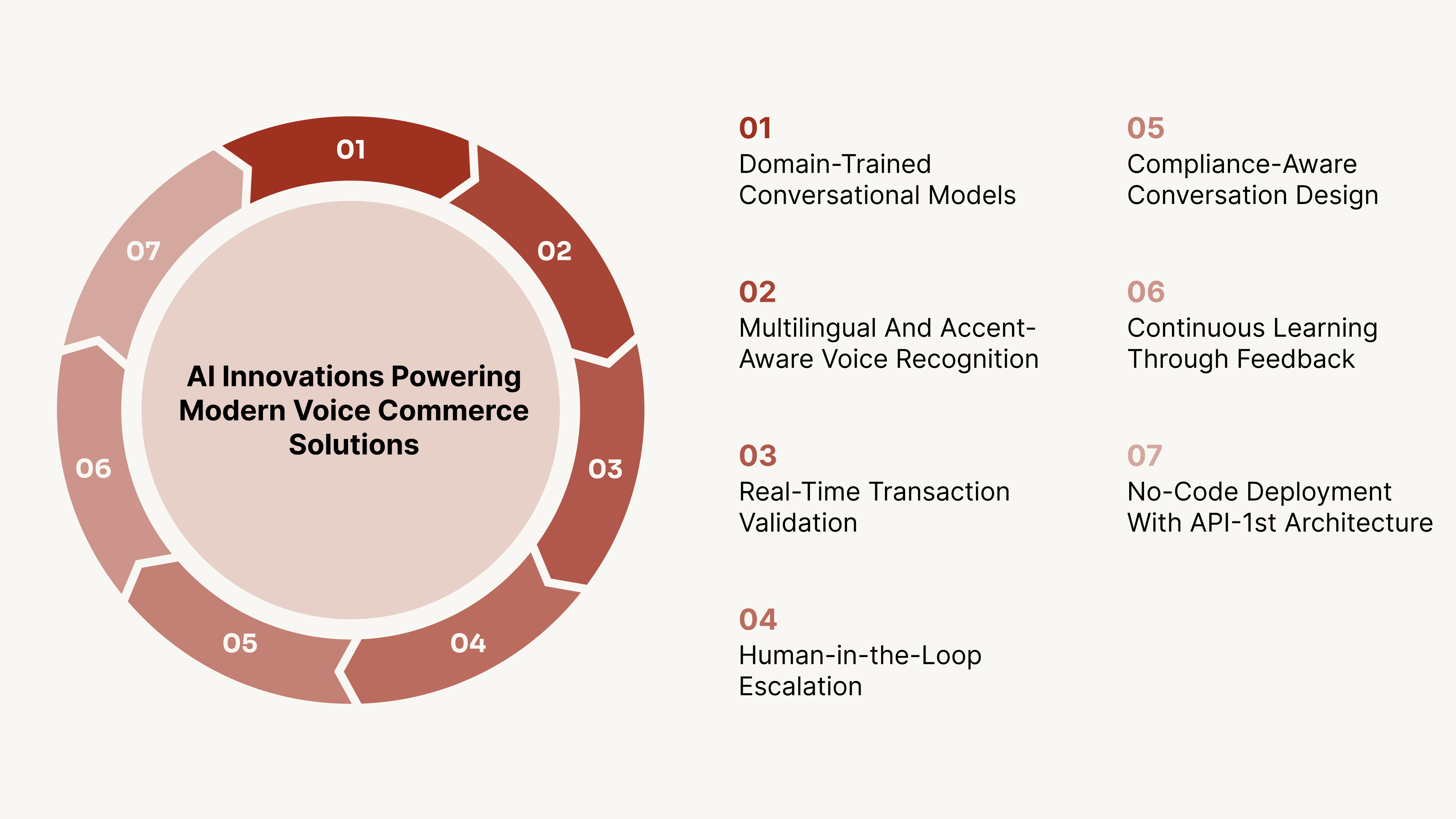
Below are the core AI innovations shaping how modern voice commerce solutions are built and deployed.
Domain-Trained Conversational Models
Generic AI struggles when conversations involve industry rules, sensitive data, or revenue-impacting decisions. Domain-trained conversational models solve this by learning your business language, not just natural language.
These models are trained on sector-specific intents, terminology, and compliance constraints, allowing voice interactions to align tightly with how your operations actually work.
Below is how domain-trained models strengthen voice commerce execution.
Industry-Specific Vocabulary Mastery: Financial terms, medical references, product attributes, and policy language are understood without misinterpretation, reducing clarification loops.
Built-In Understanding Of Process Logic: Transaction sequences such as KYC checks, order validation, or eligibility screening follow your operational rules automatically.
Reduced Risk Of Incorrect Commitments: Responses stay within approved business boundaries, preventing promises or confirmations that violate internal policies.
Higher Accuracy In Revenue-Critical Conversations: Pricing, discounts, payment timelines, and return conditions are communicated correctly during live transactions.
Faster Go-Live For Enterprise Use Cases: Pre-trained domain knowledge shortens setup time compared to training models from scratch for each workflow.
Struggling to handle complex customer conversations without increasing support costs or response time? CubeRoot’s AI-powered voice agents help enterprises automate high-volume, decision-heavy interactions like order confirmations and eligibility checks, without relying on rigid scripts.
Multilingual And Accent-Aware Voice Recognition
Serving customers across India means dealing with linguistic diversity that directly impacts transaction success. Multilingual and accent-aware voice recognition ensures spoken inputs are captured accurately, even when pronunciation, pace, or regional phrasing varies widely.
This capability removes friction from voice-based transactions and protects intent clarity in revenue-linked interactions.
Below are the ways this innovation strengthens enterprise voice interactions.
Accurate Recognition Across Indian Languages: Regional languages and mixed-language speech are understood clearly, enabling transactions beyond English-only audiences.
Accent Sensitivity Without Manual Tuning: Variations in pronunciation are handled automatically, reducing repeated prompts and call fatigue.
Improved Transaction Completion Rates: Correct capture of names, addresses, and numeric details prevents downstream failures in orders or payments.
Inclusive Access For Diverse Customer Segments: Customers interact confidently in familiar languages, increasing participation across regions and demographics.
Lower Operational Rework From Misheard Inputs: Fewer transcription errors mean less manual correction by support or operations teams.
Real-Time Transaction Validation
Voice commerce transactions succeed only when accuracy is confirmed at the moment of action. Real-time transaction validation ensures that every spoken confirmation, payment approval, or order update is verified instantly against live systems.
Below are the ways real-time validation strengthens voice commerce execution.
Instant Verification Of Transaction Details: Order values, payment amounts, and customer identifiers are checked live before confirmation is completed.
Reduced Post-Call Error Resolution: Issues are caught during the interaction, avoiding callbacks, refunds, or manual audits later.
Safer Handling Of Payment Approvals: Failed or mismatched payment attempts are flagged immediately, preventing incomplete or risky transactions.
Improved Confidence In Customer Commitments: Confirmations like promise-to-pay or delivery acceptance are validated against system records in real time.
Higher Operational Predictability At Scale: Large transaction volumes remain manageable because errors do not compound across systems.
Human-in-the-Loop Escalation
Automation works best when it knows its limits. Human-in-the-loop escalation ensures voice commerce systems handle routine transactions independently while transferring sensitive, high-value, or ambiguous cases to trained teams at the right moment. This balance protects customer trust without sacrificing efficiency.
Below are the ways human-in-the-loop escalation strengthens voice commerce outcomes.
Intelligent Identification Of Escalation Triggers: Signals like repeated hesitation, policy exceptions, or payment failures prompt timely handoff.
Context-Rich Transfer To Live Teams: Conversation history, intent, and collected data move with the call, avoiding repetition.
Protection For High-Value Transactions: Large payments, loan commitments, or sensitive updates receive human oversight when needed.
Reduced Agent Workload Without Experience Loss: Live teams focus on complex cases instead of routine confirmations.
Consistent Brand Experience Across Automation And Human Touchpoints: Escalations feel like a continuation, not a disruption, in the customer journey.
Also Read: What Is A Voice Chatbot: A Complete Guide
Compliance-Aware Conversation Design
Voice commerce conversations often involve regulated actions such as payments, disclosures, or personal data exchange. Compliance-aware conversation design ensures every spoken interaction follows predefined legal, regulatory, and internal policy requirements by default. Instead of relying on agent memory or post-call audits, compliance is embedded directly into the conversation flow.
Below are the key ways compliance-aware design strengthens enterprise voice commerce.
Mandatory Disclosures Built Into Conversation Flow: Required statements such as consent, eligibility conditions, or payment terms are delivered at the right moment. This ensures no transaction progresses without fulfilling legal disclosure obligations.
Script Governance Across All Voice Interactions: Approved language is enforced consistently, preventing deviations that could create regulatory risk. Updates to scripts apply instantly across all live voice workflows.
Automated Consent Capture And Validation: Verbal consent is explicitly requested, recorded, and time-stamped within the interaction. This creates a verifiable audit trail without manual intervention.
Audit-Ready Conversation Records: Every interaction is logged with structured metadata for easy review. Compliance teams gain faster access to evidence during audits or investigations.
With the core AI innovations in place, enterprises can better understand the concrete business outcomes voice commerce delivers across revenue, efficiency, and customer experience.
What Business Outcomes Can Enterprises Expect From Voice Commerce?
Voice commerce delivers measurable business impact when deployed as a core operating channel rather than an add-on. For enterprises managing large customer bases, complex transactions, and revenue accountability, outcomes extend beyond efficiency metrics.
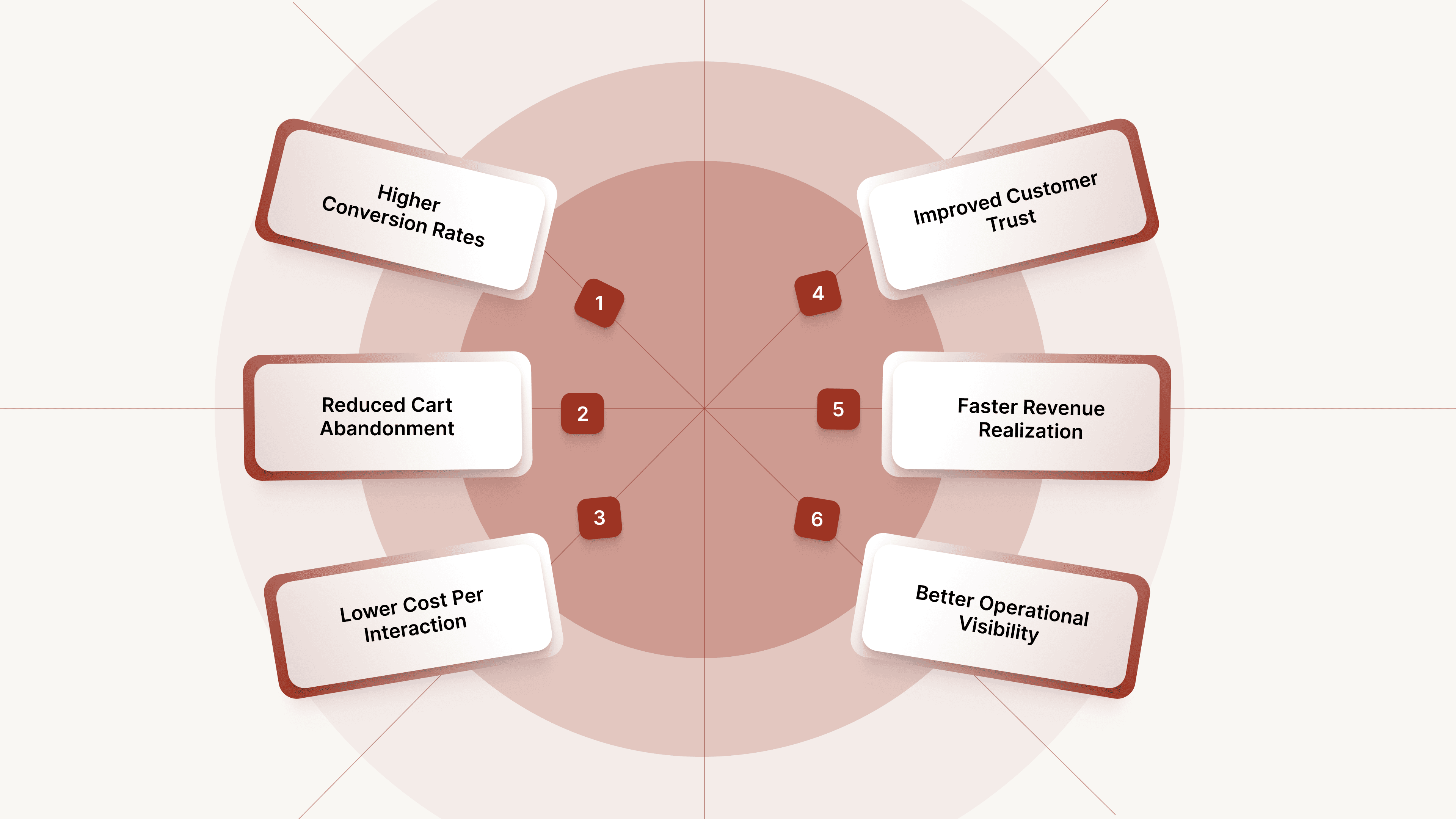
Below are the key business outcomes achieved through enterprise-grade voice commerce.
Higher Conversion Rates: Guided voice interactions resolve last-mile doubts and turn more intents into completed actions.
Reduced Cart Abandonment: Real-time clarification during checkout prevents drop-offs and completes transactions in one interaction.
Lower Cost Per Interaction: High-volume workflows scale without proportional increases in support staffing.
Stronger Customer Trust: Consistent, reliable voice experiences build confidence during sensitive or high-value transactions.
Faster Revenue Realization: Payments and approvals happen immediately, shortening cash cycles.
While voice commerce promises significant business outcomes, enterprises must also explore operational, technological, and compliance challenges to fully realize its potential.
What Challenges Do Enterprises Face When Implementing Voice Commerce?
Implementing voice commerce at enterprise scale introduces challenges that go beyond technology adoption. Risks often emerge around governance, experience consistency, and operational readiness.
Below are common challenges enterprises face, along with practical solutions.
Challenge | Practical Solution |
|---|---|
Payment security and compliance | Embed consent capture, audit trails, and controlled data handling |
Complex voice transactions | Break flows into validated, step-by-step conversations |
Cross-team operational alignment | Use shared workflows and deep system integrations |
Limited performance visibility | Track completions, payment success, and intent resolution |
Suggested Read: Everything You Need to Know About AI Assistants
Understanding the challenges of implementing voice commerce is essential before evaluating platforms that can deliver secure, scalable, and compliant voice-driven transactions.
How Should Enterprises Evaluate Voice Commerce Platforms?
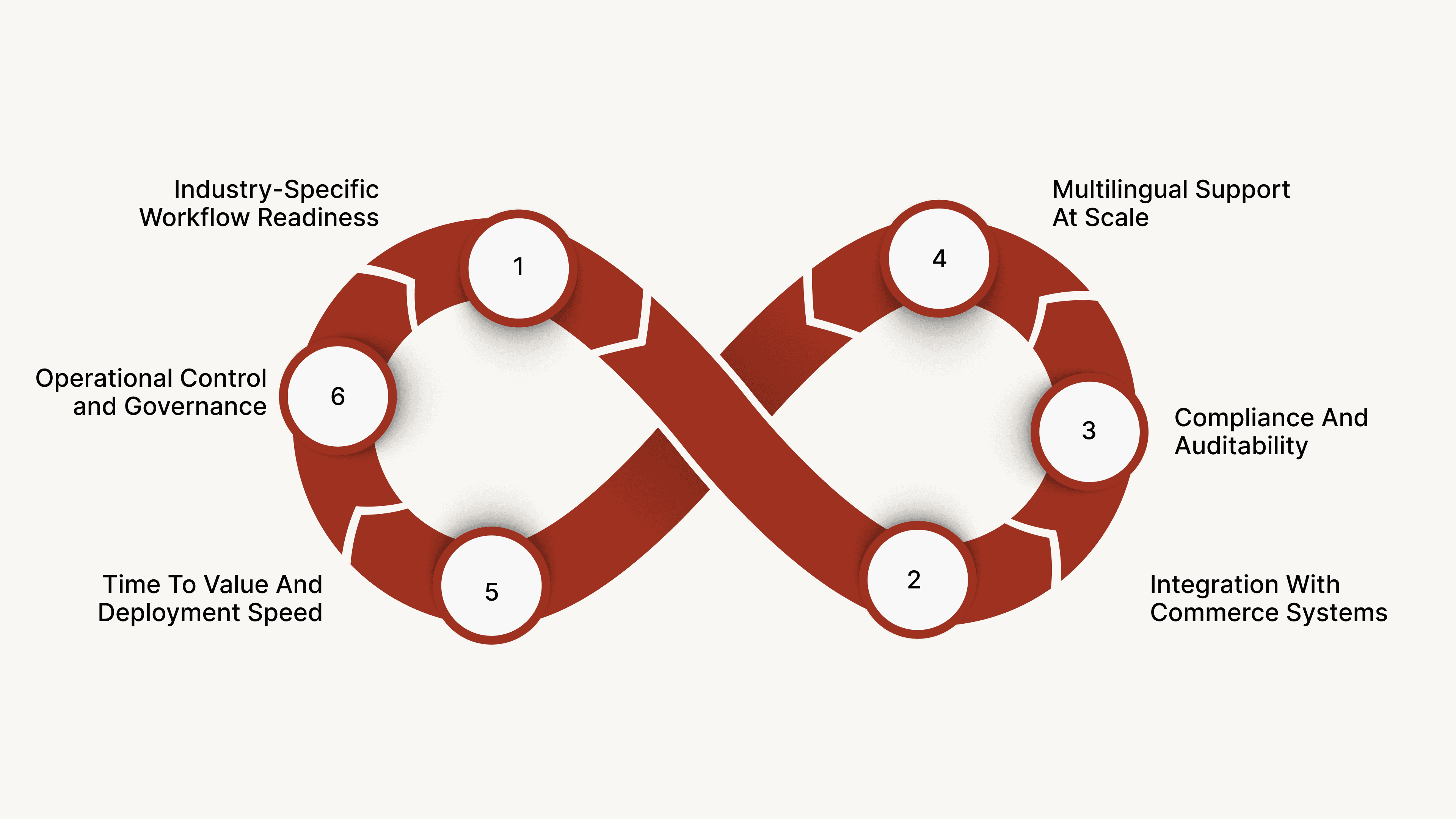
Choosing a voice commerce platform shapes how reliably transactions, compliance, and customer experience scale over time. Platforms must support regulated workflows, integrate deeply into existing systems, and remain flexible as business models change.
Below are the key criteria to assess when selecting a voice commerce platform.
Industry-Specific Workflow Readiness: Prebuilt flows for collections, ordering, or appointments reduce customization and lower rollout risk.
Commerce and Payment Integrations: Native integrations ensure real-time updates across billing, CRM, and order systems without reconciliation gaps.
Compliance and Auditability: Built-in consent capture, interaction logs, and reporting simplify audits and reduce regulatory exposure.
Multilingual Performance at Scale: Language support must remain consistent across regions and high call volumes to avoid uneven experiences.
Operational Control and Governance: Centralized management keeps voice experiences consistent, compliant, and easy to update across teams.
Once enterprises know what to look for in a voice commerce platform, the next step is exploring solutions like CubeRoot that combine scalability, security, and operational control for practical business impact.
How CubeRoot Enables Scalable, Secure Voice Commerce?
CubeRoot enables enterprises to operationalize voice commerce as a dependable, revenue-linked channel rather than an experimental layer. Built for Indian enterprise realities, CubeRoot combines domain intelligence, compliance readiness, and infrastructure scalability to support high-volume, high-stakes transactions across sectors.
Prebuilt Commerce Workflows: Ready templates for orders, COD checks, returns, and delivery feedback reduce setup time and operational errors.
Compliance-Ready Transactions: Consent capture, disclosures, and payment confirmations are embedded into conversations, with every interaction logged and audit-ready.
Multilingual Voice Agents: Native regional language and accent support enables consistent experiences across metro and non-metro markets.
Deep System Integrations: APIs sync voice interactions with CRM, ERP, OMS, and payment systems in real time, avoiding reconciliation gaps.
Unified, Multi-Sector Platform: Retail, D2C, BFSI, and healthcare workflows run on one platform with domain-specific controls.
Smart Human Escalation: High-value or sensitive cases transfer seamlessly to agents with full context, only when human judgment is needed.
With CubeRoot’s enterprise-grade capabilities, organizations can turn voice interactions into secure, compliant, and revenue-driving experiences, paving the way for a new era of scalable voice commerce.
Conclusion
Voice commerce is no longer limited to convenience or experimentation. For enterprises operating at scale, it has become a practical way to execute transactions, manage customer journeys, and protect operational integrity across high-volume interactions.
CubeRoot enables this transition by helping enterprises deploy voice commerce that is secure, scalable, and aligned with real business workflows. With industry-trained voice agents, compliance-ready conversations, multilingual reach, and seamless backend integration, CubeRoot allows organizations to turn everyday interactions into reliable commercial outcomes.
If voice commerce is part of your growth, efficiency, or automation roadmap, now is the time to act. Book a demo with CubeRoot to see how enterprise-grade voice AI can transform transactions, customer experience, and operational scale across your business.
FAQs
1. Is voice commerce suitable for high-value purchases or only low-ticket transactions?
Voice commerce supports both low- and high-value transactions. Guided flows, confirmations, and real-time validation make it effective for BFSI, insurance, and premium D2C use cases.
2. How does voice commerce handle failed or interrupted transactions?
Voice commerce platforms detect interruptions such as call drops or incomplete inputs and resume the interaction intelligently. Transaction state is preserved through backend integration, allowing follow-ups or callbacks to continue from the exact step where the interaction stopped.
3. Can voice commerce be used for outbound sales and upselling campaigns?
Voice commerce is highly effective for outbound use cases like upselling, cross-selling, renewals, and payment reminders. AI-driven conversations adapt offers based on customer responses in real time.
4. What is the typical implementation timeline for an enterprise voice commerce solution?
Implementation timelines vary by complexity, but enterprise-grade voice commerce platforms typically go live within weeks. Prebuilt workflows, no-code configuration, and API-first integration significantly reduce setup time.
5. How does voice commerce perform compared to chatbots in conversion-focused journeys?
Voice commerce often outperforms chatbots in conversion-heavy scenarios because spoken interactions feel more immediate and reassuring. Complex decisions, objections, or clarifications are resolved faster through voice.