Dec 5, 2025
Top 20 AI Use Cases in Call Centers with ROI Impact
Call centers everywhere are feeling the shift. Customers expect faster resolutions, no wait times, and support in their preferred language.
At the same time, the margin for error is shrinking; 86% of consumers will leave a brand after just two poor experiences. And industry analysts are projecting that conversational AI could cut global contact-center labour costs by as much as $80 billion by 2026.
When pressure rises on cost, efficiency, and customer experience all at once, it becomes clear why AI is no longer a “future investment” but a strategic lever for today. However, with so many tools and technologies being discussed, the real question is: Which AI applications actually move the needle?,
This blog breaks down the top 20 AI use cases in call centers, with a clear look at how each one ties back to operational impact and ROI. If you’re evaluating where AI fits in your roadmap, this will give you clarity, direction, and a practical sense of what’s possible right now.
Key Takeaways:
AI is now essential for call centers, driven by rising customer expectations and pressure on cost and efficiency.
Top AI use cases span automation, agent assist, QA, compliance, and CX, directly improving AHT, FCR, CSAT, and overall performance.
Voice AI delivers the highest ROI, automating high-volume inbound/outbound calls and reducing cost-per-interaction.
Agent-focused AI tools, real-time assist, sentiment detection, routing, and instant summaries boost productivity and reduce errors.
AI-driven QA, compliance, and analytics offer 100% call coverage, redaction, and continuous coaching, eliminating manual blind spots.
CubeRoot enables fast, scalable execution, with 14-day deployment, deep integrations, and industry-tailored voice AI that converts AI potential into measurable outcomes.
The Top 20 AI Use Cases in Call Centers
AI is now the definitive strategy for elevating call-center performance. For example , American Express credits its generative AI and machine-learning platform with significant gains: faster call resolutions, enhanced agent support, and improved customer sentiment.
When a global brand of this scale demonstrates measurable impact, it’s clear the “if” around AI has been replaced by “when” and “how.”
Below are the Top 20 AI Use Cases in Call Centers, each with strategic ROI potential ready for enterprise adoption.
Voice AI & Automation
Today’s AI agents can interpret intent, adapt to sentiment, trigger workflows, and complete full customer journeys end-to-end. Below are the high-impact voice AI use cases that prove this shift in real-world enterprise environments.

1. Voice Bot for Inbound Queries
A voice bot answers routine inbound calls, FAQs, account lookups, and order status, using natural, human-like dialogue to reduce agent workload.
How it works:
Identifies caller intent instantly.
Fetches data from CRM/OMS (orders, accounts, tickets).
Gives answers or completes simple actions.
Escalates to agents only when needed.
2. Outbound Calling for Lead Generation
AI voice agents run high-volume outbound campaigns, dialing prospects, engaging them, and qualifying leads with minimal human effort.
How it works:
Auto-dials CRM lead lists at optimal times.
Uses scripted and dynamic questions to qualify.
Books demos or transfers hot leads to sales.
Syncs call outcomes back to CRM for scoring.
3. Debt Collection & Payment Reminders
AI handles gentle, compliant follow-ups for overdue payments, reducing manual effort while improving recovery rates.
How it works:
Calls customers in preferred languages.
Provides detailed information and payment options.
Sends links or offers instalment plans.
Logs attempts and responses into billing/CRM.
4. Appointment Scheduling & Reminders
AI manages bookings, confirmations, and reminders for healthcare, education, and service firms with zero agent dependency.
How it works:
Pulls live slot availability.
Books/reschedules directly from calendars.
Sends automated reminders (call/SMS/email).
Reduces no-shows with follow-up nudges.
5. Order Tracking & E-commerce Updates
AI provides customers with instant shipment and order updates, especially during festive periods or D2C drops.
How it works:
Looks up orders from OMS/logistics APIs.
Shares delivery status and ETA in seconds.
Helps with return initiation or delivery rescheduling.
Reduces repetitive “Where is my order?” calls.
Agent Productivity & Live Support
Most AI conversations focus on automation, but the biggest competitive advantage still comes from your live agents, the people handling complex, high-value, high-risk calls.
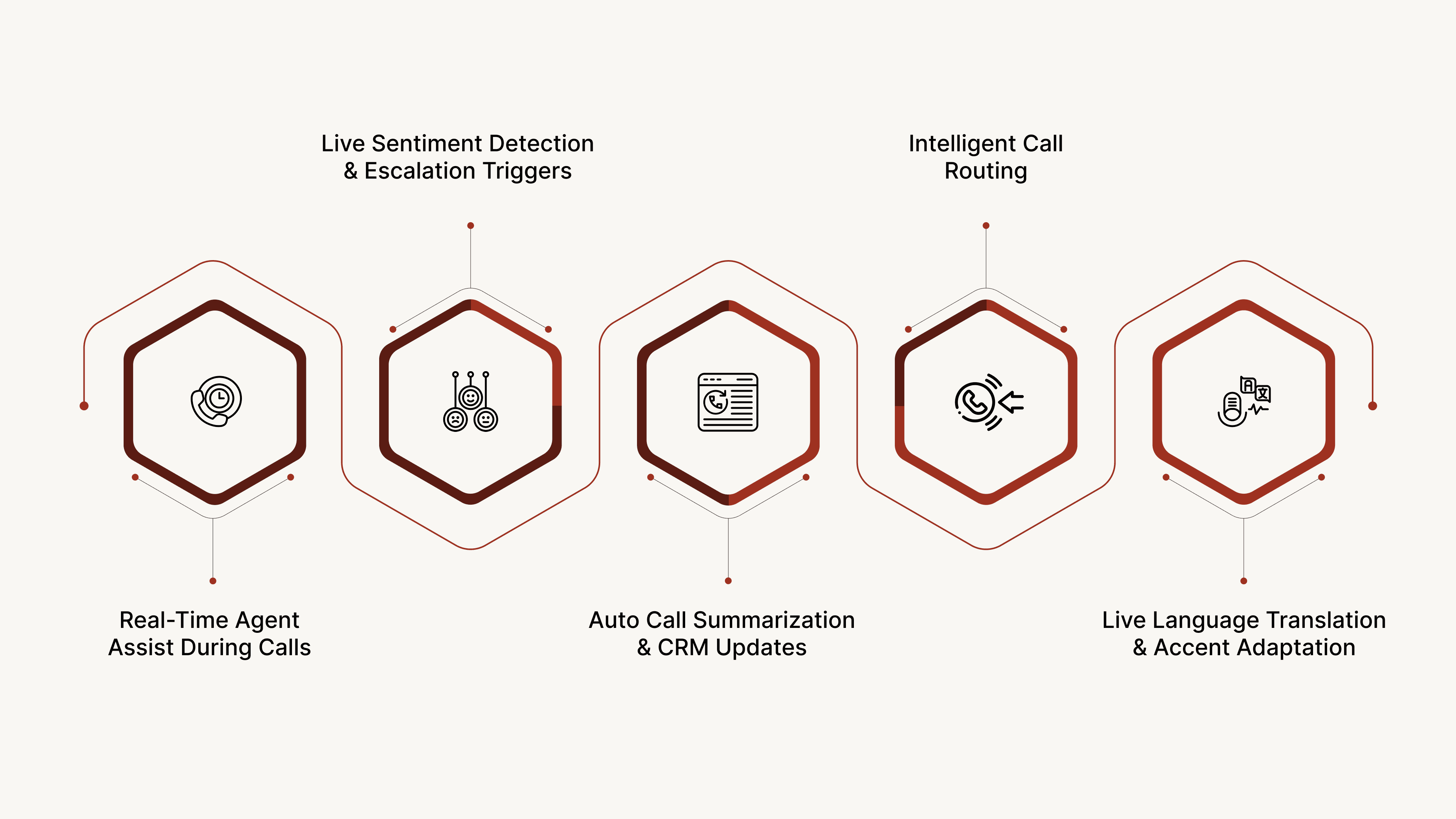
These are the use cases that strengthen the moments humans can’t afford to get wrong.
6. Real-Time Agent Assist During Calls
AI listens to the live conversation, understands intent, context, and sentiment, and instantly surfaces the exact knowledge-base article, compliance script, or next-best action the agent should take.
How it works in call centers:
AI transcribes and interprets the call in real time.
Matches utterances to KB, product data, and past resolutions.
Pushes short, accurate prompts onto the agent’s screen.
Recommends upsell/cross-sell only when signals align. This reduces cognitive load, shortens AHT, and eliminates hunting through multiple systems.
Also Read: Everything You Need to Know About AI Assistants
7. Live Sentiment Detection & Escalation Triggers
AI tracks emotional cues, tone, pace, and frustration markers to identify when a customer is getting upset, confused, or at risk of dropping off.
How it works in call centers:
Real-time scoring of sentiment and stress levels.
Flags negative sentiment instantly inside the agent dashboard.
Triggers supervisor alerts for watch-list cases.
Suggests de-escalation or empathy prompts in the moment. This helps leaders intervene before the call becomes a complaint or churn event.
8. Auto Call Summarization & CRM Updates
After the call, AI generates a clean, structured summary, reason for the call, actions taken, next steps, and updates CRM fields automatically.
How it works in call centers:
Generates call notes in seconds after hang-up.
Auto-fills fields like Issue Type, Order ID, Resolution, and Tags.
Syncs notes into CRM, ticketing, and QA workflows.
Standardizes documentation quality across all agents. This removes 1–3 minutes of wrap-up time per call and eliminates inconsistent or incomplete notes.
9. Intelligent Call Routing
AI analyzes caller intent, customer profile, language, and urgency to route calls to the right agent, not the next available one.
How it works in call centers:
Detects intent from the first few seconds of speech.
Reads customer history and value (VIP, repeat issue, past CSAT).
Matches callers to the best-skilled or available specialist.
Dynamically re-routes based on sentiment or complexity. This drastically improves FCR and agent-customer fit, reducing transfers and friction.
10. Live Language Translation & Accent Adaptation
AI bridges language and accent gaps in multilingual regions by translating speech in real time and adjusting pronunciation for clarity.
How it works in call centers:
Detects the caller’s language automatically.
Translates both sides of the conversation for the agent.
Normalizes accents to make speech clearer for AI systems.
Supports major Indian languages (Hindi, Tamil, Bengali, Kannada, Marathi). This ensures smooth conversations, especially in India/APAC markets, reducing miscommunication and repeat calls.
Also Read: Customer Service vs Customer Support- Key Differences Explained
AI-Driven Quality, Compliance, and Training
Manual QA covers barely a fraction of calls, compliance slips often go unnoticed until they become escalations, and training depends heavily on inconsistent human review. AI changes this dynamic entirely by delivering 100% call coverage, real-time compliance checks, and continuous skill improvement.
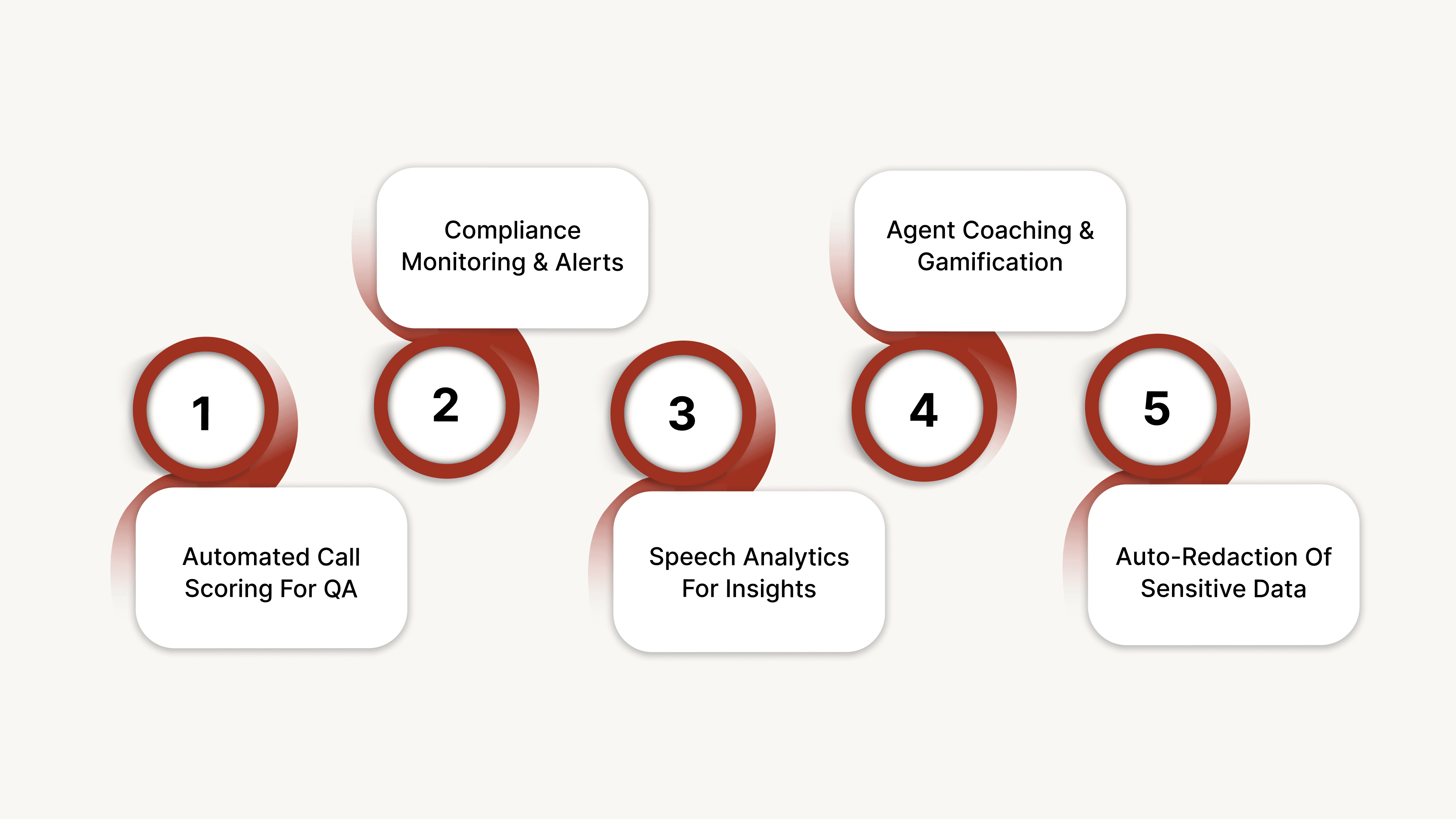
These use cases highlight the AI-driven solutions that protect your operations, standardize performance, and eliminate the blind spots that traditional QA teams simply can’t catch.
11. Automated Call Scoring for QA
AI evaluates 100% of customer calls using objective criteria, accuracy, empathy, compliance, and resolution quality, replacing the traditional 1–3% manual audit.
How it works in call centers:
Transcribes every call and scores it against QA rubrics
Flags errors: misinformation, incorrect processes, missed verification
Highlights coachable moments with evidence snippets
Auto-generates reports for supervisors
This gives leaders a true picture of quality across teams, not a sampled guess.
12. Compliance Monitoring & Alerts
AI detects non-compliant language, process deviations, and regulatory breaches in real time, critical for BFSI, healthcare, insurance, and collections.
How it works in call centers:
Tracks mandatory phrases (KYC, disclosures, disclaimers).
Flags prohibited statements or risky commitments.
Alerts supervisors instantly for sensitive calls.
Creates compliance logs for audits. This protects against penalties, disputes, and reputational damage while keeping agents safe.
13. Speech Analytics for Insights
AI analyzes thousands of conversations to uncover patterns, emerging issues, competitor mentions, churn signals, and process bottlenecks.
How it works in call centers:
Identifies keywords, themes, and recurring frustrations.
Maps sentiment trends over time.
Surfaces product or policy pain points causing repeat calls.
Correlates call drivers with CSAT, AHT, and FCR. This helps leaders prioritize fixes and improve CX at the root level, not just per call.
14. Agent Coaching & Gamification via AI Feedback
AI provides personalized, data-backed coaching based on each agent’s calls, paired with gamified dashboards to drive motivation and consistency.
How it works in call centers:
Tracks each agent’s strengths and improvement areas.
Recommends micro-learning modules or scripts.
Shows progress through scorecards and badges.
Gives team leads a focused coaching queue. This replaces generic coaching with targeted, measurable development.
15. Auto-Redaction of Sensitive Data
AI automatically removes sensitive information, such as credit card numbers, account IDs, and personal identifiers, from transcripts and call recordings.
How it works in call centers:
Detects PCI/PII patterns in real time.
Mutes sensitive segments in audio recordings.
Redacts text inside transcripts and CRM logs.
Ensures adherence to PCI-DSS, HIPAA, GDPR, and RBI norms. This secures customer data without relying on manual cleanup, reducing compliance risk.
Customer Experience & Business Growth
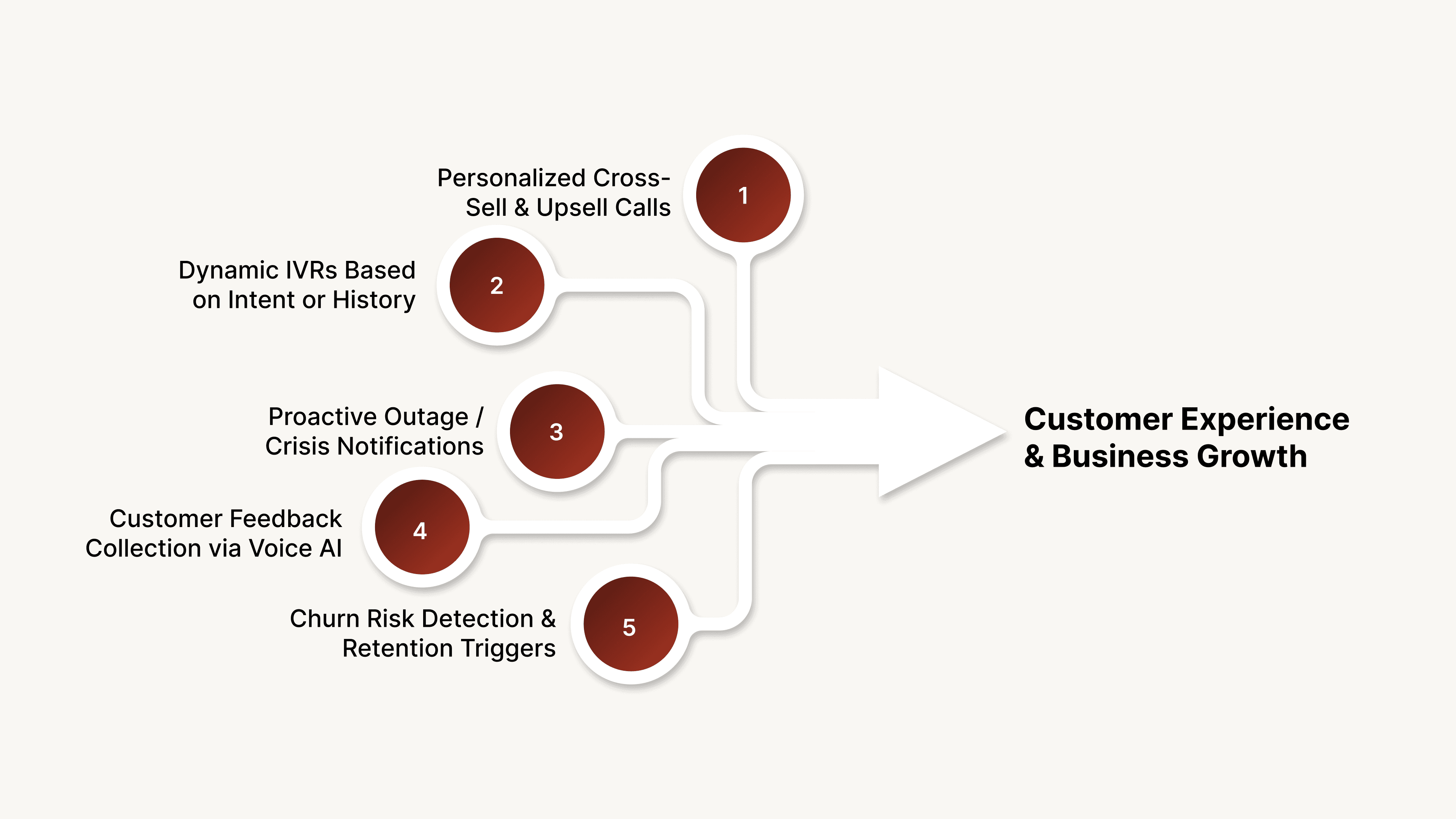
Customer expectations are rising, and your rivals aren’t waiting for you to catch up. Here are the use cases showing exactly where that gap is widening.
16. Personalized Cross-Sell & Upsell Calls
AI recommends relevant offers based on purchase history, browsing behavior, intent signals, and past interactions to increase conversion without sounding salesy.
How it works in call centers:
Pulls customer data from CRM in real time.
Scores purchase propensity during the call.
Surfaces one-line offer prompts to the agent at the right moment.
AI voice agents can deliver the offer directly if it’s an automated call. This ensures personalized offers and higher attach rates.
17. Dynamic IVRs Based on Intent or History
AI replaces rigid menus with context-aware paths that adapt to caller identity, past issues, language preferences, and early intent signals.
How it works in call centers:
Identifies the caller using ANI or CRM lookup.
Detects intent from the first few spoken words.
Selects the shortest, most relevant menu automatically.
Routes callers to self-service or specialist agents based on context. This reduces friction, transfers, and call abandonment.
Also Read: Interactive Voice Response (IVR) Meaning Explained
18. Proactive Outage / Crisis Notifications
AI sends automated voice notifications to customers affected by outages, service failures, or emergencies before they flood the contact center.
How it works in call centers:
Detects outages from internal monitoring systems.
Auto-generates outgoing call lists for impacted users.
Delivers multilingual voice messages with clear next steps.
Opens escalation paths for high-priority customers. This prevents call spikes and maintains transparency during crises.
19. Customer Feedback Collection via Voice AI
AI collects CSAT and NPS feedback conversationally instead of using rigid numeric surveys, boosting response rates and insight quality.
How it works in call centers:
Runs a voice-based survey right after call completion.
Asks personalized, context-aware questions derived from the call.
Transcribes and scores responses automatically.
Pushes insights into VoC dashboards for CX teams. This captures richer, more honest feedback at scale.
20.Churn Risk Detection & Retention Triggers
AI identifies at-risk customers by analysing tone, sentiment, unresolved issues, and repeated complaint patterns, then triggers retention actions.
How it works in call centers:
Scores churn risk in real time during conversations.
Detects frustration, negative sentiment, and escalation cues.
Alerts agents with recommended retention steps or offers.
Routes high-risk customers to dedicated retention teams when needed. This enables proactive saves instead of reactive firefighting.
These use cases become truly significant only when mapped to the tangible business outcomes they create, so let’s break down the ROI that each one drives.
The ROI Impact of AI in Call Centers
Companies adopting next-gen voice and generative AI report dramatic performance improvements, including an 87% drop in average resolution time and thousands of requests handled daily without human intervention.
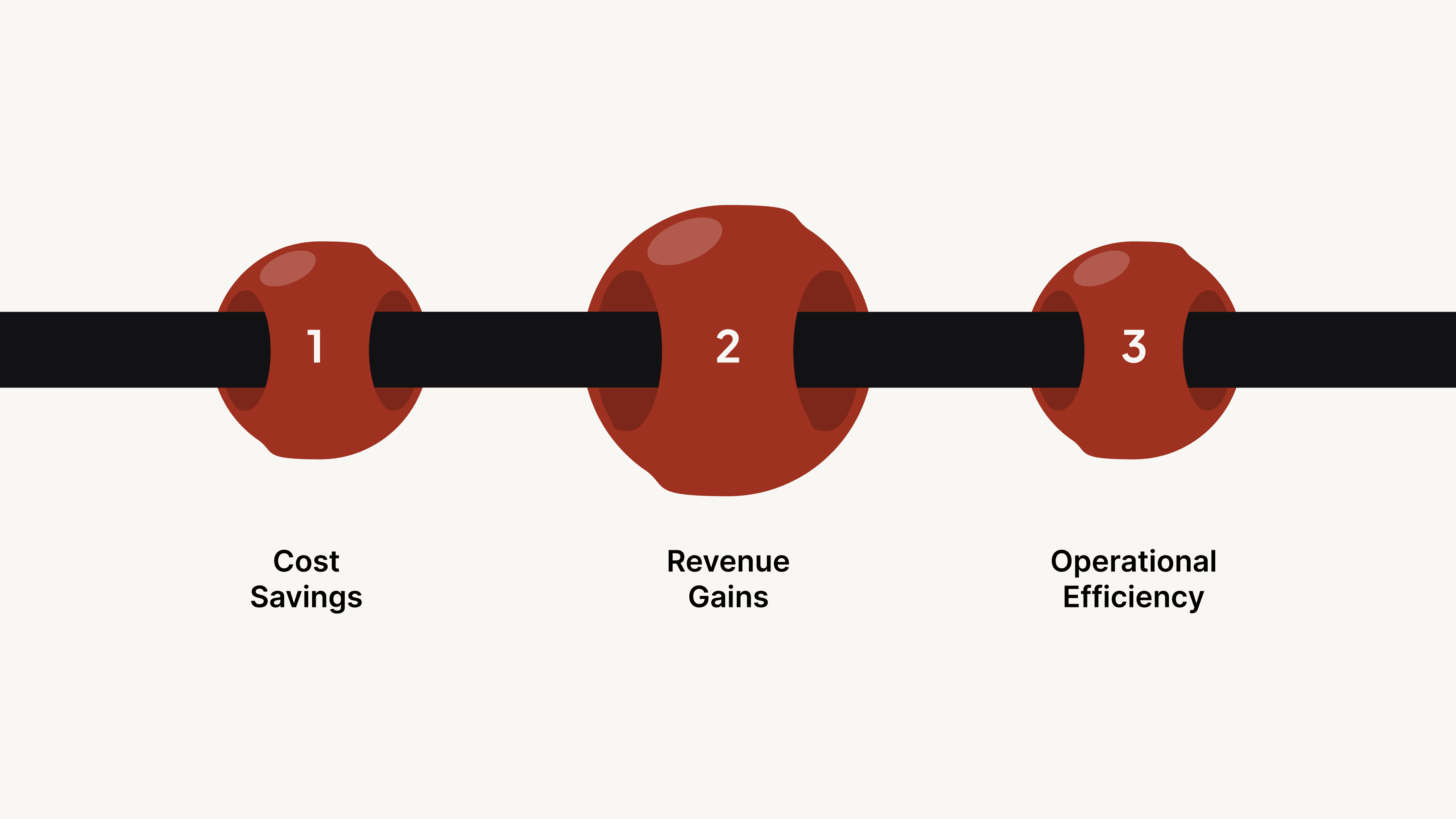
These breakthroughs emphasise that AI’s value lies not in experimentation but in measurable outcomes. Below are key ROI levers to assess when evaluating AI in your call-center operations.
1. Cost Savings
AI isn’t just automating calls; it’s optimizing entire operational layers. In other industries, AI-led optimization has already shown measurable impact: Siemens reduced unplanned downtime by up to 30% by using AI to analyze historical patterns and streamline decision-making.
When applied to contact centers, this same intelligence cuts waste, stabilizes workloads, and reduces the cost of every customer interaction.
Key ROI Pointers:
Automate repetitive, high-frequency calls, reducing dependence on large front-line teams.
Lower cost-per-interaction by shifting routine queries to voice or generative AI instead of full agent handling.
Reduce training, supervision, and QA overhead with AI-driven call scoring and targeted coaching.
2. Revenue Gains
For enterprise call centres under pressure to grow as well as optimise, AI is proving to be a revenue multiplier, not just a cost saver. According to Boston Consulting Group (BCG), companies built for AI achieve five times the revenue increase and three times the cost reduction compared with their peers.
When applied in call centre operations, via personalized routes, proactive outreach, and voice AI upsells, this potential becomes very real.
Key ROI Pointers:
Use voice AI to identify and present relevant offers during calls, increasing conversion rates and average revenue per contact.
Automate outbound campaigns and retention calls with AI agents, boosting lead generation and revenue without scaling headcounts.
Match high-value customers to top agents using AI-driven routing and upselling, increasing wallet share from the existing customer base.
3. Operational Efficiency
AI is redefining how quickly and accurately call centers can operate end-to-end. Bouygues Telecom, for example, utilized generative AI to analyze call-center data in real time and deliver personalized recommendations to agents.
This reduced pre- and post-call workloads by 30% and is projected to save over USD 5 million (Approx INR 44.4 Cr). This level of efficiency becomes a direct operational unlock for Indian contact-center environments.
Key ROI Pointers:
Shorten handle times with real-time agent assist and instant knowledge retrieval.
Reduce post-call effort through automated summaries, tagging, and CRM updates.
Improve first-call resolution by routing customers based on intent, history, and complexity.
Also Read: How AI is Transforming Call Centres and Customer Service
Now that the ROI impact is defined, the missing link is execution. This is where CubeRoot’s voice AI turns potential into measurable outcomes.
The CubeRoot Advantage in Voice AI
When enterprise call-centres ask how to turn AI potential into operational reality, CubeRoot delivers a compelling answer. With a voice-AI platform built to scale human-like interactions across inbound, outbound, multilingual, and high-volume workflows, CubeRoot offers:
Rapid Go-Live: Deploy voice agents in as little as 14 days, thanks to its streamlined Build-Train-Integrate-Scale framework.
Broad Ecosystem Integration: 150+ out-of-the-box integrations with CRMs, CTIs, ticket-systems and third-party tools ensure plug-and-play architecture.
Enterprise-Grade Conversational Stack: Features such as real-time transcription, in-call sentiment tracking, and GenAI-powered prompt builder support natural dialogues and advanced use cases.
Industry-Tailored Use Cases: Purpose-built voice AI for sectors such as BFSI, D2C, Real Estate, and Collections, delivering specific metrics (e.g., 65% faster lead qualification) from live clients.
What this means for call-centres:
As CubeRoot is built specifically for voice-first, large-scale operations, it enables enterprises to leap from pilots to production fast. This drives efficiency, cost savings, customer experience, and revenue growth with a proven platform rather than bespoke one-off projects.
Request a demo and discover how CubeRoot can transform your call-center performance!
FAQs
1. What exactly can AI do in a call center?
AI can answer routine queries, assist agents during live calls, route callers based on their intent, analyze conversations for insights, and automate post-call work, such as summaries and tagging.
2. Will AI make call centers faster and reduce wait times?
Yes. AI handles repetitive calls instantly and supports agents with real-time suggestions, thereby reducing hold times and accelerating customer resolution times.
3. How accurate is AI when people speak with different accents or mix languages?
Modern voice AI is trained on diverse speech patterns and Indian multilingual use, so it can understand accents, regional tones, and code-switching far better than older IVRs.
4. Is AI safe for industries that deal with sensitive information?
AI can be deployed with strict security controls like data redaction, encryption, and compliance checks, making it safe for BFSI, healthcare, insurance, and government processes.
5. Do call centers need a lot of data to get started with AI?
Not necessarily. Basic use cases can start with existing call recordings, FAQs, and CRM data. Over time, adding more data improves accuracy and expands what AI can handle.