Jan 14, 2026
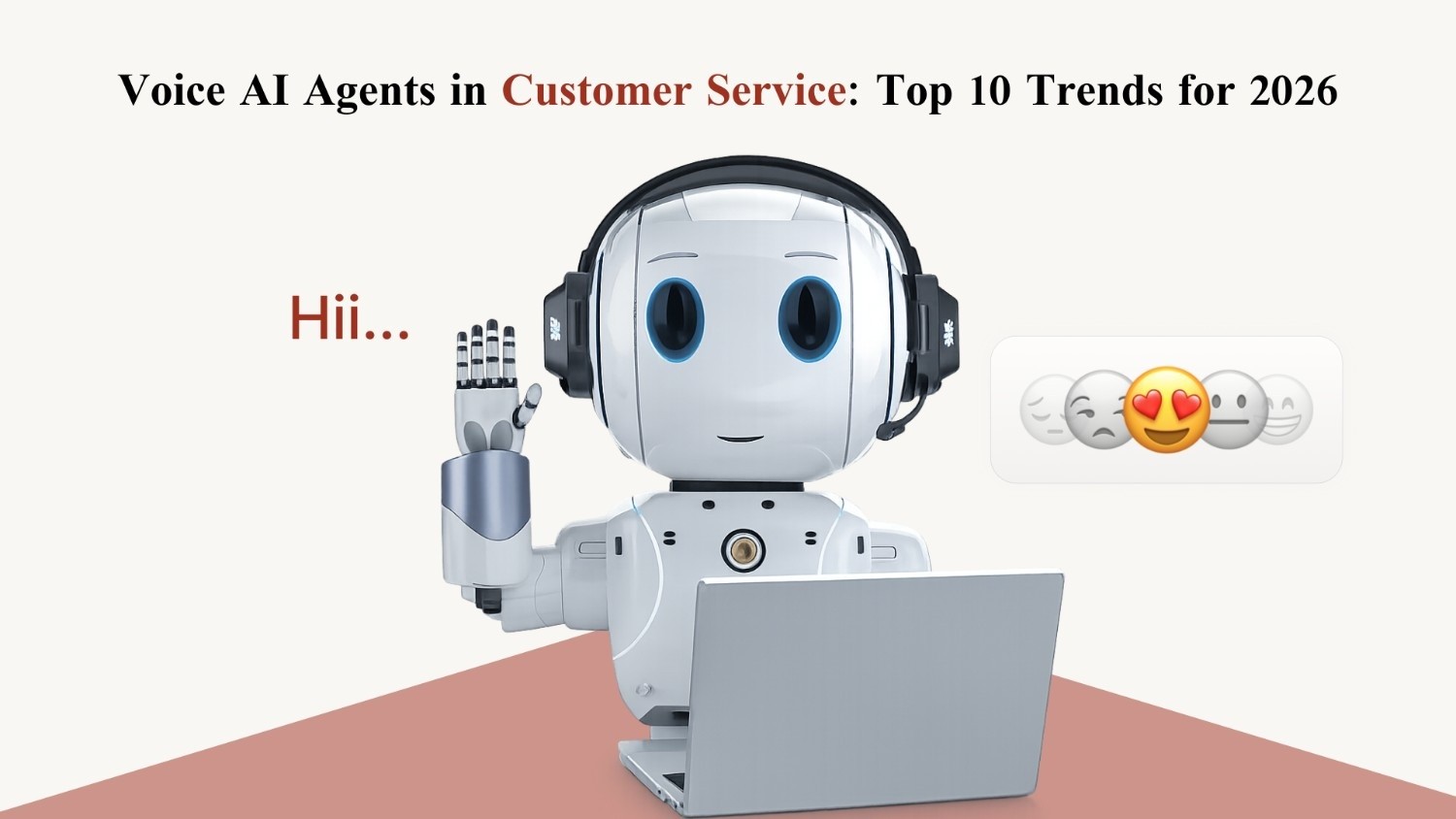
Voice AI Agents in Customer Service: Top 10 Trends for 2026
In 2026, customer service teams are under growing pressure to handle rising interaction volumes without slowing response times or losing personalization. Customers now expect instant answers, natural conversations, and consistent support across every touchpoint. This shift is pushing AI voice agents from experimental tools into the core of modern customer service operations.
Industry analysts see this change accelerating fast. Gartner projects that one in 10 agent interactions will be automated by 2026, with voice playing a central role.
As businesses prepare for 2026, AI voice agents are no longer just about cost savings. They are becoming essential for speed, personalization, and operational resilience in high-volume customer service environments.
Key Takeaways
AI voice agents continue to play the central role in customer service, handling high interaction volumes with 24/7 availability, speed, and consistent service quality in 2026.
Personalization, context awareness, and proactive engagement are redefining customer experiences, with voice AI using data and predictive signals to act before issues arise.
Autonomous task execution and deep enterprise integration allow voice agents to complete end-to-end workflows directly within CRM, billing, and support systems.
Trust, security, multilingual support, and continuous learning are now critical requirements, ensuring voice AI scales responsibly across regions, languages, and regulated industries.
CubeRoot enables enterprises to operationalize these trends, delivering scalable, compliant, and intelligent voice AI for modern customer service teams.
What Are AI Voice Agents in Customer Service?
AI voice agents are advanced conversational systems that handle customer interactions through natural, human-like speech. They combine automatic speech recognition (ASR), natural language processing (NLP), and text-to-speech (TTS) to understand requests, respond intelligently, and complete service tasks without human intervention.
Unlike legacy IVR systems that rely on rigid menus or keypad inputs, AI voice agents hold real conversations. They listen, interpret intent, understand context, and respond dynamically, even when customers speak naturally, interrupt, or change topics mid-call.
How AI voice agents differ from traditional systems:
Legacy IVR: Scripted menus, limited options, high customer frustration
Basic chatbots: Text-focused, rule-based, low contextual awareness
AI voice agents: Conversational, context-aware, voice-first, and task-executing
Modern AI voice agents can:
Understand customer intent, not just keywords
Detect emotion, urgency, and sentiment from voice cues
Retain conversation history and context across interactions
Execute workflows like ticket creation, refunds, rescheduling, or escalation
As customer service shifts from reactive support to intelligent resolution, AI voice agents are becoming the foundation of scalable, always-available service operations.
Understanding the basics paves the way to see why these agents are forecast to transform customer service by 2026.
Suggested Read: Everything You Need to Know About AI Assistants
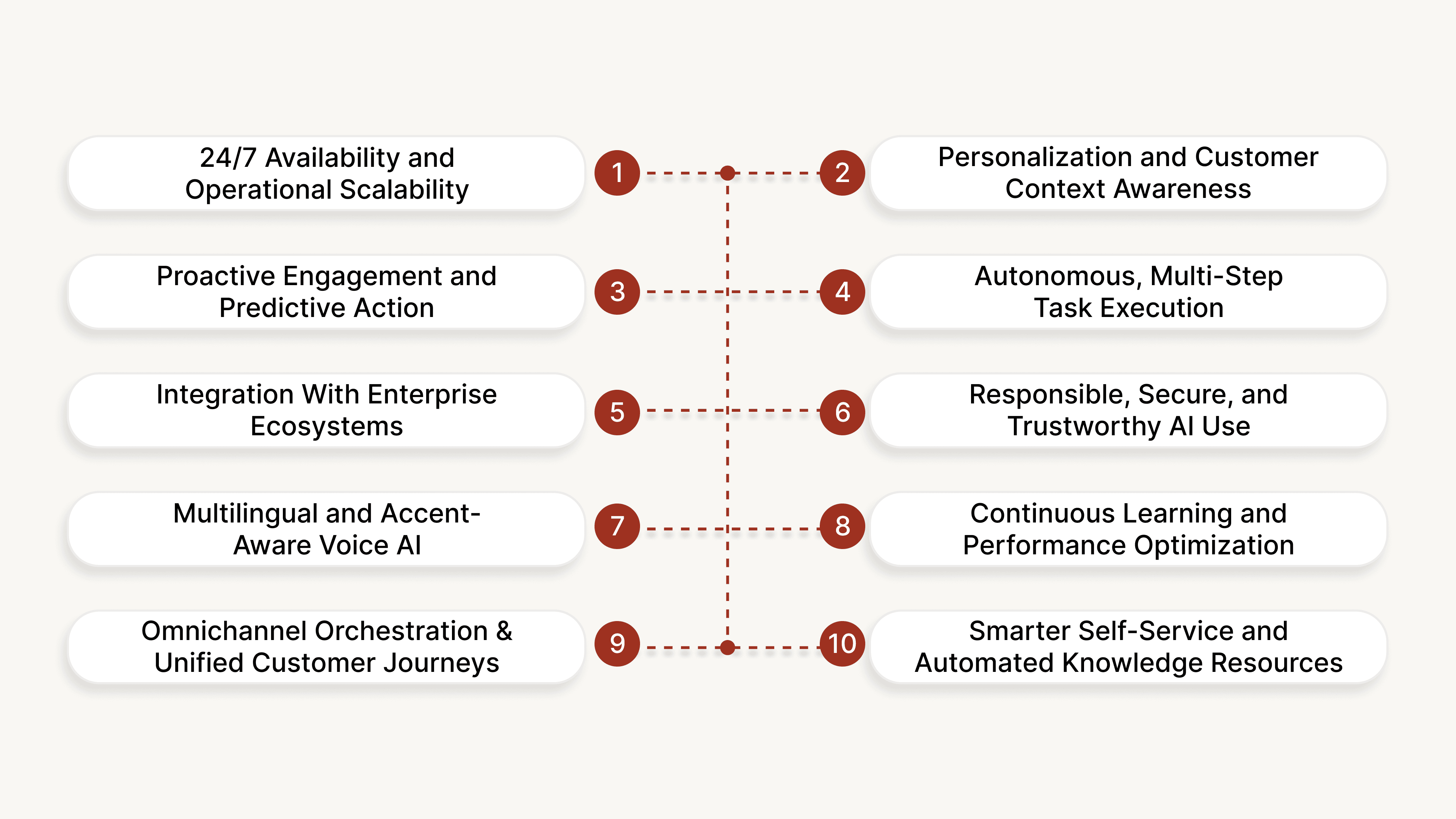
Trend 1: 24/7 Availability and Operational Scalability
AI voice agents are emerging as the foundation of 24/7 customer service, enabling businesses to manage rising interaction volumes without human capacity limits.
Key Developments
AI voice agents deliver always-on support with no queues or hold times
Enterprises scale conversations instantly without increasing headcount
Service continuity stays intact across nights, weekends, and holidays
Benefits for Enterprises
Zero wait times for routine and high-frequency queries
Peak-season readiness without temporary hiring or overtime costs
Predictable capacity management across fluctuating demand
By removing time and staffing constraints, AI voice agents shift customer service from reactive coverage to resilient, on-demand operations.
Industry examples
BFSI: Voice AI agents of banks can handle balance inquiries, card blocks, and EMI questions overnight without expanding call center shifts.
eCommerce: During sale events, voice agents can manage order tracking and delivery queries at 10x normal volume with no wait times.
Healthcare: Hospitals can provide round-the-clock appointment booking and test report status without front-desk staffing.
With continuous availability becoming table stakes, the next trend adds deeper personalization and contextual awareness.
Trend 2: Personalization and Customer Context Awareness
As availability becomes table stakes, differentiation now comes from how well AI voice agents understand each customer.
What’s New
Voice agents personalize conversations using CRM data, past interactions, and live context
Intent and sentiment detection shape responses in real time
Conversations adapt based on urgency, tone, and customer history
Impact on Customer Service
Higher customer satisfaction through relevant, human-like responses
Fewer repeat contacts because issues are resolved correctly the first time
Stronger engagement driven by empathy and contextual understanding
Personalization turns voice AI from a call-handling tool into a relationship-building channel.
Industry examples
eCommerce: The agent recalls past purchases and suggests order-specific support instead of generic answers.
Healthcare: A patient calling for follow-up hears reminders based on recent visits, prescriptions, or test results.
SaaS: Support calls adapt based on plan tier, usage behavior, and open tickets.
Beyond personalization, customer expectations are shifting toward proactive and predictive support.
Trend 3: Proactive Engagement and Predictive Action
AI voice agents are shifting customer service from reactive support to proactive engagement. Instead of waiting for customers to reach out, voice AI now initiates conversations based on predictive signals and behavioral patterns.
Modern systems analyze usage data, payment cycles, interaction history, and risk indicators to determine when and why outreach should happen. This enables timely, relevant conversations that prevent issues before they escalate.
What’s Changing
Voice agents initiate calls based on behavior, triggers, or business rules
Common use cases include:
Payment and renewal reminders
Abandoned cart follow-ups
Service alerts and usage nudges
Enterprise Advantage
Lower churn by addressing issues before frustration builds
Higher conversions through timely, relevant outreach
Stronger loyalty driven by consistent, helpful communication
Proactive voice AI feels less like support and more like a helpful assistant who calls at the right moment.
Industry examples
SaaS: AI agents notify users about expiring trials, feature usage gaps, or renewal timelines.
EdTech: Voice reminders prompt learners about upcoming classes, exams, or missed sessions.
eCommerce: Automated voice follow-ups recover abandoned carts during high-intent windows.
As agents evolve, their ability to automate complex tasks without human intervention becomes critical.
Suggested read: Voice Bots in Healthcare: Top 7 Use Cases Every Hospital Should Know
Trend 4: Autonomous, Multi-Step Task Execution
As proactive engagement becomes standard, the defining shift in 2026 is true autonomy. AI voice agents are no longer limited to answering questions or routing calls. They now complete full-service tasks from start to finish within a single interaction.
Modern voice agents can manage multi-step workflows without human handoffs. They verify customer identity, gather required information, interact with backend systems, and confirm outcomes in real time.
What’s Changing
Voice AI agents execute multi-step workflows within a single call.
Common capabilities now include:
Booking or rescheduling appointments
Creating and updating support tickets
Verifying identity and customer details
Processing service requests or transactions
Instead of handing work off to humans or other systems, the agent stays in control until the task is complete.
Business Impact
Fewer transfers between bots, agents, and departments
Higher first-contact resolution across service journeys
Lower operational costs due to reduced manual effort
Autonomous task execution turns voice AI from a conversational layer into an operational engine.
Industry examples
BFSI: A voice agent verifies identity, updates KYC details, and confirms completion in one call.
Healthcare: Appointment rescheduling, insurance verification, and confirmation happen in a single interaction.
With automation deeper than ever, enterprises also require systems that integrate seamlessly with core platforms.
Trend 5: Integration With Enterprise Ecosystems
As voice agents take on real work, seamless integration becomes non-negotiable. In 2026, effective AI voice agents sit directly inside enterprise systems, not on top of them.
Trends Shaping Integration
Voice agents connect with CRM, ticketing, billing, and knowledge systems in real time
They can fetch records, update cases, and reference policies during live conversations
Responses stay accurate because data flows directly from backend systems
Why It Matters
Single source of truth across all customer interactions
Faster issue resolution without switching systems or repeating questions
Context persistence across calls, channels, and touchpoints
Integration transforms voice agents from smart responders into fully informed service operators.
Industry examples
eCommerce: Agents sync with OMS and logistics platforms for accurate delivery updates.
Healthcare: Integration with HMS and EMR enables context-aware patient conversations.
SaaS: CRM and ticketing integrations ensure continuity across support touchpoints.
As integration succeeds, customer service leaders also demand responsible and safe deployments.
Also Read: How Voice Assistants Enhance Delivery Updates for Businesses?
Trend 6: Responsible, Secure, and Trustworthy AI Use
As AI voice agents become core to customer service operations, trust, security, and governance are no longer optional. Enterprises now assess voice AI platforms with the same scrutiny applied to financial systems, healthcare platforms, and customer data infrastructure.
Voice interactions often contain sensitive personal, financial, and operational information. As a result, organizations are prioritizing AI systems that demonstrate secure data handling, transparent decision-making, and regulatory readiness from day one.
Key Priorities
Secure voice and data handling using encryption, role-based access, and controlled storage
Explainable AI models that support transparency and regulatory requirements
Clear consent and disclosure when customers interact with AI systems
Enterprise Readiness
Strong customer data protection across voice interactions
Comprehensive audit trails for reviews and compliance checks
Bias minimization to ensure fair and consistent outcomes
Industry examples
EdTech: Protection of student data and payment information.
Consumer Durables: Controlled access to warranty and customer identity details.
Responsible AI use ensures voice agents scale safely while protecting customer trust.
Trend 7: Multilingual and Accent-Aware Voice AI
Customer service is expanding across regions and demographics, and consequently, AI voice agents are evolving to understand multiple languages, accents, and code-mixed speech without losing context or accuracy.
What’s emerging
Modern voice AI agents are equipped with these capabilities:
To understand regional accents and code-mixed speech (e.g., Hinglish)
To switch languages mid-conversation without breaking context
To maintain intent accuracy across diverse speech patterns
Why it matters for customer service
Improves reach across Tier 2 and Tier 3 markets
Reduces misunderstandings caused by accent bias
Delivers inclusive, human-like service experiences at scale
Industry examples
EdTech: Learners interact in preferred languages without accuracy loss.
BFSI: Regional banks support Hindi, Hinglish, and local dialects for rural customers.
Healthcare: Patients receive care instructions in their preferred language.
As voice AI becomes more inclusive across languages and accents, enterprises are also focusing on improving agent performance continuously using real-time learning.
Also Read: Conversational AI Examples and Use Cases in Various Industries
Trend 8: Continuous Learning and Performance Optimization
AI voice agents are increasingly designed to learn from every interaction, using feedback loops and analytics to improve accuracy, conversation quality, and resolution outcomes over time.
What’s changing
AI voice agents in 2025–2026 are no longer static systems. They continuously improve by learning from conversations, outcomes, and feedback loops.
Key advancements include:
Automatic model refinement from resolved and escalated calls
Conversation quality scoring and intent accuracy tracking
Feedback-driven tuning without retraining from scratch
Enterprise impact
Higher accuracy over time without manual reconfiguration
Faster adaptation to new policies, products, or issues
Consistent improvement in resolution rates and customer satisfaction
Industry examples
BFSI: Voice agents improve fraud detection accuracy based on past call outcomes.
EdTech: AI adapts to new courses, policies, and student queries automatically.
Real Estate: Lead qualification accuracy increases with every interaction.
Trend 9: Omnichannel Orchestration and Unified Customer Journeys
Customers don’t think in “channels”; they think in conversations. Modern customer service leaders are moving from multichannel support to omnichannel orchestration—where context, history, and sentiment follow the user across every touchpoint (chat, email, voice, WhatsApp, SMS). This unified data layer eliminates repeated questions and ensures seamless handoff between AI and humans.
Key aspects:
A single conversation history across chat, voice, and messaging
Reduced customer frustration from repeated context inputs
Higher resolution performance and brand consistency
Industry examples
EdTech: Voice follow-ups reflect prior interactions with the website or app.
Healthcare: Voice follow-ups reflect prior app or portal interactions.
Why this matters:
Omnichannel orchestration dramatically improves satisfaction and reduces average handle time by ensuring that voice AI agents and human teams share a single view of every customer interaction.
Trend 10: Smarter Self-Service and Automated Knowledge Resources
Customer service is shifting toward dynamic self-service powered by AI. Beyond static FAQs, today’s systems use AI to deliver personalized answers, automatically update content based on interaction trends, and proactively push help resources before customers even ask.
What’s new:
Intelligent FAQ and help content driven by AI
Personalized knowledge suggestions based on caller intent
Dynamic updates to self-service content based on real usage
Business impact:
Higher self-service success rates
Lower ticket volumes and reduced agent load
Better CSAT as customers get help faster
This trend reflects the ongoing move from reactive support to proactive, automated guidance, which reduces friction and cost while empowering customers.
Industry examples
eCommerce: Customers receive instant answers to return policy questions without agent escalation.
EdTech: Learners receive instant guidance on exams, classes, and fees.
Consumer Durables: Voice agents provide troubleshooting steps before escalation.
These trends show where the industry is going; now, let’s see how CubeRoot addresses them.
Where CubeRoot Fits in Voice AI Agents Trends
As customer service shifts toward AI-led, voice-first engagement, enterprises need platforms built for real-world scale, security, and outcomes. CubeRoot aligns closely with the key voice AI agent trends shaping customer service in 2026, helping organizations move from experimentation to operational impact.
Always-On, Scalable Voice Support
Handles high call volumes across inbound and outbound use cases
Reduces wait times while improving service availability
Maintains consistent performance during peak demand periods
Contextual Conversations and Personalization
Connects with enterprise systems to access customer history and context
Delivers intent- and sentiment-aware conversations
Creates more natural, relevant service experiences
Proactive and Autonomous Engagement
Initiates reminders, alerts, and outreach based on business triggers
Supports renewals, follow-ups, and service nudges
Helps reduce churn and missed actions
Deep System Integration
Integrates with CRM, ERP, ticketing, and support platforms
Enables real-time data access and updates during calls
Maintains context across customer interactions
Secure and Compliance-Ready
Encrypted voice and data storage
Built-in consent tracking and audit trails
Designed for regulated environments
AI voice agents are redefining customer service with faster resolution, proactive engagement, and scalable support. By 2026, organizations that adopt these trends will set the benchmark for customer experience and operational efficiency.
Lead the next phase of customer service with AI voice agents. Request a CubeRoot demo today.
FAQs
Q1. What are voice AI agents in customer service?
AI systems that use NLP and speech technologies to handle voice interactions autonomously with real-time understanding.
Q2. How will voice AI agents change customer service in 2026?
They will handle a large share of interactions through personalization, proactive outreach, and task automation.
Q3. What business problems do voice AI agents solve?
They reduce wait times, cut operational costs, deliver consistent 24/7 support, and improve satisfaction.
Q4. Can voice AI agents integrate with existing systems, such as CRM?
Yes, modern voice agents connect with backend systems to pull/push data, enabling richer service.
Q5. Are voice AI agents secure for enterprise use?
When built with encryption, governance, and compliance measures, voice AI meets enterprise standards.