Jan 13, 2026

AI Voice Customer Service Trends 2026
Customer service has undergone a dramatic transformation in recent years.
What once relied heavily on human agents and scripted IVRs is now powered by intelligent voice automation that understands context, intent, and customer sentiment.
As we approach 2026, businesses across industries are leveraging voice AI to deliver faster, more personalised, and more efficient support.
In this article, we explore voice AI customer service trends 2026- what’s changing, what’s driving value, and how organisations can prepare for the next wave of voice-driven customer engagement.
TL;DR
Voice AI in 2026 focuses on context, emotion, and personalization—not just automation
Multilingual, compliance-ready systems become essential for enterprise scale
AI increasingly supports human agents instead of replacing them
Proactive, predictive voice interactions reduce call volumes and costs
Choosing the right platform is now a strategic, not technical, decision
Why Voice AI Customer Service Trends Matter in 2026
Voice remains the most natural way for humans to communicate, especially for service interactions that require empathy, clarity, and immediate resolution.
According to a report by Grand View Research, the global voice recognition market is projected to grow to USD 20.25 billion in 2023 and is anticipated to reach USD 53.67 billion by 2030, growing at a CAGR of 14.6% from 2024 to 2030, reflecting the increasing adoption of voice-enabled systems across industries.
With customers expecting speed and accuracy, businesses are turning to voice AI customer service solutions to deliver assistance at scale, reduce operational costs, and improve satisfaction.
As more enterprises incorporate voice AI into their customer support strategy, understanding the trends shaping this evolution becomes essential.
To understand why these trends are accelerating in 2026, it helps to look at how voice-based customer service has evolved from rigid call systems into intelligent, conversation-driven experiences.
Also Read: 8 Best AI Voice Assistant Chatbot Apps to Enhance User Experience
How Voice AI Customer Service Has Evolved
Transitioning from traditional phone support to AI-powered conversations didn’t happen overnight.
Conversational AI is expected to reduce contact centre agent labour costs by up to $80 billion by 2026, reflecting its impact on automation and operational efficiency.
Early voice systems were limited to simple menus and rigid paths, often frustrating customers because of a poor understanding of speech variations and context.
In contrast, modern voice AI employs advanced speech recognition, natural language processing (NLP), and machine learning to overcome these challenges.
These capabilities enable systems to:
recognise intent, even in diverse accents and languages
Maintain context over multi-turn conversations
personalise responses based on customer history
Seamlessly escalate complex queries to human agents
This shift is already visible in how leading brands use voice AI today.
For example, Amazon uses conversational voice systems across customer support and logistics to resolve common queries faster and route complex issues to human agents, reducing wait times and improving resolution rates at scale.
On the enterprise side, platforms like CubeRoot reflect how far voice AI has matured.
Its voice automation systems can handle multiple languages and comply with strict regulatory requirements for regulated industries.
They ensure conversations are accurate, preserve context, and are fully auditable.
These real-world examples show that voice AI is no longer just experimental; it’s being used successfully every day.
What this means for 2026:
Voice AI customer service trends are moving beyond cost reduction toward measurable experience and performance gains.
With these advancements in accuracy, context, and multilingual support, voice AI is ready to drive the next wave of customer service trends in 2026.
AI Voice Customer Service Trends 2026
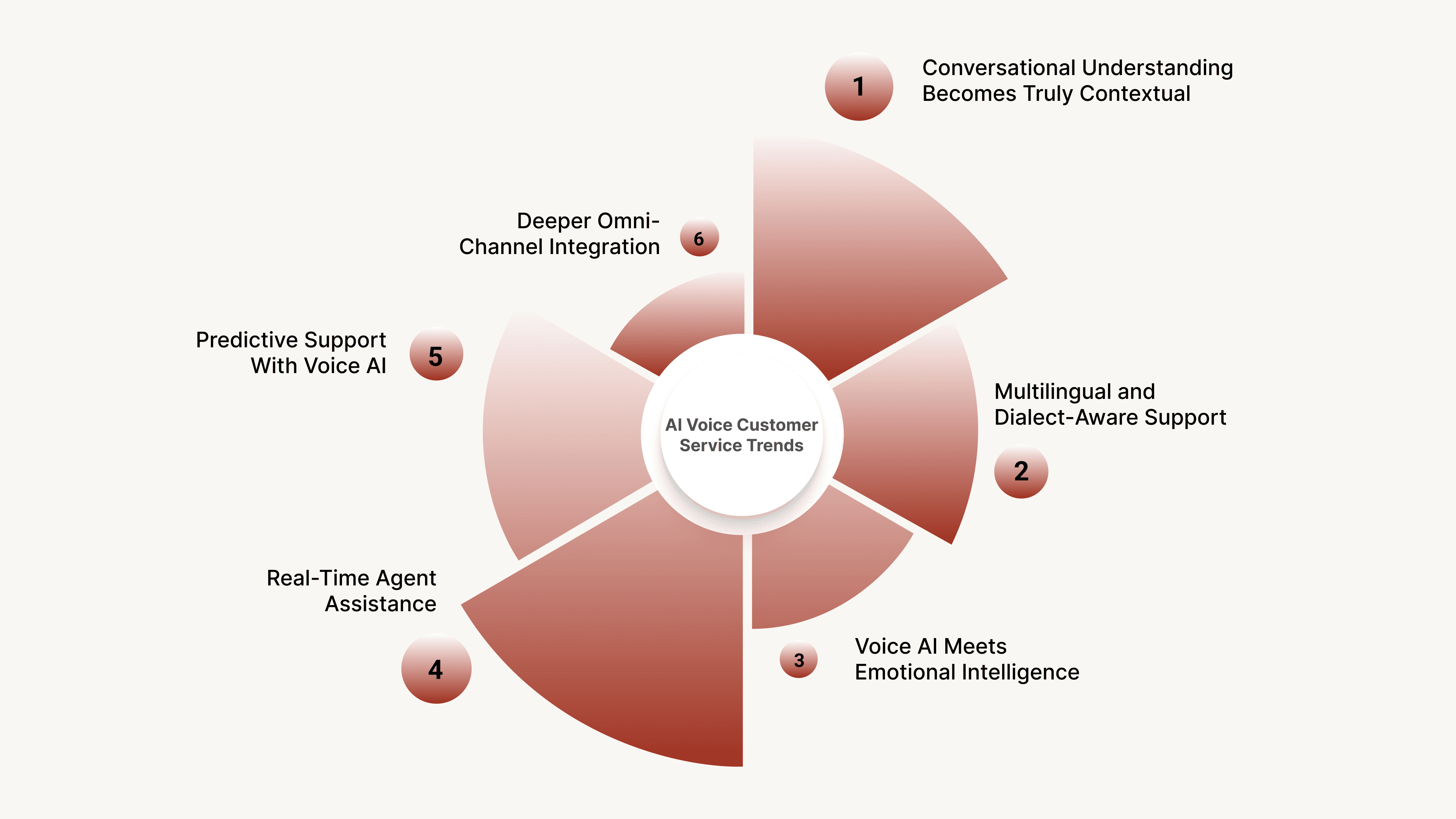
Voice AI in customer service is moving beyond basic automation to systems that anticipate needs, personalise responses, and work seamlessly with human agents.
Around 70 % of contact centres now use AI tools, and AI‑enabled interactions are increasingly handling customer service workloads.
These trends are shaping how businesses interact with customers, making support faster, smarter, and more human-like.
1. Conversational Understanding Becomes Truly Contextual
In 2026, voice AI will stop behaving like a command-based tool and start functioning like a continuous conversation engine.
Contextual voice AI will remember what the customer said earlier in the call- intent, preferences, issues, and decisions and use that information naturally as the conversation progresses.
For example, if a customer mentions a billing issue at the start, the AI won’t later ask “What is your concern today?”
This matters because:
Customers spend less time repeating themselves
Call flows become shorter and more efficient
Conversations feel closer to human support
Context awareness also improves escalation quality, since the AI can pass full conversation context to a human agent when needed.
2. Multilingual and Dialect-Aware Support
Multilingual support in 2026 goes far beyond translation.
Voice AI will understand how people actually speak, including regional accents, mixed-language sentences, slang, and culturally specific phrases.
This is especially important in regions where customers naturally switch between languages during a call.
The impact is significant:
Higher accuracy in intent recognition
Better accessibility for non-native speakers
Increased customer comfort and trust
For global enterprises, dialect-aware voice AI reduces language-based friction and improves service consistency across regions.
3. Voice AI Meets Emotional Intelligence
Emotion detection will become a core capability, not a nice-to-have.
By analyzing tone, speed, pitch, and pauses, voice AI will understand how a customer feels, not just what they say.
This allows the system to change its approach mid-conversation.
For example:
Slow, calm responses for frustrated callers
Faster, concise replies for confident users
Immediate escalation when emotional risk is detected
Emotion-aware systems help resolve issues faster and reduce repeat calls driven by poor emotional handling, a major driver of customer dissatisfaction.
4. Real-Time Agent Assistance
Voice AI will increasingly act as a co-pilot for human agents.
During live calls, the AI will listen in real time and provide agents with:
Suggested responses based on intent
Relevant customer data and history
Recommended next actions
This reduces the mental load on agents and helps newer team members perform at the level of experienced staff.
The result is more consistent service quality and lower agent burnout.
5. Predictive Support With Voice AI
By 2026, voice AI will help prevent issues before customers feel the need to call.
Predictive systems will use customer data, behavioral patterns, and timelines to proactively deliver useful information.
These interactions feel helpful rather than intrusive because they solve problems early.
Common examples include:
Payment or renewal reminders
Appointment confirmations
Status updates and alerts
This reduces inbound call volume while improving customer trust and operational efficiency.
6. Deeper Omni-Channel Integration
Voice AI will be fully embedded in the broader customer journey.
Customers may begin an interaction on chat, continue on voice, and finish on email or SMS.
Voice AI will have access to the entire interaction history across channels.
This creates:
Seamless transitions between channels
No repeated explanations
Faster resolutions
Omni-channel voice AI ensures continuity, a major gap in customer service today.
7. Compliance-First Voice AI for Regulated Industries
As voice AI handles financial, medical, and personal data, compliance becomes critical.
By 2026, platforms will be designed with built-in controls for regulated industries such as banking, insurance, and healthcare. Compliance will be enforced automatically, not manually.
Key capabilities include:
Secure call recordings with audit trails
Script enforcement for regulated conversations
Controlled access to sensitive data
This allows enterprises to scale voice AI without increasing legal or regulatory risk.
Also Read: Top 10 Conversational AI Platforms Transforming Enterprise CX in 2026
8. Voice AI Integrated Directly With Business Systems
Voice AI will be deeply connected to enterprise systems rather than operating as a standalone layer.
Direct integration with CRMs, ERPs, ticketing platforms, and billing systems allows the AI to take real action during calls.
This enables:
Instant access to customer records
Automatic updates after conversations
Triggered workflows without manual input
Integration reduces delays, errors, and internal handoffs.
9. Personalization Driven by Customer History
Customers expect voice AI to remember past interactions.
In 2026, personalization will be based on behavior and context, not just names or account numbers. Voice AI will adapt conversations based on what it already knows.
Examples include:
Avoiding repeated verification steps
Suggesting relevant options based on past issues
Tailoring responses to customer preferences
This improves trust, reduces friction, and makes interactions feel respectful of the customer’s time.
10. Self-Learning Voice Models With Continuous Improvement
Voice AI systems will no longer remain static after deployment.
Through continuous learning, these systems will analyze:
Call outcomes
Customer feedback
Human agent interventions
Over time, they will automatically improve intent detection, response quality, and escalation logic.
This reduces the need for frequent manual tuning and ensures the system continues to improve as usage grows.
11. Faster Deployment With No-Code and Low-Code Tools
Speed will be a major expectation in 2026.
No-code and low-code tools will allow business teams to build, update, and test voice AI workflows without heavy technical involvement.
This helps organizations:
Launch faster
Respond quickly to regulatory or policy changes
Experiment and iterate without delays
Faster deployment means faster value realization.
12. Voice AI as a Measurable Performance Channel
Voice AI will be treated as a performance-driven channel, not just a cost-saving tool.
Organizations will track metrics such as:
Resolution rates and call containment
Customer sentiment and satisfaction
Cost reduction and agent efficiency
Advanced analytics will help teams optimize voice AI performance and clearly demonstrate ROI to stakeholders.
Trends show the direction, but execution determines results.
To turn these voice AI customer service trends for 2026 into real outcomes, selecting the right platform becomes critical.
How to Choose the Right Voice AI Customer Service Platform
Selecting the right platform is not just about features; it’s about readiness for real business environments.
Here are key considerations:
Language and Accent Support: Can the system handle local languages and accents accurately?
Context Awareness: Does it retain conversation context across sessions?
Scalability: Can it handle peak call volumes without slowing down?
Compliance and Security: Is voice data protected, and are interactions auditable?
Human-in-the-loop: Can agents easily take over without losing context?
Platforms that excel in these areas are better positioned to deliver value as voice AI becomes more embedded in customer service operations.
How CubeRoot Reflects Voice AI Customer Service Trends
As voice AI customer service evolves, enterprise solutions must adapt to real business needs, handling complexity, compliance, and scale.
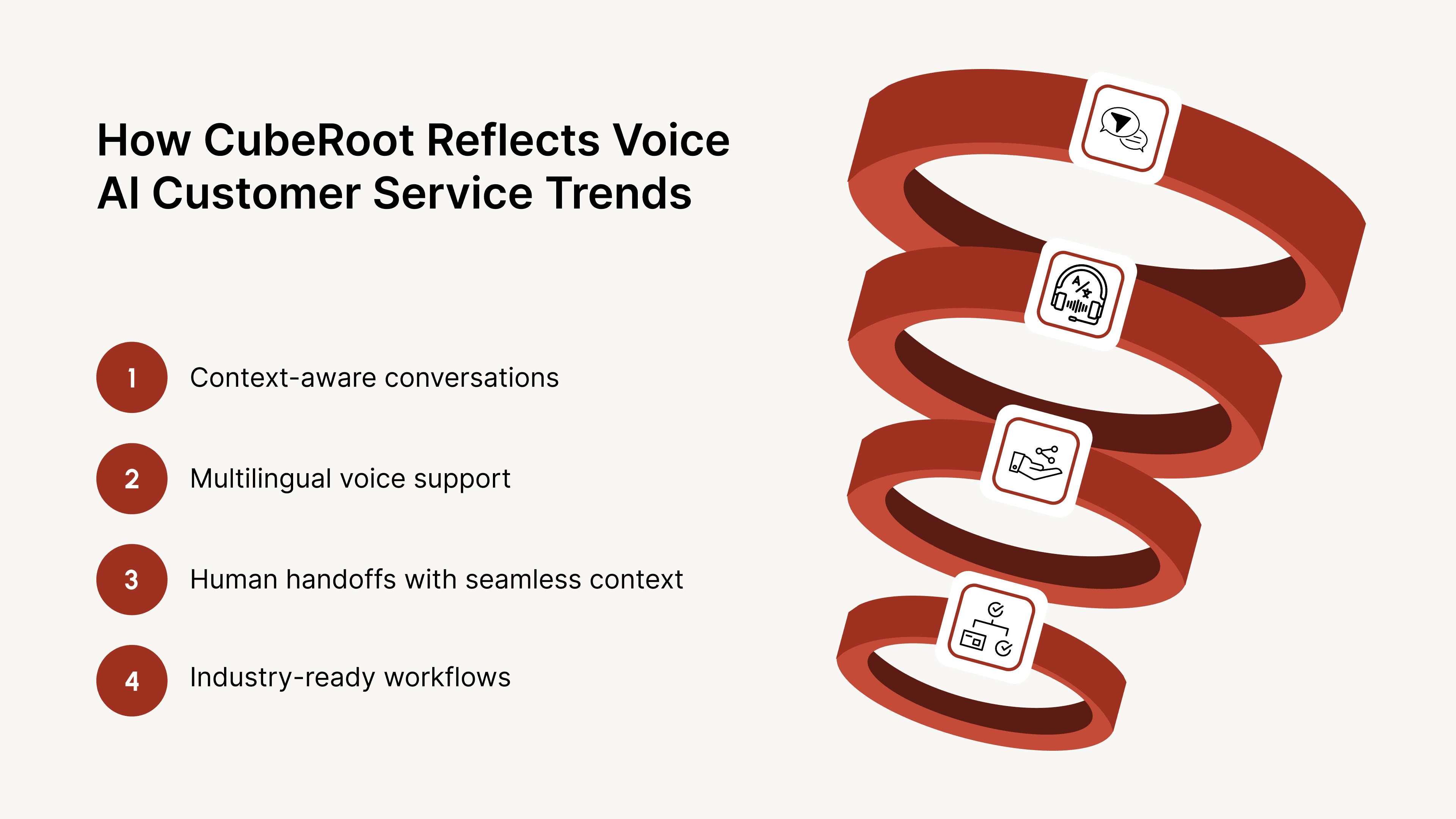
Key areas where modern voice AI platforms are evolving include:
Context-aware conversations that reduce repetition and increase resolution speed
Multilingual voice support for broader customer reach
Human handoffs with seamless context for complex issues
Industry-ready workflows for sectors such as BFSI and healthcare
These capabilities align with where voice AI customer service trends are headed, toward intelligent, responsive, and scalable automation.
By carefully evaluating platforms against key criteria like language support, scalability, context retention, and security, businesses can ensure their voice AI investments deliver measurable results.
Conclusion
Voice AI customer service trends for 2026 emphasise systems that understand both speech and users, are proactive, context-rich, and integrated with business systems.
As enterprises prepare for this next phase, choosing a platform that balances intelligence with operational control, personalization with compliance, and automation with human oversight is key.
Platforms like CubeRoot are already enabling enterprises to scale voice AI customer service effectively. With multilingual support, compliance-ready workflows, and seamless human handoffs, CubeRoot helps businesses deliver smarter, faster, and more reliable customer interactions.
Ready to future-proof your customer service?
Explore CubeRoot’s enterprise-grade voice AI solutions today and experience intelligent, scalable, and human-like automation.
FAQs
1. What Are AI Voice Customer Service Trends for 2026?
They include contextual conversations, predictive support, emotional understanding, multilingual reach, and hybrid agent integration.
2. Will AI Replace Human Agents?
Not entirely. AI handles routine cases, while humans manage complex, sensitive interactions.
3. Why Is Multilingual Support Important?
It helps reach more customers in their preferred language, improving satisfaction and engagement.
4. How Does Voice AI Reduce Costs?
By automating repetitive calls, cutting average handle times, and reducing agent workload.
5. How Should Enterprises Choose a Voice AI Platform?
Focus on context awareness, scalability, language support, security, and human escalation.