Dec 26, 2025

How Conversational AI IVR Transforms CX for Indian Enterprises
Interactive Voice Response (IVR) is finally catching up to how customers want to communicate. Traditional IVR menus force callers through rigid options and long wait times, which often leads to frustration. Conversational AI IVR changes that experience by allowing callers to speak naturally and get immediate, accurate responses.
This shift is already well underway. According to Salesforce, 71% of service organizations now use customer-facing intelligent assistants powered by AI.
For businesses, this change translates into lower call volumes, faster resolution times, and round-the-clock support without increasing headcount.
In this blog, we break down what conversational AI IVR is, how it works, the benefits it offers, and what it takes to implement it effectively.
At a glance:
Conversational AI IVR understands natural speech, detects intent, and resolves queries without rigid menu options.
It improves CX with faster routing, lower wait times, and contextual answers.
Key capabilities include NLU, sentiment detection, CRM integration, and automated workflows.
Industries use it to cut call center load, resolve queries faster, and improve CSAT.
CubeRoot delivers enterprise-grade Conversational AI IVR with multilingual support and industry-ready workflows.
What Is Conversational AI IVR?
Conversational AI IVR is an intelligent, voice-based self-service system that allows customers to speak naturally instead of navigating rigid menu trees. It uses Natural Language Understanding and machine learning to interpret intent, extract key details, and deliver accurate, context-aware responses.
Traditional IVR vs Conversational AI IVR
Traditional IVR | Conversational AI IVR |
Menu-based system with fixed options like “press 1, press 2.” | Free-flow conversation where customers speak naturally. |
Limited to predefined paths and keywords. | Understands intent, context, entities, and variations in language. |
High friction, longer wait times, and high abandonment. | Faster resolutions with natural dialogues that reduce effort. |
Cannot personalize beyond basic routing. | Fetches data and tailors responses using CRM or backend systems. |
Only routes based on button inputs. | Routes intelligently using real-time intent detection and customer history. |
Difficult to scale or modify. | Scales easily with new intents, languages, and workflows. |
Conversational AI IVR is more accurate because it processes meaning rather than button presses. It is more intuitive because callers can explain what they need in their own words. It is more scalable because new tasks can be added through training rather than rebuilding menu structures.
The system detects intent in real time, applies context from past interactions, and routes customers to the right solution without repeated inputs.
Also read: Interactive Voice Response (IVR) Meaning Explained
Challenges with Traditional IVR and How Conversational AI Solves Them
Legacy IVR systems were built around rigid menu trees and limited automation, which often creates more friction than convenience. Conversational AI removes these barriers by understanding natural speech, applying context, and routing callers intelligently.
Here are the key limitations of traditional IVR and how modern AI-driven systems address them.
1. Menu Complexity
Legacy IVR forces callers into long, branching menus. If they pick the wrong option or miss something, they must start over. This increases handle time and drives up caller frustration. Most customers press “0” or try to bypass the system entirely.
How conversational AI solves it: Callers can simply say what they need in their own words. The AI uses Natural Language Understanding (NLU) to identify intent, interpret variations of the same request, and move the caller to the right place instantly.
2. High Abandonment Rates
Slow menu navigation, repetitive prompts, and long wait times cause customers to hang up. IVR abandonment often spikes when call volumes surge because static systems cannot adapt or prioritize intelligently.
How conversational AI solves it: AI responds instantly, identifies the right workflow within seconds, and resolves many requests without involving an agent. This combination of shorter steps and reduced waiting significantly lowers call drop-off rates.
3. Poor Multilingual Support
Legacy systems typically support a handful of languages, and even then require callers to choose the language before continuing. They struggle with accents, mixed languages, natural phrasing, or background noise.
How conversational AI solves it: Modern speech models can understand dozens of languages, detect accents, handle code-switching (mixing languages), and interpret real conversational speech.
4. No Personalization
Menu-based IVR treats every caller the same. It cannot remember past interactions, see account data, or use context to speed up the conversation. Customers must repeat information they have already provided.
How conversational AI solves it: AI-driven IVR connects to CRM, billing, ticketing, and other backend systems. It knows who the caller is, their recent activity, and their likely intent.
5. Manual Agent Dependency
Most calls still end up with a live agent because the IVR cannot complete tasks. Agents spend time on repetitive, low-value requests that could be automated.
How conversational AI solves it: AI workflows can reset passwords, process payments, verify identity, check order status, update account details, and more, all without human intervention. When escalation is needed, AI passes full context to the agent so the caller does not repeat themselves.
Conversational AI transforms IVR from a static phone tree into a dynamic, intelligent system that improves speed, accuracy, and customer satisfaction.
How Conversational AI IVR Works Behind the Scenes
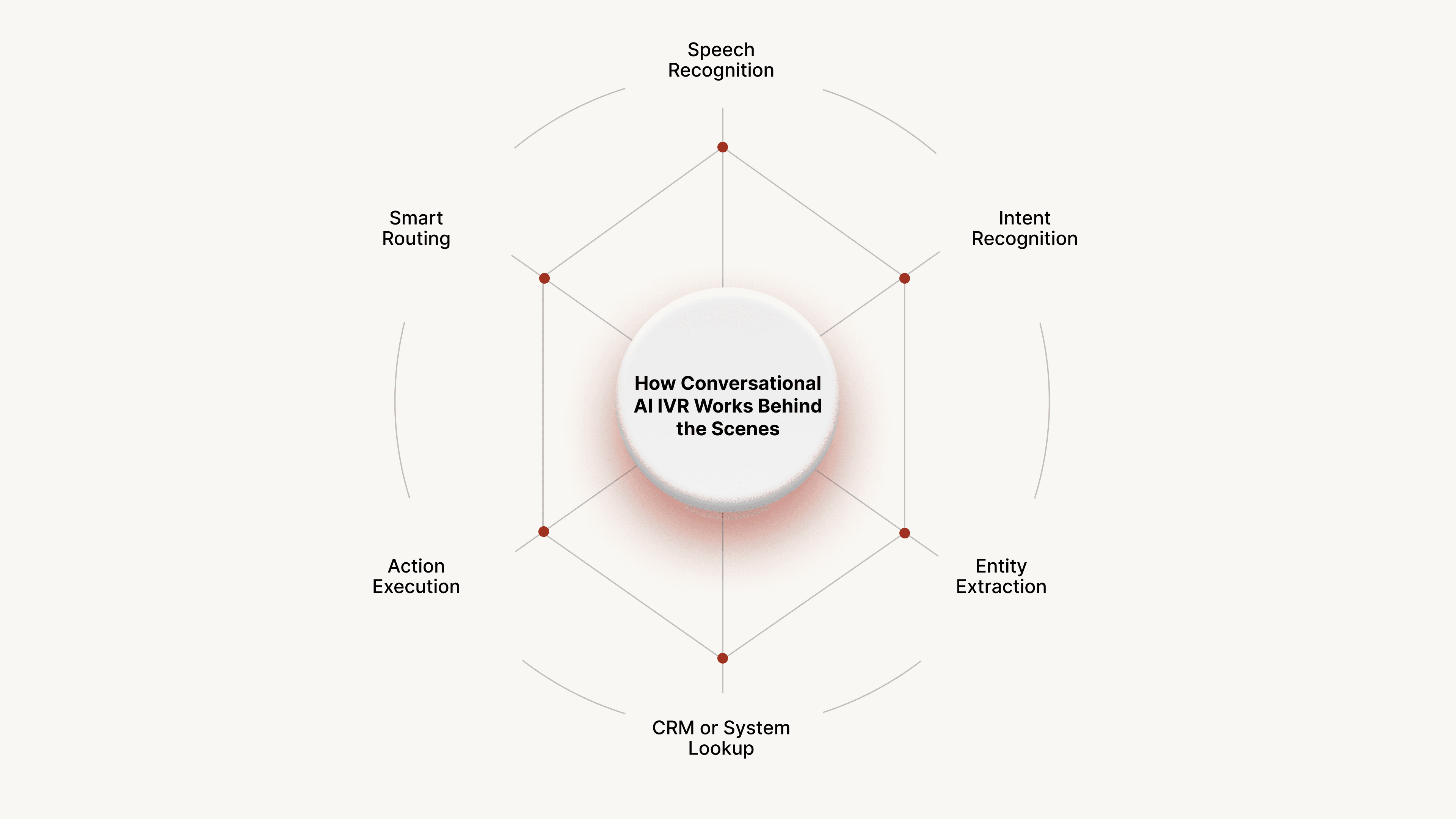
Conversational AI IVR replaces rigid menu navigation with intelligent, natural dialogue. Behind the scenes, a sequence of AI-driven components works together to understand the caller, retrieve information, complete tasks, and route issues when needed.
1. Speech Recognition
The system converts spoken input into text so it can be analyzed. Accurate speech-to-text ensures the IVR captures what the customer says, even with accents or background noise.
2. Intent Recognition
NLU interprets the purpose of the call. It identifies whether the customer wants a refund, order status, card activation, address update, or another action. This step eliminates the need for menu navigation.
3. Entity Extraction
The system extracts key details from the caller’s message, such as order ID, policy number, payment date, or account type. Extracted entities help the IVR execute tasks precisely.
4. CRM or System Lookup
The IVR checks backend systems such as CRM, ticketing platforms, or order management tools. It retrieves customer history, recent transactions, open tickets, and past interactions to give contextual responses.
5. Action Execution
Based on the intent and the retrieved data, the IVR performs the required action. This can include updating records, processing cancellations or refunds, raising support tickets, confirming deliveries, or sending alerts.
6. Smart Routing
If the issue is complex or requires human intervention, the system routes the caller to the right agent. It also passes context such as intent, extracted entities, and conversation history, so the agent does not need to repeat questions.
Why Enterprises Are Moving to Conversational AI IVR
Conversational AI IVR improves customer experience and operational efficiency by removing the limitations of traditional menu-based systems. Here are the core benefits enterprises see after adopting it.
1. Natural, Human-Like Interactions
Customers can speak naturally without navigating long menus or guessing which option fits their issue. The system understands free-flowing speech, which creates a smoother and more intuitive experience.
2. Faster Resolutions
Intent-based routing enables immediate understanding and quicker action on customer requests. This reduces handling time, especially during peak hours.
CubeRoot deployments have shown up to 70% query resolution through Voice AI and wait times brought below 10 seconds, delivering consistently faster outcomes.
3. Lower Call Center Load
Repetitive, high-volume queries such as balance checks, order status updates, delivery confirmations, or cancellations can be fully automated. This frees human agents to focus on complex interactions that require expertise.
4. Higher CSAT and NPS
Customers face less friction, get faster answers, and receive responses that match their context. These improvements directly increase satisfaction scores and reduce abandonment.
5. 24/7 Automated Support
The system can handle inquiries at any time, including nights, weekends, or seasonal spikes. This ensures customers always receive timely assistance, even when agents are unavailable.
6. Scalable and Cost-Efficient
Conversational AI IVR scales easily as call volumes grow. It requires no additional headcount and reduces operational costs while maintaining consistent quality across every interaction.
Top Conversational AI IVR Use Cases Across Industries
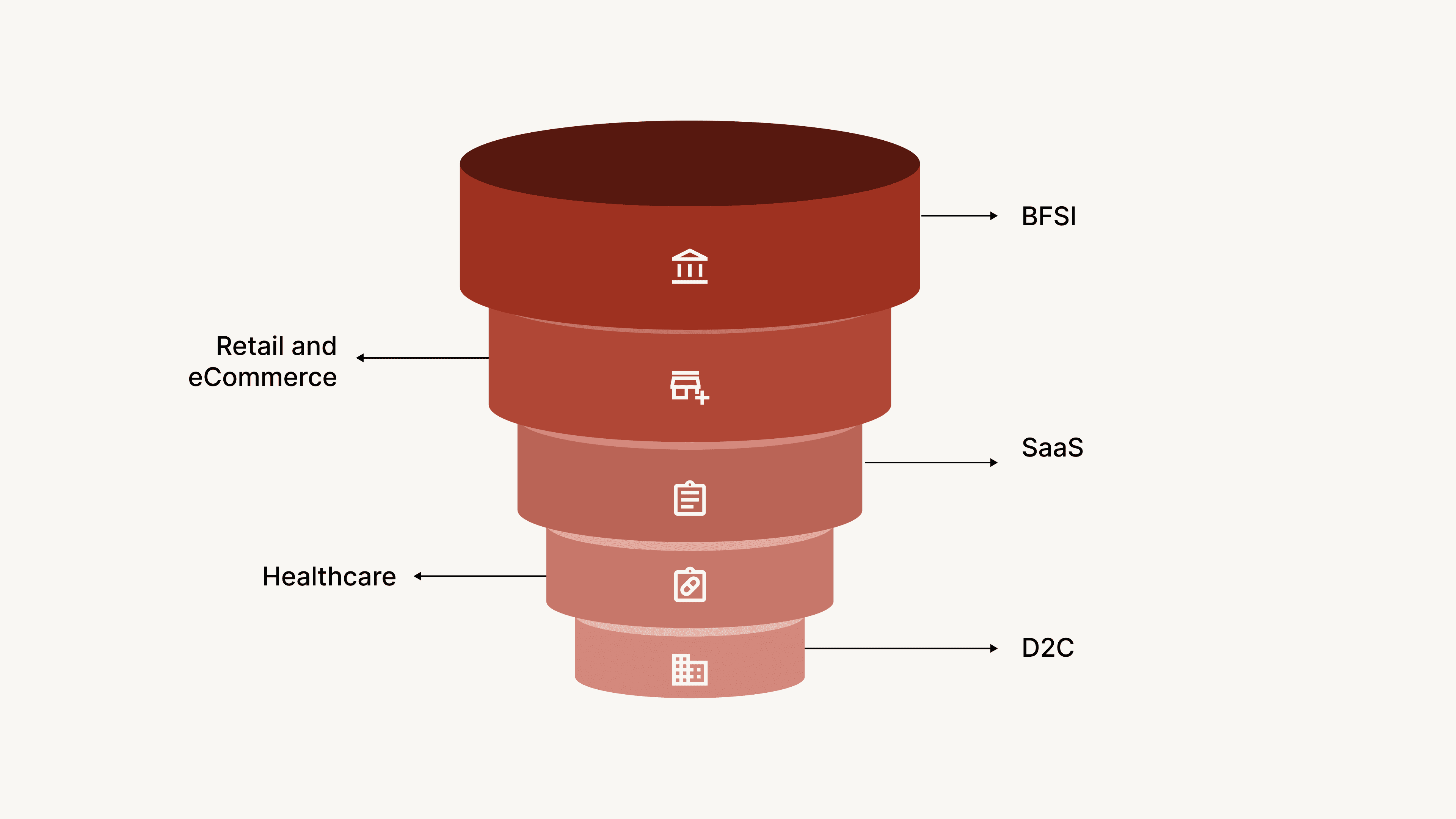
Conversational AI IVR is designed for enterprises that manage high call volumes and time-sensitive customer interactions. By understanding natural speech and accessing backend systems, it automates routine queries and improves routing across sectors.
Here are the most impactful use cases by industry.
1. BFSI
Banks and financial institutions handle large volumes of inbound calls daily. Conversational AI IVR reduces wait times and resolves requests instantly by accessing account information and validating identity.
Common use cases include:
Balance checks
EMI reminders and payment status
Fraud or suspicious activity queries
KYC updates and verification steps
2. Retail and eCommerce
Retail and eCommerce companies deal with frequent post-purchase queries. Conversational AI IVR helps customers get updates quickly without relying on agents.
Common use cases include:
Order tracking and status checks
Return and exchange eligibility
Delivery updates and delays
Post-delivery feedback collection
3. SaaS
SaaS companies rely on efficient self-service to support customers across time zones. IVR automation reduces support tickets and accelerates issue resolution.
Common use cases include:
Password resets
Renewal and billing inquiries
Account issue triage
Product or feature guidance
4. Healthcare
Patients need timely, accurate information. Conversational AI IVR automates routine communication while maintaining privacy and compliance.
Common use cases include:
Appointment scheduling and reminders
Lab result notifications
Prescription refill reminders
5. D2C
D2C brands often manage high daily call volumes related to orders and deliveries. Conversational AI IVR reduces manual workload and improves customer experience.
Common use cases include:
COD confirmation
Shipment status updates
Return initiation and support
With these use cases in mind, the next step is understanding how to implement conversational AI IVR effectively within your own operations.
Also read: AI In Customer Service: A Complete Guide
How to Implement Conversational AI IVR
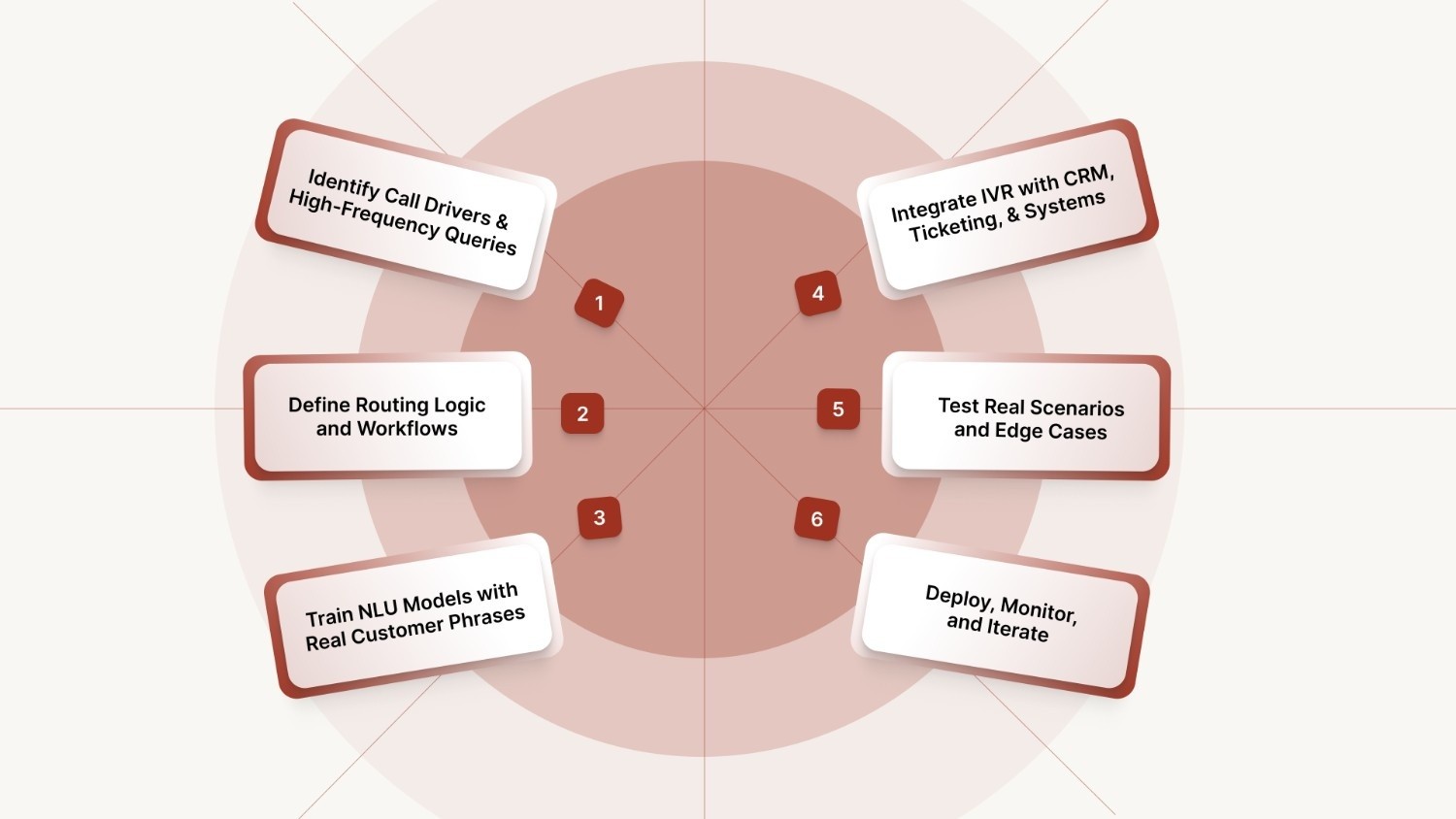
Implementing Conversational AI IVR requires more than replacing a menu. It involves aligning customer journeys, backend systems, and automation workflows to create seamless, human-like interactions. Here is a practical step-by-step framework for successful deployment.
1. Identify Call Drivers and High-Frequency Queries
Start by analyzing why customers call most often. Common drivers include order status, account issues, payment reminders, renewals, or appointment scheduling. Prioritize the top categories to maximize immediate impact.
2. Define Routing Logic and Workflows
Map how each query should flow from detection to resolution. Outline self-service actions, escalation paths, fallback responses, and the conditions that route callers to live agents. Clear workflows ensure smooth automation.
3. Train NLU Models with Real Customer Phrases
Gather real examples of how customers describe their problems. Include variations, slang, multilingual phrases, and common misunderstandings. This helps the system recognize intent accurately from day one.
4. Integrate IVR with CRM, Ticketing, and Backend Systems
Enable the system to fetch and update customer data automatically. Integrations allow the IVR to check order status, retrieve account details, raise tickets, or process renewals without human intervention.
5. Test Real Scenarios and Edge Cases
Simulate real customer calls, including noisy environments, accents, incomplete sentences, and ambiguous requests. Verify that the IVR can understand, respond, and escalate appropriately.
6. Deploy, Monitor, and Iterate
After launch, track key metrics such as containment rate, resolution time, fallback triggers, and customer sentiment. Use these insights to refine conversation flows and expand the IVR to additional use cases.
How CubeRoot Powers Conversational AI IVR
CubeRoot brings enterprise-grade automation to IVR by combining natural language intelligence with deep system integration. Its Voice AI platform delivers fast, accurate, and scalable interactions that reduce call center load while improving customer experience.
Key Capabilities of CubeRoot
Human-like multilingual conversations: Understands natural speech across English and multiple Indian languages, enabling accessible and intuitive interactions for diverse customer bases.
Real-time CRM and ticketing integration: Fetches and updates customer records instantly, logs call outcomes, and creates or closes tickets without manual effort.
Automated workflows for renewals, reminders, and order tracking: Handles high-volume tasks such as repayment reminders, renewal follow-ups, appointment updates, and shipment status checks.
Intent-driven routing to the right team: Recognizes customer purpose and routes complex issues to human agents with complete context for faster resolution.
Industry-ready IVR templates: Prebuilt workflows designed for BFSI, eCommerce, SaaS, Healthcare, D2C, and EdTech that reduce setup time and improve accuracy.
Rapid deployment with more than 150 integrations: Connects easily with CRMs, order systems, and ticketing platforms, allowing enterprises to go live quickly with minimal engineering.
Continuous learning: Adapts to new terms, customer behavior, and regional speech patterns to improve recognition and response quality over time.
By combining intelligent speech understanding with workflow automation, CubeRoot helps enterprises deliver faster resolutions, lower operational costs, and a modern customer experience. Request a CubeRoot demo today.
FAQs
1. How is Conversational AI IVR different from traditional IVR?
Traditional IVR relies on “press 1, press 2” menus. Conversational AI IVR understands free-flow speech, provides context-aware responses, and resolves requests faster.
2. Does Conversational AI IVR support multiple languages?
Yes. CubeRoot supports English and multiple Indian languages, enabling accessible and personalized conversations for diverse customer groups.
3. Is Conversational AI IVR secure for sensitive sectors?
Yes. It supports encryption, secure authentication, audit logs, and role-based access suitable for BFSI, healthcare, and regulated industries.
4. What types of queries can Conversational AI IVR handle?
It can process order tracking, balance checks, renewals, appointments, cancellations, feedback, fraud queries, and more. Complex cases are routed to agents with full context.