Jan 13, 2026
7 Ways Voice Assistants Power In-Store Retail Events
Retail store events bring high footfall and sales opportunities, but they also put pressure on store teams. Long queues, repeated questions, and inconsistent support can quickly frustrate shoppers during busy event hours. For enterprise retailers, maintaining a smooth experience at scale remains challenging.
In 2025, 29% of consumers said they stopped using or buying from a brand due to poor customer experience, either online or in-person. During in-store events, where expectations are higher and patience is limited, even small service gaps can affect brand trust and future purchases.
Voice assistant store events retail strategies help brands manage these peak moments by offering instant, voice-led assistance across store floors. This article breaks down how voice assistants support retail events and the specific ways they improve experience, efficiency, and consistency.
Key Takeaways
Retail store events create high volumes of repeated customer questions that are difficult to manage with staff alone during peak hours.
Voice assistants help deliver instant event information, reduce queues, and guide customers across busy store floors.
Multilingual voice support improves accessibility and consistency in diverse retail environments.
Real-time integration with POS and inventory systems prevents missed sales and customer frustration.
Voice-led lead capture and feedback collection extend the value of retail events beyond the store visit.
What Are Voice Assistants in Retail Store Events?
Voice assistants in retail store events are AI-powered voice systems designed to support customers during high-footfall, time-bound in-store activities.
They help shoppers get instant answers about event offers, product availability, store navigation, and timings without waiting for staff assistance. Unlike voice commerce tools focused on transactions, these assistants are built to manage real-time event interactions on the store floor.
As retail events continue to grow in scale and complexity, it becomes important to understand why relying on human staff alone is no longer sufficient.
Why Do Retail Store Events Need Voice Assistants?
Retail store events bring a sudden spike in footfall, questions, and service demands within a limited time window. Store teams often struggle to respond consistently while managing sales, inventory, and customer flow. Voice assistants help fill this gap by handling repetitive, time-sensitive interactions at scale.
Retail store events need voice assistants because they:
Handle hundreds of repeated queries about offers, timings, and product availability without increasing staff count.
Reduce queue pressure by guiding customers to the right counters, sections, or help points in real time.
Deliver consistent messaging across all store locations during national or regional campaigns.
Support multilingual shoppers instantly, especially in high-density urban and regional markets.
Allow store staff to focus on high-value interactions instead of routine event inquiries.
With these foundations in place, it becomes easier to see the specific ways voice assistants improve execution and customer experience during retail store events.
Also Read: AI-Driven Voice Interaction: A Practical Guide for Indian Enterprises
7 Ways Voice Assistants Improve Retail Store Events
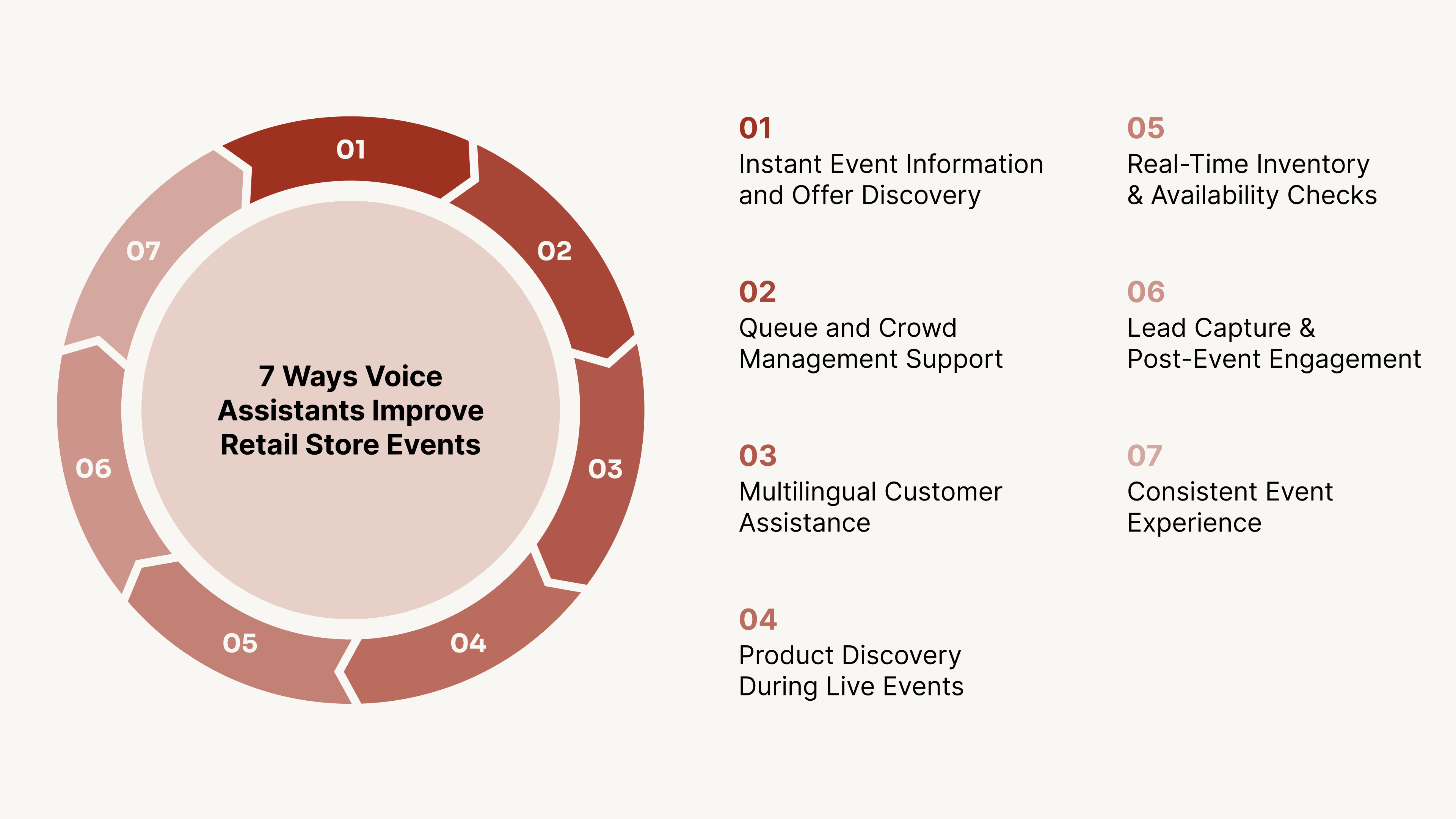
Retail store events demand speed, clarity, and consistency at moments when stores are at their busiest. Voice assistants support these needs by handling real-time customer interactions without slowing down store operations.
Below are the key ways voice assistants strengthen retail store events and help teams manage high footfall more effectively.
1. Instant Event Information and Offer Discovery
During store events, a large share of customer queries revolve around offers, eligibility, timings, and exclusions. When these questions go unanswered or responses vary, customer frustration builds quickly.
This matters even more as 53% of consumers under 45 expect brands to offer AI-powered digital experiences, including in physical stores.
Voice assistants handle these queries instantly, responding to natural questions like "What discounts are running today?" while ensuring event messaging stays accurate and consistent across locations.
2. Queue and Crowd Management Support
High-footfall events often lead to congestion at billing counters, demo zones, or returns desks, which directly impacts customer perception. Voice assistants help manage this by guiding shoppers to the right counters, sharing wait times, or redirecting them to less crowded sections in real time.
Given that 69% of Indians would stop doing business with a brand after one bad experience, reducing visible friction during events becomes critical. Voice-led guidance improves crowd flow without relying solely on floor staff.
3. Multilingual Customer Assistance Across Store Floors
Retail events attract a linguistically diverse audience, especially in metro and Tier 2 cities. Voice assistants supporting multiple Indian languages ensure customers can ask questions and receive help in their preferred language.
This is particularly useful during events where temporary staff may not cover all languages.
Platforms like CubeRoot's multilingual voice agents allow retailers to maintain inclusivity and clarity without increasing staffing complexity.
4. Product Discovery During Live Events
During live demos or promotional events, customers often want quick comparisons, specifications, or availability details.
Voice assistants support product discovery by answering questions like "Does this model support fast charging?" or "What's the difference between these two variants?" This helps customers move faster through decision-making while sales staff focus on closing or demonstrations.
Voice-led discovery also reduces dependence on printed signage during dynamic events.
5. Real-Time Inventory and Availability Checks
Nothing disrupts an event experience faster than discovering a promoted product is out of stock. Voice assistants integrated with inventory systems allow customers to check availability by size, color, or variant instantly.
For example, a shopper can ask if a product is available in another section or nearby store. This capability helps retailers prevent missed sales and redirect demand intelligently during peak hours.
6. Lead Capture and Post-Event Engagement
Retail events generate valuable intent data, but capturing it manually isn't easy in busy environments. Voice assistants can collect opt-ins for callbacks, product alerts, or post-event offers through simple voice prompts.
For instance, customers can register interest in out-of-stock items or upcoming launches. CubeRoot supports structured lead capture workflows that feed directly into CRM systems for timely follow-ups.
7. Consistent Event Experience Across Multiple Store Locations
Running the same event across multiple stores often leads to inconsistencies in messaging and execution. Voice assistants solve this by deploying centrally managed workflows across all locations.
Whether it's offering explanations, event schedules, or escalation rules, every store follows the same voice logic. This ensures customers receive a consistent experience, regardless of location, during nationwide retail campaigns.
To make these event-level improvements possible, voice assistants must work in sync with the systems retailers already rely on, which brings us to how voice assistants integrate with retail systems.
Also Read: How AI Voicebots Reduce Wait Times in Customer Service
How Voice Assistants Integrate With Retail Systems?
Voice assistants deliver real value during retail store events only when they connect seamlessly with existing retail technology stacks. Integration allows voice interactions to reflect live data, approved workflows, and operational rules without manual intervention.
Voice assistants integrate with retail systems by connecting to:
POS systems to surface real-time billing status, counter availability, and transaction-related queries
Inventory management systems to provide live stock availability by variant, size, or location
CRM platforms to capture customer intent, event opt-ins, and follow-up requests in a structured format
Order management systems to answer delivery, returns, and exchange-related questions during event peaks
Analytics and reporting tools to track interaction volumes, drop-offs, and event-specific customer behavior
With system integrations in place, the next step is understanding the operational, technical, and compliance considerations before deploying voice assistants for store events.
What to Consider Before Deploying Voice Assistants for Store Events?
Deploying voice assistants for retail store events requires more than enabling voice responses on the store floor. Event environments are fast-paced, high-volume, and highly visible, which makes accuracy, reliability, and governance critical. Getting these elements right determines whether voice assistance improves or disrupts the event experience.
Before deploying voice assistants for store events, retailers should evaluate:
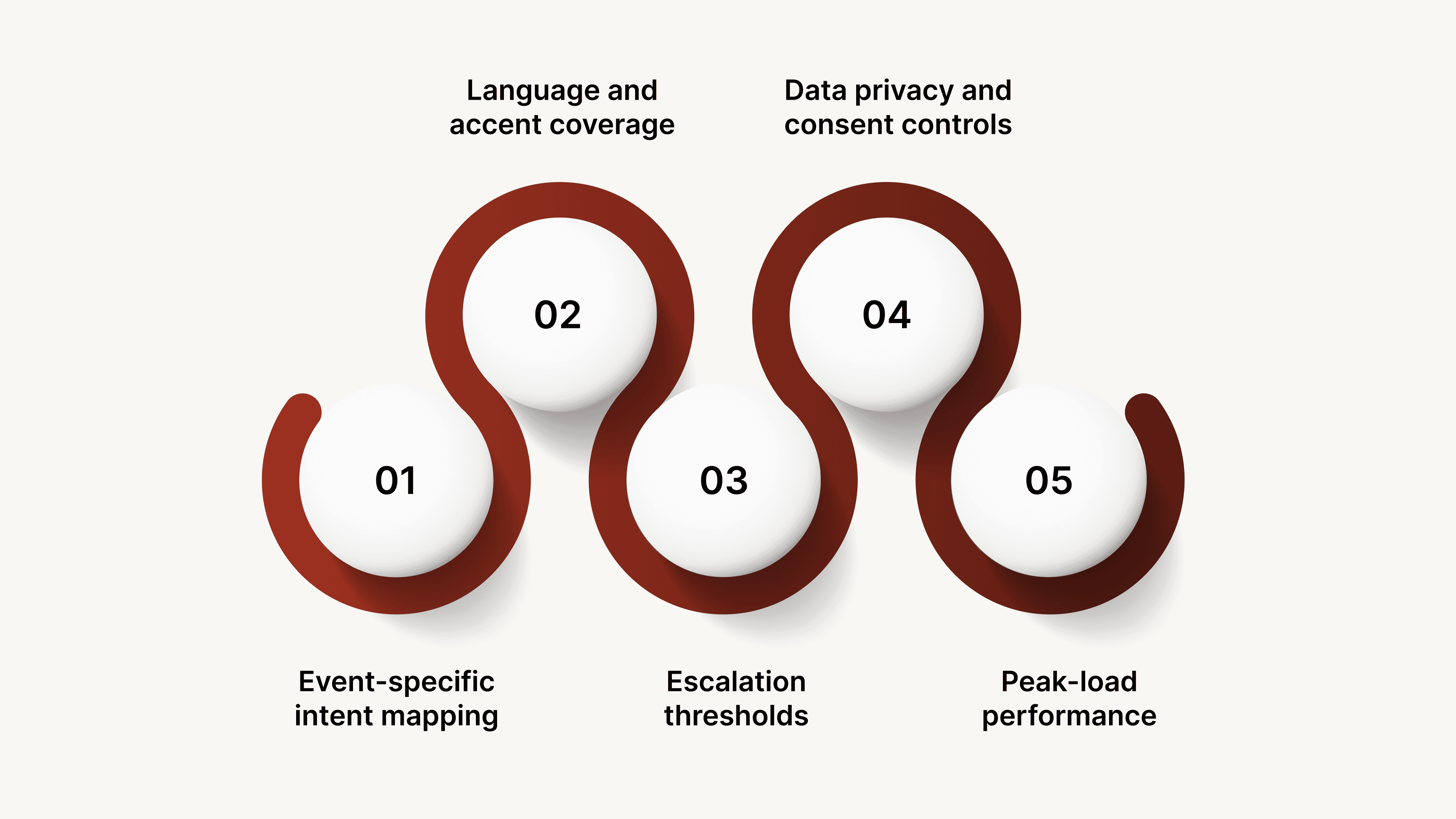
Event-specific intent mapping, ensuring the assistant understands queries related to offers, timings, eligibility rules, and exclusions unique to each campaign
Language and accent coverage, particularly for regional stores, where pronunciation and dialect variations affect recognition accuracy
Escalation thresholds, defining when and how conversations should be handed over to floor staff during high-intent or sensitive interactions
Data privacy and consent controls, especially when capturing customer details or post-event opt-ins through voice
Peak-load performance, validating that the system can handle sudden spikes in simultaneous interactions without latency or failures
With the key deployment considerations in place, it helps to look at how enterprises are already applying these principles in real retail environments using CubeRoot’s voice AI to manage store events more effectively.
How Enterprises Use CubeRoot’s Voice AI to Manage Retail Events?
CubeRoot is an enterprise-grade Voice AI platform built to support high-volume, real-time customer interactions across retail environments. It enables retailers to deploy multilingual, domain-trained voice agents that assist customers during busy store events without increasing staff load.
The platform integrates directly with retail systems to deliver consistent, compliant, and scalable voice experiences.
Enterprises use CubeRoot's Voice AI to:
Deploy multilingual voice assistance across store floors during high-footfall events
Handle repetitive customer queries related to offers, product availability, and event logistics
Escalate complex or high-intent interactions to staff without disrupting the customer journey
Capture structured interaction data to improve post-event follow-ups and CX decisions
1. Customer Support During Retail Events
CubeRoot's multilingual Voice AI enables retailers to support customers 24/7 during store events, ensuring accessibility even during peak hours.
Retailers can resolve 70% of customer queries automatically, reduce wait times to under 10 seconds, and significantly lower support costs by minimising dependency on large floor teams.
2. Voice-Led Feedback Collection
Retailers use CubeRoot to collect immediate post-interaction feedback through short voice conversations instead of long surveys.
This approach captures 5× more feedback in 30-second calls and helps translate insights into action, leading to a 25% improvement in customer experience scores.
By combining real-time voice support with enterprise-grade control, CubeRoot helps retailers run store events more smoothly while protecting both customer experience and operational efficiency.
Wrapping Up
Retail store events demand fast responses, consistent information, and smooth crowd handling at scale. Voice assistants support these needs by managing real-time customer interactions while reducing pressure on store teams.
CubeRoot helps enterprises deliver this experience through multilingual, system-integrated Voice AI built for high-footfall retail events. The platform enables consistent support, efficient escalation, and actionable insights across store locations.
Looking to run retail events with smarter voice-led support? Contact us to see how CubeRoot can help.
FAQs
1. Can voice assistants work offline during retail store events?
No, most voice assistants require an active internet connection to process speech and fetch real-time data. However, some retailers use fallback prompts or cached responses to handle basic queries during brief connectivity issues.
2. Do customers need to install an app to use in-store voice assistants?
No. In-store voice assistants are typically accessed through kiosks, smart speakers, or store devices, allowing customers to interact instantly without downloads or logins.
3. Are voice assistants suitable for temporary pop-up stores or short-term events?
Yes. Voice assistants can be deployed quickly for pop-ups and limited-time events, making them useful for managing customer queries without hiring additional temporary staff.
4. Can voice assistants handle multiple customers speaking at the same time?
Yes, when deployed across multiple touchpoints or zones, voice assistants can manage simultaneous interactions, which is especially helpful during peak event hours.
5. Do voice assistants replace human staff during retail events?
No. They support store teams by handling repetitive and informational queries, allowing staff to focus on personalised service and high-intent customer interactions.