Dec 29, 2025

Voice AI for Refund Status: Faster Updates, Lower Costs, Better CX
If you're running an eCommerce or fintech operation, you already know that refund-status queries never stop. Customers want to know “Where is my refund?” and they want the answer now.
The problem is that agents must check multiple systems, delays create frustration, and refund calls quickly become one of the highest-volume, highest-cost interactions for your team.
Voice AI changes this completely.
Instead of waiting in a queue, customers can call anytime and get instant, accurate refund updates pulled directly from your OMS, CRM, warehouse systems, and payment gateway.
In this blog, we’ll show how Voice AI automates refund inquiries end-to-end and why it’s becoming essential for fast-growing brands.
At a glance:
Refund-status queries are increasing as returns reach $890B in 2024, making them one of the highest-volume and most expensive support interactions.
Voice AI agents give customers instant, accurate refund updates by pulling real-time data from OMS, CRM, warehouse systems, and payment gateways.
It automates the entire workflow: authentication, intent detection, data retrieval, escalations, and CRM writebacks with zero agent involvement.
Automating refund calls reduces support load, cuts costs, improves transparency, and significantly boosts customer satisfaction.
Platforms like CubeRoot, Voice AI, and others make this easy with deep integrations, domain-trained voice agents, multilingual support, and fast deployment.
What Is Voice AI for Refund Status?
Voice AI for refund status is an intelligent voice system that allows customers to check the progress of their refunds through natural, human-like conversations. Instead of waiting for an agent, customers can call and instantly get updates on return processing, payment reversals, or reimbursement timelines.
This is very different from basic IVR or rule-based chatbots. Traditional systems rely on fixed options like “Press 1 for refund status” and break easily when customers ask questions in their own words. Voice AI agents understand natural language regardless of phrasing, accents, or mixed-language inputs.
A key requirement for accurate refund updates is real-time data access. The system must pull live information from:
The Order Management System (OMS)
CRM and support history
Warehouse or QC status
Payment gateway or bank logs
Without this data, the bot can only give vague or generic replies.
With deep integrations, Voice AI provides precise refund updates, explains reasons for delays, and guides customers on next steps without needing human involvement.
Why Refund Status Is a High-Volume, High-Cost Problem
Consumer returns have become a massive operational burden. According to NRF and Happy Returns, shoppers are expected to return $890 billion worth of goods in 2024, representing 16.9% of all retail sales. Return rates for online purchases are even higher, which means a significant portion of customer interactions will revolve around refund updates.
This surge in returns directly translates into high volumes of refund-status inquiries — and most of them are routine, repetitive, and expensive to handle manually.
Here’s why refund queries create disproportionate operational strain:
High Customer Frustration: Customers experience long wait times, repeated follow-ups, and inconsistent answers when refund timelines are unclear.
Manual, Multi-System Dependency: Agents must check OMS, CRM, warehouse systems, and payment gateway logs to provide a single update, increasing handling time.
High Volume of Refund Queries: Refund status and order updates consistently rank among the top inbound queries for online brands, driving up cost per contact.
Inconsistent Communication: Different agents often give different answers because refund visibility varies across teams and systems.
Agent Bandwidth Overload: Most refund inquiries are routine and predictable, yet they consume a disproportionate amount of agent time during peak seasons.
Voice AI eliminates these bottlenecks by answering refund questions instantly and accurately, without human intervention.
Also read: What is Call Automation and How It Works?
How Voice AI Automates Refund Status End-to-End
Refund status inquiries follow a predictable workflow, and Voice AI agents can handle every step of it automatically. By connecting to your OMS, CRM, payment gateway, and warehouse systems, it delivers accurate, real-time updates without agent involvement.

Here’s how the process works from start to finish:
1. Identify and Authenticate the Customer
The bot begins by recognizing the caller through their phone number or order ID. If required, it validates identity using OTP or security questions. This ensures the system retrieves and displays the correct refund details for the right customer.
2. Understand the Refund Intent
Customers may phrase refund questions in hundreds of ways. Voice AI uses NLU to understand intent, even if the question is incomplete or informal.
For example:
“Where is my refund?”
“Money hasn’t come yet.”
“I returned my order. What next?”
“When will I get the amount back?”
The bot identifies that the user wants a refund update, not order tracking, delivery info, or a replacement.
3. Fetch Real-Time Refund and Payment Data
Voice AI pulls the latest information directly from:
OMS to check return pickup and QC status
Warehouse systems for received and processed returns
Payment gateway logs for refund initiation timestamps
CRM for any prior tickets, notes, or escalations
This ensures the customer gets accurate information, not generic responses.
4. Provide a Clear and Accurate Status Update
Based on the retrieved data, the bot gives a precise answer, such as:
“Your return was received this morning.”
“QC is complete, and your refund is being initiated today.”
“Your bank will credit the amount within 48 hours.”
“There is a delay. I can initiate an escalation for you.”
The information is always up-to-date because it is pulled in real time.
5. Trigger Next Steps Automatically
If needed, the bot continues the workflow by:
Starting an escalation when a refund is delayed
Sending SMS/email confirmations
Updating refund timelines in the CRM
Creating or updating a support ticket
Notifying internal teams if intervention is required
This eliminates manual follow-ups and prevents cases from slipping through the cracks.
6. Log the Entire Interaction in the CRM
Finally, Voice AI agents write everything back into the customer profile:
Intent (refund status)
Data shared with the customer
Sentiment and tone markers
Summary of the interaction
Any actions taken
This keeps your CRM clean, complete, and audit-ready.
Key Benefits of Using Voice AI for Refund Status
Voice AI removes the biggest friction points in the refund journey by giving customers instant clarity and reducing operational effort. Here’s how it transforms both sides of the experience:
1. Instant, 24/7 Refund Updates
Customers get real-time status information whenever they call, even outside business hours. This eliminates queues, backlogs, and repeat follow-ups.
2. Major Reduction in Support Volume and Cost
Refund inquiries often account for a large share of inbound calls. Automated handling deflects these queries completely, lowering cost per ticket and reducing the need to scale headcount during peaks.
3. Faster Resolution Because No Agent Lookup Is Needed
Voice AI connects directly to OMS, warehouse systems, and payment gateways. It retrieves the exact refund stage in seconds, something that usually takes an agent several minutes and multiple system checks.
4. Higher Customer Satisfaction and Trust
Customers feel reassured when they get immediate, consistent answers. This reduces refund anxiety, improves transparency, and boosts NPS and repeat purchase likelihood.
5. Accurate and Consistent Responses Every Time
The bot pulls live data, so customers always hear the correct status. No guesswork, no contradictions between agents, and no misinformation that leads to escalations.
6. Reduced Dependency on Back-Office Teams
Agents no longer need to chase warehouse, QC, finance, or payment teams for basic updates. The bot handles routine queries end-to-end, allowing teams to focus on exceptions only.
7. Cleaner CRM With Automatic Logging
Each conversation is summarized and written to the CRM automatically. This keeps refund data organized, improves reporting, and supports better forecasting and customer insights.
Also read: How Conversational Customer Service Enhances Business Success
Top Voice AI Tools for Automating Refund Status
Several Voice AI platforms can automate refund-status workflows, but only a few offer the depth of integration, accuracy, and reliability needed for real-time OMS and payment updates.
Here are the leading tools to consider:
1. CubeRoot

CubeRoot is an enterprise-grade Voice AI platform built for automating high-volume customer interactions, including real-time refund status updates. It integrates deeply with OMS, CRM, payment systems, and backend databases to deliver accurate, automated responses without agent involvement.
Key Features:
Human-Like, Context-Aware Conversations: Voice AI engages customers in natural speech, understands intent and context, and reduces friction in refund interactions.
Deep Integrations With CRM and Backend Systems: Seamlessly connects with CRMs, OMS, dialers, and payment systems to fetch live data and update workflows in real time.
Ready-To-Use Voice Agents: Offers a library of domain-trained conversational agents tailored for specific business functions and languages.
GenAI-Powered Prompt Builder: Enables rapid deployment of new workflows without heavy technical effort.
Real-Time Transcription and Sentiment Tracking: Captures call transcripts and customer sentiment to improve accuracy, compliance, and CX insights.
150+ Seamless Integrations: Plug-and-play connections with CRMs, ticketing platforms, and backend tools for unified, automated processes.
Best Suited For: Mid-to-large eCommerce, fintech, and BFSI brands that need accurate, scalable, and fully automated refund status support without manual agent effort.
2. Voiceflow
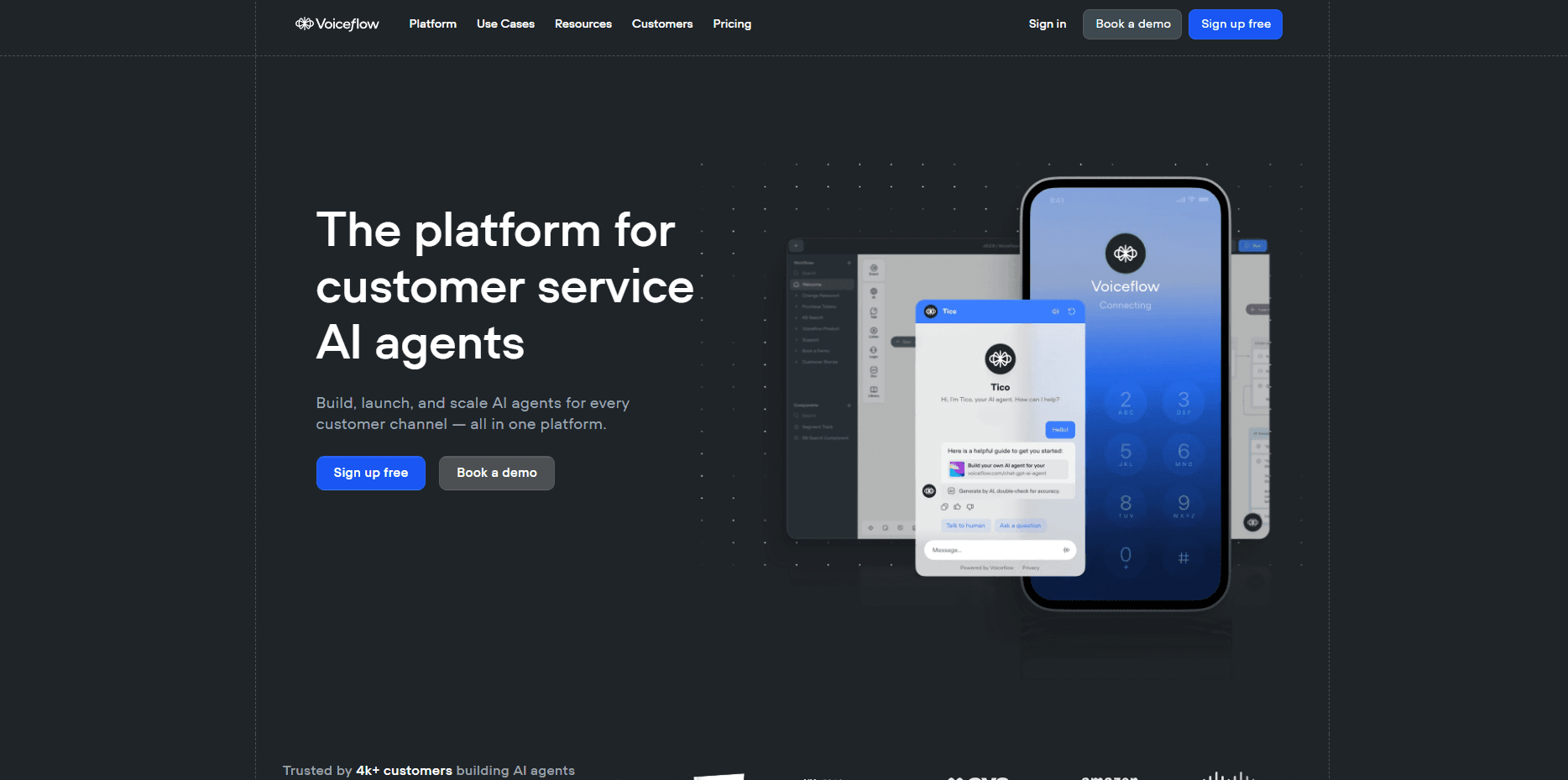
Voiceflow is a collaborative, low-code platform for building and deploying conversational AI voice agents and chat assistants using a drag-and-drop interface. It helps teams design, test, and scale AI-powered voice workflows without writing code.
Key Features:
No-Code Drag-and-Drop Builder: Allows rapid creation and iteration of voice and chat AI flows without technical expertise.
Multi-Channel Deployment: Supports voice agents across phone, web, and apps from the same build environment.
Collaborative Workspace: Teams can co-design, test, and refine conversational experiences together.
Custom Logic & Integrations: Enables integration with APIs and backend systems for dynamic responses.
Best Suited For: Product and support teams that want to build and experiment with custom voice and chat bots quickly without code.
3. Vapi
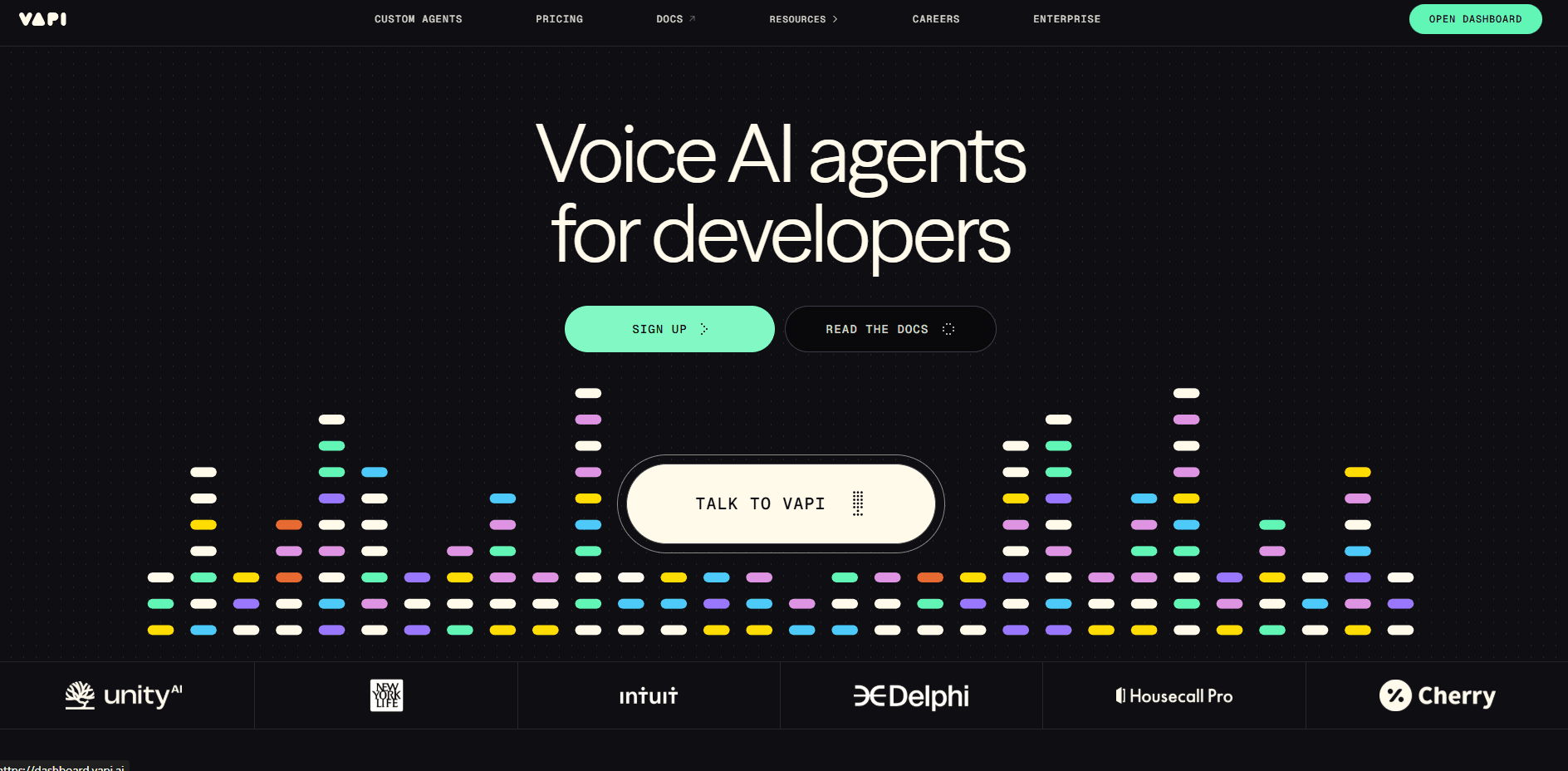
Vapi is a developer-centric voice AI platform that provides API-first tools to build, test, and deploy advanced voice agents at scale. Its infrastructure supports high concurrency and low latency for enterprise voice workloads.
Key Features:
API-Native Architecture: Offers full voice agent control via flexible APIs for deep customization.
Multilingual Support: Handles conversations in English, Spanish, Mandarin, and 100+ languages.
Automated Testing Suites: Built-in testing tools help validate voice flows before launch.
Enterprise-Grade Reliability: Scales to millions of calls with sub-500ms latency and 99.99% uptime.
Best Suited For: Developers and technical teams building custom, multi-language voice AI solutions with deep backend integrations.
4. VoiceGenie

VoiceGenie delivers AI-powered voice agents designed to autonomously handle sales and support conversations. It focuses on lead qualification, engagement, and customer interaction with a human-like voice presence.
Key Features:
Generative Voice Conversations: AI agents converse naturally to qualify leads and assist customers.
24/7 Sales and Support Coverage: Automated calling and handling of inbound/outbound queries.
Empathetic Response Engine: Understands and reacts to customer tone and intent.
Scalable Deployment: Can handle high volumes of interactions without manual intervention.
Best Suited For: Small to mid-sized businesses looking for AI-driven sales engagement and automated voice support.
5. Voice AI

Voice AI is a versatile voice platform that combines AI voice agents, text-to-speech, and voice cloning capabilities. It provides tools to automate calls, generate highly realistic speech, and embed voice AI into apps or contact systems.
Key Features:
Human-Like Voice Agents: Deploys AI call agents that answer questions, schedule, and manage conversations.
Realistic Text-to-Speech: Studio-quality voices suitable for interactive and branding use.
Voice Cloning & Custom Voices: Create custom voice personas from short audio samples.
Secure, Compliant Integrations: Built with enterprise compliance (e.g., GDPR, HIPAA, SOC 2) and API support.
Best Suited For: Teams needing rich voice generation plus voice AI agents, especially where expressive TTS or custom voice personalities matter.
Also read: AI In Customer Service: A Complete Guide
How to Implement Voice AI for Refund Status: A Practical Step-by-Step Guide
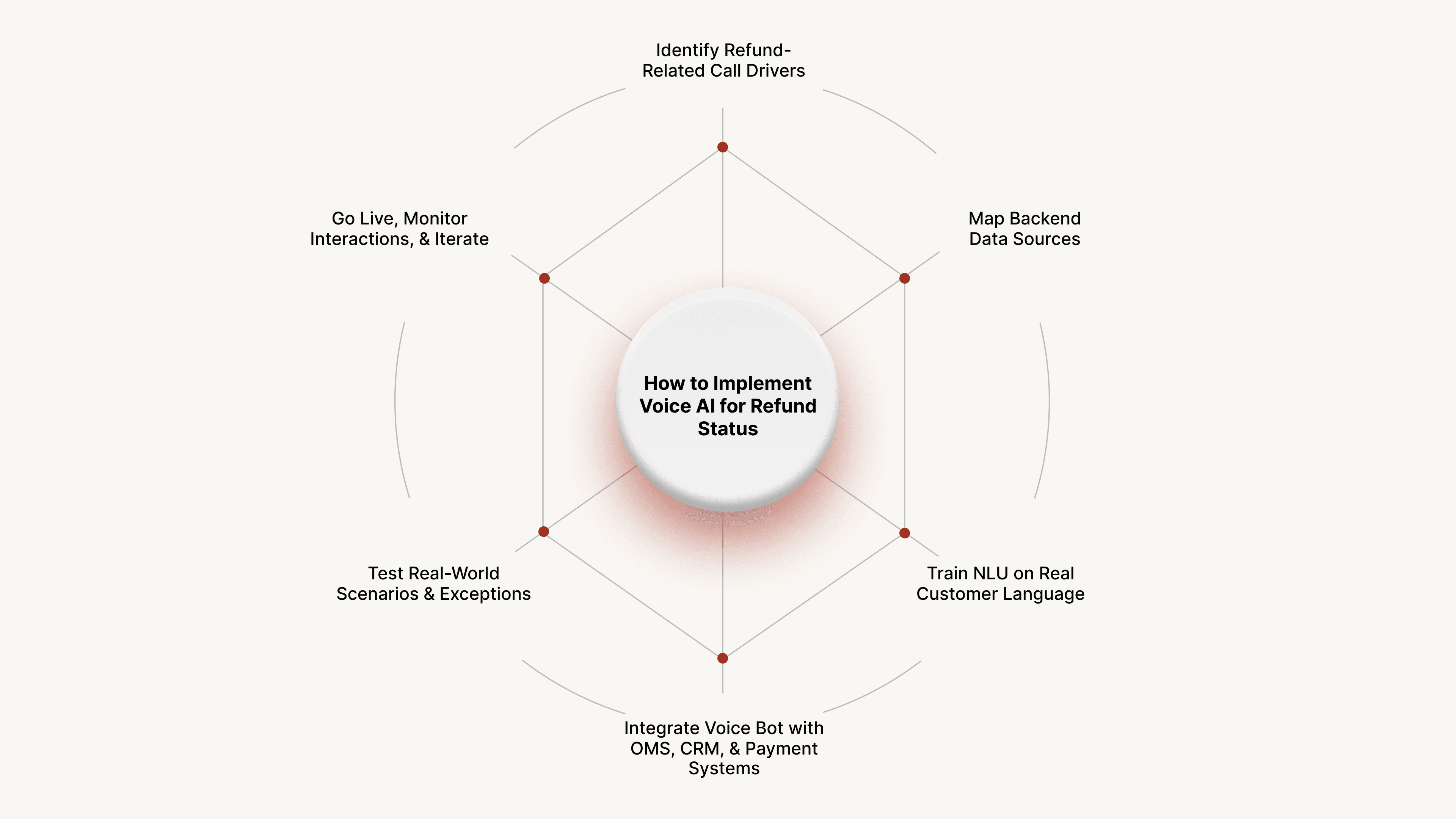
Implementing Voice AI for refund automation is not just a tech project; it requires aligning systems, workflows, and customer expectations. Here is a clear, actionable framework to deploy it smoothly and at scale.
1. Identify Refund-Related Call Drivers
Start by mapping the top refund queries your agents handle daily:
“Where is my refund?”
“Has my return been approved?”
“When will the amount reflect in my account?”
These become the first workflows for automation.
2. Map Backend Data Sources
Refund status typically sits across multiple systems. Ensure Voice AI can access:
OMS (return status, pickup completion)
CRM (ticket status, customer identity)
Payment gateway logs (refund initiated, processed, failed)
Define which fields the bot must read and which actions it must write back.
3. Train NLU on Real Customer Language
Feed the AI real refund queries from call logs and chats. Customers rarely speak formally. They say things like:
“Money kab aayega?”
“Refund nahi mila abhi tak.”
“Did you process my return pickup?”
Training on real utterances ensures high accuracy across languages, accents, and slang.
4. Integrate the Voice Bot With OMS, CRM, and Payment Systems
Connect the bot to your backend so it can retrieve real refund data instantly. This enables:
Real-time status updates
Correct timelines
Automatic escalation workflows
CRM writebacks for clean records
5. Test Real-World Scenarios and Exceptions
Before going live, test:
Delayed refunds
Partial refunds
Failed refund attempts
Missing customer data
Multiple orders linked to one number
This ensures the bot handles both ideal paths and edge cases.
6. Go Live, Monitor Interactions, and Iterate
Post-launch, track:
Refund query resolution rate
Accuracy of status updates
Reduction in refund-related ticket volume
Customer sentiment and call completion rate
Use this data to refine intents, enhance flows, and expand automation to adjacent areas like returns or cancellations.
When implemented well, Voice AI transforms refund queries from a high-volume burden into a fast, fully automated experience customers can rely on.
Wrapping Up
Refund status queries are one of the most frequent and time-consuming interactions in eCommerce and fintech. Voice AI removes this friction by giving customers instant, accurate updates without waiting for an agent or raising a ticket. It reduces support load, eliminates back-office dependency, improves data accuracy, and delivers a faster, more transparent experience that customers trust.
The real value comes when Voice AI connects directly with your OMS, CRM, and payment systems to automate the entire refund workflow end-to-end.
CubeRoot is built for exactly this. Its enterprise-grade Voice AI agents handle refund inquiries autonomously while keeping your systems updated in real time.
Ready to streamline refunds at scale? Request a demo with CubeRoot.
FAQs
1. What is Voice AI for refund status?
Voice AI systems let customers check their refund progress through natural, human-like conversations. It retrieves real-time information from systems like OMS, CRM, warehouse tools, and payment gateways to share accurate updates instantly.
2. How is this different from a traditional IVR?
Traditional IVR depends on fixed menu options and cannot understand open-ended questions. Voice AI understands natural language, interprets intent, and provides detailed refund updates based on live backend data.
3. Can Voice AI provide real-time refund information?
Yes. When integrated with OMS, CRM, and payment systems, it can access the latest refund stage, processing status, and timelines directly from backend databases.
4. Will this reduce the burden on support teams?
Yes. Refund queries are often the highest-volume inbound calls. Automating them helps brands reduce ticket load, lower operating costs, and free agents to focus on complex issues.
5. Is it safe to share refund information through Voice AI?
When implemented correctly, Voice AI uses secure APIs, encrypted data transfers, and authenticated sessions to ensure sensitive customer information is protected.