Dec 29, 2025
AI Voice Assistants: Advantages & Applications For Indian Enterprises
Across Indian enterprises, one challenge keeps surfacing: customer conversations are getting too complex, frequent, and costly to manage manually. A lending team in Pune must complete thousands of repayment reminders on time. An e-commerce brand needs to set up instant order confirmations to avoid return losses. Every sector is under pressure to deliver faster responses, multilingual clarity, and compliance-ready communication, at scale.
When teams rely only on human-driven workflows, operational cracks appear quickly. Peak-hour surges go unanswered, collection cycles slow, shoppers abandon orders, and patient follow-ups get delayed. These gaps directly affect revenue, customer trust, and long-term retention.
Moreover, with the Indian voice assistant market projected to grow to $957.61 million by 2030 (at a 35.7% CAGR), it’s clear that voice-led automation is becoming a mainstream enterprise priority.
That's why understanding the advantages of AI voice assistants becomes crucial. Knowing their strengths and industry applications helps you simplify operations, reduce costs, and deliver consistent customer experiences.
At a Glance
AI voice assistants help you manage several customer interactions by delivering faster responses, reducing operational costs, and providing consistent, compliant communication.
Their core advantages include frictionless user experiences, instant scalability, higher operational efficiency, actionable insights, and greater accessibility. These make them far more capable than IVR systems.
Industry applications range from automated EMI reminders and COD confirmations to onboarding assistance, student guidance, patient coordination, and real-estate lead management.
Cross-enterprise use cases simplify internal workflows, including HR queries, finance updates, meeting scheduling, voice-driven reporting, marketing outreach, and feedback collection.
Successful deployment requires addressing challenges such as data security, authentication, NLU accuracy, integrations, and user adoption to ensure it delivers reliable, high-quality outcomes.
What AI Voice Assistants Bring to an Enterprise
AI voice assistants have developed into powerful, enterprise-ready systems capable of understanding natural speech, interpreting context, and delivering accurate, human-like responses at scale. They are no longer limited to answering simple questions; they now automate workflows, personalize customer interactions, and operate 24/7 across multiple languages.
Here are the key capabilities that truly set them apart:
Understand natural, conversational speech using NLP and ML
Interpret context and intent, not just commands
Deliver consistent, compliant responses across every interaction
These capabilities make them fundamentally different from traditional IVR systems that rely on rigid, menu-based navigation.
AI Voice Assistants vs Traditional IVR
Aspect | Traditional IVR | Modern AI Voice Assistants |
|---|---|---|
Interaction Style | Menu-based, fixed options | Natural, conversational speech |
Language Support | Limited | Multilingual, contextual |
Ability to Handle Complex Queries | Low | Much higher |
Personalization | Minimal | Dynamic and data-driven |
Learning Capability | None | Continuous feedback-based learning |
Scalability | Manual scaling needed | Instant, automated scalability |
With this foundation in place, it’s easy to see how AI voice assistants create real enterprise impact. Let’s now look at the key advantages of AI voice assistants for Indian businesses.
Also Read: Top AI Voice Assistants in 2025
Key Advantages of AI Voice Assistants You Can’t Ignore
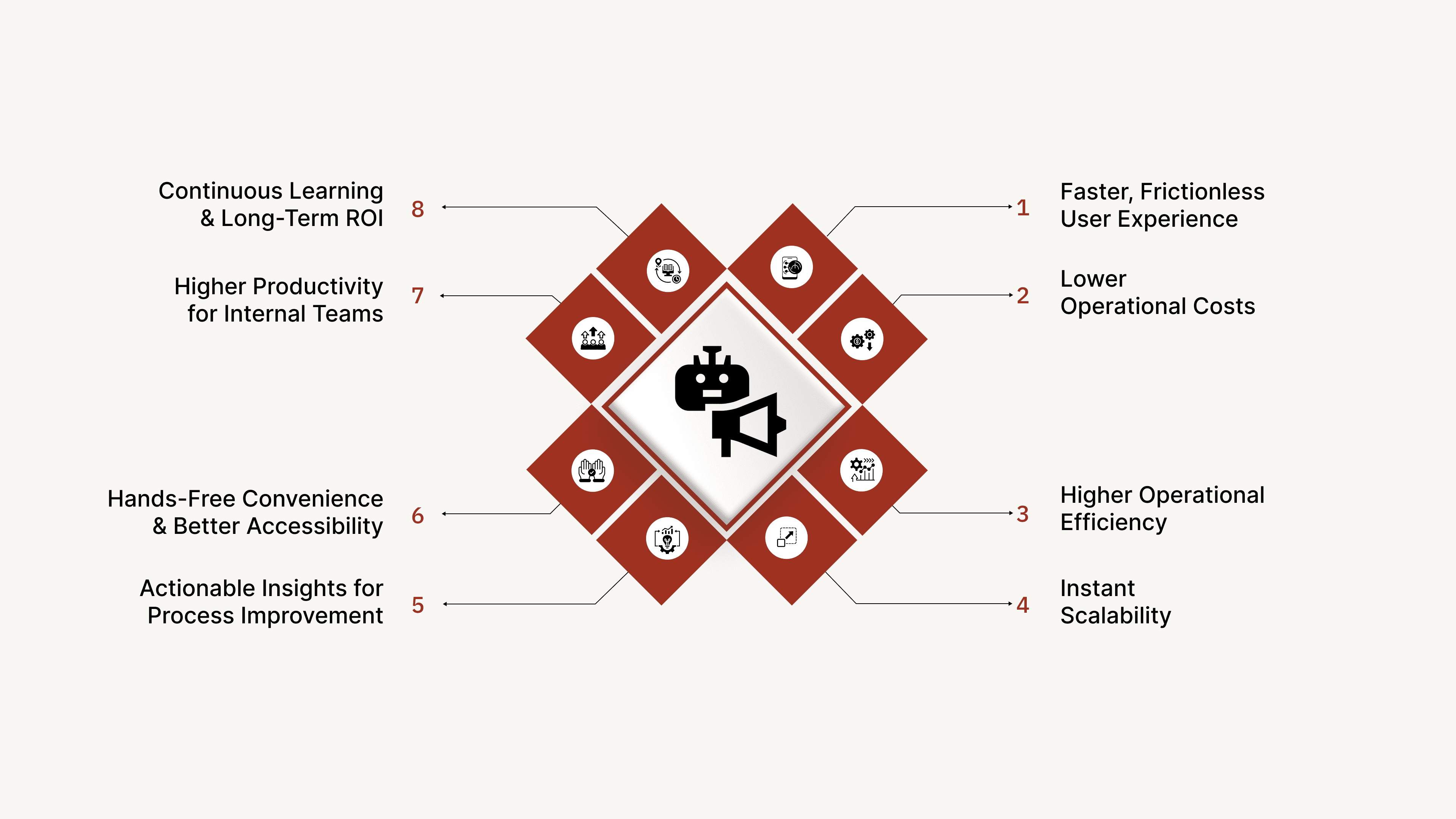
AI voice assistants deliver a powerful upgrade to how you manage high-volume, multilingual customer interactions. Below is a structured breakdown of their core advantages, enriched with quick insights.
1. Faster, Frictionless User Experience
AI voice assistants make every interaction smoother by eliminating wait times, offering natural conversations, and adapting to user intent.
What Makes It Valuable:
Instant, 24/7 responses
Fluent, human-like dialogue
Multilingual support for diverse Indian audiences
Why It Matters: Speed shapes perception. Faster responses directly improve satisfaction, reduce drop-offs, and strengthen trust.
2. Lower Operational Costs
Voice AI assistants handle repetitive tasks autonomously, significantly reducing the cost of serving every customer. The significant cost advantages originate from:
Lower hiring and training expenses
Reduced need for large call-center teams
Fewer escalations
Consistent performance without human variability
3. Higher Operational Efficiency
AI voice assistants bring discipline and accuracy to everyday operations. They follow predefined processes precisely. This ensures that every interaction stays compliant, every workflow stays aligned, and every user receives the same quality of support.
Efficiency Drivers:
Real-time access to policies and knowledge bases
Automatic updates to CRMs, ERPs, and OMS systems
100% script compliance for regulated sectors
Higher first-contact resolution (FCR)
Reduced follow-ups thanks to automated action-taking
4. Instant Scalability
One of the most business-critical advantages of AI voice assistants is their ability to scale effortlessly. Whether it’s festive shopping spikes, billing cycles, seasonal demand, or sudden surges, AI can handle large volumes without compromising quality.
Scaling Challenge | Human Teams | AI Voice Assistants |
|---|---|---|
Peak-hour capacity | Limited | Virtually unlimited |
Training time | High | Low |
Performance consistency | Varies | 100% steady |
Cost impact | Increases with volume | Predictable and optimized |
5. Actionable Insights for Process Improvement
Every interaction generates structured, analyzable data that helps enterprises identify patterns, inefficiencies, and unmet needs. These insights are often invisible in traditional call-center operations.
Typical Insights It Unlocks:
Identification of frequently asked queries
Clarity on user sentiments and roadblocks
Recognition of workflow bottlenecks
Accurate mapping of drop-offs and confusion areas
Insights to improve both product and service delivery
6. Hands-Free Convenience & Better Accessibility
Voice-first interaction eases access. Users who struggle with typing, small screens, complex menus, or limited literacy can interact naturally by speaking. This makes engagement far more inclusive. Here are the primary accessibility benefits:
Hands-free operation is ideal for multitasking.
More straightforward navigation for elderly or differently-abled users
Supports users with literacy, mobility, or language challenges
Smooth onboarding for first-time digital users
Why It Matters: India’s digital user base is diverse, with over 50% of internet users expected to use voice assistants by 2026. Voice removes the barrier of “tech intimidation,” opening digital access to millions.
7. Higher Productivity for Internal Teams
When AI voice assistants handle repetitive internal queries, your employees gain uninterrupted time for high-value work. This improves team morale, strengthens focus, and increases overall efficiency. That, in turn, translates to the following productivity gains.
Fewer HR/IT/ops tickets
Reduced interruption-driven fatigue
Faster internal self-service
Higher employee satisfaction
8. Continuous Learning and Long-Term ROI
AI voice assistants improve over time. With continuous updates, reinforcement learning, and real-world data, they become more accurate and capable, without additional infrastructure investment. Here are the long-term advantages:
Better performance with every interaction
Lower long-term maintenance and ownership costs
Future-ready upgrades built into the system
No costly hardware replacements
Key Takeaway: AI’s learning curve means you get compounding value. Systems become smarter while costs remain stable.
With these advantages established, the next step is understanding how AI voice assistants create real impact in day-to-day enterprise operations.
Unlocking Value Across Industries: The Most Powerful Applications
As voice AI becomes integral to enterprise operations, its role varies significantly across industries. Here’s how different businesses use it to drive real impact, along with broader applications that benefit teams across sectors.
A. Sector-Wise Applications
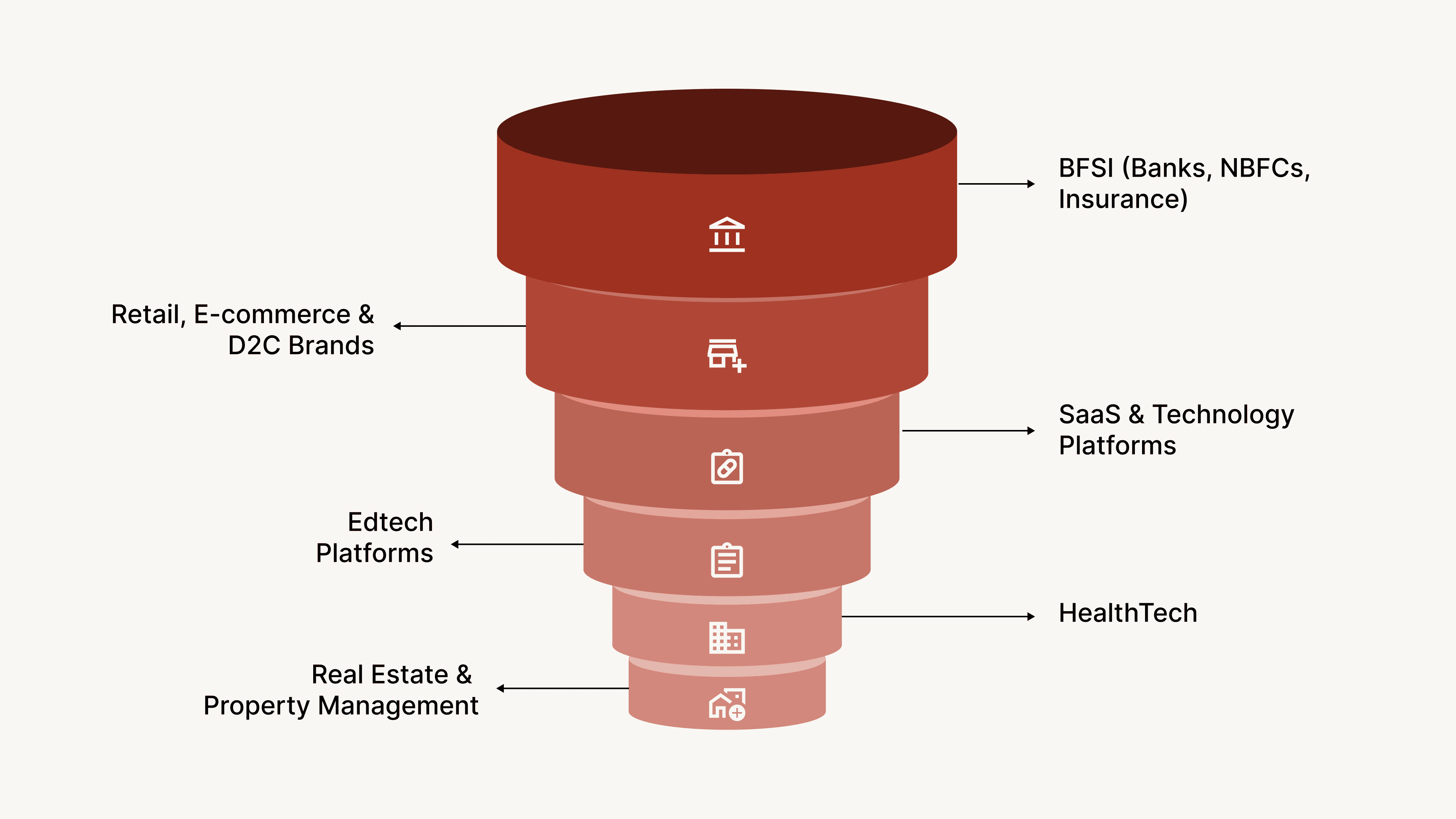
1. BFSI (Banks, NBFCs & Insurance)
Voice AI supports BFSI institutions by automating a significant portion of customer communication tied to payments, verification, and account management. These include:
Automated EMI reminders with PTP (Promise-to-Pay) capture
Loan status updates, balance inquiries, and account information
Premium renewal reminders and policy explanations
Fraud alert verification and customer authentication
Example: A major NBFC may use AI voice assistants to deliver pre-due reminders in multiple languages. That way, connect rates can increase significantly, improving recovery without additional call-center hiring.
2. Retail, E-commerce & D2C Brands
Retail brands with high order volumes benefit from AI voice assistants that simplify pre- and post-purchase communication and reduce repetitive support calls.
Core Applications:
Instant order tracking and delivery updates
COD confirmation calls to prevent losses
Returns initiation and refund status updates
Voice-powered product discovery and reordering
Peak-season surge handling without extra staff
Upsell/cross-sell based on purchase behavior
Also Read: How Voice Assistants Enhance Delivery Updates for Businesses?
3. SaaS & Technology Platforms
SaaS companies rely on fast onboarding and smooth product support to drive user adoption. AI voice assistants simplify complex features, guide users through key actions, and much more.
Use Cases:
Voice-first onboarding walkthroughs
Instant feature explanations and product help
Software troubleshooting and account support
Subscription/renewal reminders
Ticket creation and routing automation
Example: A CRM SaaS platform can integrate a voice assistant to handle “How do I…?” queries, reducing L1 ticket volume and improving product adoption.
4. Edtech Platforms
Edtech platforms experience massive spikes in engagement during admissions, exams, and course enrollments. AI voice assistants help manage this load, ensuring students receive the guidance right when they need it.
Admission and enrollment guidance
Automated fee/assignment reminders
Class schedule and exam notifications
Student support FAQs
5. HealthTech
AI voice assistants support hospitals and clinics by automating appointment coordination, follow-up instructions, and patient updates. This improves care continuity while reducing administrative workload. Typical uses include:
Appointment booking, confirmation, and follow-ups
Pre- and post-procedure instructions
Prescription refill reminders
Diagnostic scheduling
Patient onboarding and helpline FAQs
Also Read: AI Voice Assistants in Healthcare: Key Use Cases
6. Real Estate & Property Management
Real estate businesses rely heavily on quick lead response and sustained follow-ups. AI voice assistants ensure potential buyers receive attention at the right moment, without too much manual effort from sales teams. Here's how:
Lead qualification and site-visit scheduling
Project updates and availability queries
Document checklist reminders
Follow-ups for high-intent buyers
B. General Enterprise Applications
Application Area | What the AI Voice Assistant Does |
|---|---|
HR Query Resolution | Answers queries about leave, payroll, policies, onboarding, and reimbursements. |
Finance & Procurement Assistance | Tracks expense reports, clarifies budget codes, starts PO requests, and explains finance rules. |
Internal Workflow Execution | Schedules meetings, retrieves data, logs CRM updates, fetches SOPs, and creates quick reports. |
Marketing Voice Campaigns | Runs personalized outbound campaigns and records user preferences. |
Voice-Based Feedback Collection | Collects NPS/CSAT feedback through natural voice interactions. |
These opportunities come with operational and technical challenges that you must address to ensure successful deployment.
Challenges in Implementing AI Voice Assistants
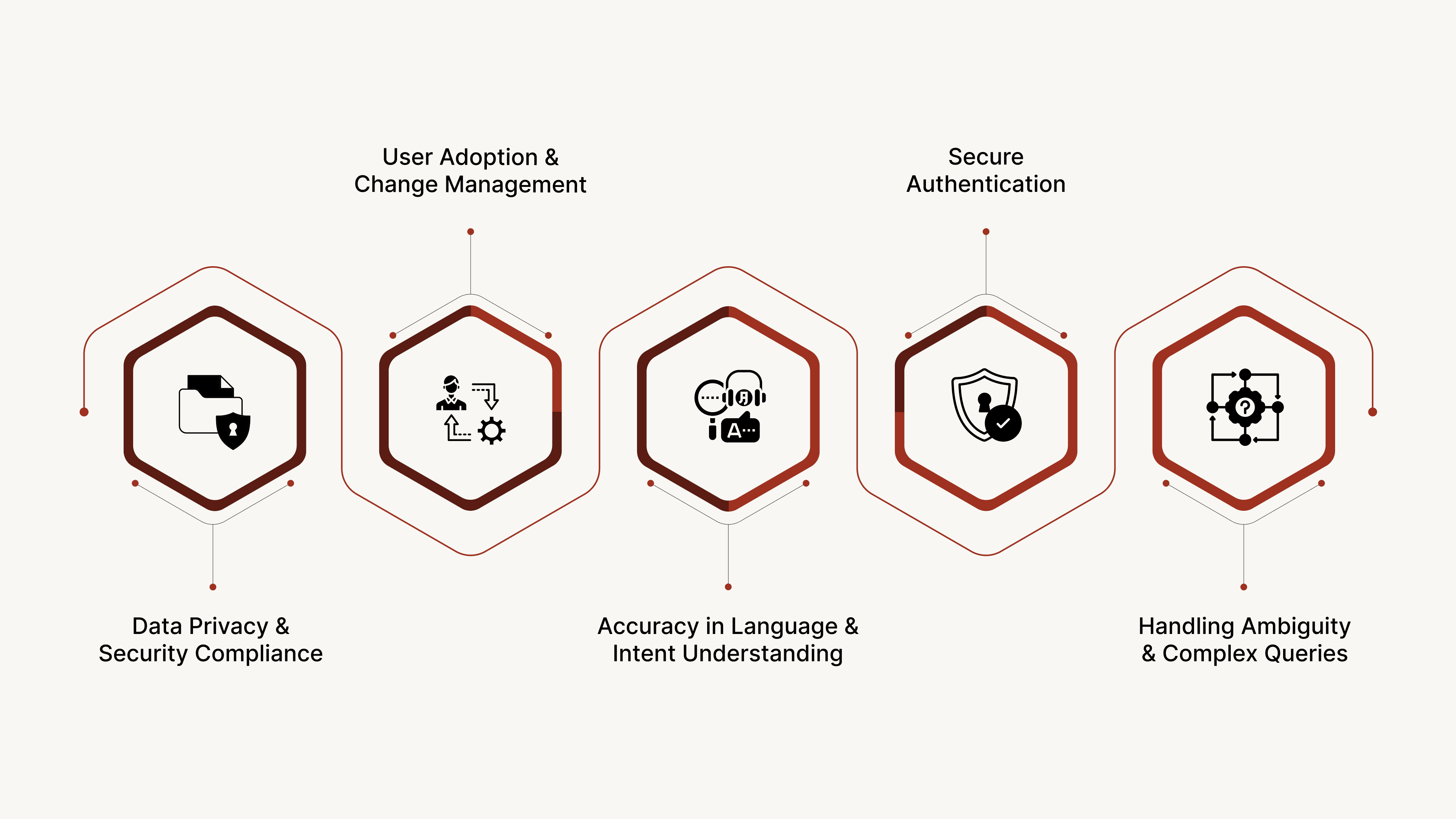
Achieving consistent, high-quality outcomes with voice AI means preparing for the challenges that come with deployment. The most important ones are:
Data Privacy & Security Compliance: Sensitive information, including financial details, health records, and employee data, must be protected with strong encryption, secure storage, and access controls. Also, if they don't comply with relevant regulations such as RBI/SEBI guidelines, you may face legal risks.
User Adoption & Change Management: Employees and customers may initially resist voice AI due to unfamiliarity or fear of losing human support. Transparent communication, onboarding guidance, and quick wins help boost confidence.
Accuracy in Language & Intent Understanding: Ensuring AI voice assistants correctly interpret accents, slang, regional nuances, and industry-specific terminology is a complex process. It requires ongoing NLU training, expanded datasets, and continuous monitoring to ensure conversational accuracy.
Secure Authentication: Voice interfaces require foolproof identity verification mechanisms, such as voice biometrics or OTP-based workflows, to prevent misuse and ensure frictionless authentication for legitimate users.
Handling Ambiguity & Complex Queries: AI systems must gracefully manage unclear or multi-layered questions and escalate to human agents when needed. Otherwise, users will get stuck in loops or receive irrelevant responses.
To overcome these barriers and unlock the full potential of AI voice assistants, you need a solution engineered for enterprise-grade complexity. That’s where CubeRoot comes in.
How CubeRoot Makes AI Voice Assistants Work for Modern Enterprise Needs
Rising call volumes, compliance demands, and diverse languages make voice automation challenging. CubeRoot closes this gap with an enterprise-grade Voice AI platform explicitly designed for India’s regulation-heavy environments. Here's how the platform helps you deploy voice automation that is faster, more reliable, and significantly more impactful.
GenAI-Powered Prompt Builder: CubeRoot’s GenAI prompt builder lets your teams design accurate voice workflows without technical complexity.
Emotion-Aware, Human-Like Voice Experiences: Our natural, expressive voice assistants reduce user friction and escalations, while in-call sentiment tracking guides timely interventions that significantly improve CSAT.
14-Day Implementation-to-Go-Live: With a no-code, API-first framework, you can launch production-ready workflows in under two weeks. This way, you can drive 50% faster ticket resolution and reduce support costs by up to 35%.
AI-Driven Insights for Continuous Optimization: Daily reports and analytics enable more thoughtful decisions, improving lead qualification speed by 65% and shortening sales cycles by up to 45% through data-backed refinement.
Enterprise-Grade Security and Compliance: With hosting on AWS, Azure, or GCP and ISO 27001 + SOC 2 readiness, CubeRoot ensures encrypted logs, role-based access, and privacy-first controls.
Smooth Integrations for Unified Workflows: It integrates with CRMs, ERPs, OMS systems, and dialers, ensuring AI and human agents share the same context for faster, more consistent resolutions.
Real-Time Transcription With AI Summaries: Every call is transcribed instantly, and AI-generated summaries highlight intent. This helps you review interactions and take proactive measures.
CubeRoot gives you complete visibility into interactions, sharpens response quality, and strengthens operational execution. If you're ready to reap the benefits of AI voice assistants for your enterprise, book a demo now and experience the platform in action.
FAQs
1. Can AI voice assistants integrate with legacy systems?
Modern voice AI platforms use middleware, APIs, and adapter layers to bridge data from legacy CRMs, custom ERP setups, and homegrown databases. This enables unified workflows without requiring upfront full-stack modernization.
2. How do we ensure AI voice assistants don’t miscommunicate during sensitive or compliance-heavy interactions?
Guardrails restrict responses to verified data and approved scripts. When confidence drops, the system triggers clarification or escalates to a human agent. This prevents incorrect interpretations in areas such as payments, medical queries, or financial disclosures.
3. How do these assistants manage noisy environments or poor audio quality?
Advanced acoustic models filter background noise, enhance speech clarity, and adapt to low-quality inputs. They also use contextual predictions to fill gaps in understanding, ensuring continuity even in noisy areas.
4. What are the infrastructure requirements for deploying enterprise voice AI?
Most solutions run on cloud infrastructure via APIs. You only need stable network connectivity and access to integration. No specialized hardware is required unless deploying on-premise for compliance-heavy use cases.
5. How do voice assistants maintain context when users pause, ramble, or rephrase questions?
They use context memory, intent prediction, and semantic mapping to track conversation flow. Even with interruptions or lengthy explanations, the system identifies relevant details and steers the conversation without losing direction.