Dec 31, 2025

How AI Voice Agents Power Upselling: Benefits, Use Cases & Setup
Upselling should be one of the easiest ways for brands to increase revenue, yet most teams struggle to do it consistently. Manual calling is slow, agents deliver uneven pitches, and outreach rarely happens at the right moment.
That’s a missed opportunity, especially when 72% of sales professionals report revenue growth from upselling and cross-selling strategies.
AI voice agents change this completely.
They call customers instantly, speak naturally, understand objections, and personalize offers using real CRM data. Whether it’s upgrades, add-ons, renewals, or bundles, these AI-driven conversations convert far better than traditional telesales efforts.
In this blog, we’ll break down why manual upselling is so challenging, how AI voice agents automate the entire process, high-impact use cases, and implementation steps.
At a glance:
Manual upselling is hard to scale because outreach is ignored, pitches vary by agent, and offers lack CRM-driven personalization.
Upsell voice agents automate these conversations by calling customers instantly, understanding intent, and handling objections naturally.
Personalization improves dramatically when AI uses real-time CRM or OMS data to tailor upgrades, add-ons, and plan recommendations.
AI completes the entire workflow end-to-end, including executing upgrades and logging outcomes back into the CRM for clean reporting.
CubeRoot makes upselling predictable and scalable with multilingual voice agents, deep integrations, and high-volume automated calling.
Why Upselling Is So Hard for Traditional Teams
Upselling is the practice of offering customers a higher-value product, plan, or add-on based on what they already own or intend to buy. When done well, it boosts revenue, improves customer satisfaction, and increases lifetime value.
But despite its importance, most brands struggle to execute upselling consistently through traditional sales or support teams.
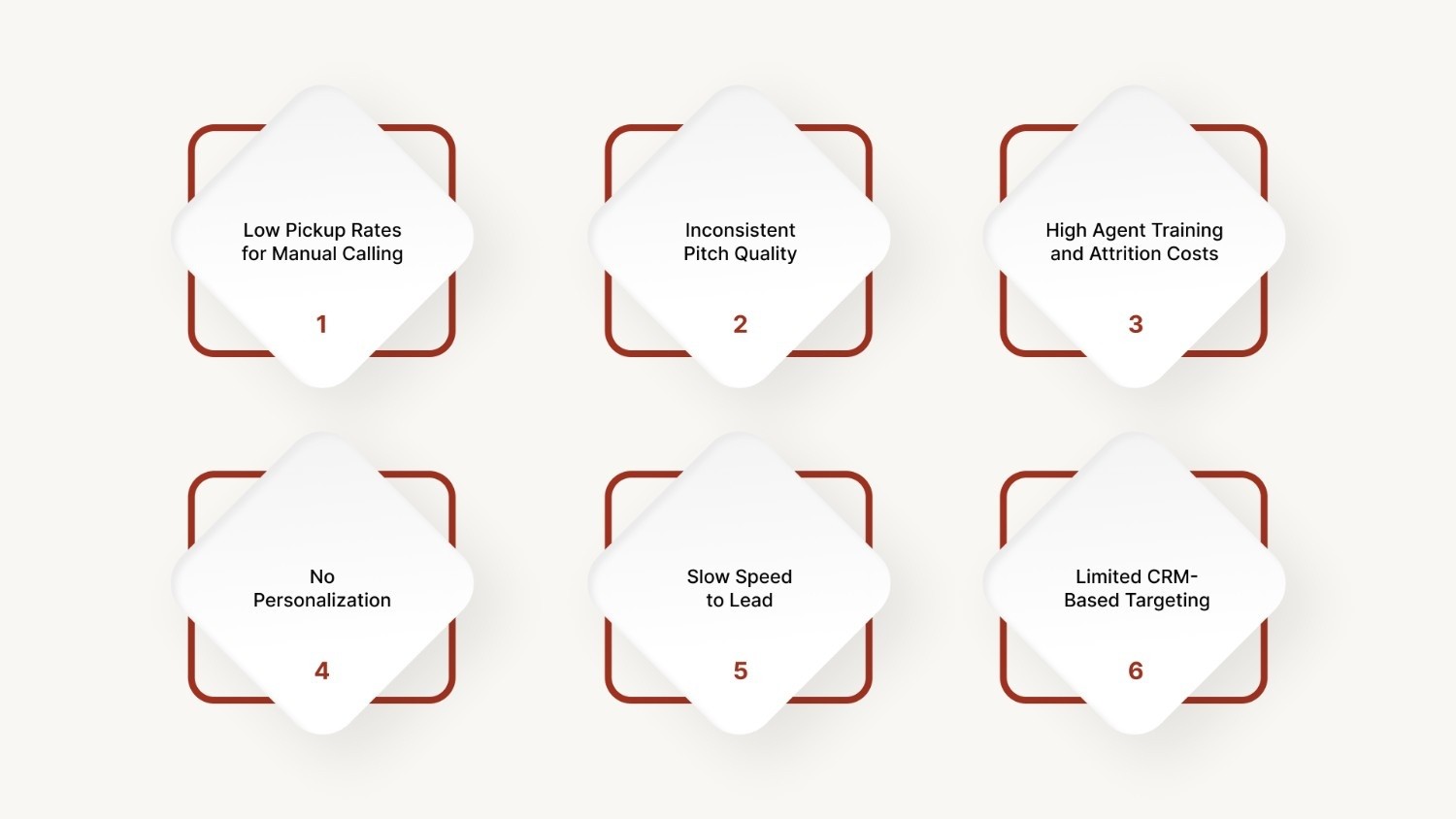
Here are the biggest barriers that make manual upselling difficult and unreliable:
Low Pickup Rates for Manual Calling: Customers often ignore unknown numbers or promotional calls, which means a large share of manual outreach never even reaches the customer.
Inconsistent Pitch Quality: Agents vary in tone, persuasion ability, product knowledge, and confidence. This inconsistency directly impacts conversion rates.
High Agent Training and Attrition Costs: Upselling requires well-trained reps, but training is expensive and ongoing, especially in high-churn environments like BPOs.
No Personalization: Most manual calls follow a generic script. Without CRM-driven context, the offer rarely matches the customer’s actual needs or purchase history.
Slow Speed to Lead: By the time an agent calls, the upsell window may already be gone. Slow follow-up kills high-intent opportunities.
Limited CRM-Based Targeting: Traditional teams struggle to identify who is likely to buy, what they should be offered, and when to reach out, leading to wasted effort and lower ROI.
These challenges explain why many brands try upselling, but few achieve a consistent, scalable revenue lift without automation.
What Is an Upsell Voice Agent?
An upsell voice agent is an AI-powered system that calls customers, understands their responses, and presents personalized upgrade or add-on offers through natural, human-like conversation. It automates revenue-focused interactions that traditionally depend on manual calling teams.
Unlike telecalling, IVR flows, or outbound dialers, an upsell voice agent can:
Understand open-ended customer responses
Handle objections dynamically
Adapt its pitch in real time
Complete the upgrade or add-on within the same call
An AI voice agent can interpret customer responses, handle objections, dynamically adjust its pitch, and complete the upsell workflow end-to-end.
The impact becomes even stronger when CRM or OMS data informs the conversation. The agent knows what the customer bought, when they purchased it, their usage patterns, and what they are likely to accept next, making upsell offers more relevant and successful.
Examples:
eCommerce: “You recently bought a phone. Would you like to add a 1-year protection plan?”
BFSI: “Your credit limit is eligible for an upgrade. Would you like to increase it?”
Subscription brands: “Your plan renews soon. Would you like to switch to an annual plan and save 20 percent?”
In short, an upsell voice agent automates revenue-focused conversations with accuracy, personalization, and scale that human teams alone cannot match.
How AI Voice Agents Automate and Improve Upsell Offers
AI voice agents streamline the entire upsell workflow from targeting the right customer to completing the purchase without manual calling or inconsistent pitches.
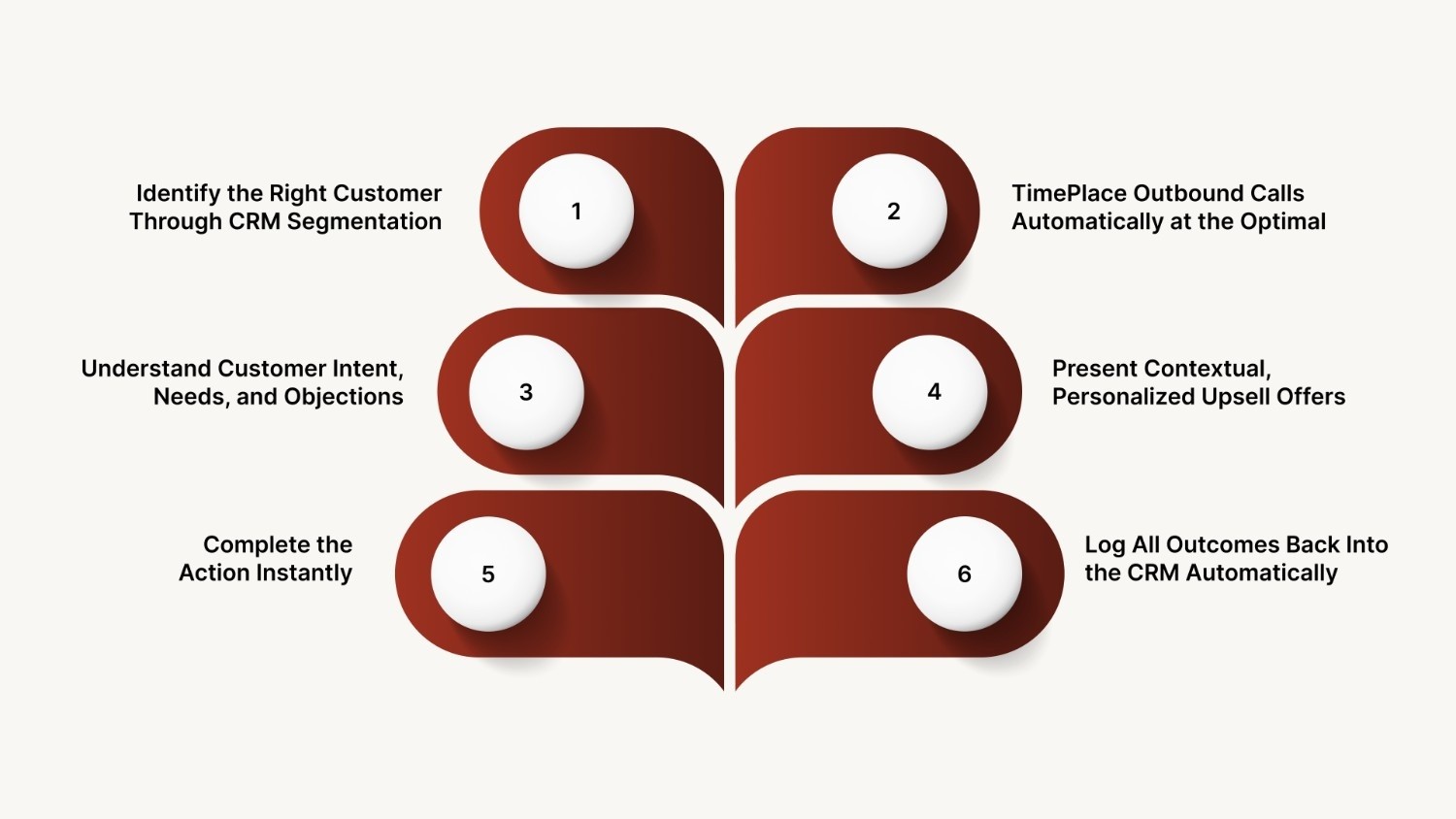
Here is how the process works end-to-end:
1. Identify the Right Customer Through CRM Segmentation
The system analyzes CRM data to pinpoint who is most likely to convert based on purchase history, product usage, payment patterns, renewal cycles, and past interactions.
2. TimePlace Outbound Calls Automatically at the Optimal
AI agents call customers autonomously using smart scheduling to increase pickup rates (e.g., post-delivery, pre-renewal, or after cart activity). No agent bandwidth is required, and thousands of calls can run in parallel.
3. Understand Customer Intent, Needs, and Objections
With advanced NLU, the AI listens, interprets objections, and dynamically adjusts the conversation. It can understand statements like:
“I don’t need it right now,”
“Is there a cheaper option?” or
“What is the difference between plans?”
4. Present Contextual, Personalized Upsell Offers
Using CRM insights and real-time context, the AI recommends the offer most relevant to the customer. For example, an AI voice agent can suggest, “I see you ordered running shoes last week. Would you like to add cushioned insoles at 20 percent off?”
This personalized messaging increases acceptance significantly compared to generic scripts.
5. Complete the Action Instantly (Upgrade, Add-On, Subscription)
Once the customer agrees, the AI executes the transaction by writing directly into the CRM, OMS, or payment system.
Customers do not need to switch channels or fill forms. The entire conversion happens within the call.
6. Log All Outcomes Back Into the CRM Automatically
Every call is documented, including:
Offer presented
Customer response
Objections raised
Final action taken
Sentiment indicators
Follow-up tasks if needed
This improves reporting accuracy and supports future personalization.
Also read: How Voice Bots Enhance Flash Sales Updates and Drive Conversions
Key Benefits of Using Voice AI for Upsell Offers
Upselling only works when timing, context, and execution align. AI voice agents do exactly this by combining automation, personalization, and real-time data to improve both conversion and operational efficiency.
Here are the biggest advantages you get:
Higher Conversion Rates: AI reaches the right customers with personalized offers, improving acceptance rates compared to manual calling.
Instant Outreach Without Agent Delay: Voice agents contact customers the moment a trigger occurs, such as post-purchase or pre-renewal, increasing relevance and timing.
Personalization at Scale: Every pitch is tailored using CRM history, purchase behavior, and customer segments, something human teams cannot do at volume.
Consistent Pitch and Compliance: AI delivers the same approved script, explanations, and disclosures every time, reducing errors and compliance gaps.
Lower Cost Than Human Campaigns: Automated outbound calls eliminate the cost of large telesales teams while allowing unlimited scale.
Real-Time CRM Updates and Reporting: All responses, outcomes, and objections are logged instantly, creating cleaner data and better forecasting.
When done well, Voice AI turns upselling from a manual, low-yield effort into a predictable revenue engine that runs at scale.
6 High-Impact Upsell Use Cases for AI Voice Agents
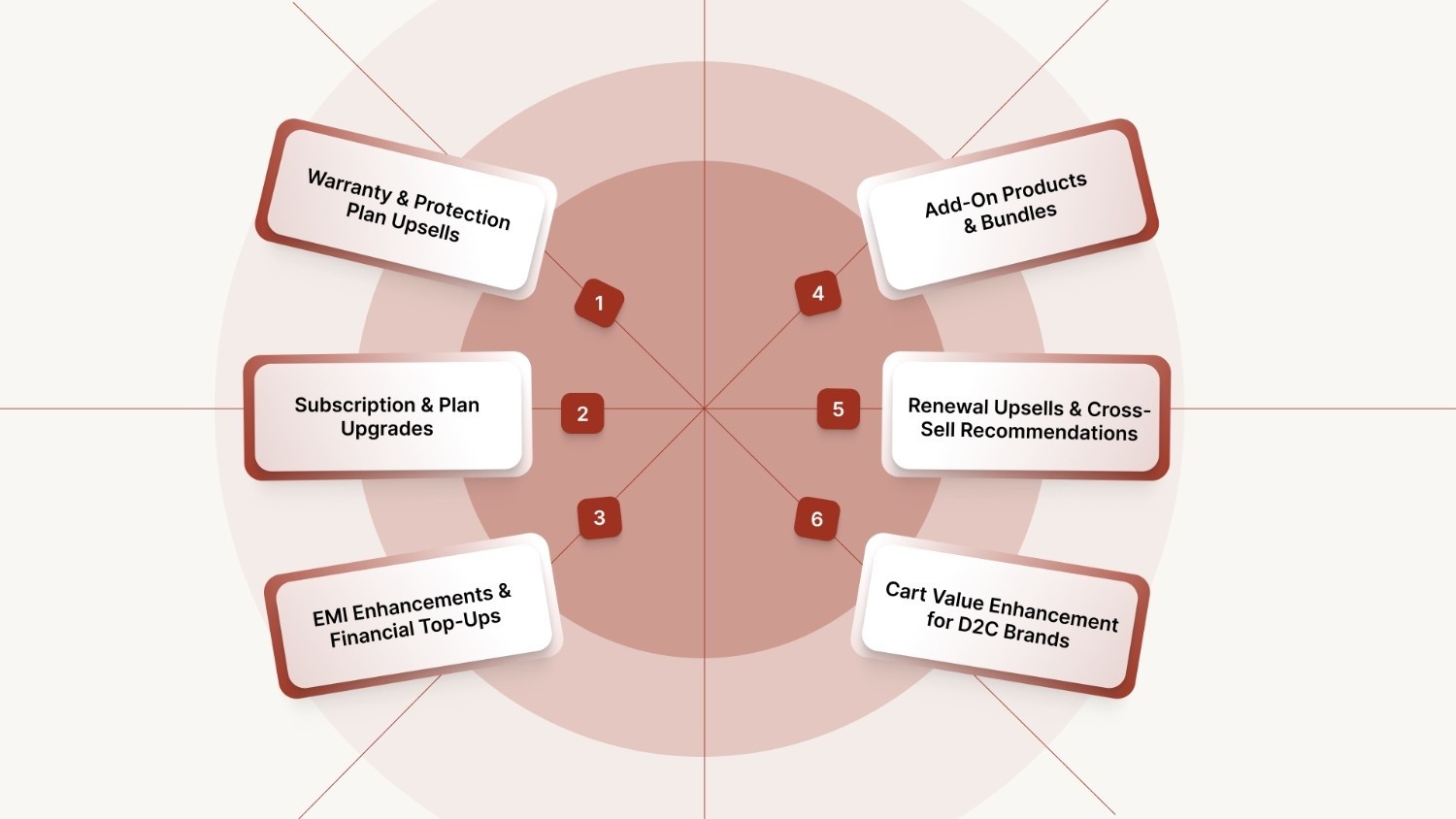
These are the real-world scenarios where AI voice agents consistently drive higher revenue and customer satisfaction:
1. Warranty and Protection Plan Upsells
AI voice agents automatically reach out after a high-value purchase, such as electronics, appliances, or gadgets, to offer extended warranties or accidental damage protection when customers are most receptive.
Why it works: The timing aligns with perceived risk, so customers see the offer as relevant and helpful.
2. Subscription & Plan Upgrades
For SaaS, telecom, OTT, and membership brands, AI reviews usage patterns and proactively calls customers with upgrade recommendations that match their behavior, such as hitting limits or requesting premium features.
Why it works: Customers view the upgrade as a solution to an immediate need rather than a generic sales pitch.
3. EMI Enhancements & Financial Top-Ups
Banks and NBFCs use AI to reach eligible customers with pre-approved top-up loans, credit line increases, or premium add-ons based on repayment history and risk scores.
Why it works: Offers feel personal and trustworthy because they reflect real eligibility and financial behavior.
4. Add-On Products & Bundles
eCommerce brands use voice agents to recommend accessories or complementary items right after purchase, such as a laptop sleeve for a laptop or a memory card for a camera.
Why it works: Suggestions relate directly to the customer’s purchase, making the upsell feel natural and useful.
5. Renewal Upsells & Cross-Sell Recommendations
Insurance, SaaS, OTT, and service brands rely on AI to remind customers before expiry and present higher-value renewal options or complementary services aligned with their usage or policy.
Why it works: Early outreach prevents lapses and positions the upsell as a logical next step.
6. Cart Value Enhancement for D2C Brands
Voice agents encourage customers to add items that help them unlock incentives such as free shipping or bundle discounts based on real-time cart value.
Why it works: Customers are motivated by savings, making these micro-upsells easy and effective for increasing order value.
How to Implement AI Voice Agents for Upsell Offers: A Practical Guide
Implementing upsell-focused voice agents is not just about deploying an AI bot. The real impact comes from aligning data, workflows, and timing. Here is a step-by-step framework to ensure your rollout delivers measurable revenue lift from day one.
Step 1: Define Your Upsell Triggers and Goals
Identify when an upsell should occur. Common triggers include post-purchase, pre-renewal, usage thresholds, eligibility updates, or new product drops. Set clear goals such as upgrade conversion, AOV lift, or attachment rate.
Step 2: Map Required CRM and Backend Data
Upsell accuracy depends on clean, accessible data. Ensure the voice agent can read and update fields such as purchase history, plan type, eligibility, usage patterns, renewal dates, and past declines.
Step 3: Train the AI on Real Customer Language
Use call logs and chat transcripts to teach the model how customers ask questions, express objections, or show buying intent. This improves natural conversation quality and objection handling.
Step 4: Build and Test Conversational Flows
Create pitch variations, objection responses, and action-driven paths for completing upgrades or add-ons. Test flows with real scenarios such as limited-time offers, product availability constraints, and multi-offer branching.
Step 5: Integrate with CRM, Billing, Payment, and OMS Systems
Ensure the voice agent can perform real actions such as upgrading plans, adding products, triggering payments, creating tickets, or updating subscription status. This is essential for closing the loop.
Step 6: Run a Controlled Pilot
Start with a small customer segment or one or two upsell workflows. Monitor conversion rate, call completion rate, offer acceptance, and customer sentiment to validate performance before scaling.
Step 7: Scale, Optimize, and A/B Test Offers
Iterate quickly by testing different scripts, timing, discount strategies, and customer segments. Use real-time analytics to refine targeting and pitch effectiveness.
With the right data, testing, and system integrations, AI voice agents become a predictable revenue engine that consistently drives higher conversions with minimal operational load.
Also read: Top AI Voice Assistants in 2025
How to Choose the Right AI Voice Agent for Upsell Automation
Selecting the right upsell voice agent comes down to how well the system understands customers, executes real actions, and fits into your tech stack.
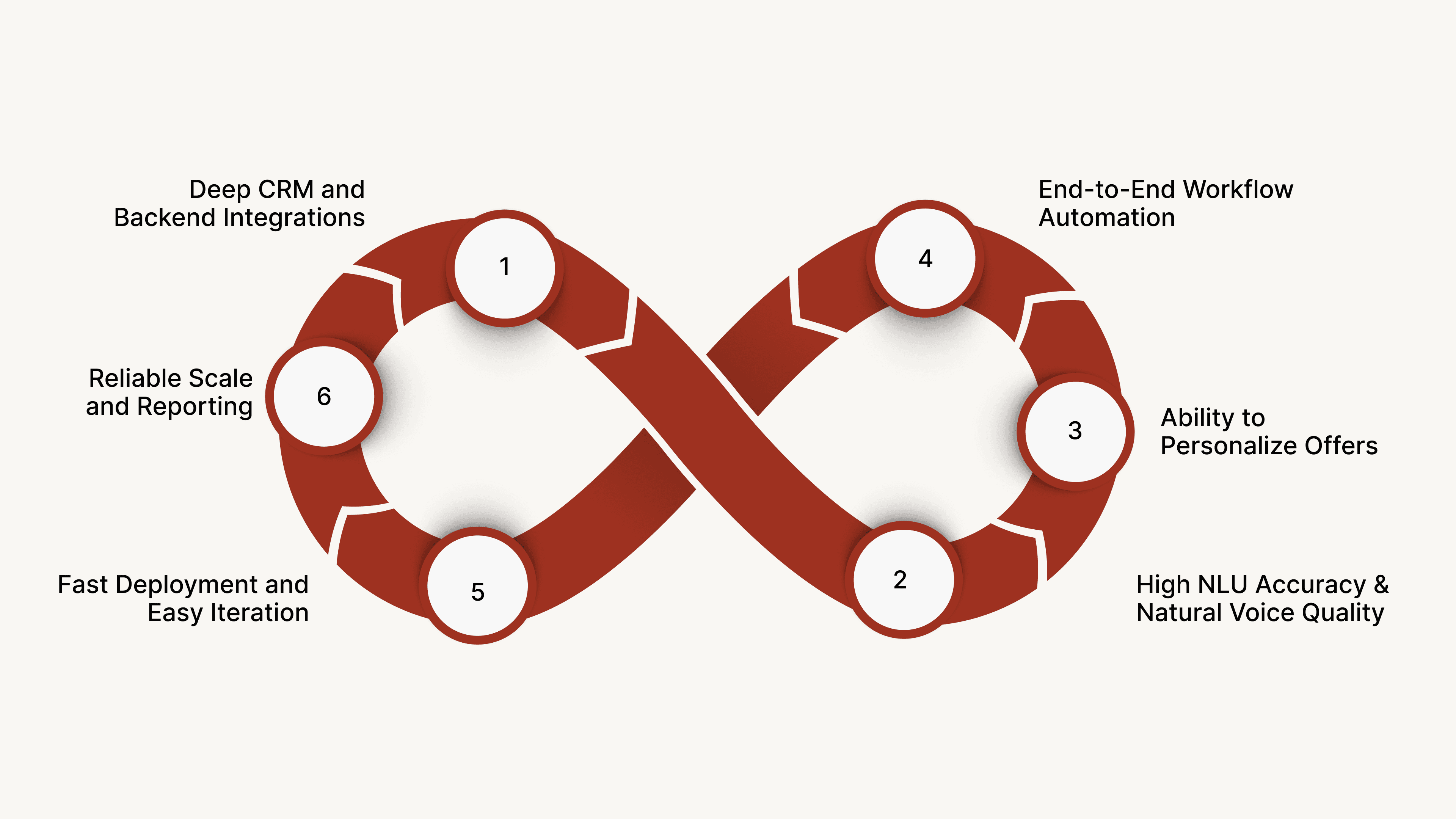
Focus on these six essentials:
1. Deep CRM and Backend Integrations
The platform must read and write customer data in real time and execute actions such as upgrades, add-ons, plan changes, and payments. Without this, the agent can talk but cannot convert.
2. High NLU Accuracy and Natural Voice Quality
Test how well the agent understands accents, mixed languages, informal speech, and objections. Strong NLU directly improves conversion and reduces frustration.
3. Ability to Personalize Offers Using Customer Context
Look for platforms that use purchase history, eligibility, usage patterns, and renewal cycles to tailor every pitch. Personalization is the core driver of upsell success.
4. End-to-End Workflow Automation (Not Just Conversation)
Choose a system that completes the upsell, triggers backend updates, sends confirmations, and logs outcomes automatically. Revenue impact comes from closed loops, not scripted dialogs.
5. Fast Deployment and Easy Iteration
Prioritize no-code or low-code tools that let teams launch new upsell campaigns quickly, A/B test scripts, and adjust offers without engineering delays.
6. Reliable Scale and Reporting
Ensure the platform can handle thousands of outbound calls with low latency and provides clear analytics on conversions, objections, drop-offs, and segment performance so teams can optimize.
A strong upsell voice agent is one that understands your customer, executes actions without friction, and delivers measurable revenue lift.
Use CubeRoot for Automated Upsell and Upgrade Workflows
CubeRoot is an enterprise-grade Voice AI platform built for brands that want to drive revenue through human-like, automated conversations. Our AI agents can speak naturally, understand intent, handle objections, and complete transactions while reading and writing live data into your CRM, OMS, or billing system.
Here are the key features that make CubeRoot ideal for upsell automation:
GenAI-Powered Prompt Builder: Create and refine upsell workflows quickly without engineering effort. Ideal for iterating scripts, objections, and offer variations.
Human-Like, Multilingual Voice Agents: Run natural conversations across English and major Indian languages with in-call sentiment detection for better persuasion and customer experience.
Deep CRM, Billing, and OMS Integrations: 150-plus ready connectors allow the agent to check eligibility, pull order history, verify usage, and complete upgrades or add-ons instantly.
Real-Time Transcription and Summaries: Every call is transcribed, summarized, and analyzed, improving reporting accuracy and compliance.
AI-Driven Insights and Daily Reports: Track offer acceptance, objections, drop-offs, and call outcomes to optimize campaigns continuously.
High-Scale Outbound Calling: Call thousands of customers simultaneously with smart scheduling and no dependency on agent bandwidth.
With CubeRoot, upselling becomes predictable, scalable, and fully automated — delivering measurable revenue lift without increasing team effort.
Ready to turn upselling into a revenue engine? Book a demo today.
FAQs
1. What is upselling in BPO?
In a BPO, upselling refers to offering customers a higher-value product, plan, or add-on during a support or sales interaction. Agents or AI voice agents use customer context to recommend upgrades that increase revenue and improve customer satisfaction.
2. What does an “upsell offer” mean?
An upsell offer is a suggestion to purchase a more valuable version of a product or service, such as an extended warranty, a higher-tier subscription, or an add-on item. The goal is to enhance the customer’s experience while increasing revenue per customer.
3. How do you upsell in a call center?
Traditional call centers upsell by training agents to identify opportunities, follow scripts, handle objections, and present personalized offers. Modern teams increasingly use AI voice agents to automate this process, which allows for faster outreach, consistent pitches, and data-driven personalization at scale.
4. Can AI voice agents really improve upsell conversions?
Yes. AI voice agents reach customers instantly, use real-time CRM data to personalize offers, handle objections consistently, and run high-volume campaigns without delays. This combination typically results in higher conversion rates compared to manual calling teams.