Dec 29, 2025
AI Voice Agents Implementation Considerations: Getting Deployment Right
AI is becoming the foundation of modern business, and voice is rapidly emerging as the most intuitive medium for customer and enterprise interaction. Voice AI promises scalability, consistency, and efficiency at a level traditional operations cannot match. Yet despite its growing relevance, adoption continues to fail far more often than it succeeds. The problem is not interest or investment; it is implementation.
There is no single failure point. For some organizations, the challenge lies in adapting legacy workflows to an AI-driven model. For others, integration complexity or fragmented data systems become the blockers.
In many cases, the expectations placed on early-stage automation do not align with the operational realities required to support it. Industry research reinforces this complexity: 65% of enterprises report compatibility issues with their existing AI stack, and 60% cite integration as a major barrier to voice AI adoption. These numbers illustrate that the struggle is multifaceted and global.
This blog aims to bring clarity to that landscape. We explore what is actually happening inside enterprise deployments, why voice AI adoption stalls, and which strategic, technical, and operational foundations determine success.
If the goal is not just to implement a voice agent but to ensure it performs, scales, and delivers measurable value, understanding these dynamics is the first step toward doing it right.
Key Takeaways
Voice AI fails not due to model limitations but because enterprises lack the data, workflows, and integration discipline required for real-world performance.
AI adoption challenges are multifaceted, like compatibility issues, poor internal adoption, talent shortages, and fragmented systems, which collectively derail outcomes.
A structured deployment lifecycle is essential; without precise scoping, accurate workflow mapping, and disciplined piloting, automation cannot scale reliably.
Continuous optimization, not one-time deployment, is what drives accuracy, consistency, and long-term ROI in Voice AI.
Implementation success accelerates when supported by platforms engineered for speed, stability, and integration readiness, exactly where CubeRoot provides a measurable advantage.
Why AI Implementations Fail: Understanding the Real Barriers Behind Adoption
AI adoption is accelerating, with 92% of companies planning to increase their AI investment over the next three years. Yet only 1% of leaders describe their organizations as truly mature in deployment, where AI is deeply integrated into workflows and consistently delivering measurable business outcomes.
The gap between ambition and execution is widening, and voice AI is no exception. Below are the core, multifaceted reasons for this failure.
1. Insufficient Proprietary Data
A significant barrier is the lack of high-quality, domain-specific data. According to IBM, 42% of organizations lack sufficient proprietary data to customize or fine-tune models. When the training dataset lacks real-world transcripts, intent variations, or workflow examples, voice agents struggle to interpret requests accurately.
This often leads to misclassifications, repetitive clarifications, or incorrect responses. For instance, a bot may repeatedly ask for details that have already been provided because it has never been trained on that conversational pattern. This is not a model problem; it’s a data readiness problem.
2. Low Internal Adoption and Weak Workflow Integration
Even when AI systems are deployed, they rarely evolve without active human interaction. PwC reports that 68% of organizations say half or fewer of their employees use AI tools in daily work. When teams bypass the system, fail to document edge cases, or do not update workflows, the AI remains static and immature.
Operational teams may revert to manual handling because early versions feel incomplete, but this lack of engagement prevents the AI from improving. The system stays in “pilot mode” indefinitely because real-life feedback never reaches it.
3. Shortage of Skilled Implementation Talent
AI deployment requires specialized expertise across conversation design, systems integration, ML ops, and domain logic. But Statista notes that 50% of businesses cite the lack of skilled professionals as their biggest AI adoption challenge.
Without the right talent, integrations break, conversation flows remain rigid, and optimization cycles never occur. A voice agent might technically “go live,” but it cannot scale or adapt because no one is equipped to refine it. The result is a system that works only in controlled conditions, not in production environments.
4. The GenAI Divide: High Investment, Minimal Return
Despite $30–40 billion in enterprise investment, 95% of organizations report no measurable ROI from GenAI initiatives. Only a small group, roughly 5%, converts pilots into operational value.
The divide is not driven by model quality or regulatory limits. It is driven by an approach: unclear ownership, rushed deployments, disconnected pilots, and a lack of integration discipline.
This same pattern shows up in voice AI projects, where powerful models fail simply because they are not linked to the systems, data, and workflows that make automation usable.
5. Fragmented Systems and Unrealistic Expectations
Many businesses attempt to deploy AI onto stacks that were never designed for real-time automation, like legacy CRMs, partial APIs, siloed data, or inconsistent identifiers across systems.
When the voice agent cannot fetch real-time information or update records accurately, it appears “inaccurate,” though the model itself is not at fault.
Compounding this, organizations often expect full automation before establishing exception handling, escalation paths, and ongoing tuning processes. When reality does not match expectations, trust erodes and adoption stalls.
5 Key Components of AI Voice Agent Deployment
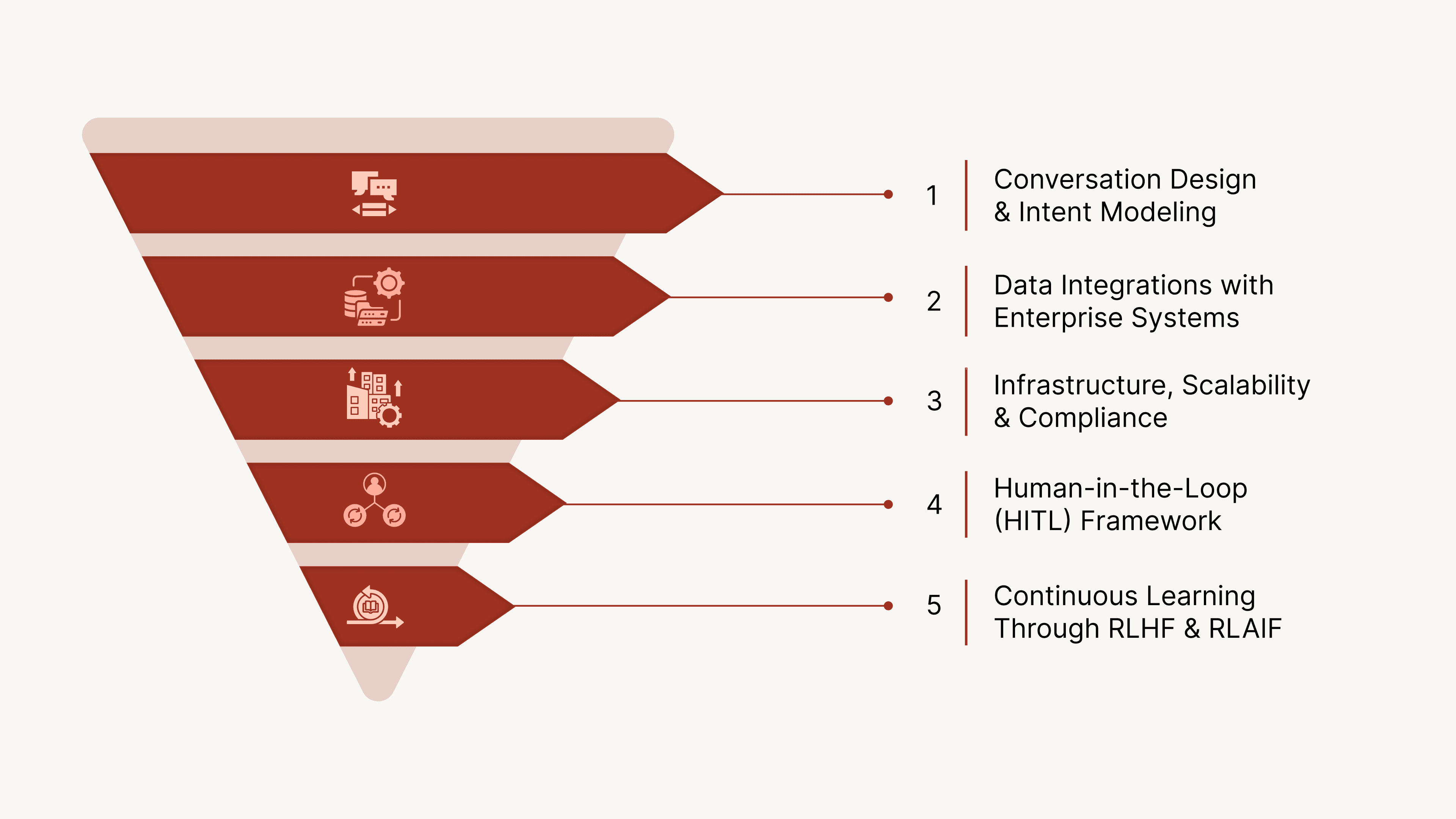
Deploying a production-grade AI voice agent requires far more than a well-trained model. It demands alignment across conversation design, data systems, infrastructure, compliance, and human oversight.
The components below form the essential backbone of any enterprise-grade deployment.
1. Conversation Design & Intent Modeling
Domain-trained workflows built around real customer scenarios.
Clear intent hierarchies and sub-intents for predictable routing.
Multilingual scripting with natural variations in phrasing.
Handling interruptions, confirmations, and edge-case phrasing.
Compliance-driven dialogue patterns for regulated workflows.
2. Data Integrations with Enterprise Systems (CRM, ERP, LOS, OMS, HIS, LMS)
Real-time API connections to fetch and update customer records.
Stable, secure data exchange ensuring accuracy across touchpoints.
Unified data formats to avoid mismatches or failed queries.
Authentication flows that validate customer identity instantly.
Write-back capabilities for accurate logging and workflow completion.
3. Infrastructure, Scalability & Compliance
Parallel call execution for high-volume inbound and outbound traffic.
Low-latency response pipelines to maintain natural conversation flow.
Horizontal scaling during peak demand periods.
Encryption, role-based access, and audit trails for compliance.
Infrastructure resilience to telephony, network, or API failures.
4. Human-in-the-Loop (HITL) Framework
Smooth handover to live agents when the AI reaches a point of uncertainty.
Supervisor dashboards to monitor interactions in real time.
Logging for root-cause analysis and training improvements.
Flexible escalation paths based on sentiment, complexity, or risk.
Human review loops to refine scripts and resolve edge cases.
5. Continuous Learning Through RLHF & RLAIF
Reinforcement learning driven by human feedback.
Automated retraining pipelines based on real conversation outcomes.
Intent drift monitoring to detect shifting customer behaviors.
Error detection to identify misclassifications and false positives.
Ongoing tuning of dialogue flows, prompts, and fallback strategies.
When these components are engineered together, voice agents perform reliably and scale across complex workflows. When even one layer is weak, automation breaks down, accuracy drops, and the system fails to deliver value.
Deployment Phases of AI Voice Agents (End-to-End Lifecycle)
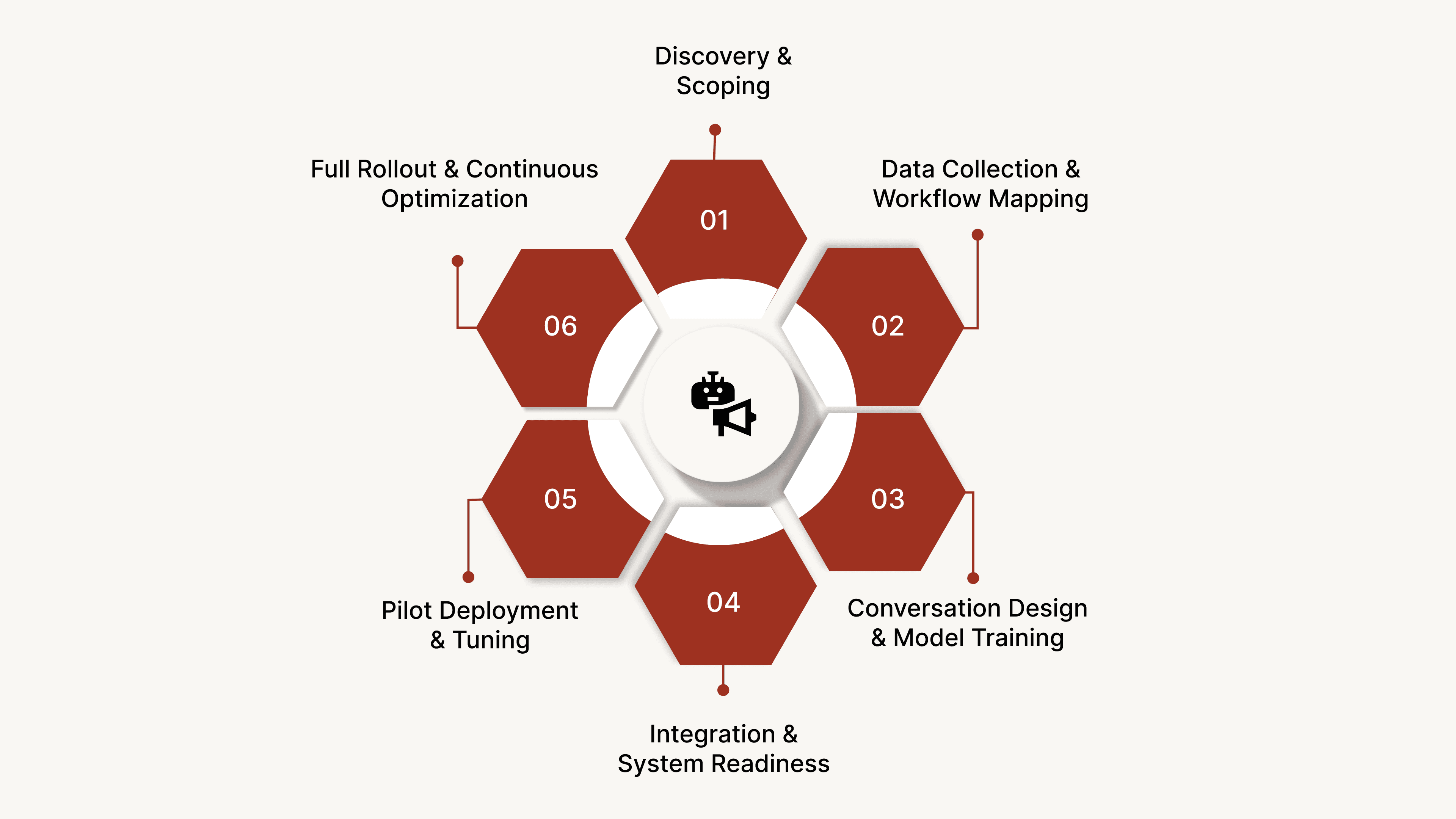
Implementing an enterprise-grade voice AI system requires a structured, multi-phase approach that moves from discovery to integration, pilot testing, and full-scale rollout. Each phase builds on the previous one, ensuring the voice agent is aligned with business goals, supported by clean data and robust integrations, and capable of handling real production workloads.
Without a disciplined lifecycle, deployments become fragmented, underperforming, or unable to scale. The following phases outline the complete journey from initial scoping to continuous optimization and provide the operational steps needed to ensure a successful implementation.
Phase 1: Discovery & Scoping
This phase defines what the organization wants to achieve and why the voice agent is needed. Leaders clarify expected outcomes, the scope of automation, and the value the initiative must deliver. Strong scoping keeps the project focused and prevents teams from building features that don’t support real business impact.
Actionables:
Assess call volumes, peak periods, and automation opportunities.
Prioritize use cases based on value, feasibility, and urgency.
Identify compliance considerations and risk boundaries.
Establish ownership, roles, and decision-making structure.
Phase 2: Data Collection & Workflow Mapping
Every successful voice agent is built on an accurate understanding of current customer conversations. This phase uncovers how people actually interact with your business, what they ask, and how your teams respond. It ensures the AI reflects real-world behavior, not assumptions.
Actionables:
Gather transcripts, tickets, and call logs to understand core inquiry patterns.
Identify the most common reasons customers call and where they get stuck.
Map end-to-end workflows, including exceptions and escalation points.
Prepare structured examples the AI can learn from.
Phase 3: Conversation Design & Model Training
Here, the organization defines how the AI should speak, respond, and guide customers. This phase shapes the customer experience and determines how effectively the agent handles different situations. The focus is on clarity, consistency, and building trust in every interaction.
Actionables:
Design clear conversation paths for each use case.
Create multilingual and variant responses that reflect natural speech.
Decide where automation ends and where human support takes over.
Train and test the agent using real examples and edge cases.
Phase 4: Integration & System Readiness
This phase ensures the voice agent can actually perform the tasks customers expect. Without the right system connections, even a well-designed agent cannot deliver accurate answers or complete transactions. Readiness also includes ensuring reliability, security, and compliance.
Actionables:
Connect the agent to customer records, order systems, or account data.
Confirm the agent can retrieve and update information reliably.
Validate security, access control, and data-handling requirements.
Test the full workflow to ensure responses are timely and accurate.
Phase 5: Pilot Deployment & Tuning
A pilot is where theory meets reality. This phase reveals what customers truly say, how they react, and where the AI needs refinement. Pilots help organizations uncover issues early, adapt quickly, and build confidence before scaling.
Actionables:
Launch with a limited audience or a single use case.
Monitor how customers respond and where the agent struggles.
Adjust messaging, logic, and escalation points based on real interactions.
Review performance metrics to determine readiness for expansion.
Phase 6: Full Rollout & Continuous Optimization
Once validated, the system is rolled out more broadly. The goal is to scale responsibly, ensuring the agent remains accurate, reliable, and aligned with evolving business needs. Continuous improvement keeps the AI effective as customer behavior, policies, and workflows change.
Actionables:
Increase coverage gradually, expanding to more users and use cases.
Track KPIs such as containment, response accuracy, and customer satisfaction.
Regularly review transcripts to identify opportunities for improvement.
Update responses and logic to match new business rules or exceptions.
Capture failure cases and rapidly retrain or adjust conversation flows on a weekly cadence.
Related: What Is Voice AI and How Can It Transform Customer Engagement?
Measuring Success & Optimization Framework
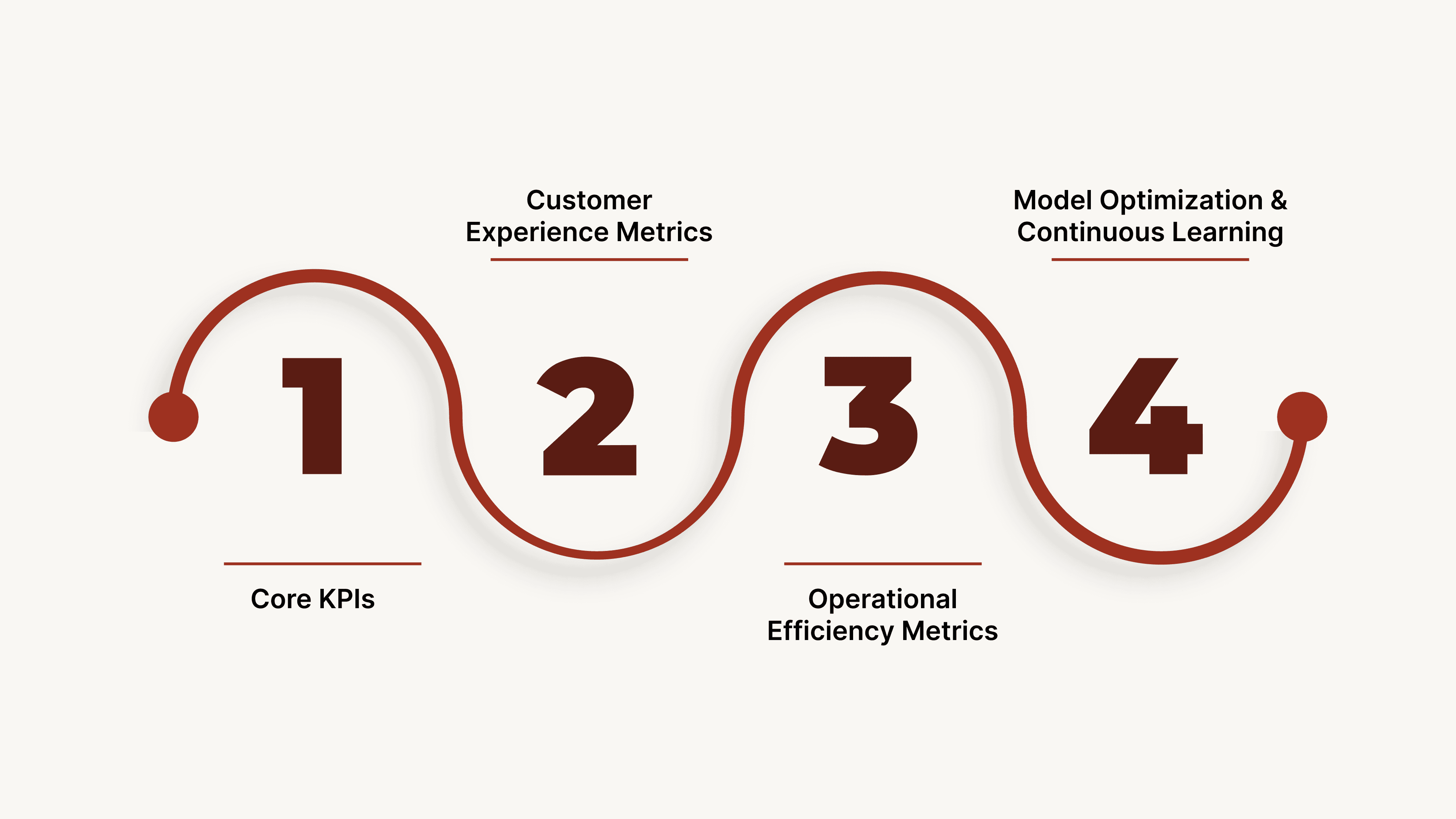
Measuring the performance of a voice AI system is essential, not only to justify the investment but to ensure the agent remains accurate, efficient, and aligned with evolving customer needs.
The metrics below form a comprehensive framework for evaluating both the operational impact and customer experience of your voice AI, while the optimization cycle ensures the system continues to learn, adapt, and deliver value at scale.
Core KPIs
These metrics assess whether the AI is actually doing the intended work and reducing human effort. They serve as the primary indicators of automation effectiveness.
Containment Rate: Percentage of calls resolved fully by the AI without human intervention.
Pickup Rate: How often outbound calls are answered. A key metric for reminders, confirmations, and collections.
Recovery %: For financial workflows, the improvement in collections or commitments attributed to AI-led outreach.
Average Handling Time (AHT): How efficiently the AI manages customer queries compared to human agents.
Escalation Percentage: The rate at which calls transfer to humans; high levels signal gaps in logic or training.
Customer Experience Metrics
These indicators reflect how customers feel about interacting with the voice agent, critical for adoption, trust, and brand perception.
CSAT / NPS: Customer feedback scores showing satisfaction and likelihood to recommend.
Voice Sentiment Analysis: Real-time assessment of stress, frustration, or positive engagement throughout the call.
Resolution Clarity: Whether customers leave the interaction with a clear understanding of next steps or outcomes.
Drop-off Rate: How often customers abandon the call mid-conversation.
Operational Efficiency Metrics
These metrics help leaders quantify the cost benefits and operational improvements achieved by automation.
Cost per Call: Direct cost reduction compared to human-led interactions.
Agent Productivity Lift: How much human agent capacity is freed up for complex tasks?
Volume Shift: Percentage of routine inquiries moved from human queues to AI.
Error Reduction: Decrease in repeat calls caused by misinformation or inconsistent handling.
Model Optimization & Continuous Learning
A voice AI system must evolve with customer behavior, business rules, and environmental changes.
Weekly Drift Checks: Detect shifts in how customers phrase queries or changes in intent patterns.
Reinforcement Feedback Loops: Improve performance using real-world interactions, corrections, and supervised feedback.
Error Case Mining: Identify and fix misclassifications, incomplete flows, or conversation dead-ends.
Script & Logic Refresh: Update dialogue paths to match new products, policies, or regulatory requirements.
Performance Tuning: Regular adjustments to latency, routing, escalation, and threshold settings.
Also read: Top AI Voice Assistants in 2025
How CubeRoot Reduces Implementation Challenges
Most Voice AI initiatives fail because implementation is slow, complex, and dependent on fragmented systems. CubeRoot is built to eliminate these barriers.
By combining a proprietary voice tech stack with pre-trained industry workflows and 150+ out-of-the-box integrations, CubeRoot enables enterprises to deploy reliable, human-like voice agents quickly and scale them without operational friction.
Key Features That Reduce Implementation Risk:
14-Day Deployment Framework: Move from concept to full go-live in as little as 14 days. Build the agent’s personality, train it on your internal knowledge, integrate it with existing systems, and scale through real-time monitoring and continuous optimization.
GenAI-Powered Prompt Builder: Build and refine use cases quickly without heavy technical effort.
In-Call Sentiment Tracking: Instantly understand customer sentiment to reduce escalations and improve CSAT.
Daily Reports & AI-Driven Insights: Turn conversations into actionable intelligence and continuous optimization.
150+ Ready Integrations: Connect to CRMs, ticketing tools, databases, and internal systems from day one.
Multilingual, Human-Like Voice Engine: Natural, expressive conversations for inbound and outbound journeys.
Enterprise-Grade Security: ISO 27001, SOC 2, encrypted call logs, role-based access, and data sovereignty options.
If you’re looking to overcome integration challenges, accelerate deployment, and launch Voice AI that performs from day one, CubeRoot makes the transition seamless.
Request a Demo to connect with the CubeRoot Team
Conclusion
The journey to effective Voice AI isn’t defined by how advanced the technology is, but by how well it is implemented. The organizations that see results are the ones that approach it with structure, clarity in scope, disciplined workflow mapping, reliable integrations, and a commitment to continuous optimization.
When these fundamentals are in place, Voice AI becomes more than an automation tool; it becomes an operational advantage that scales conversations with consistency and precision.
For businesses looking to reach that level of maturity, the priority is no longer experimenting with AI; it’s adopting a deployment framework that removes friction, speeds up execution, and delivers measurable impact without disrupting existing operations.
This is the gap CubeRoot is designed to fill, enabling enterprises to move from intent to impact with a platform built for real-world conditions and rapid time-to-value.
If you’re ready to deploy a voice agent that actually performs in production, CubeRoot can help you get there. Connect Now.
FAQs
1. What’s the biggest misconception about implementing Voice AI in enterprises?
Many leaders assume Voice AI is primarily a technology decision. In reality, success depends more on aligning workflows, data access, and operational processes than on the underlying model itself. The misconception leads to underestimating the planning and orchestration required for meaningful results.
2. How long does it typically take for a Voice AI system to show measurable impact?
Most organizations begin seeing early indicators, such as reduced manual effort or improved resolution times, within the first few weeks after launch. Sustained impact, however, comes from continuous refinement as the system learns from real interactions.
3. Can Voice AI work alongside existing human teams without disrupting current operations?
Yes. When designed with clear escalation rules, Voice AI complements human teams rather than replacing them. It handles predictable, high-volume tasks, allowing human agents to focus on complex or sensitive interactions.
4. What type of conversations are ideal for Voice AI automation?
Voice AI works best with structured or semi-structured interactions like status checks, confirmations, reminders, scheduling, verifications, and other repeatable tasks. These allow the AI to deliver consistent outcomes while freeing human agents for higher-value work.
5. How do organizations maintain accuracy as products, policies, and customer needs evolve?
Accuracy is preserved through ongoing updates to content, workflows, and logic. Regular reviews of transcripts, performance metrics, and customer feedback ensure the voice agent stays aligned with the latest business requirements.