Dec 29, 2025

AI Agents in Property Sales Funnel: The New Blueprint for Conversions
Real estate operates on one of the most complex and leak-prone sales funnels. Buyers take weeks, often months, to move from interest to site visit to booking, and every delay or missed follow-up causes prospects to slip through the cracks.
With lead volumes rising from property portals and digital ads, sales teams struggle to keep pace, especially when 70% of their time is spent on non-selling tasks like CRM updates, manual reminders, and repetitive qualification calls.
In a market where buyers expect immediate clarity, not delayed callbacks, even a small gap in speed or consistency sends them to competing projects.
This is why AI agents are becoming foundational to modern real estate sales. By automating first contact, qualification, follow-ups, and site-visit management, AI plugs the funnel’s most significant leak points and frees sales teams to focus on closing.
This blog breaks down what a property sales funnel truly looks like, how AI-powered funnels work, the challenges of traditional manual workflows, and a step-by-step guide to building your own AI-driven sales engine.
Key Takeaways
Real estate funnels leak because of slow responses and missed follow-ups, not due to a lack of leads.
Sales teams lose productivity because 71% of their time goes to non-selling tasks. AI agents automate these touchpoints, enabling reps to focus solely on high-intent buyers.
AI-powered funnels outperform manual ones by delivering consistent qualification, nurturing, and site-visit management 24/7. This increases conversions across every stage.
AI only works in property sales when it’s trained on project data, integrated with the CRM, and aligned to structured cadences.
Developers who adopt AI gain a compounding advantage: more site visits, lower costs, and predictable bookings at scale.
What Is a Property Sales Funnel? (Simple Breakdown)
A property sales funnel is the structured path a buyer follows from initial inquiry to final booking. Unlike typical B2B or eCommerce funnels, real estate funnels are longer, more emotional, and highly information-driven.
Each stage requires precise timing, consistent engagement, and clear communication to prevent lead leakage.
1. Top of Funnel (TOFU): Lead Capture & First Contact
This is where buyers first express interest, through property portals, paid ads, social campaigns, referrals, or walk-ins. The goal at this stage is simple:
Capture the lead.
Respond instantly.
Qualify their intent, budget, location preference, and buying horizon.
2. Middle of Funnel (MOFU): Property Discovery, Nurturing & Site Visit Planning
Once a lead is qualified, they enter a phase of exploration. They compare units, ask questions, and evaluate multiple projects. Core actions in MOFU include:
Sharing property details, brochures, videos, amenities, and pricing.
Handling FAQs and objections.
Scheduling and reminding buyers about site visits.
Maintaining consistent follow-up across channels.
The objective is to build enough clarity and momentum for the buyer to commit to a site visit.
3. Bottom of Funnel (BOFU): Booking, Documentation & Follow-Through
This is the decision stage. Buyers need confidence, clarity, and support to move forward.
Typical BOFU workflows include:
Document checks and verification.
Booking assistance and payment nudges.
Final clarification on pricing, offers, or possession timelines.
Post-visit nurturing until closure.
The property sales funnel guides a buyer from curiosity → clarity → commitment through structured, timely touchpoints.
What Is an AI-Powered Property Sales Funnel?
An AI-powered property sales funnel uses intelligent voice and chat agents to manage every stage of the buyer journey, from first inquiry to final booking with speed, consistency, and personalization.
These AI agents engage prospects instantly across voice calls, WhatsApp, and webchat, qualify them in real time, nurture them with project information, and maintain structured follow-ups without missing a single touchpoint.
Unlike manual workflows, where response times vary, follow-ups get delayed, and sales teams are overloaded, AI agents keep the funnel active 24/7. They adapt messaging based on buyer behavior, learn from interactions, and ensure every prospect receives timely, accurate communication.
Here is a quick side-by-side view of how AI agents transform every stage of the property sales funnel compared to traditional manual workflows.
Aspect | Manual Sales Funnel | AI-Powered Sales Funnel |
|---|---|---|
First Response Time | Minutes to hours | 0–5 seconds |
Lead Qualification | Inconsistent, rep-dependent | Automated, structured & accurate |
Follow-Ups | Often missed or delayed | Never skipped; consistent cadences |
Site Visit Scheduling | Manual coordination | Automated scheduling + reminders |
Information Sharing | Slow, manual messages | Instant brochures, videos, FAQs |
Sales Team Workload | High (repetitive calls) | Low (AI handles routine tasks) |
Scalability | Limited by team size | Unlimited, parallel conversations |
24/7 Availability | No | Yes |
Conversion Visibility | Fragmented data entry | Real-time analytics & lead scoring |
Buyer Experience | Varies by rep | Consistent, fast, multilingual |
Challenges of a Manual Property Sales Funnel (and How AI Agents Solve Them)
The traditional property sales funnel breaks down not because teams lack skill, but because the funnel requires speed, consistency, and structured follow-ups at a scale human teams alone cannot sustain.
Below are the real bottlenecks that property developers and brokers face, paired with how AI agents resolve them.
1. Slow First Response Times → AI Provides Instant Engagement
Manual teams take minutes or hours to call back new leads, especially during high-volume periods. In real estate, that delay is often enough for a prospect to book a site visit with a competing project.
AI solves this by:
Responding within seconds across voice, WhatsApp, and chat.
Capturing intent while the buyer is still active.
Keeping leads warm before they drift to competitors.
2. Inconsistent or Shallow Lead Qualification → AI Uses Structured Filters
Sales reps often qualify leads differently, leading to poor prioritization and wasted follow-up effort.
AI solves this by:
Asking consistent qualification questions.
Capturing budget, location preference, configuration, and timeline automatically.
Routing only high-quality leads to sales reps.
Tagging cold leads for long-term nurturing.
3. Missed or Delayed Follow-Ups → AI Never Skips a Cadence
Human teams struggle to maintain perfect follow-through, especially when juggling hundreds of prospects.
AI solves this by:
Running automated follow-up sequences across multiple channels.
Delivering brochures, videos, and FAQs instantly.
Sending reminders for site visits, callbacks, and project updates.
AI maintains the momentum that keeps buyers interested.
4. Low Conversion From Site Visit Interest to Actual Attendance → AI Reduces Friction
Many prospects express interest but never show up due to forgotten appointments, unclear details, or hesitation.
AI solves this by:
Scheduling and rescheduling visits automatically.
Sending timely reminders and route details.
Clarifying common doubts before the visit.
The result: higher turnout and better-quality appointments.
5. Inconsistent Messaging Across Sales Teams → AI Ensures Uniform, Accurate Communication
Different reps often share different details, leading to confusion and lost trust.
AI solves this by:
Delivering standardized, project-approved information every time.
Ensuring buyers receive consistent pricing, offers, amenities, and possession timelines.
Reducing dependency on individual rep knowledge.
6. Limited Sales Team Bandwidth → AI Scales Without Limits
Sales teams cannot handle thousands of conversations simultaneously, especially during launch phases or heavy marketing cycles.
AI solves this by:
Managing unlimited parallel conversations.
Handling all repetitive tasks so reps focus on closing.
Keeping every lead engaged, even when human teams are busy.
Also read: Voice AI in Real Estate: Transforming Client Engagement
A Step-by-Step Guide to Building Your Own AI-Driven Property Sales Funnel
Real estate teams often start experimenting with AI, hoping it will instantly boost lead response and conversions, only to lose momentum within weeks. This usually happens for one reason: AI gets deployed like a generic tool, not as a structured sales engine. Without a clear funnel map, qualification rules, follow-up cadences, and CRM integration, even the best AI agents will underperform.
AI agents in real estate cannot be deployed the way generic GenAI tools are. Property sales have longer cycles, deeper buyer queries, and multiple decision triggers. Your AI agents must be trained, structured, and integrated into the sales funnel, not layered on top of it.
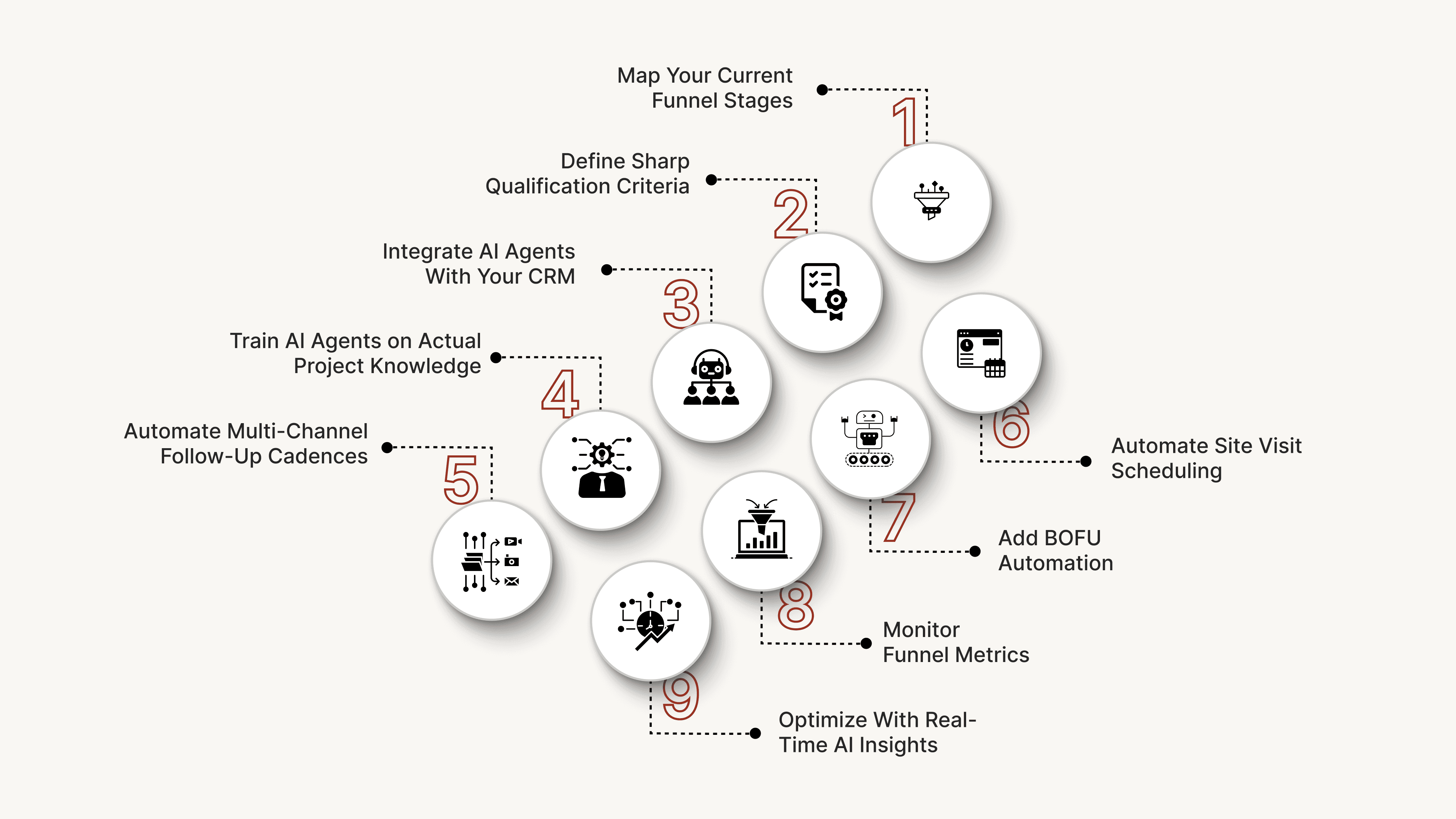
Below is a practical, real-world roadmap that shows exactly how to build an AI-powered property sales funnel that is consistent, scalable, and built for conversions.
Step 1: Map Your Current Funnel Stages (Identify the Real Leak Points)
Before adding AI, you need a clear view of where your funnel is breaking. This is where most AI deployments fail, as teams automate without knowing what to fix.
What to identify:
Portal leads that receive delayed callbacks.
WhatsApp/voice follow-ups that drop after Day 3.
Leads asking for details but never receiving them.
Low site visit attendance.
Post-visit silence from reps.
Booking-stage delays due to missing documents.
Example: A project receives 600 leads/week, but only 20% get contacted within 30 minutes. AI should be deployed exactly at this choke point for instant recovery.
Step 2: Define Sharp Qualification Criteria
AI agents must know what a serious buyer looks like. Without qualification rules, AI becomes a glorified receptionist.
Qualification filters to define:
Budget: ₹60–90L, ₹1–1.5Cr, etc.
Preferred unit: 2BHK, 3BHK, villa, plot
Location preference: close to school, near metro, etc.
Buying timeline: immediate / 30 days / 90 days+
Financing readiness: home loan required or not
Example: If a buyer says, “Budget under ₹50L,” and your project starts at ₹80L, the AI routes them into a long-term nurture bucket instead of wasting rep bandwidth.
Step 3: Integrate AI Agents With Your CRM (The Heart of the Funnel)
If AI is not connected to your CRM, your funnel is already broken. AI needs live data to know who to call, message, nudge, or escalate.
Integrate with:
LeadSquared
Salesforce
NoBroker CRM
HubSpot
Custom ERP/booking systems
Example: When a lead becomes "hot" (clicked brochure + asked for possession date), AI should instantly notify the rep and trigger a follow-up sequence.
Step 4: Train AI Agents on Actual Project Knowledge
AI must speak like your best sales rep.
Train AI on:
Project pricing, payment plans.
Floor plans, amenities, and USP.
Construction status and possession date.
Nearby landmarks, schools, and connectivity.
FAQs: car parking, upgrades, and registration costs.
Competitive differentiators.
Example: When a buyer asks, “Is the metro opening near your project?”
AI should respond with the correct milestone (e.g., “Phase 2 expected in Q4 2025”).
Step 5: Automate Multi-Channel Follow-Up Cadences
Most deals are lost between Day 2 and Day 10 due to inconsistent follow-up. AI eliminates this by running structured cadences.
Cadences for:
New leads: Instant reply → 5-min follow-up → Day 1 brochure → Day 2 call → Day 3 clarification
Warm leads: Daily nudges, FAQs, comparisons, offer reminders
Site visit confirmations: Time, map link, parking, checklist
Post-visit nurturing: “Which unit did you like?”, EMI calculator, documentation guide
Step 6: Automate Site Visit Scheduling (The Most Critical Conversion Stage)
AI should manage the entire site visit workflow:
Offer available slots.
Book the slot inside CRM.
Send reminders 24 hours & 2 hours prior.
Handle “Running late” responses.
Reschedule instantly.
Notify the sales rep.
Step 7: Add BOFU Automation (Document, Payment & Booking Support)
Most bookings fail here due to friction, confusion, or slow follow-up.
AI agents can:
Remind buyers to upload KYC documents.
Share payment links.
Explain the booking steps.
Send offer expiry reminders.
Escalate hot prospects to senior closers.
Step 8: Monitor Funnel Metrics
Track KPIs that show funnel health:
Average response time.
Qualification rate.
Brochure open rate.
Site visit conversion.
Post-visit engagement.
Booking rate.
Drop-off stage.
Example: If site visits are high but bookings are low, AI insights may reveal recurring objections like pricing, possession clarity, or loan delays.
Step 9: Optimize With Real-Time AI Insights
AI can reveal:
Common objections delaying bookings.
Best-performing follow-up timings.
Which unit types convert fastest?
What budget bands generate maximum bookings?
Which sales reps need support?
Related: Everything You Need to Know About AI Assistants
Challenges of Using AI Agents in the Property Sales Funnel (and How to Solve Them)
AI agents can transform the property sales funnel, but like any powerful technology, they come with trade-offs. These challenges don’t make AI ineffective; they simply need the right setup, training, and guardrails. Solving them early ensures your funnel runs smoothly and delivers consistent conversions.
Below are the most common challenges real estate teams face when deploying AI agents and the practical solutions to fix them.
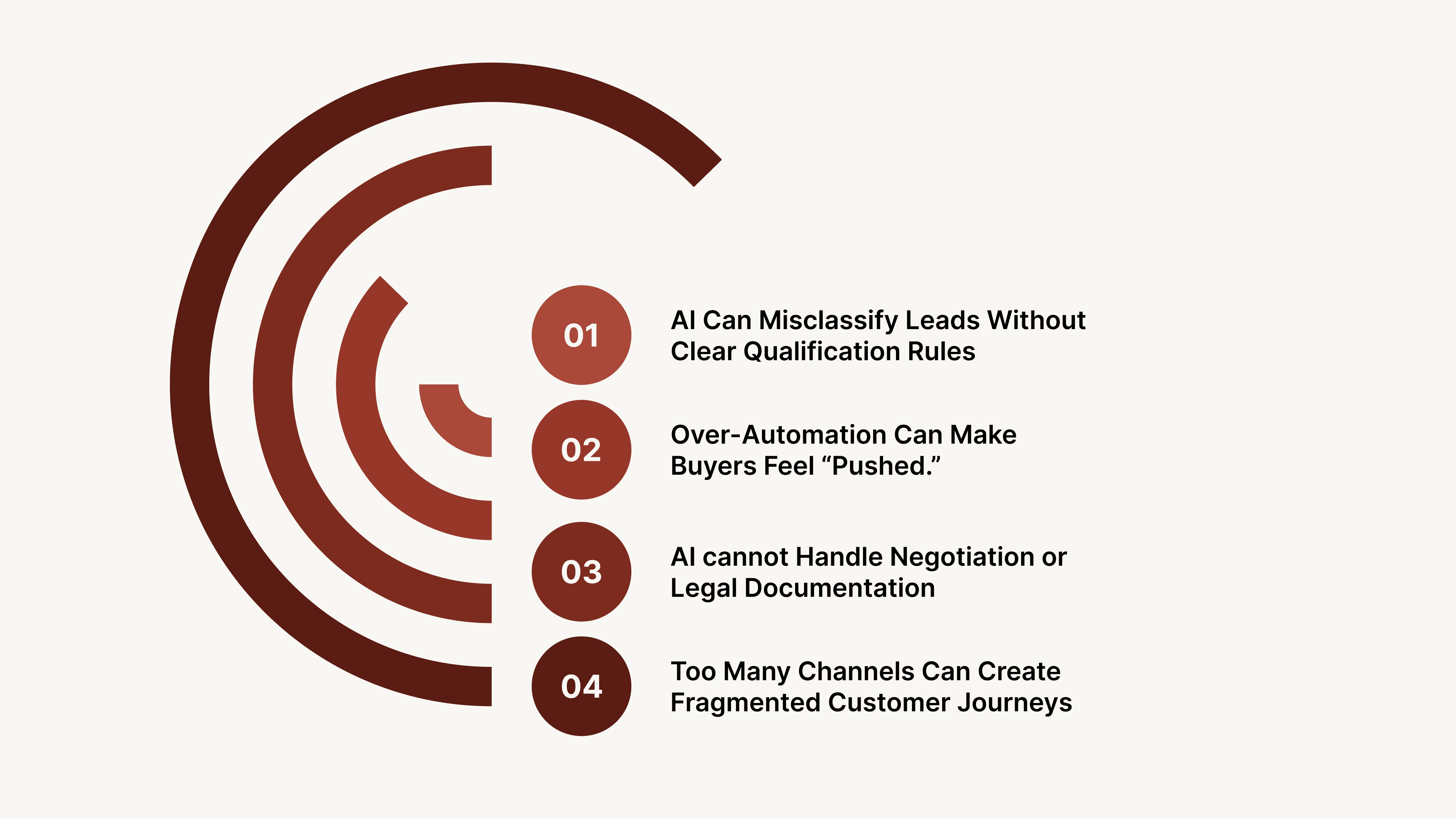
1. AI Can Misclassify Leads Without Clear Qualification Rules
If the qualification logic is vague, AI may tag serious buyers as cold or send low-intent leads to sales reps.
How to fix it:
Define budget bands, unit preferences, and buying timelines clearly.
Set thresholds for “hot,” “warm,” and “cold” leads.
Update rules as project demand shifts.
2. Over-Automation Can Make Buyers Feel “Pushed.”
Real estate decisions are emotional and high-ticket. Too many automated nudges can overwhelm or annoy buyers.
How to fix it:
Set sensible cadence intervals.
Personalize messages based on buyer behavior.
Add human handovers at key decision points.
Let AI reduce, not replace, trusted human interactions.
3. AI cannot Handle Negotiation or Legal Documentation
Buyers often want to negotiate pricing, request special offers, or clarify legal documents. AI cannot (and should not) close negotiations.
How to fix it:
Auto-transfer to senior sales when negotiation keywords appear.
Use AI only for documentation reminders, not explanations.
Allow AI to assist, not authorize, pricing decisions.
4. Too Many Channels Can Create Fragmented Customer Journeys
If AI engages on WhatsApp, voice, email, and SMS without coordination, buyers receive repeated or conflicting messages.
How to fix it:
Use a unified AI orchestration layer.
Maintain a single “conversation state” across channels.
Trigger communication based on buyer activity, not a fixed schedule.
Why Cuberoot Is the Ideal AI Agent Platform for Property Sales Funnels
Real estate funnels succeed when response speed, qualification accuracy, and follow-up consistency come together. Cuberoot’s Voice AI agents are built precisely for this environment: high lead volumes, multilingual buyers, long decision cycles, and intense competition.
If your goal is to improve site visits, accelerate bookings, and reduce sales team load, Cuberoot gives you the automation foundation to do it at scale.
Cuberoot’s AI capabilities are built for property sales:
3X faster lead response with instant voice/WhatsApp engagement.
80% boost in site visits through timely AI-driven reminders and follow-ups.
90% automated lead qualification available 24/7.
Pre-built templates for lead nurturing, site-visit flows, and post-visit cadences.
50+ out-of-the-box CRM integrations for rapid deployment.
Intelligent automated workflows for scheduling, reminders, FAQs, and call transfers.
ROI from Day Zero with go-live in 14 days.
Unlimited concurrent calls at 1/10th the cost of human agents.
Multilingual operation across Hindi, English, and additional languages.
Enterprise-grade reliability with automated QA, audit trails, and privacy controls.
Site Visit Qualification Agent optimized for discovery, intent capture, and visit conversion.
Cuberoot ensures every lead is contacted instantly, nurtured consistently, and guided through the funnel with zero drop-offs, freeing your sales team to focus on closing.
Ready to accelerate your property sales funnel? Book a Cuberoot demo and see how AI agents can triple response speed, boost site visits, and automate your entire buyer journey.
FAQs
1. Can AI agents handle multiple projects or phases at the same time?
Yes. AI agents can be trained with separate data sets for each project, tower, or phase. They can respond with project-specific pricing, amenities, availability, and timelines based on the lead source or CRM tagging, ensuring accuracy across the entire portfolio.
2. How does AI manage leads coming from channel partners and brokers?
AI can automatically greet, log, and qualify channel partner leads while maintaining tagging integrity. It ensures CP leads follow the same structured funnel, including instant response, qualification, and nurturing, while preserving attribution and commission tracking inside the CRM.
3. Can AI agents assist buyers after the booking stage?
Yes. AI can support post-booking workflows such as payment reminders, documentation checklists, construction updates, and milestone notifications. This reduces incoming support queries and enhances post-sales experience.
4. What happens if a buyer wants to interact with a human instantly?
AI agents can detect signals like urgency, negotiation intent, or dissatisfaction and immediately transfer the conversation to a human sales executive. The rep receives full conversation context, so the buyer never has to repeat information.
5. Can AI adjust its conversations for different types of buyers (for example, investors vs. end-users)?
Yes. AI agents can modify their speech based on the buyer’s intent.
For example:
Investors receive information on rental yield, appreciation potential, nearby commercial growth, and exit value.
End-users receive details about layout, amenities, schools, commute, neighborhood quality, and possession timelines.
This ensures each buyer type gets the information that matters most to their decision, without the sales team having to personalize every interaction manually.