Dec 31, 2025
How Voice-Based Patient Feedback is Transforming Healthcare Quality
Patient satisfaction surveys sent via email or SMS often see low response rates. This leaves healthcare administrators in India making critical decisions with limited, often biased, data. You cannot improve what you do not measure, and the traditional feedback loop is fundamentally broken.
This silence is costly. It masks operational inefficiencies, delays service improvements, and can ultimately impact clinical outcomes. Adopting a proactive voice-based patient feedback system directly addresses this gap by capturing rich, actionable insights from a much larger patient demographic.
This guide details how intelligent voice technology automates and enhances feedback collection. You will learn to implement it effectively, measure its success with the right metrics, and use the insights to systematically elevate the quality of care at your facility.
Key Takeaways
Multilingual AI agents capture feedback in regional languages to ensure inclusivity across diverse patient demographics in every state.
Automated voice systems record emotional tone, which provides deeper insights into patient satisfaction beyond simple numerical survey scores.
Real-time data processing allows hospital administrators to address negative feedback immediately before it impacts the public reputation of the facility.
Integrating feedback loops into hospital management systems ensures that quality improvements are based on actual and current patient experiences.
Automated calls reduce the administrative burden on nursing staff who traditionally handle follow-up calls and manual feedback documentation.
What Is Voice-Based Patient Feedback?
Voice-based patient feedback is an automated system that uses AI to conduct post-service phone calls for gathering critical medical insights. These agents ask open-ended questions and record patient responses to understand their satisfaction levels regarding treatment and hospital facilities.
The technology converts spoken words into structured data, which allows your team to analyze trends without manual entry or transcription. It provides a natural way for patients to share their thoughts using their own voice.
Moving from a basic definition to practical application reveals why many top clinics are moving away from older feedback methods.
Also read: Top Use Cases of E-commerce Voice Bots
Why Voice Beats Surveys for Patient Insights
Traditional methods often feel impersonal and time-consuming for patients who are recovering from illness or are busy with their daily lives. Voice interactions provide a more human touch that encourages patients to share detailed stories about their personal care journey.
Implementing this technology helps you overcome the limitations of written communication by providing a more accessible platform for all patients:
1. Captures Emotional Context
Text surveys only provide raw data, while voice recordings capture the tone and urgency behind the spoken words of a patient. This depth helps your staff distinguish between minor inconveniences and serious clinical errors that require immediate management intervention.
Understanding the emotion behind a complaint allows your team to respond with the appropriate level of empathy and priority.
2. Higher Participation Rates
Answering a phone call is much easier for many people than typing long responses on a small mobile screen or paper. Most patients prefer speaking their mind, which leads to a significant increase in the volume of data your facility collects daily.
Higher participation ensures that your quality metrics represent a broader and more accurate sample of your entire patient base.
3. Multilingual Accessibility
India has many regional languages that can be difficult to support through standard written surveys or physical feedback forms. Voice AI communicates in local dialects so every patient can share their experience regardless of their literacy or primary language.
This inclusivity ensures that your hospital captures insights from all social and geographic segments of the population.
Feature | SMS and Paper Surveys | Voice AI Feedback |
Response Rates | Usually below 5 percent | Often exceeds 20 percent |
Data Depth | Limited to numbers or short text | Includes tone and detailed stories |
Language Support | Difficult to manage multiple scripts | Supports numerous regional dialects |
Patient Effort | High effort to type or write | Low effort to speak naturally |
After understanding the advantages of voice, you must identify the specific data points that define a successful feedback strategy.
Also read: How to Handle Customer Complaints Effectively?
Key Metrics to Measure Feedback Success
Tracking the right indicators ensures that your feedback system contributes to measurable improvements in hospital operations and patient trust. You need to focus on metrics that reflect both the quality of the interaction and the accuracy of the data.
Monitoring these specific areas will help you determine the return on investment for your automated communication tools:
1. Response Completion Rate
This metric tracks the percentage of patients who finish the entire feedback call instead of hanging up midway through the conversation. A high completion rate suggests that your questions are engaging and the voice agent sounds professional to the listener.
If this rate drops, it may indicate that your scripts are too long or the voice sounds too mechanical.
2. Sentiment Accuracy Score
It measures how well the AI categorizes patient emotions as positive, neutral, or negative based on their spoken responses. Accurate sentiment analysis allows your team to prioritize follow-up actions for patients who expressed high levels of dissatisfaction.
Consistent accuracy ensures that your administrative reports reflect the true state of patient happiness within your medical facility.
3. Actionable Insight Volume
This represents the number of specific suggestions or complaints that lead to an actual change in hospital policy or service. Measuring this ensures that the feedback loop is not just collecting data but driving real progress in your clinic.
High volume in this area proves that the voice feedback system is providing valuable information for operational growth.
Establishing these metrics provides a foundation for the technical setup required to launch a voice-driven feedback program for patients.
Step-by-Step Voice Feedback Implementation Using Voice AI Tools
Implementing a voice feedback system requires a structured approach to ensure the technology aligns with your clinical goals and patient needs. Using an enterprise-grade tool like CubeRoot simplifies this process by providing pre-built workflows designed for the Indian healthcare sector.

1. Audit Current Processes and Identify Pain Points
Review how your hospital currently collects feedback and identify the departments that receive the most patient complaints or queries. Knowing your pain points helps you program the AI to ask the most relevant questions for specific clinical areas.
You should expect a clear roadmap of which patient segments will benefit most from automated voice calls after this audit.
2. Design Natural Conversation Scripts in the Tool
Create natural conversation flows within your Voice AI platform that feel like a real person is calling to check on the recovery of the patient. Use simple language and avoid medical jargon to ensure that patients from all backgrounds understand the questions being asked.
This step ensures that patients feel comfortable sharing honest opinions about their stay at your medical facility.
3. Connect to Hospital CRM or HMS
Integrate the voice feedback platform with your central database to trigger calls automatically after a patient is discharged or treated. This connection ensures that the feedback request happens while the experience is still fresh in the mind of the patient.
You will then have a system that operates without manual intervention from your busy administrative staff.
4. Configure Automated Sentiment Analysis
Set up the tool's dashboard to automatically categorize responses and alert your quality management team whenever a patient leaves a highly negative response. Immediate action shows patients that you value their voice and are committed to resolving any issues they faced during treatment.
Expect to see a rise in patient loyalty as you demonstrate a proactive approach to service recovery.
Avoiding these common errors will protect your investment and ensure the program is seen as a valuable tool, not a burden.
Don't let IT bottlenecks slow down your quality improvements. CubeRoot’s API-first platform integrates with your existing HMS or CRM in just a few days, not months. Book a demo to learn more.
Common Mistakes and Avoidance Strategies
Launching an automated system without considering the patient perspective can lead to low engagement and skewed data results for your hospital. Avoiding these frequent errors will help you maintain a high standard of communication with your local community.
Focus on these areas to ensure your voice AI remains a helpful tool rather than an annoyance for your patients:
1. Calling at Inappropriate Times
Patients may feel annoyed if they receive a feedback call during early morning hours or late at night while they are resting. Calling during these times leads to higher hang-up rates and creates a negative impression of your hospital's professional standards.
Pro Tip: Schedule your automated calls for mid-morning or early evening when patients are most likely to be alert and available.
2. Using Robotic Voice Tones
A voice that sounds too mechanical can make patients feel like their feedback is being ignored by a machine. This lack of human connection often results in short and unhelpful answers that do not provide deep clinical insights.
Pro Tip: Choose high-quality voice models that use natural intonation and pacing to create a more conversational and warm experience.
3. Asking Too Many Questions
Long surveys frustrate patients and lead to fatigue, which causes them to give hurried or inaccurate responses to the later questions. Keep your feedback calls brief to respect the time of your patients and ensure high data quality throughout the call.
Pro Tip: Limit your feedback call to three or four targeted questions that focus on the most critical aspects of the visit.
Fixing these mistakes allows your facility to explore the various ways voice feedback can be applied across different medical departments.
Also read: What Is Customer Satisfaction and How to Improve It?
Top Use Cases in Hospitals and Clinics
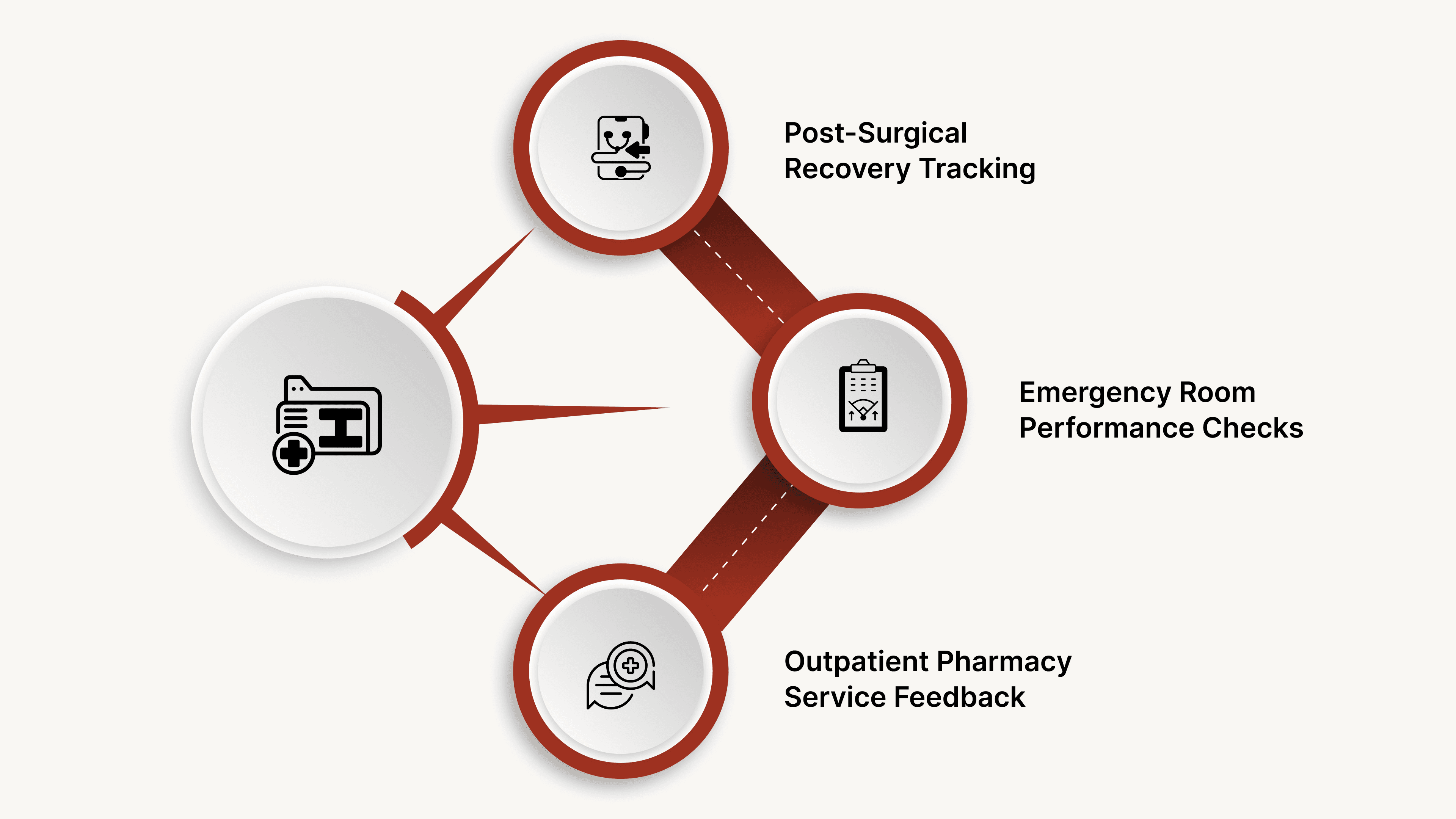
Voice feedback is not limited to general satisfaction but can be used to gather specific data for different medical specialties. These applications help you understand the unique needs of patients across various stages of their care journey.
Consider these scenarios where automated voice calls can provide the most value to your clinical operations:
1. Post-Surgical Recovery Tracking
Call patients after a surgery to ask about their pain levels and if they are following the prescribed care instructions. This use case combines feedback with patient safety by identifying those who might be experiencing complications at home.
It allows your surgical team to intervene early if a patient reports unexpected symptoms during the automated conversation.
2. Emergency Room Performance Checks
Gather insights specifically about the wait times and the speed of care provided in your emergency department during peak hours. Understanding these dynamics helps hospital managers adjust staffing levels to improve the flow of urgent care for future patients.
This data is vital for maintaining high standards in high-pressure environments where manual feedback is rarely collected.
3. Outpatient Pharmacy Service Feedback
Survey patients who visited your pharmacy to understand if they received the correct medications and clear instructions on how to use them. This feedback helps you identify areas where pharmacists may need more training to improve patient education and safety.
It ensures that the final step of the hospital visit is as professional as the initial consultation.
Secure, auditable, and compliant patient engagement. Learn how CubeRoot maintains the highest data security standards for Indian healthcare providers. Book a demo now.
Applying these use cases effectively requires following established industry standards for automated voice communication in modern healthcare settings.
Best Practices for Gathering High-Quality Voice Feedback
Maintaining a high level of quality in your automated interactions ensures that patients remain willing to participate in your feedback programs. These practices focus on creating a respectful and helpful environment for every caller who interacts with your AI.
Implementing these standards will help you build a more patient-centric organization that values every piece of shared information:
1. Ensuring Strict Data Privacy
Protect all recorded patient voices and transcribed data using encryption and secure servers that follow national healthcare regulations for information safety.
How it helps:
Builds long-term trust with your patient base regarding the safety of their personal data.
Prevents legal liabilities related to the mishandling of sensitive medical information.
Ensures that your facility remains compliant with evolving Indian healthcare data laws.
2. Closing the Feedback Loop
Contact patients who left negative feedback to inform them about the specific steps you have taken to address their concerns.
How it helps:
Increases patient retention by showing that you take their complaints seriously.
Provides an opportunity for service recovery before a patient leaves a public review.
Encourages more patients to provide honest feedback in the future.
3. Personalizing the Interaction
Use the name of the patient and mention the specific department they visited during the automated call to make it relevant.
How it helps:
Reduces the feeling that the patient is receiving a generic or spam call.
Improves the accuracy of the feedback as the patient recalls specific details.
Increases the likelihood that the patient will stay on the line to finish the call.
Delivering these personalized and secure feedback experiences at a high volume requires a platform built for enterprise healthcare needs.
Also read: Outbound Calls Explained: What They Are and How They Work?
How CubeRoot Delivers Voice Feedback at Scale
Indian hospitals and clinics face a unique triad of challenges: the need to connect with a multilingual patient population, the imperative to operate within strict data compliance frameworks, and the pressure to derive actionable insights from feedback without adding administrative overhead. Generic survey tools or basic telephony systems fracture under these demands.
CubeRoot is engineered specifically to solve these problems. We provide a voice-based patient feedback system that is secure, scalable, and insightful, turning patient conversations into a strategic asset for quality improvement.
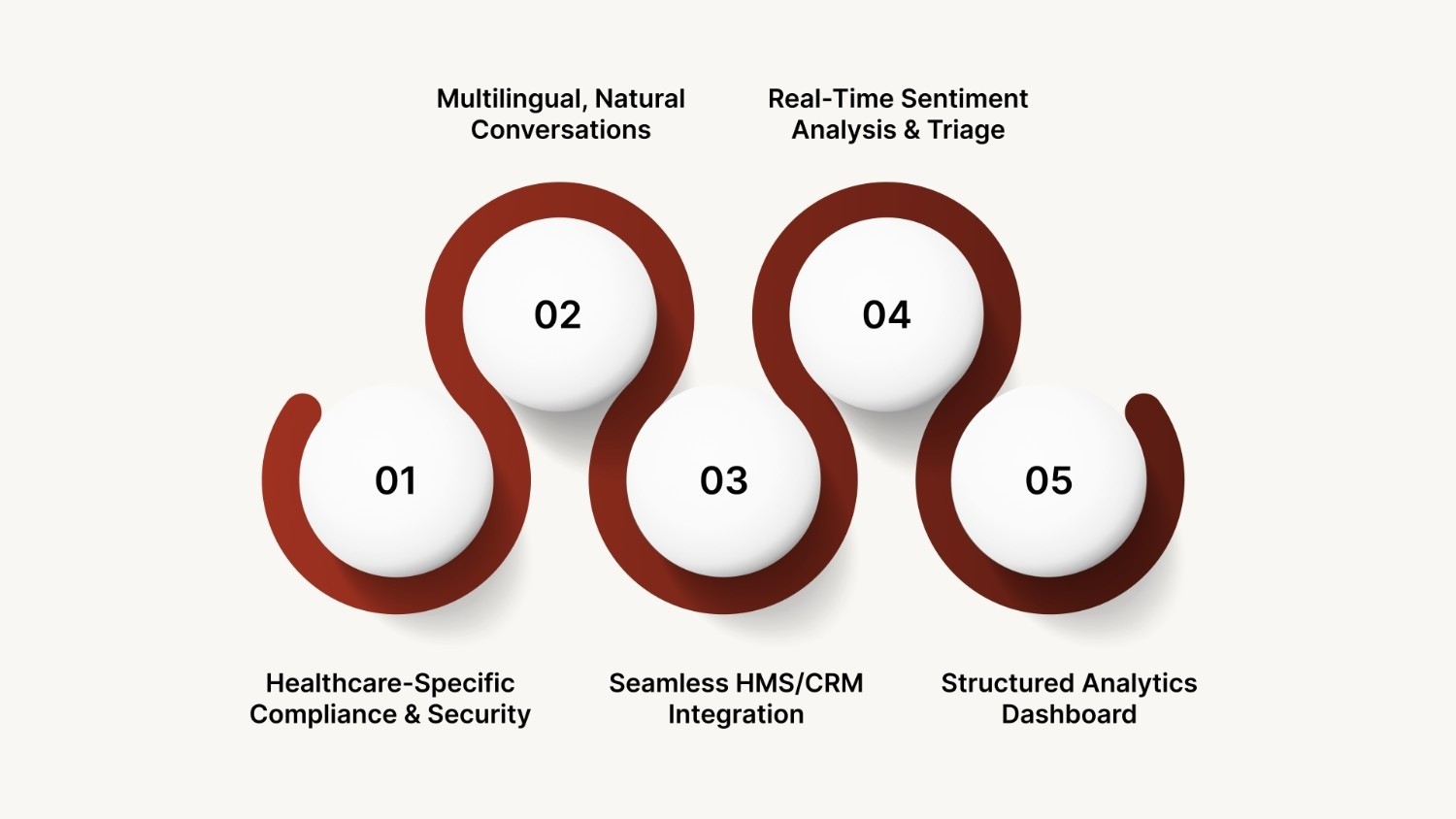
Healthcare-Specific Compliance & Security: Our platform is built with healthcare data privacy laws as a foundation. It features end-to-end encryption, secure voice logging, and adherence to relevant standards to ensure complete patient data protection.
Multilingual, Natural Conversations: We move beyond simple translation. Our AI is trained on diverse Indian language datasets and accents, enabling natural, empathetic conversations in English, Hindi, and other major regional languages to capture authentic feedback from all patient groups.
Seamless HMS/CRM Integration: CubeRoot's system integrates directly with your existing Hospital Management System via APIs. This allows for automatic triggering of feedback calls based on discharge dates or appointment types, and the direct logging of insights back into patient records for a unified view.
Real-Time Sentiment Analysis & Triage: Every conversation is analyzed in real-time for emotional tone. Cases indicating high dissatisfaction or distress can be flagged for immediate escalation to your patient relations team, enabling proactive service recovery.
Structured Analytics Dashboard: We transform unstructured voice conversations into structured data. Our dashboard provides clear metrics on response rates, NPS/CSAT trends, sentiment scores, and thematic analysis of common feedback topics, delivering actionable intelligence to administrators.
CubeRoot transforms patient feedback from a periodic survey into a continuous, integrated, and intelligent listening system that drives tangible quality enhancement.
Conclusion
Voice-based patient feedback represents a fundamental shift from transactional surveying to relational listening. It breaks through the low-response barrier of traditional methods, capturing the nuanced, emotional, and detailed insights needed to drive meaningful quality improvements in healthcare delivery.
For administrators in India's diverse and dynamic healthcare sector, the choice of technology partner is pivotal. Success depends on a platform that respects linguistic diversity, integrates seamlessly with clinical workflows, and turns conversational data into clear, actionable intelligence.
Explore how CubeRoot's specialized voice AI can help you build a more responsive and patient-centric organization. Request a demo to see how our feedback system can be tailored to your hospital's specific quality goals.
FAQs
Q. Is a voice-based feedback system secure for healthcare data?
Yes, when you choose a compliant platform. Enterprise solutions like CubeRoot are designed with healthcare regulations in mind, featuring end-to-end encryption, access controls, and signed data processing agreements to ensure all patient information remains protected.
Q. How does it handle different Indian languages and accents?
Advanced platforms train their AI models on diverse Indian language datasets. CubeRoot's systems are built to understand mixed-language speech (like Hinglish) and regional accents in Hindi, Tamil, Bengali, and more, ensuring clear communication and accurate feedback collection from all patients.
Q. Can it integrate with our existing hospital software?
Yes. Reputable enterprise AI platforms offer API-based integration. They can connect with major Hospital Management Systems (HMS) and Electronic Medical Records (EMR) to automatically pull patient lists for outreach and push feedback data back into the system for a complete patient journey view.
Q. What if a patient is upset or wants to talk to a human?
The system includes intelligent escalation protocols. It is programmed to detect signs of distress or negative sentiment in real-time. When triggered, it can immediately transfer the call to a designated human agent in your patient relations or quality department for personal follow-up.
Q. What is the typical implementation timeline for a pilot?
With a focused use case and a platform using pre-built healthcare templates, a pilot can be designed, integrated, and launched within 4-6 weeks. This includes technical setup, conversation design, and a controlled rollout to a specific patient group for testing and refinement.