Dec 26, 2025
How AI Voice Solutions Recover Abandoned Carts and Boost eCommerce Revenue
Every e-commerce and D2C brand in India faces the same challenge. Shoppers browse, compare, add items to their carts, and then drop off before completing payment. A recent industry analysis found that 69.99 percent of online shopping carts in India are abandoned, which means most high-intent customers never convert.
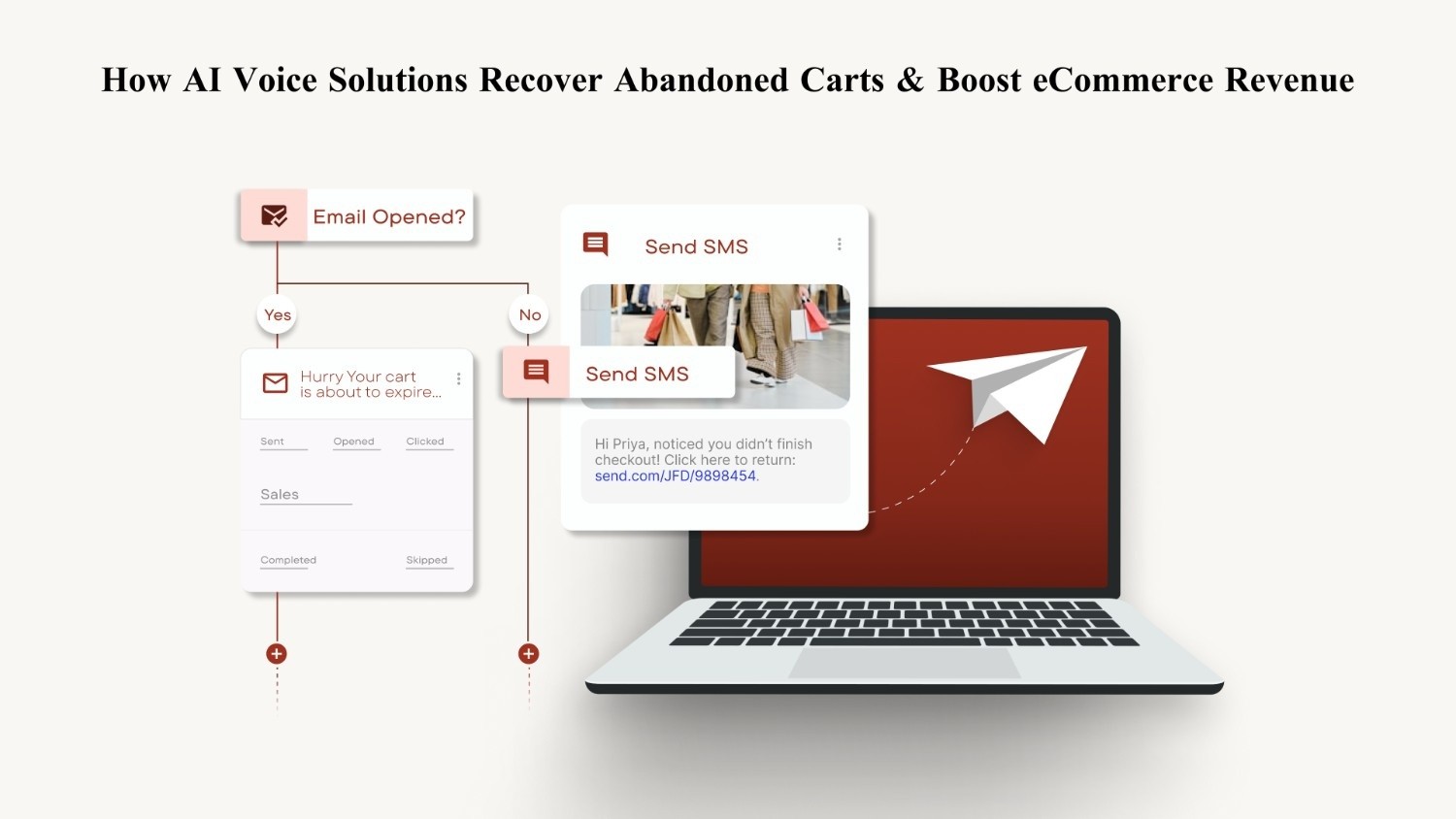
You already invest in ads, influencers, and performance marketing to bring users this far, but traditional recovery channels do not close the gap. Emails and SMS reminders are easy to ignore. Push notifications get lost among daily alerts. What shoppers need at that moment is a quick way to resolve confusion, payment friction, or last-minute hesitation.
AI voice agents create this opportunity. They call shoppers within minutes of the drop-off, understand what stopped them from completing the purchase, and offer immediate solutions. This real-time interaction helps you recover revenue that would otherwise be lost, without growing your calling team or increasing marketing spend.
As Indian shoppers browse on mobile, switch apps frequently, and rely heavily on UPI and COD, voice-led cart recovery offers a direct and timely way to bring them back to checkout. It provides the clarity and reassurance customers need in the critical moments that determine conversion.
Key Takeaways
Most abandoned carts in India come from simple, fixable friction points that voice agents can address instantly.
Real-time conversations outperform email and SMS because they resolve payment, delivery, and policy confusion on the spot.
Integrating voice agents with your storefront enables precise, cart-level personalization during recovery calls.
Tracking metrics like answer rate, recovery conversion, and cost per recovered cart helps optimize performance.
Responsible outreach, consent, and data protection are essential for scaling voice automation in India.
CubeRoot delivers faster recovery through multilingual conversations, real-time cart context, and compliance-ready workflows.
Why Cart Abandonment Happens in Indian eCommerce
Cart abandonment in India is driven by shopper expectations that differ from mature eCommerce markets. Your customers move fast, browse on mobile, and drop off when any part of checkout feels unclear or inconvenient.
Why Indian shoppers abandon carts
lack of instant clarity on delivery timelines for their location
uncertainty about COD availability in specific pincodes
confusion around final pricing or additional charges
UPI or wallet failures during peak traffic hours
hesitation caused by unclear return, refund, or warranty terms
How this impacts your business
you lose high-intent shoppers who were ready to buy
marketing spend becomes less efficient as fewer visitors convert
retargeting costs increase with every abandoned session
ROI from influencers and performance ads drops sharply
Why addressing this matters now
most drop-offs come from small, fixable friction points
faster resolution directly improves conversion without raising CAC
shoppers in Tier 2 and Tier 3 cities expect guidance in their preferred language
uncertainty during checkout harms trust, especially for new or mid-sized D2C brands
Understanding these patterns is the first step in recovering revenue consistently. The next step is using the right channel to address hesitation at the moment it happens.
Suggested read: Conversational AI for Customer Service: Benefits and How It Works
What AI Voice Agents Are and How They Recover Abandoned Carts
AI voice agents are automated callers that speak to shoppers in natural, human-like conversations and guide them back to checkout. They focus on resolving the specific blockers that prevented the shopper from completing the order, using context pulled directly from your storefront and customer data.
What makes them different from traditional reminders
they hold two-way conversations instead of sending static messages
they respond to the shopper’s answers in real time
they adjust the flow based on cart value, category, and past behavior
they can offer clear next steps rather than sending generic nudges
How they personalise each conversation
reference the exact items left in the cart
identify the last step the shopper reached
pick the shopper’s preferred language automatically
tailor the conversation to new, returning, or high-value customers
What they help your team achieve
reconnect with shoppers within minutes of the drop-off
highlight the real reason behind each abandoned cart
deliver consistent communication without manual calling
create a smoother path to conversion for ready-to-buy customers
AI voice agents allow you to reach shoppers at the right moment with the clarity, guidance, and reassurance needed to bring them back to checkout.
Also read: What Is Customer Satisfaction and How to Improve It?
Core Capabilities of AI Voice Solutions for Cart Recovery
Cart-recovery voice agents work because they combine timing, context, and adaptive conversation flows. Each capability is designed to address specific drop-off behaviors common in Indian eCommerce.
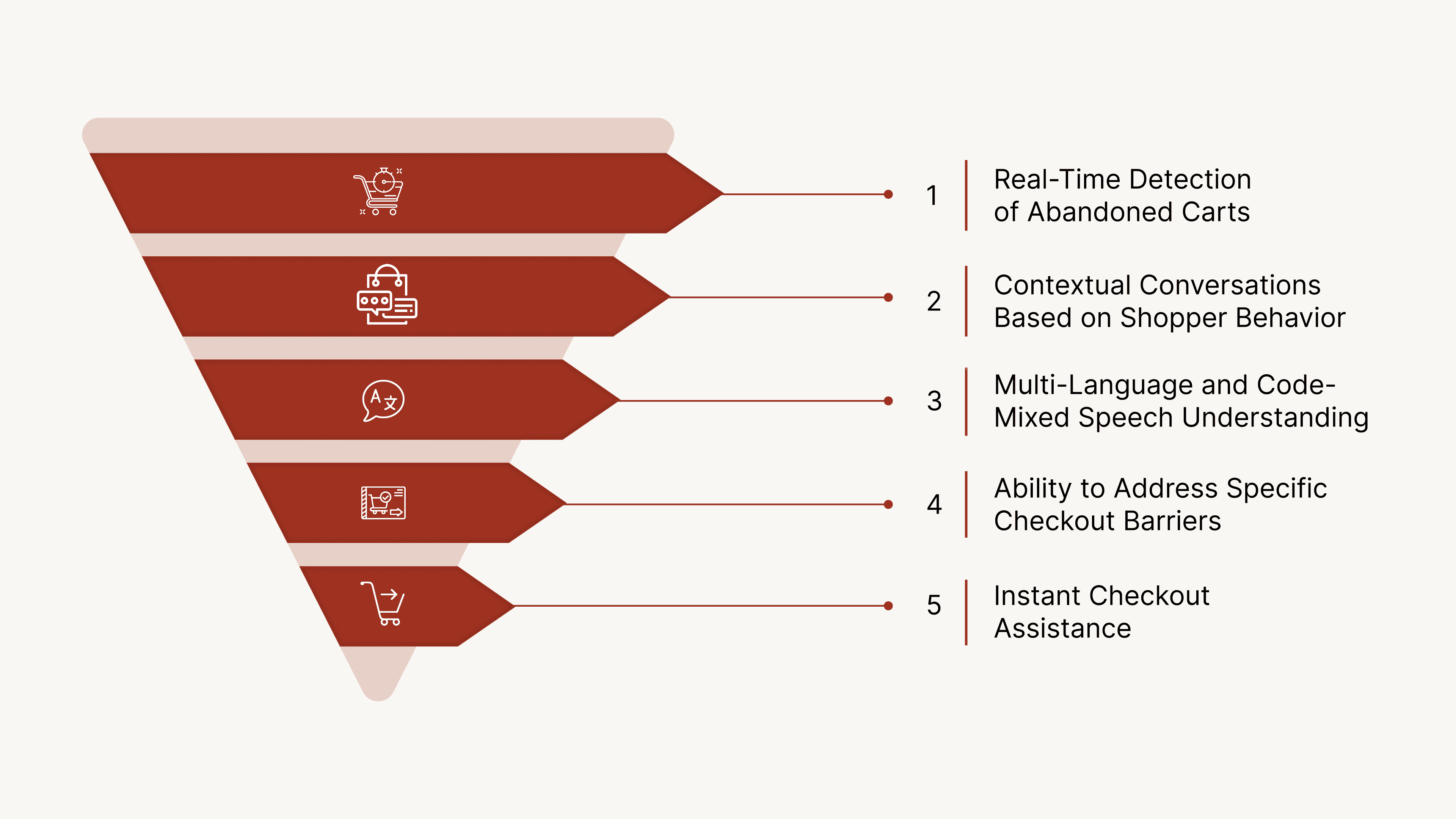
1. Real-Time Detection of Abandoned Carts
Voice agents pick up abandonment events as soon as they happen. They use data signals such as:
the step where the shopper exited
the value and type of products in the cart
whether a payment attempt was made
This ensures outreach happens when intent is still fresh.
2. Contextual Conversations Based on Shopper Behavior
The agent uses your data to shape the interaction. It can:
adjust tone for new or returning users
tailor guidance for categories like electronics, beauty, or home goods
recognize hesitation patterns based on past interactions
This keeps conversations relevant and helpful.
3. Multi-Language and Code-Mixed Speech Understanding
Shoppers across India expect to speak naturally. Voice agents can:
understand Hindi–English mixing
switch to regional languages such as Tamil, Bengali, or Kannada
adapt to accents across metros and non-metros
This builds trust and reduces confusion.
4. Ability to Address Specific Checkout Barriers
The agent can support scenarios that would require manual intervention. It can:
clarify policies that customers are unsure about
offer alternative payment options
answer product-specific questions
confirm availability or delivery feasibility
This helps reduce unnecessary drop-offs.
5. Instant Checkout Assistance
When the shopper decides to buy, the agent can:
send a personalised checkout link
restore the abandoned cart session
share the updated order summary
This removes friction and shortens the path to conversion.
These capabilities allow voice agents to address the real reasons shoppers abandon carts and guide them confidently toward completing their orders.
Must read: Multilingual Voice Bots for Enhanced Customer Interaction
How AI Voice Agents Integrate with Your eCommerce Tech Stack
A voice agent performs well only when it is connected tightly to your existing commerce systems. This ensures every call is triggered at the right time, uses accurate cart data, and routes shoppers back to a seamless checkout experience.
1. Direct Connection With Your Storefront
Voice agents integrate with your platform so they can read real-time cart activity. Typical routes include:
Shopify apps or private API keys
WooCommerce and Magento webhooks
REST APIs for custom-built stores
This makes the agent aware of what the shopper saw, selected, and abandoned.
2. Access to Customer and Order Data
To personalise each call, the system can pull details from:
CRM profiles
order history
loyalty or membership programs
This allows the agent to understand whether the shopper is new, returning, or high-value and adjust the conversation accordingly.
3. Secure Event Flow for Abandonment Signals
The system listens for specific signals such as:
payment attempt failures
delivery-step exits
coupon validation errors
session timeouts
Each signal helps the agent focus on the most likely barrier.
4. Automated Session Restoration
When a shopper is ready to complete the purchase, the agent can trigger:
an auto-filled checkout link
a restored cart with preserved selections
a new payment link if the previous attempt failed
This prevents customers from navigating the journey all over again.
5. Multilingual Speech Layer Optimized for India
The voice stack supports India’s linguistic complexity by handling:
code-mixed Hindi-English patterns
regional languages used in Tier 2 and Tier 3 shopping
pronunciation variants linked to different states
This ensures seamless conversations regardless of location.
6. Enterprise-Grade Data Protection
To keep customer trust intact, integrations follow strict controls:
encrypted data transfer
consent-based outreach
limited access to order identifiers
compliance aligned with DPDP guidelines
This helps brands scale voice automation responsibly.
Tight integration with your commerce stack ensures every outreach is contextual, accurate, and aligned with your checkout flow, leading to higher recovery success.
Suggested read: Understanding Customer Value: Definition, Impact, Trends & Strategies
Key Performance Metrics for AI Voice–Led Cart Recovery
Once your voice agent is live, the real impact becomes visible through measurable performance indicators. These metrics help you understand how efficiently the agent converts intent into revenue and where you can optimize further.
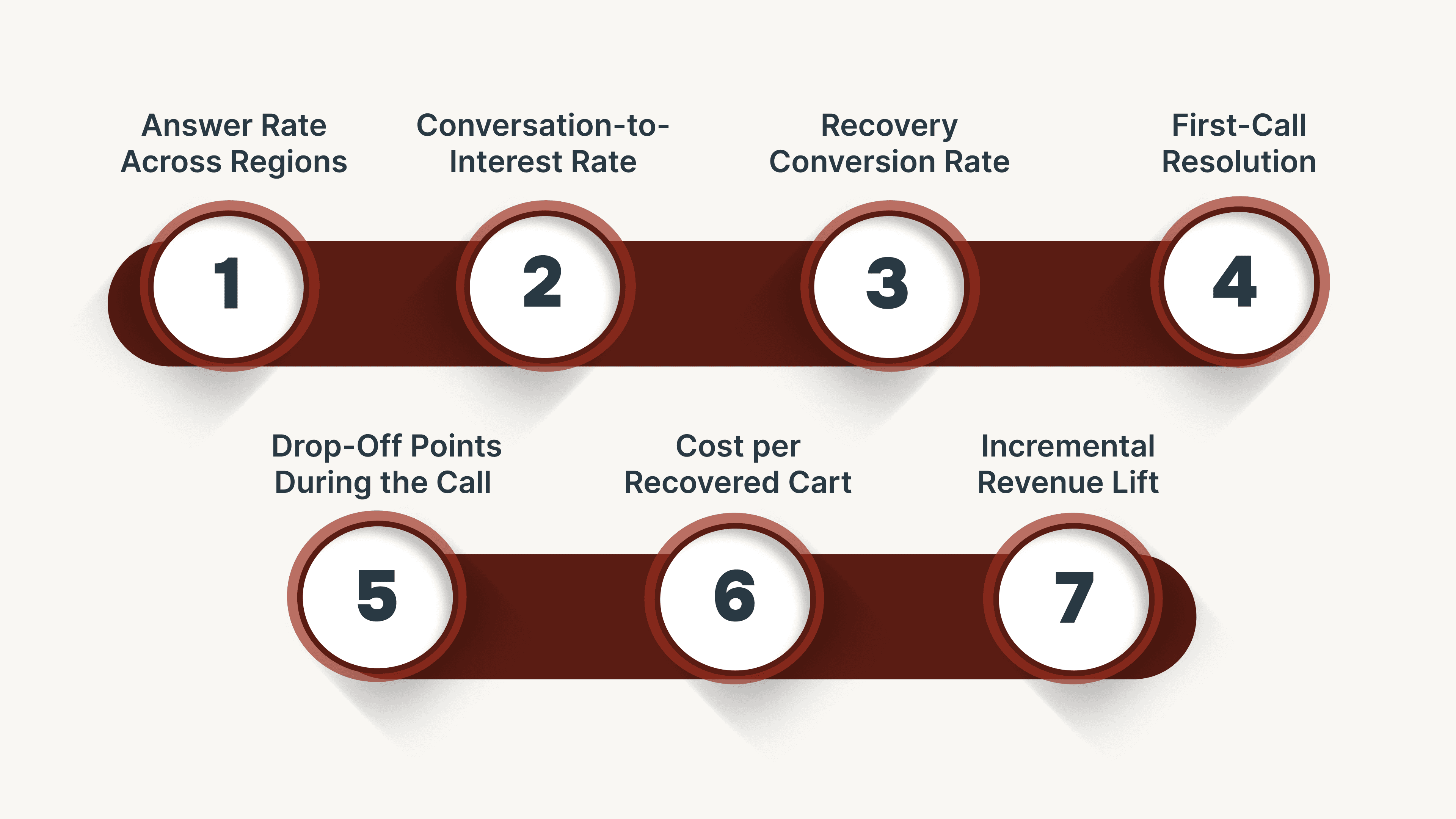
1. Answer Rate Across Regions
In India, answer rates vary widely based on region, language, and time. Tracking this helps you:
identify the best outreach windows
tailor languages based on geography
avoid repeated calls to low-engagement cohorts
A higher answer rate directly improves recovery potential.
2. Conversation-to-Interest Rate
This measures how many shoppers stay engaged during the call. It helps you evaluate:
clarity of the conversation flow
relevance of the prompts
whether the timing of outreach matches shopper intent
A strong engagement rate indicates healthy conversational fit.
3. Recovery Conversion Rate
This is the core metric: How many shoppers complete their purchase after the voice interaction?
Tracking this reveals which product categories or cart values respond best to voice-led recovery.
4. First-Call Resolution (FCR)
FCR indicates how many shoppers complete the required action without needing a follow-up. In cart recovery, this means:
completing the order in one call
resolving a payment friction instantly
clarifying a policy without escalation
Higher FCR = lower cost per recovery.
5. Drop-Off Points During the Call
Monitoring call-level drop-offs tells you:
where shoppers lose interest
which questions cause friction
whether the tone or pacing needs tuning
This helps refine your call flow for different segments.
6. Cost per Recovered Cart
This metric shows the real efficiency of voice agents. It includes:
outreach cost
platform usage
escalations (if any)
A strong voice system reduces recovery cost while increasing recovered revenue.
7. Incremental Revenue Lift
To understand true impact, you measure:
uplift in recovered revenue
improvement in ROI compared to SMS or email
contribution of voice to your monthly sales pipeline
This helps you build the internal case for expanding automation.
Tracking these metrics helps your team fine-tune outreach, improve efficiency, and capture more revenue from high-intent shoppers.
Compliance and Responsible Outreach for Voice-Based Cart Recovery
Voice-led cart recovery works only when shoppers feel respected and safe. In India, where data protection standards are tightening and outreach fatigue is common, responsible automation is essential. A compliant voice workflow protects your brand and improves customer trust.
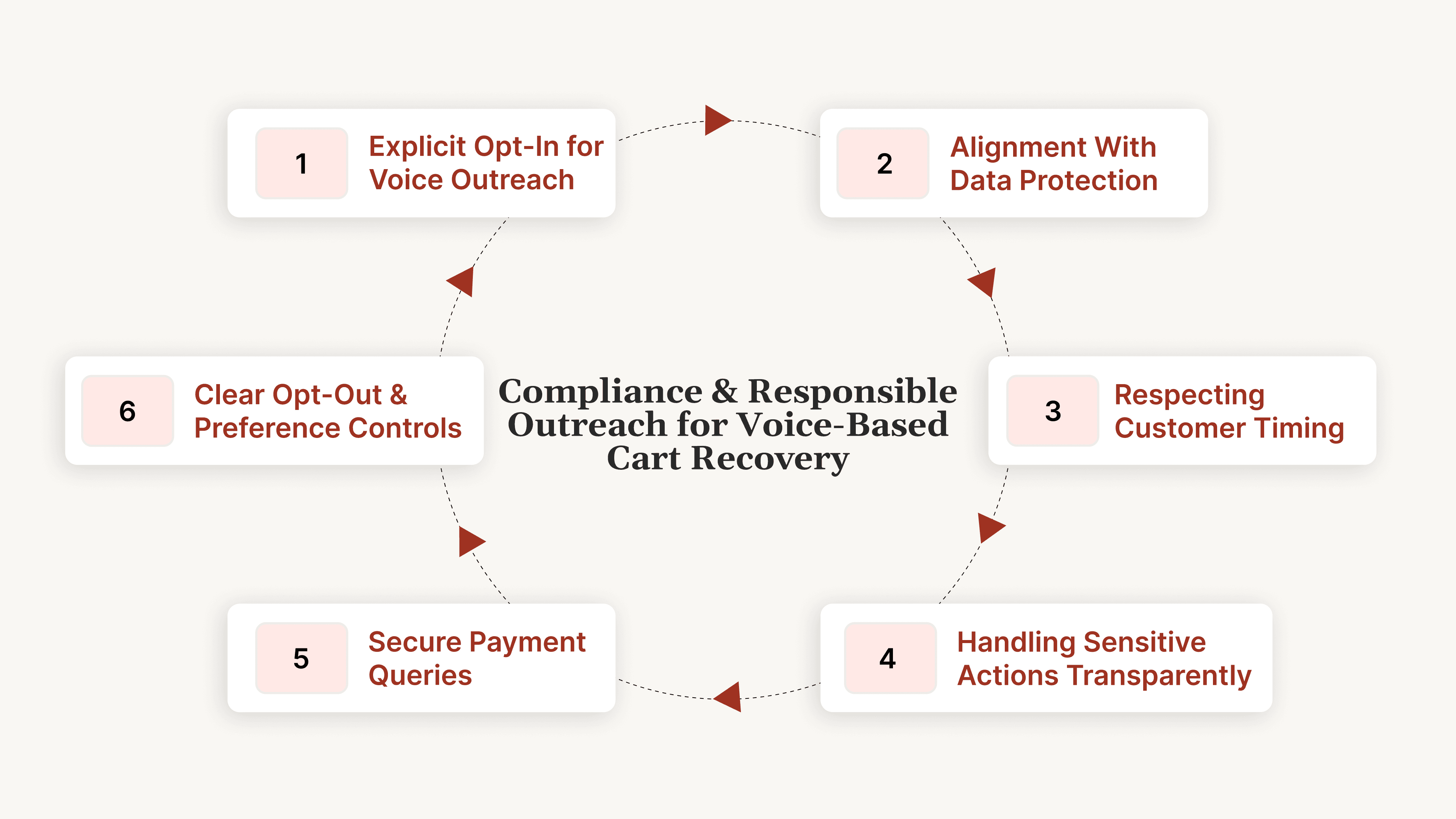
1. Explicit Opt-In for Voice Outreach
Before making recovery calls, brands must ensure customers have agreed to receive voice communication. This can be captured through:
checkout consent checkboxes
app permissions
account-level communication preferences
Clear opt-in reduces complaints and protects your outreach pipeline.
2. Alignment With India’s Data Protection Regulations
With the Digital Personal Data Protection (DPDP) Act coming into force, brands must ensure voice-driven workflows follow the required standards, including:
collecting only the data necessary for the interaction
storing call outcomes securely
restricting access to sensitive identifiers
maintaining audit trails for compliance
This ensures your automation adheres to national expectations.
3. Respecting Customer Timing and Call Frequency
Responsible cart recovery avoids creating friction by:
limiting retries for unanswered calls
restricting outreach during non-preferred hours
adapting call windows for different regions
This prevents negative experience while improving the chances of conversion.
4. Handling Sensitive Actions Transparently
Voice agents must disclose:
who is calling
why the customer is being contacted
what data is being referenced
This transparency builds credibility and reassures first-time shoppers.
5. Secure Handling of Payment-Related Queries
Because checkout discussions may involve payment context, the agent must avoid collecting sensitive details verbally. Instead, it should:
redirect shoppers to secure payment links
avoid requesting confidential information
validate identity through non-sensitive markers only
This reduces risk while maintaining conversion flow.
6. Clear Opt-Out and Preference Controls
Shoppers should be able to stop receiving voice calls easily. This can be done through:
in-call opt-out options
account settings
post-call preference updates
Simple controls keep your outreach compliant and customer-friendly.
A responsible, compliant voice workflow protects your brand reputation while ensuring shoppers engage comfortably with recovery calls.
How CubeRoot Enhances AI Voice–Driven Cart Recovery
CubeRoot helps you convert high-intent shoppers quickly with workflows built for India’s eCommerce environment. The platform focuses on speed, context, compliance, and multilingual clarity.
What Makes CubeRoot Effective for Cart Recovery
Quick activation using simple APIs and prebuilt cart-recovery templates.
Category-specific conversation flows for electronics, fashion, beauty, home products, or high-ticket items.
Real-time cart visibility so the agent references SKUs, variants, and active offers accurately.
India-ready compliance controls, including consent routing, safe data handling, and configurable retry limits.
Multilingual conversations tuned for Hindi, English, and major regional languages to improve reach.
Structured insights showing why shoppers abandoned their carts and what drove successful recoveries.
Elastic scaling during sale events, ensuring timely outreach even when abandonment spikes.
Ready to Turn Abandoned Carts Into Revenue?
If you want a cart-recovery system that speaks your customer’s language, adapts to your category, and connects directly with your checkout, CubeRoot can help you get there.
Conclusion
Cart abandonment is not just a checkout issue. It reflects hesitation, unanswered questions, and moments where shoppers need clarity before they commit. Voice-led recovery fills this gap by giving your customers a quick, human-like interaction that resolves friction faster than any reminder email or push notification.
When your team understands why people drop off and can intervene within minutes, you recover revenue that was already within reach. You also improve the buying experience for customers who expect instant support, especially on mobile and during high-traffic sale periods.
For brands working with tight CAC targets and rising competition, this becomes a strategic advantage. You convert more high-intent shoppers without expanding support teams, and you gain visibility into the exact blockers that impact your margins.
Request a personalised walkthrough, and we’ll show you how voice-led automation can lift conversions across your entire store.
FAQs
Q: How do AI voice agents perform compared to email and SMS for cart recovery?
A: AI voice agents offer real-time, two-way conversations that help you uncover why a shopper left the cart and resolve the issue instantly. CubeRoot enhances this by personalizing each call based on cart value, product type, and shopper history, which results in higher recovery than email or SMS reminders.
Q: What is the best time to call a customer after they abandon their cart?
A: The strongest results come when outreach happens within minutes or a few hours of the drop-off. CubeRoot allows you to set timing rules for different cart sizes, regions, and customer segments so you reach shoppers precisely when intent is still high.
Q: Which metrics help measure the success of voice-led cart recovery?
A: Useful metrics include:
Answer rate
Conversation completion rate
Cart recovery conversion rate
Cost per recovered cart
Incremental revenue lift
CubeRoot provides these insights in a structured dashboard so your team can track performance and refine outreach quickly.
Q: Can voice agents handle Indian regional languages and mixed-language conversations?
A: Yes. CubeRoot supports Hindi, Tamil, Bengali, Marathi, Kannada, Telugu, and natural code-mixed conversations such as Hinglish. This helps you recover carts from shoppers across Tier 1, Tier 2, and Tier 3 markets with higher clarity and comfort.
Q: Is voice cart recovery scalable during peak sale events?
A: Yes. CubeRoot scales automatically during festive sales, heavy campaigns, and high-traffic days. It can handle thousands of abandoned carts at once, prioritise high-value shoppers, and maintain consistent call quality even during spikes.