Dec 26, 2025
Future of the BPO Industry in India: Trends, Challenges & Predictions
India remains a preferred base for large-scale customer operations because it combines depth, quality, and cost control.
Enterprises seek reliability, multilingual reach, and measurable outcomes across voice, chat, and back-office workflows.
CX, finance ops, and data work now demand faster responses with tighter compliance.
Boards expect elastic capacity without runaway budgets or long hiring cycles.
This blog focuses on practical moves for enterprise teams buying or running programs in India. You will see sector insights, execution risks, and a clear playbook for the next twelve months.
Key Takeaways
India remains a strategic base for voice and process work due to depth, multilingual talent, and disciplined cost control.
Buyers prioritize compliance-ready multilingual voice, script discipline, and audit trails across BFSI and healthcare, improving trust and reducing regulatory risk.
AI handles repeat volume while agents focus on complex cases, improving first-call resolution, lowering handle time, and protecting margins during spikes.
Elastic capacity and intent-based routing beat rigid headcount models, strengthening SLA stability during festive peaks, EMI cycles, and major product launches.
Programs stall without real-time visibility and strong AI-to-human handoffs; leaders need live metrics, context transfer, and rapid iteration.
BPO Industry in India: 2025 Executive Snapshot
This snapshot highlights what leaders must track before committing budgets or renewing contracts. Use it as a quick brief to align teams on priorities, risks, and expected outcomes.
Demand & Scope: Enterprises still outsource voice CX, finance ops, and data work, but now judge partners on outcomes, compliance strength, and multilingual reach.
Operating Model: Automation absorbs routine volume while trained agents handle complex cases; contracts shift from fixed seats to outcome commitments with surge triggers.
GCC vs Third-Party: Global captives expand analytics and strategic roles, while third-party partners run scaled CX and peaks under shared KPIs and common governance.
Pricing & Margins: Wage pressure and higher quality bars squeeze rates; renewals favor elastic capacity, tougher SLAs, and transparent unit economics across programs.
Talent & Locations: Tier-2 and tier-3 cities add language depth and continuity for 24×7 coverage; hybrid teams standardize access controls, QA, and data handling.
Compliance & Security: Script discipline, consent capture, and audit-ready logs are mandatory in BFSI and healthcare, supported by zero-trust access and masked data.
Tech in Daily Ops: Voice bots handle confirmations, reminders, and collections with clean escalation; agent-assist surfaces disclosures, next steps, and data lookups.
Visibility & SLAs: Leaders track real-time adherence, FCR, AHT, sentiment, and escalation outcomes, fixing root causes before SLAs slip and budgets take a hit.
With the baseline set, let’s examine the sectors fueling demand and the delivery standards they now consider non-negotiable.
Sectors Powering Growth: Who Leads the BPO Industry in India
These align budgets with real demand drivers in 2025. Each sector lists spend areas, non-negotiables, and what renewals hinge on.
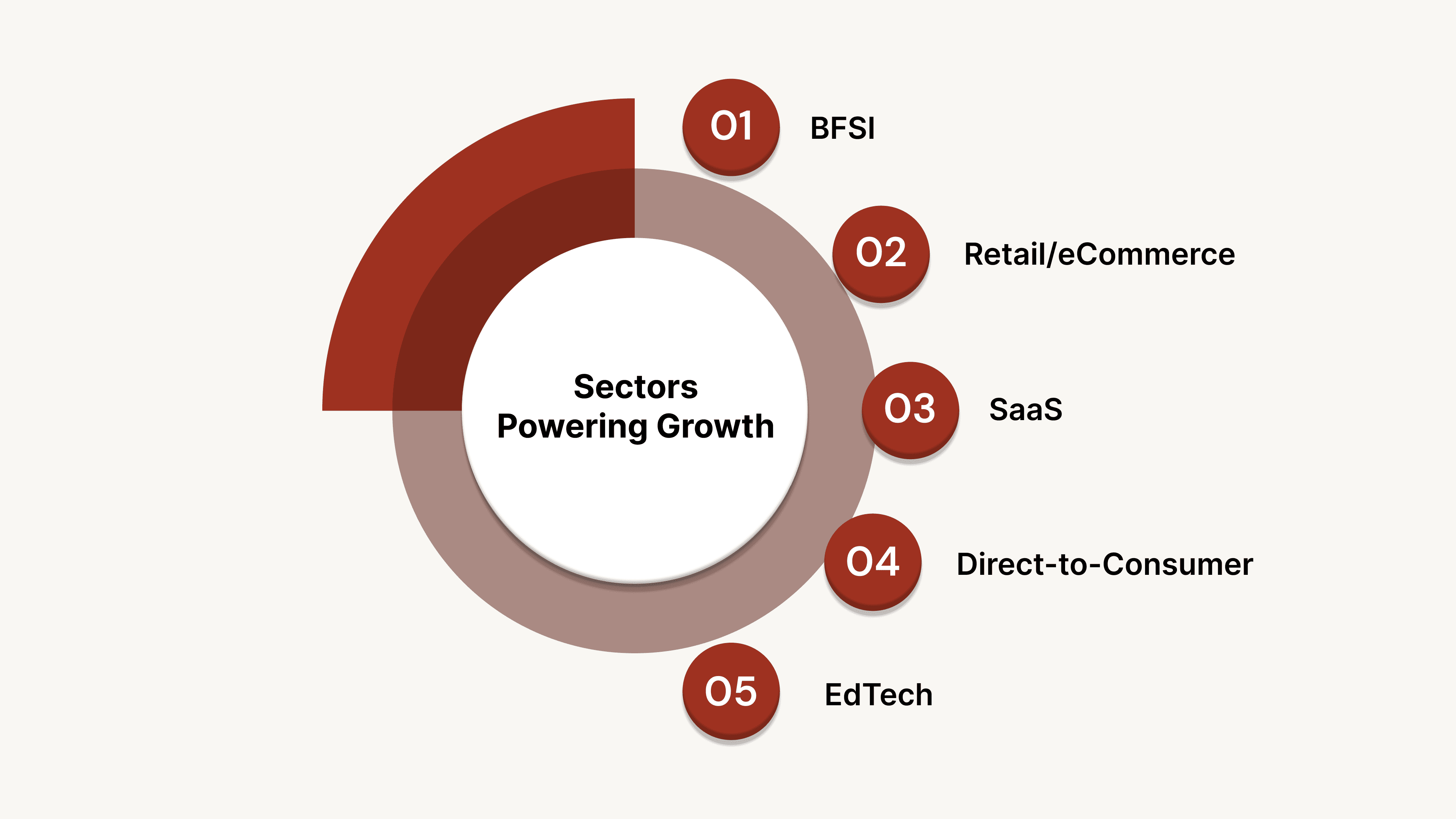
BFSI
Where the spend goes: Collections, dispute handling, KYC, fraud checks, and loan servicing.
Non-negotiables: Script adherence, consent capture, secure logs, multilingual voice for EMI cycles.
What wins renewals: Higher right-party connects, lower roll rates, faster clear-to-close on escalations.
Retail/eCommerce
Where the spend goes: Order status, returns, replacements, COD confirmations, peak elasticity.
Non-negotiables: Regional languages, fast after-hours coverage, flexible surge capacity.
What wins renewals: Lower WISMO volume, faster refunds, higher first-contact containment.
SaaS
Where the spend goes: Onboarding, tier-1 troubleshooting, renewals outreach, and admin changes.
Non-negotiables: 24×7 SLOs, precise entitlement handling, clean AI-to-agent handoffs.
What wins renewals: Higher product adoption, reduced backlog, shorter time-to-resolution.
Direct-to-Consumer (D2C)
Where the spend goes: Post-purchase support, exchanges, delivery issues, and feedback collection.
Non-negotiables: Proactive notifications, multilingual voice, easy escalation for high-value orders.
What wins renewals: Fewer repeat contacts, faster replacements, stronger review scores.
EdTech
Where the spend goes: Admissions, fee reminders, student and parent queries, exam spikes.
Non-negotiables: Safeguarding policies, after-hours support, and clear multilingual explanations.
What wins renewals: Higher enrollment conversion, timely fee recovery, and lower abandonment.
Healthcare
Where the spend goes: Appointments, pre/post-care calls, insurance coordination, reminders.
Non-negotiables: PHI controls, recorded disclosures, strict access governance.
What wins renewals: Fewer no-shows, quicker eligibility checks, stronger care-plan adherence.
With sector expectations clear, let’s map the execution hurdles that derail Indian BPO programs and how leaders contain them.
Also Read: Understanding Customer Value: Definition, Impact, Trends & Strategies
Where Indian BPO Programs Struggle in 2025: The Challenges That Matter
Identify potential pitfalls in your BPO programs before they impact performance. This section highlights key challenges and the questions you should ask vendors to avoid them.
1) Market Pressure and New Competition
What’s happening: Philippines, Malaysia, and Mexico compete on price and maturity, while GCCs in India hire directly.
Why it matters: Renewal pricing tightens, win rates fall, and metro wages push margins down.
Ask your vendor: How have your win rates, wage bands, and renewal discounts changed during the last four quarters?
2) Shift From BPO to KPO Expectations
What’s happening: Buyers want analytics, domain advice, and decision support, not only transactions and tickets.
Why it matters: Seat-based billing loses relevance; programs must prove outcome ownership with credible case results.
Ask your vendor: Which KPO use cases did you add this year, and what measurable uplift did each deliver?
3) Talent Depth, Ramp Speed, and Multilingual Coverage
What’s happening: Attrition stays high; Tier-2 and Tier-3 hiring grows; dialect coverage varies widely by region.
Why it matters: Slow ramp hurts SLAs, while weak language depth depresses connects, collections, and first-contact containment.
Ask your vendor: What is time-to-proficiency by workflow, and how many trained backups exist for each language?
4) Compliance Discipline and Data Protection
What’s happening: Script slips, missed consent, and uneven logging still occur in voice workflows.
Why it matters: Regulated sectors need audit-ready conversations or face penalties and rework costs.
Ask your vendor: Show last month’s adherence rate, disclosure miss rate, and evidence of consent capture for each queue.
5) POC-to-Scale Gaps in Voice Automation
What’s happening: Pilots pass, but concurrency, accents, and multi-use-case loads fail at production volumes.
Why it matters: Throttling and dropped escalations trigger emergency rollbacks and brand complaints.
Ask your vendor: Prove stable performance at 10k–50k daily calls, with logs for error types and escalation outcomes.
6) Slow Change Cycles and Fragile Escalations
What’s happening: Simple flow edits sit in IT queues, and AI-to-agent handoffs still lose context.
Why it matters: Scripts age quickly; customers repeat details; CSAT and handle time slip.
Ask your vendor: What is average lead time for a flow change, and how do you pass full context during handoff?
7) Visibility Gaps and Late Quality Control
What’s happening: Many programs still rely on monthly decks instead of daily live dashboards.
Why it matters: Leaders miss early signals on adherence, sentiment, and repeat contacts, then fix issues too late.
Ask your vendor: Give supervisor-level dashboards for live adherence, AHT, FCR, sentiment, and escalation triggers.
8) Pricing Models That Don’t Fit Peak Reality
What’s happening: Fixed FTE models struggle during festive peaks, EMI cycles, and campaign spikes.
Why it matters: Queues explode, overtime rises, and unit economics turn shaky.
Ask your vendor: Offer elastic capacity terms with clear surge triggers and pre-priced burst bands.
9) Security Controls for Hybrid and Remote Teams
What’s happening: Access creep, inconsistent masking, and weak home setups still appear in audits.
Why it matters: PHI and PII require strict controls; lapses extend reviews and raise incident risk.
Ask your vendor: Show role-based access, data masking proof, and remote workstation checks from the last audit.
With risks mapped, the next step is technology, what is actually changing, what scales cleanly, and which investments move outcomes fastest.
Also Read: Automated Calling System For Businesses
Technological Innovations Shaping the Future of the BPO Industry
The integration of advanced technologies is transforming how BPOs operate, enabling faster, more efficient services while reducing costs. These innovations are reshaping customer experiences, improving scalability, and driving long-term growth. Here’s how:
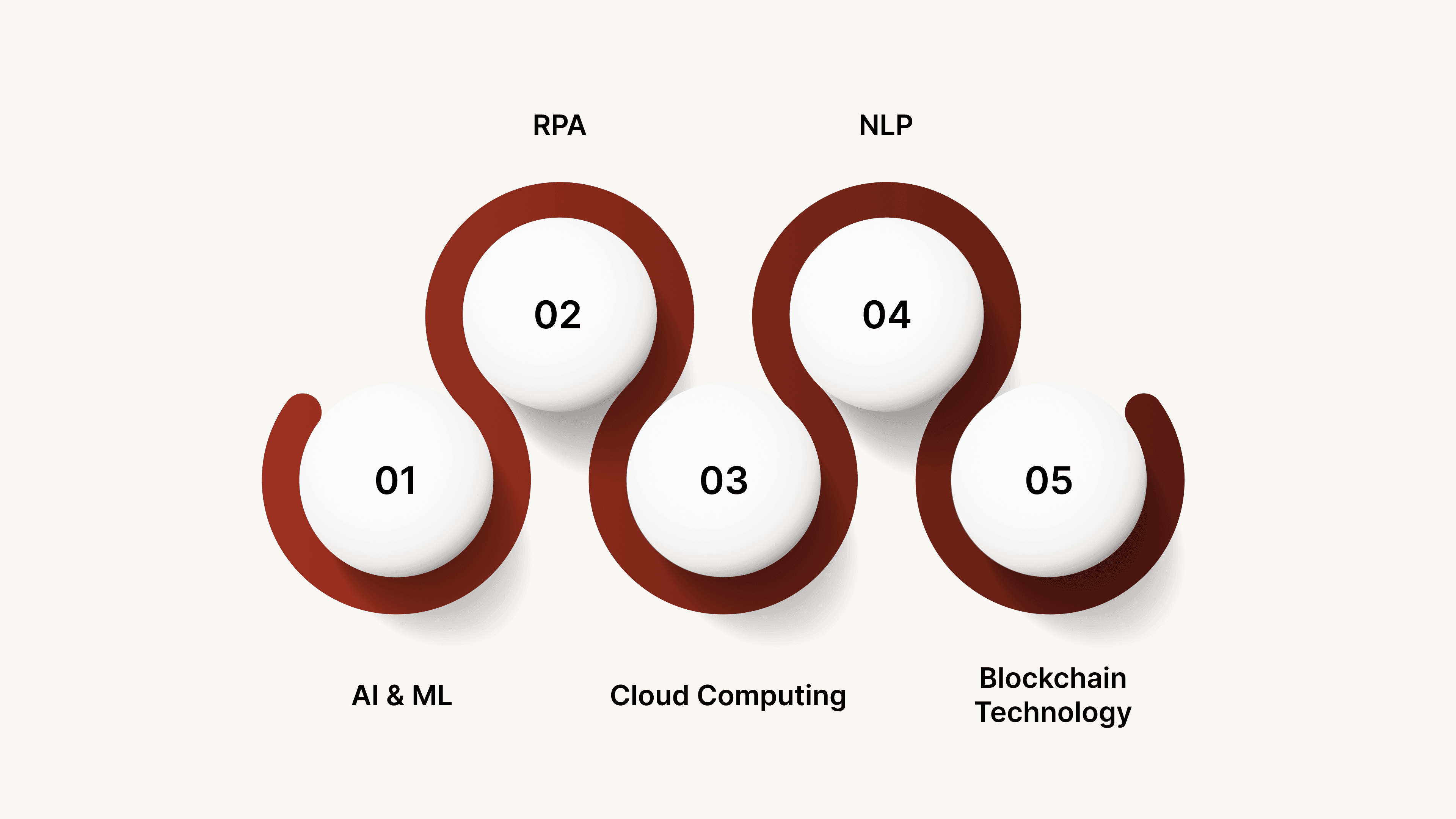
1) Artificial Intelligence (AI) and Machine Learning (ML)
AI and ML are revolutionizing BPO operations by automating routine tasks, enhancing decision-making, and enabling personalized customer experiences. These technologies are optimizing call routing, predictive analytics, and customer interaction.
Impact:
AI-driven voice bots handle routine inquiries, freeing up agents for more complex tasks.
Machine learning algorithms help predict customer needs and tailor services proactively.
2) Robotic Process Automation (RPA)
RPA is transforming the back-office landscape by automating repetitive, rules-based tasks such as data entry, order processing, and compliance checks. RPA reduces human error, increases speed, and enhances operational efficiency.
Impact:
Significantly reduces cycle time and boosts consistency in back-office operations.
Lowers operational costs, particularly for high-volume, repetitive processes.
3) Cloud Computing
Cloud solutions are providing BPOs with scalable, flexible infrastructure. By migrating applications and data to the cloud, BPO providers can quickly adapt to changing demands, ensuring smooth operations even during seasonal surges.
Impact:
Scalability without major investment in physical infrastructure.
Facilitates remote work, enabling geographically distributed teams while maintaining data security and compliance.
4) Natural Language Processing (NLP)
NLP is transforming how BPOs interact with customers by enabling machines to understand and respond to human language. This technology powers chatbots and voice assistants that handle customer interactions in multiple languages, improving the efficiency of customer service.
Impact:
Provides multilingual support, reducing reliance on human agents for language-specific tasks.
Enhances customer satisfaction by analyzing sentiment and tailoring responses based on emotions.
5) Blockchain Technology
Blockchain is improving data security and transparency in BPO operations, particularly in the BFSI and healthcare sectors. Its decentralized nature ensures data integrity and facilitates secure transactions, enhancing trust and compliance.
Impact:
Strengthens security by ensuring tamper-proof transaction records.
Streamlines contract management and payment processes by removing intermediaries.
Next, let us explore how KPO is reshaping the BPO industry in 2025.
Also Read: What Is Customer Satisfaction And How To Improve It?
The Growing Importance of KPO in 2025
The shift from traditional BPO to Knowledge Process Outsourcing (KPO) is accelerating. In 2025, businesses are seeking more than just transactional services; they want specialized expertise in high-value areas like data analytics, market research, and strategic decision-making.
KPO providers are now essential partners, offering the expertise and insights that drive business outcomes, reduce risks, and open new growth opportunities.
Why KPO is Gaining Traction?
1. Access to Specialized Talent
India’s talent pool extends beyond basic outsourcing to include professionals in sectors like healthcare, finance, and legal. Enterprises can tap into this expertise without the overhead of hiring and training in-house.
Why it matters:
Faster access to specialized knowledge.
Scalable expertise for business-critical functions.
2. Data Analytics and Actionable Insights
With the increasing need for data-driven decisions, businesses are relying on KPO providers for advanced analytics. These services enable actionable insights that drive strategic growth and operational improvements.
Why it matters:
Real-time insights for better decision-making.
Enhanced customer engagement and operational efficiency.
3. Moving Beyond Transactional Work
KPO is taking on more strategic tasks such as market research and risk management. Enterprises are outsourcing functions that add measurable value beyond routine processes.
Why it matters:
Frees up internal teams for core business tasks.
Strengthens business strategies with specialized knowledge.
4. Global Reach and Multilingual Support
India’s KPO providers offer multilingual support and global coverage, making them ideal for enterprises looking to expand their reach.
Why it matters:
Seamless 24/7 support across regions.
Access to a diverse talent pool capable of serving international markets.
5. Scalability and Cost Efficiency
KPO services offer flexibility, allowing businesses to scale operations quickly without the costs of expanding internal teams. This scalability is critical for businesses with fluctuating demand.
Why it matters:
Ability to scale quickly during peak periods.
Cost-efficient without compromising on quality.
As KPO evolves, technology is key. Next, we’ll explore how AI-driven voice solutions are transforming CX and how CubeRoot helps businesses scale efficiently.
How CubeRoot is Enabling Enterprises to Scale Voice CX with AI Solutions?
As BPO programs evolve, AI-powered voice solutions are becoming a critical enabler of scale and efficiency. Platforms like CubeRoot are helping businesses automate and optimize customer interactions, enabling them to deliver seamless, multilingual, and compliance-driven experiences at scale.
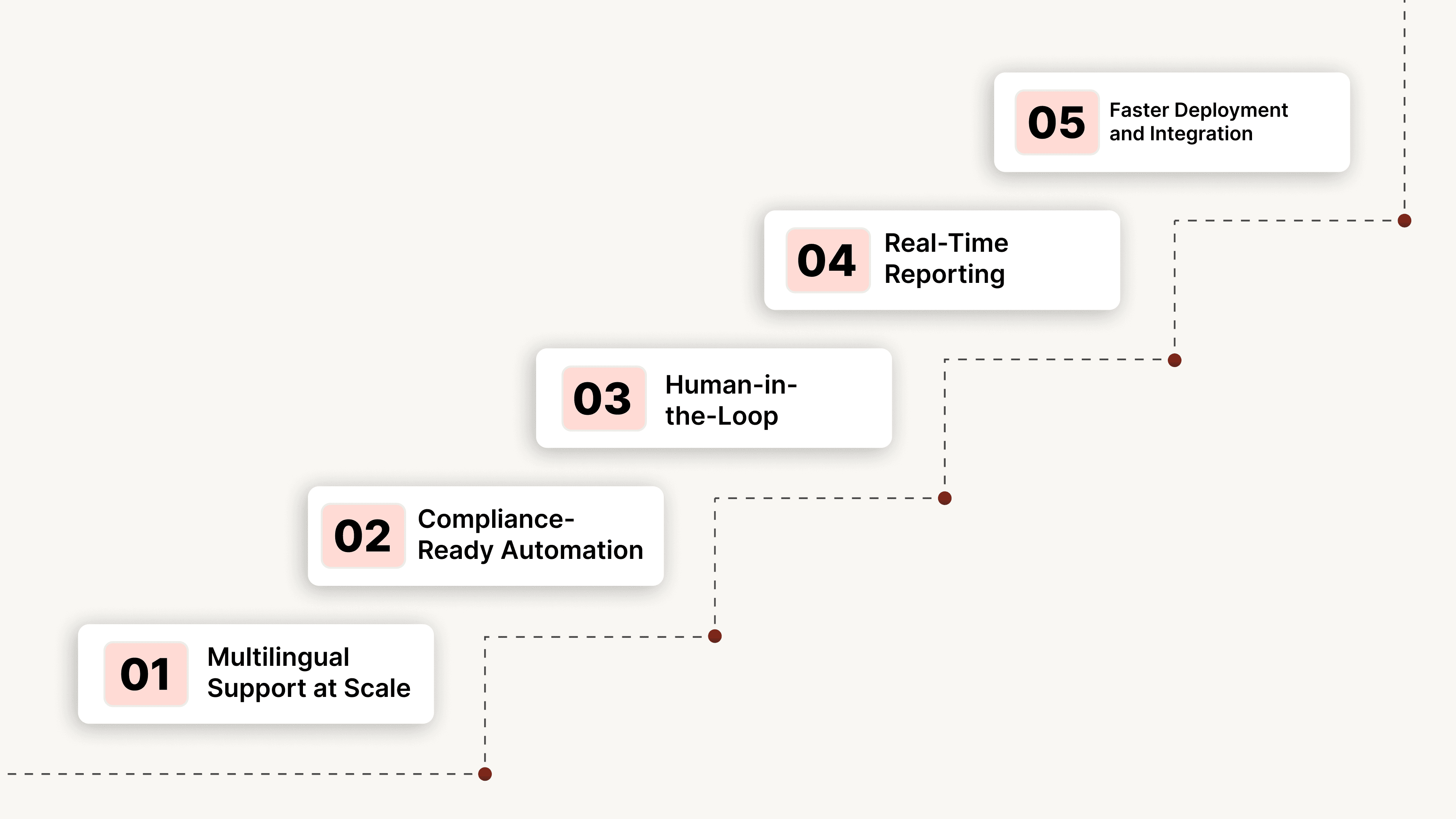
Why CubeRoot Works for Enterprise Teams
Multilingual Support at Scale: CubeRoot’s AI voice agents handle customer interactions in multiple languages, eliminating the need for separate language-specific teams and ensuring consistent service across regions.
Compliance-Ready Automation: With built-in compliance features, CubeRoot ensures every interaction adheres to industry standards, helping businesses reduce the risk of audit failures or legal challenges, especially in regulated industries like BFSI and healthcare.
Human-in-the-Loop: CubeRoot integrates human escalation paths to maintain high service levels for complex cases. AI handles routine queries, while humans focus on higher-value interactions, enhancing both efficiency and customer satisfaction.
Real-Time Reporting and Analytics: The platform provides real-time insights into customer sentiment, query resolution times, and agent performance. This data allows businesses to optimize their operations and improve customer experience continuously.
Faster Deployment and Integration: CubeRoot integrates seamlessly with existing CRM systems and workflows, enabling faster deployment without the need for extensive IT involvement or long implementation timelines.
Conclusion
The BPO industry in India is no longer just about cost reduction, it’s about driving growth, improving customer experience, and ensuring compliance across every interaction. In sectors like BFSI, Retail, SaaS, D2C, EdTech, and Healthcare, BPO providers are now expected to deliver specialized services that contribute directly to business outcomes.
Is your enterprise ready to embrace AI-powered automation, scale customer engagement without adding headcount, and meet evolving compliance demands?
The future of BPO lies in AI-driven automation, where routine tasks are handled by voice bots, human agents focus on complex issues, and compliance is seamlessly integrated into every interaction. CubeRoot makes this future a reality today through multilingual, compliance-ready, and human-in-the-loop voice automation, transforming how enterprises engage with customers.
For Indian enterprises, the time to modernize your BPO strategy and build for scalability, efficiency, and compliance is now.
Book a demo with CubeRoot today and empower your team to resolve 70% of routine queries instantly, qualify 80% of leads in minutes, and cut support or collection costs by up to 50% all while letting your human agents focus on what matters most. |
FAQs
Q: How can AI improve the efficiency of BPO services in India?
A: AI automates routine tasks, reducing manual effort and freeing up agents to focus on more complex issues. This boosts operational efficiency, reduces costs, and improves customer experience.
Q: What role does multilingual support play in India’s BPO industry?
A: With India’s linguistic diversity, multilingual support ensures that BPOs can serve a broader customer base, improve engagement, and meet the needs of customers across different regions.
Q: How does CubeRoot help in scaling BPO operations?
A: CubeRoot provides AI-powered voice solutions that automate high-volume tasks, integrate multilingual support, and allow human escalation for complex queries, enabling businesses to scale operations while maintaining service quality.
Q: What should enterprises look for when choosing a BPO provider in India?
A: Enterprises should prioritize compliance, security, multilingual support, and scalability to ensure that the BPO provider can meet their evolving needs while delivering high-quality service.
Q: How does CubeRoot ensure compliance in regulated industries like BFSI and Healthcare?
A: CubeRoot’s platform integrates compliance features like consent capture, audit logs, and secure data handling to meet regulatory standards, especially in highly regulated sectors like BFSI and healthcare.
Q: What is outcome-based pricing, and why is it important for BPO services?
A: Outcome-based pricing ties service costs to performance metrics like customer satisfaction and issue resolution, offering businesses better ROI by aligning payment with actual service quality and results.
Q: How can businesses prepare for the future of BPO in 2025?
A: Businesses should embrace AI automation, multilingual support, and end-to-end integrated solutions to stay competitive. Ensuring scalability, compliance, and data security will also be essential to meeting evolving customer expectations.