Jan 14, 2026
Future of Conversational AI: 6 Key Trends to Watch
Indian enterprises are hitting a critical moment in customer engagement. Interaction volumes are rising faster than contact centers can scale, costs are increasing, and legacy IVRs are still frustrating customers when expectations are higher than ever.
At the same time, India is multilingual. Large sections of customers prefer Hindi or regional languages, speak in Hinglish, and expect human-like empathy, something most generic chatbots still struggle to deliver.
And while leaders want to innovate with AI, they must do it without risking compliance, data security, or audit readiness, especially in regulated sectors like BFSI and Healthcare.
The future of conversational AI needs to be scalable, multilingual, emotionally aware, and fully enterprise-ready. Let’s check the key trends that will shape this future.
Key Takeaways
Conversational AI is evolving from simple bots to intelligent, emotionally aware, multilingual AI agents that understand context, predict intent, and execute workflows at scale.
Multimodal, proactive, and deeply integrated conversational systems will power enterprise operations across high-volume service environments.
Security, responsible AI governance, and regulatory compliance will define scalable adoption as conversational AI becomes core infrastructure rather than a CX add-on.
CubeRoot leads this future with scalable voice AI, multilingual capability, enterprise integrations, proactive automation, and compliance-ready architecture to help enterprises grow with confidence.
What Conversational AI Means Today
Conversational AI today is no longer about simple chatbots answering predefined FAQs. It refers to intelligent systems that use advanced Natural Language Processing (NLP), machine learning, and speech recognition to understand intent, respond contextually, and handle full customer journeys across voice and text channels.
Modern conversational AI platforms process context, pick up emotional cues, personalize responses using enterprise data, and trigger real business actions such as payments, bookings, status updates, and escalations.
Unlike legacy IVR scripts or rule-based bots, today’s conversational AI can learn continuously, adapt to user behavior, support multilingual interactions, and operate at enterprise scale with governance, compliance, and integration maturity. This evolution has transformed conversational AI from a support add-on into a strategic CX and automation engine for organizations that deal with high-volume interactions.
With this stronger, enterprise-grade foundation already in place, the next shift is understanding where conversational AI is headed and how its evolution will reshape business operations, customer experience, and competitive advantage.
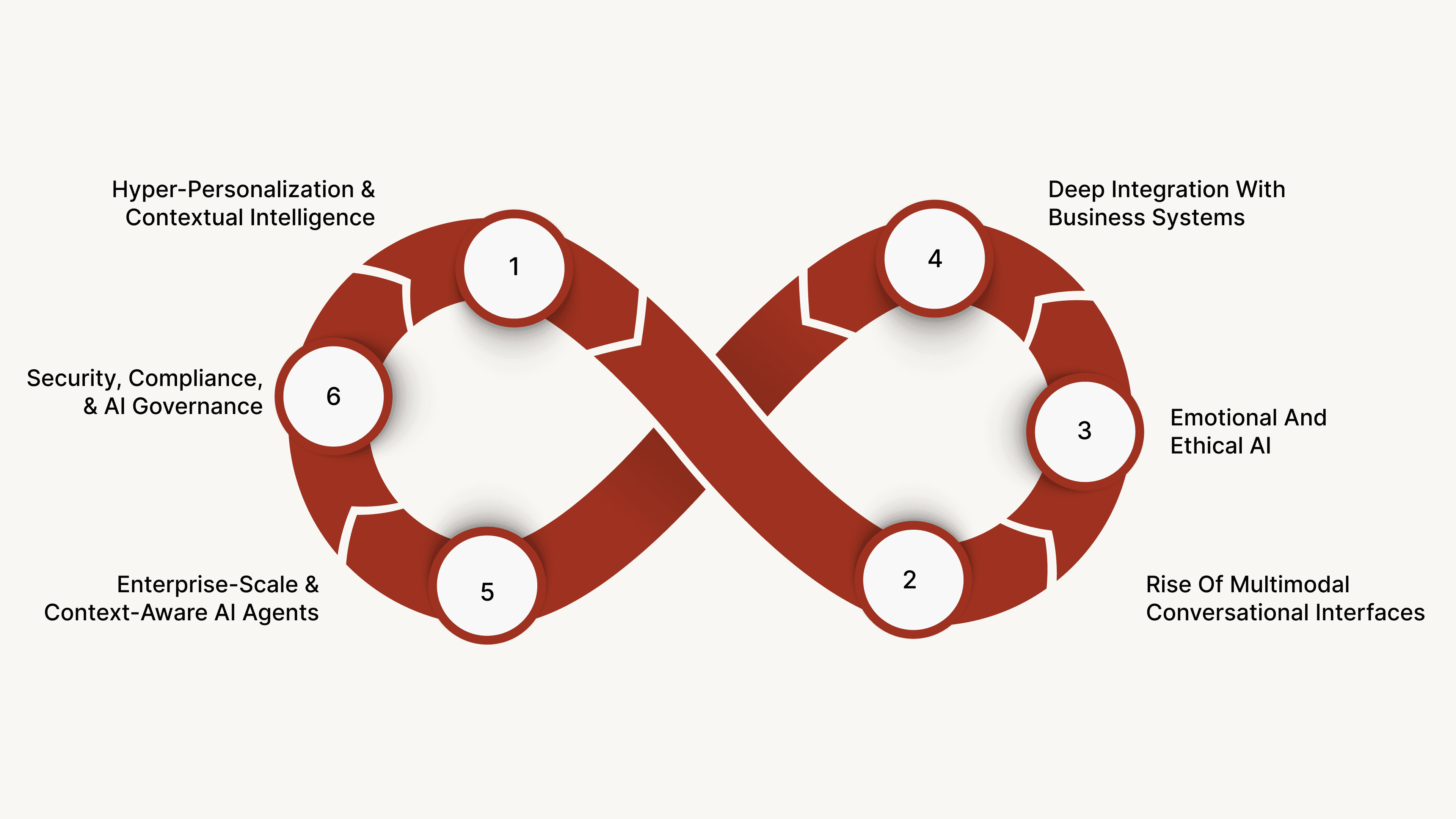
Trend 1: Hyper-Personalization And Contextual Intelligence
Hyper-personalization focuses on building conversations around who the customer is, what they’ve done earlier, and what they are likely to need next.
Instead of treating every user as a first-time interaction, advanced conversational AI leverages behavioral history, contextual data, and ongoing signals to deliver responses that feel intentional, timely, and human, not robotic. For enterprises, this shifts AI from a support tool to a decision-aware engagement layer that improves retention, lifetime value, and trust.
Real-Time Data Integration
Advanced platforms connect directly with enterprise systems such as CRM, transaction records, and past support data to:
Recognize returning users
Recall previous conversations
Predict intent and preempt escalations
Recommend next-best actions in real time
Adaptive Tone and Responses
Personalization also shapes how AI communicates.
Sentiment and urgency influence response tone
Conversations adapt to be empathetic, direct, or transactional
Users experience more respectful, emotionally aware interactions
As personalization becomes more intelligent and emotionally responsive, enterprises are also moving toward richer, more natural interaction models, leading to the rise of multimodal conversational interfaces that combine voice, text, and visual cues for deeper engagement.
Trend 2: Rise Of Multimodal Conversational Interfaces
Conversational AI is moving beyond single-channel interactions toward multimodal experiences that combine voice, text, visuals, and interactive elements.
Instead of forcing users into one format, multimodal AI allows people to speak, type, or visually confirm actions based on what feels most natural at the moment. This results in faster interactions, clearer understanding, and higher task completion rates for enterprises
Voice and Visual Interaction Working Together
Modern conversational systems guide users through complex tasks using both spoken instructions and visual support.
Voice conversations paired with on-screen summaries or options
Real-time visual confirmation for actions like claims, orders, or payments
Reduced confusion in workflows across BFSI, healthcare, and commerce
This combination improves accuracy and decision-making in high-stakes interactions.
Accessibility and Inclusion Advantages
Multimodal AI plays a critical role in India’s diverse digital ecosystem.
Voice-first access for users uncomfortable with typing
Visual cues for users who prefer reading instructions
Better support across languages, literacy levels, and abilities
By blending voice and visuals, conversational AI becomes more inclusive, usable, and effective at scale.
As multimodal experiences make interactions richer and more human-like, the next advancement lies in giving AI the ability to interpret emotion, intent depth, and ethical considerations, moving conversational systems closer to truly empathetic and responsible intelligence.
Suggested Read: Everything You Need to Know About AI Assistants
Trend 3: Emotional And Ethical AI
Conversational AI is evolving from systems that simply process queries to ones that understand emotion, urgency, and human intent.
Emotionally aware AI has become a key differentiator for enterprises because it enables more responsible handling of sensitive conversations, improves trust, and strengthens long-term customer relationships. At the same time, organizations recognize that AI cannot scale without strong ethical and governance foundations.
Emotion Recognition Capabilities
Modern conversational AI analyzes tone, pacing, and language to detect signals such as frustration, anxiety, urgency, or dissatisfaction.
Adjusts responses in real time based on emotional cues
De-escalates tense interactions and prioritizes critical cases
Routes sensitive conversations to human agents when needed
This creates interactions where users feel acknowledged rather than processed.
Ethical AI Practices
As adoption grows, ethical responsibility becomes non-negotiable:
Clear disclosure when users interact with AI
Secure logging and handling of sensitive data
Explainable decisions and audit-ready systems
In regulated sectors like BFSI and healthcare, ethical AI design ensures compliance, reduces risk, and preserves institutional credibility.
With emotional intelligence and ethical governance shaping trust, the next critical step is to embed conversational AI more deeply into enterprise workflows, where it does more than converse and begins to power real business execution at scale.
Trend 4: Deep Integration With Business Systems
Conversational AI is shifting from a standalone engagement tool to a core operational layer within enterprise ecosystems.
Modern platforms integrate directly with CRMs, ERPs, core banking systems, hospital platforms, and policy engines, allowing AI to access data, trigger actions, and complete workflows instead of just responding to queries. This turns conversational AI into a functional execution engine rather than a support add-on.
Workflow Automation
With direct system integration, conversational AI can:
Book appointments and process returns
Trigger payment reminders and updates
Create tickets and escalate priority cases in real time
This reduces manual effort, shortens resolution cycles, and lowers operational costs.
Real-Time Operational Insights
Every interaction becomes structured intelligence:
Tracks intent trends and recurring issues
Identifies service gaps and satisfaction patterns
Supports proactive, data-driven decisions
Enterprises use these insights to improve processes, maintain compliance readiness, and optimize service delivery at scale.
As conversational AI becomes deeply embedded in core systems and starts driving real work, enterprises naturally progress toward scaling these capabilities across broader teams, departments, and business models, accelerating adoption at an enterprise-wide level.
Also Read: What is Conversational AI Analytics?
Trend 5: Enterprise-Scale And Context-Aware AI Agents
Basic chatbots are giving way to intelligent AI agents that act as digital workforce extensions.
These agents understand business context, retain memory across interactions, integrate with enterprise systems, and execute tasks end to end. As a result, conversational AI is now driving real operational outcomes across support, sales, onboarding, and collections.
AI Agents for Support and Sales
Context-aware AI agents handle far more than FAQs:
Qualify leads using behavioral signals
Schedule appointments and process payments
Manage returns, identity verification, and feedback
Escalate intelligently when human input is required
Because they integrate with CRMs and transaction systems, these agents deliver consistent, informed engagement that improves conversion and reduces handling time.
Proactivity Over Reactivity
Next-generation AI agents initiate conversations based on triggers rather than waiting for users.
EMI reminders, renewals, and abandoned carts
Missed appointments and churn indicators
Compliance and risk alerts
This proactive engagement helps enterprises prevent issues, recover revenue, and strengthen customer relationships.
When organizations move toward these powerful, autonomous, and deeply embedded AI agents, the stakes naturally rise, making security, regulatory alignment, governance, and compliance essential foundations for scaling conversational AI responsibly and safely.
Trend 6: Security, Compliance, And Responsible AI Governance
As conversational AI becomes core enterprise infrastructure, trust and governance are no longer optional.
Enterprises now evaluate AI systems with the same rigor as financial or healthcare platforms. Every interaction must be secure, compliant, and auditable to protect users, meet regulatory expectations, and maintain institutional credibility.
Data Privacy Practices
Modern conversational AI platforms are built with privacy by design:
Encrypted storage of voice and text data
Consent-driven recording and access controls
Anonymization of sensitive information
In regulated sectors like BFSI and healthcare, this ensures alignment with RBI, IRDAI, and evolving data protection laws.
Governance and Audit Trails
Responsible AI requires transparency and traceability:
Clear audit logs for conversations and actions
Explainable AI decision paths
Controls to reduce bias and support compliance reviews
Strong governance frameworks give enterprises the confidence to scale conversational AI responsibly across complex environments.
When conversational AI is secured, governed, auditable, and compliant, enterprises gain the confidence to scale adoption across large, complex environments, accelerating strategic rollout and long-term transformation initiatives with far greater certainty.
Also Read: Conversational AI Examples and Use Cases in Various Industries
Conversational AI Trends Across Indian Business Sectors
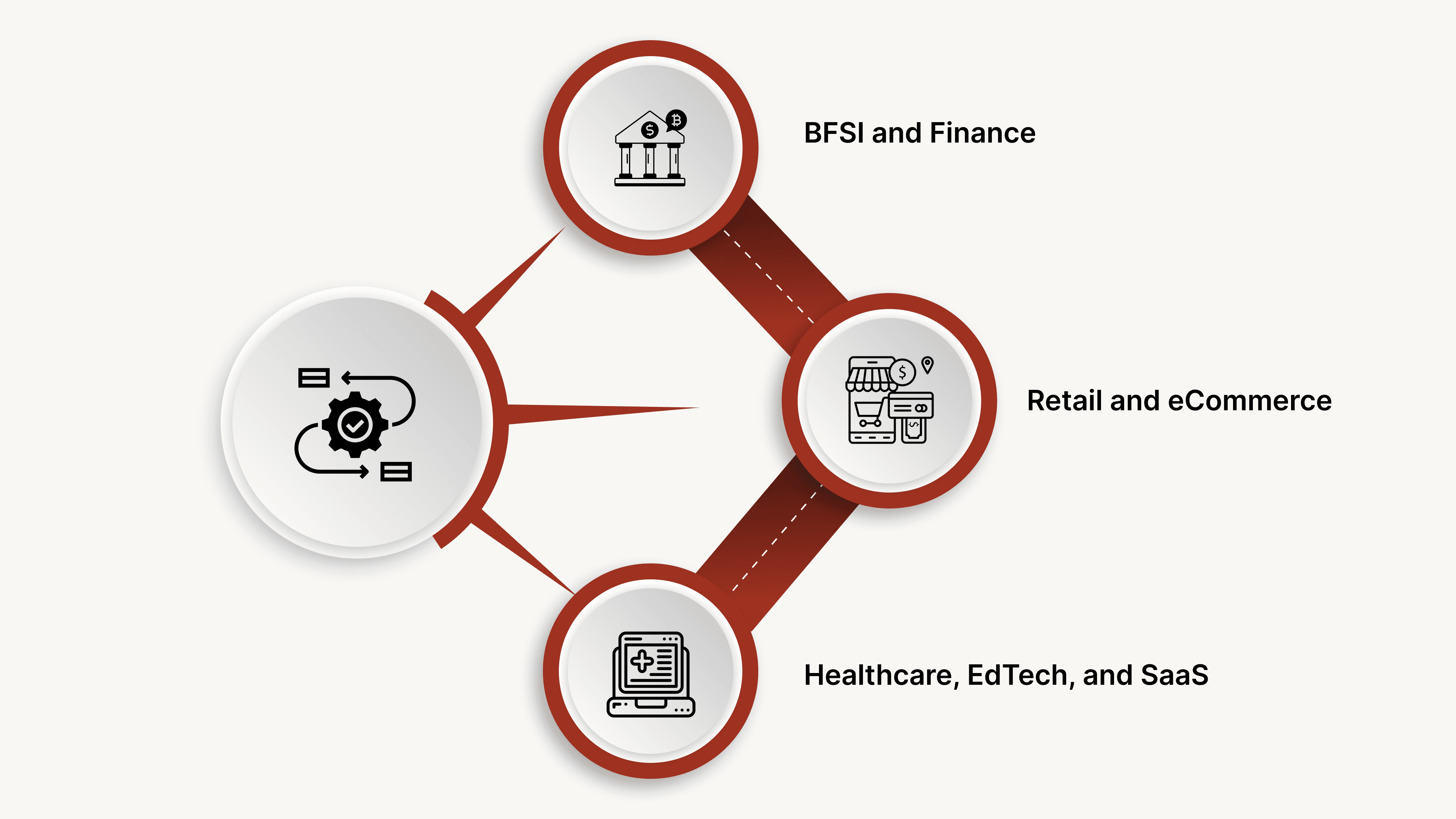
India is seeing one of the fastest enterprise shifts toward conversational AI, driven by high interaction volumes, language diversity, and rising expectations for faster, more human support.
Unlike many markets, adoption in India is shaped by accessibility and regulatory accountability as much as efficiency. As a result, conversational AI is moving from pilot programs to core operational infrastructure across industries.
BFSI and Finance
Banks, NBFCs, and insurers use conversational AI for:
Account servicing and onboarding
EMI reminders, collections, and renewals
Fraud checks and compliance-driven communication
Enterprise-grade AI agents support multilingual voice interactions, consent logging, sentiment detection, and real-time escalation, allowing financial institutions to scale engagement without expanding call center capacity.
Retail and eCommerce
In eCommerce and D2C, conversational AI powers:
Order status updates and delivery support
Returns, refunds, and COD verification
Post-purchase engagement during peak seasons
Multilingual voicebots help brands reach Tier-2 and Tier-3 customers where English-first chat systems fall short, while reducing resolution time and support workload.
Also Read: How Voice Assistants Enhance Delivery Updates for Businesses?
Healthcare, EdTech, and SaaS
Across other high-volume sectors:
Healthcare: Appointment scheduling, discharge follow-ups, reminders, and patient feedback
EdTech: Admissions support, fee reminders, and student engagement
SaaS: Onboarding assistance, renewals, and customer support
In each case, conversational AI improves communication at scale without adding operational burden..
Suggested read: Voice Bots in Healthcare: Top 7 Use Cases Every Hospital Should Know
With these sector-specific shifts accelerating, the next strategic question for enterprises isn’t whether conversational AI matters but which platforms can genuinely support scale, security, multilingual capability, and deep industry fit in India’s evolving business environment.
The Future Of Conversational AI: Where CubeRoot Fits In
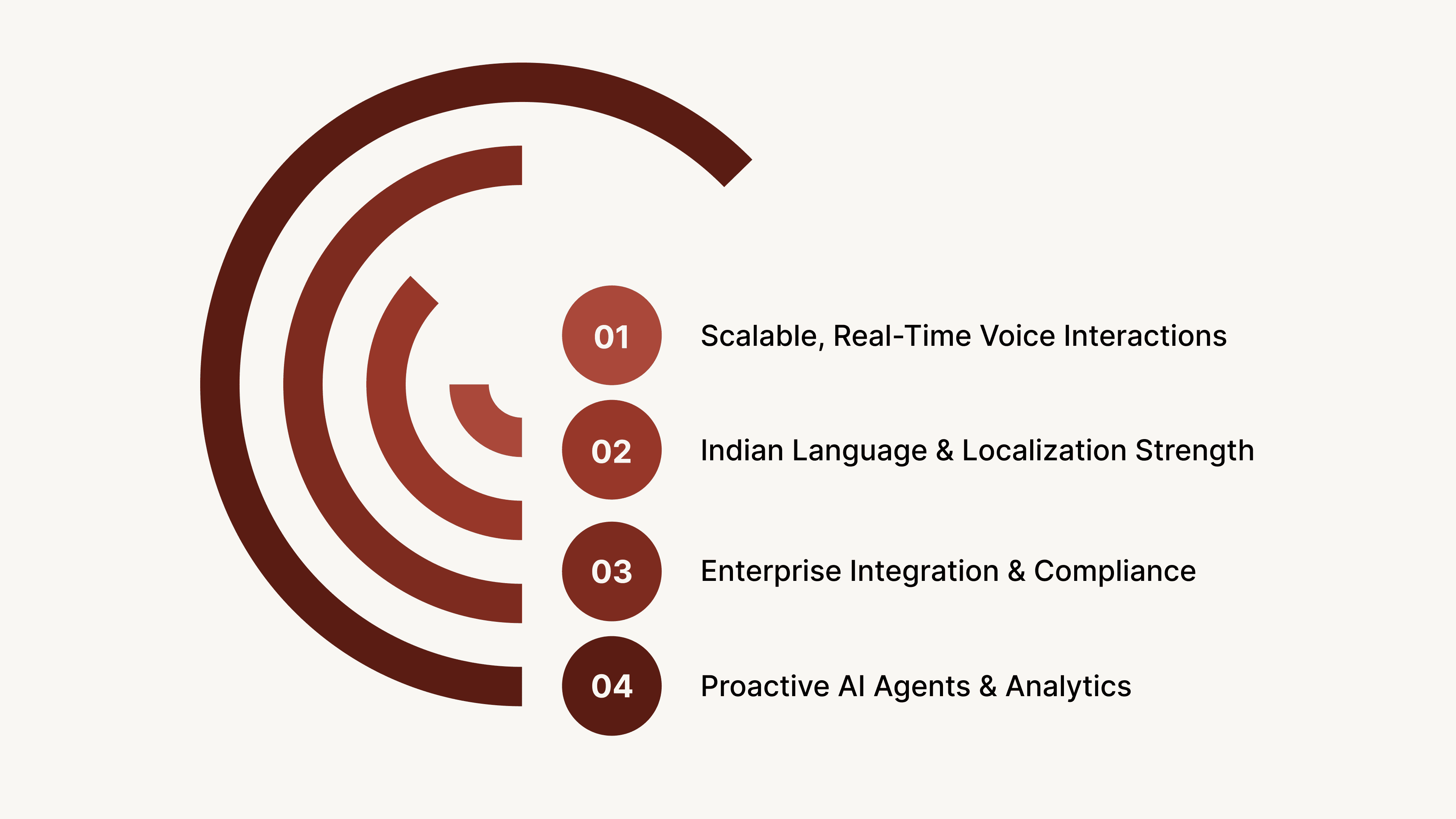
As Indian enterprises move from chatbot experiments to enterprise-grade conversational AI, the need is clear: voice-first, multilingual, compliant, and deeply integrated platforms that scale reliably. CubeRoot is built for exactly this shift.
CubeRoot delivers industry-ready conversational AI designed for India’s volume intensity, language diversity, and compliance expectations, making it a practical, enterprise-strength partner for the road ahead.
Why CubeRoot?
Scalable, Real-Time Voice Interactions: Handles millions of inbound and outbound conversations without latency and delivers natural, human-like voice experiences at scale
Indian Language and Localization Strength: Supports Hindi, Hinglish, and major regional languages and is designed for Tier 1, Tier 2, and Tier 3 customer engagement
Enterprise Integration and Compliance: Integrates with CRM, ERP, HMS, and core systems via secure APIs
Proactive AI Agents and Analytics: Triggers outreach for renewals, reminders, churn risks, and follow-ups
CubeRoot enables Indian enterprises to deploy conversational AI that scales safely, works across languages, integrates deeply, and delivers measurable business outcomes.
If your organization is ready to move beyond basic chatbots and build future-ready conversational AI systems that are intelligent, multilingual, compliant, and enterprise-scale, CubeRoot is built for you. Talk to CubeRoot today and start shaping the future of AI-driven engagement and automation.
FAQs
Q1. What is the future of conversational AI in business?
Conversational AI is evolving from scripted chatbots to proactive, context-aware assistants that automate tasks and enhance user engagement.
Q2. How will conversational AI change customer experience?
Conversational AI will deliver personalized, real-time interactions across voice and text channels, improving satisfaction and reducing operational costs.
Q3. Will conversational AI replace human agents?
AI will augment human workflows, handling routine queries while enabling humans to focus on complex and high-value conversations.
Q4. What industries benefit most from conversational AI?
BFSI, eCommerce, Healthcare, SaaS, and D2C sectors see high impact due to the volume of interactions and the need for 24/7 support.
Q5. What are the biggest challenges for conversational AI adoption?
Security, data privacy, ethics, and integration complexity remain key challenges as organizations scale AI systems.