Dec 31, 2025
Conversational AI in Retail: Benefits and Must-Know Use Cases in 2026
In Indian retail, every customer interaction carries weight. A fashion retailer in Surat must confirm store-level stock availability within seconds. A home appliances chain in Chennai needs to manage installation queries and warranty follow-ups without overwhelming its service desk. The fulfillment of these demands shapes how customers perceive your brand.
But when support teams can’t respond quickly enough, or when information varies across stores, customers feel the friction. Missed calls turn into missed sales. Delayed responses lead to cancellations. Inconsistent communication damages trust, and that's something no Indian retailer can afford in a highly competitive market.
This is why you need intelligent, conversational AI that can instantly handle high volumes, deliver accurate information, and speak to customers in their preferred language. Before choosing how to implement it, you should understand its advantages and the specific retail use cases where it delivers measurable impact.
Key Takeaways
Conversational AI is reshaping Indian retail by enabling fast, multilingual, and accurate customer interactions across channels. It supports high inquiry volumes.
Its impact spans the entire retail journey, enhancing product discovery, guided selling, checkout assistance, post-sale support, and loyalty engagement. This delivers a smooth experience across online and offline touchpoints.
You gain measurable operational and revenue benefits, including lower agent workload, fewer escalations, more innovative personalization, and deeper insights from honest conversations.
You must address key challenges, including fragmented systems, data inconsistencies, and linguistic diversity, up front to maintain AI accuracy and customer trust.
Successful implementation requires structured execution, including clear goals, system integrations, journey mapping, controlled pilots, and continuous optimization. This ensures the AI stays accurate as products, offers, and customer needs change.
What Conversational AI Means in Retail
Conversational AI in retail refers to intelligent, NLP-powered virtual assistants that interact with shoppers in natural language across websites, mobile apps, WhatsApp, and in-store kiosks. These assistants help customers find products, resolve queries, and complete purchases, just like a trained store associate, but available round-the-clock.
The conversational AI market in India is projected to reach $1,846 million by 2030, growing at a 26.3% CAGR. That shows retailers are aggressively adopting it to meet rising customer expectations and operational complexity.
Example: A regional apparel retailer in Indore can deploy voice and chat automation to confirm size availability, suggest alternatives, or inform customers about ongoing offers. That can reduce wait times and drive faster purchase decisions.
Also Read: Conversational AI Examples and Use Cases in Various Industries
With the fundamentals in place, let’s explore the key benefits it brings to modern retail.
The Most Powerful Benefits of Conversational AI in Retail
For Indian retailers, conversational AI is becoming the engine behind smarter operations, stronger customer relationships, and faster revenue growth. Below is a high-value breakdown of the benefits.
1. Actionable Insights Through Intelligent Data Extraction
Retail generates enormous amounts of customer data every minute, from product inquiries to warranty questions. Conversational AI acts as a continuous insight engine, capturing and interpreting these interactions to help you understand shopper intent, sentiment, and emerging trends.
What it delivers:
Identifies popular products, frequently asked questions, and buying triggers
Reveals friction points in the customer journey
Helps forecast demand and optimize assortments
Example: A furniture retailer in Kochi can analyze chatbot interactions and learn that customers frequently ask about delivery timelines for specific sofa models. This insight helps them adjust inventory planning and improve regional stocking.
Also Read: What is Conversational AI Analytics?
2. Instant, Always-On Customer Interactions
Retailers handle high inquiry volumes daily. Conversational AI provides instant responses across touchpoints, ensuring your customers get help even beyond store or call-center hours.
Advantages:
24/7 multilingual support
Consistent and accurate replies across all stores
Lower dependency on large customer support teams
3. Improved Sales Through Personalization
Retail shoppers expect personalized recommendations. Conversational AI analyzes behavior, preferences, and past interactions to suggest relevant products.
How it boosts revenue:
Recommends complementary items (cross-sell) to increase Average Order Value (AOV)
Identifies premium alternatives (upsell)
Helps shoppers find the right size, color, or variant
Example: A beauty retailer in Hyderabad may use AI chat assistants to recommend skincare products based on concerns (“dry skin”, “acne care”), increasing conversion rates.
Did You Know? Beauty retailer Nykaa found that personalizing recommendations led to a 40% boost in sales.
4. Unified Online and Offline Retail Experience
Shoppers expect a consistent journey across channels. Conversational AI bridges store and digital experiences. Here's what it offers in this regard:
Checking store stock before visiting
Sharing personalized offers before customers arrive
Providing product details via voice/chat kiosks inside stores
Helping customers build shopping lists they can redeem offline
Example: A large apparel chain may use conversational AI to help customers shortlist outfits online and reserve them for try-on at their nearest store. This approach helps drive higher footfall and conversions.
5. Stronger Engagement Through Interactive Content
With high smartphone usage, engaging content influences buying decisions. Conversational AI complements this trend by guiding users while they consume digital content. It can:
Display product recommendations below the videos
Answer questions during live streams
Push exclusive offers during product demos
Why it matters: Engagement becomes two-way instead of static, improving both time spent and conversion likelihood.
6. Enhanced Post-Sale Experience
It enhances the after-sales experience by providing reliable support after purchase. By learning from every interaction, AI assistants deliver responses that feel more human, more contextual, and more relevant to each shopper’s preferences. It improves:
Post-sale support (order tracking, installation, warranty queries, service updates)
Personalized follow-ups and feedback collection
Also Read: How Voice Assistants Enhance Delivery Updates for Businesses?
7. Improved Employee Productivity
Instead of handling repetitive queries, staff can focus on high-value tasks such as in-store conversions, complex service issues, and complaint handling.
Benefits:
Higher productivity
Reduced burnout
Better quality of human-led conversations
8. Consistent Brand Experience
Conversational AI allows you to standardize tone, accuracy, and response quality, regardless of store location or team size. It allows you to:
Custom-train assistants to match brand voice
Maintain consistent service across metros and Tier-2/Tier-3 towns
Offer uniform information on offers, policies, and processes
9. Reduced Customer Escalations
Indian shoppers expect quick, precise answers, and any delay can lead to irritation or disengagement. Conversational AI helps you prevent frustration before it builds.
How it prevents churn:
Immediate answers reduce store/call abandonment
Intelligent routing ensures timely handover to human agents
Consistent tone prevents negative experiences
With the benefits clear, the next step is to understand where conversational AI has the most significant impact on retail operations.
Top Retail Use Cases for Conversational AI
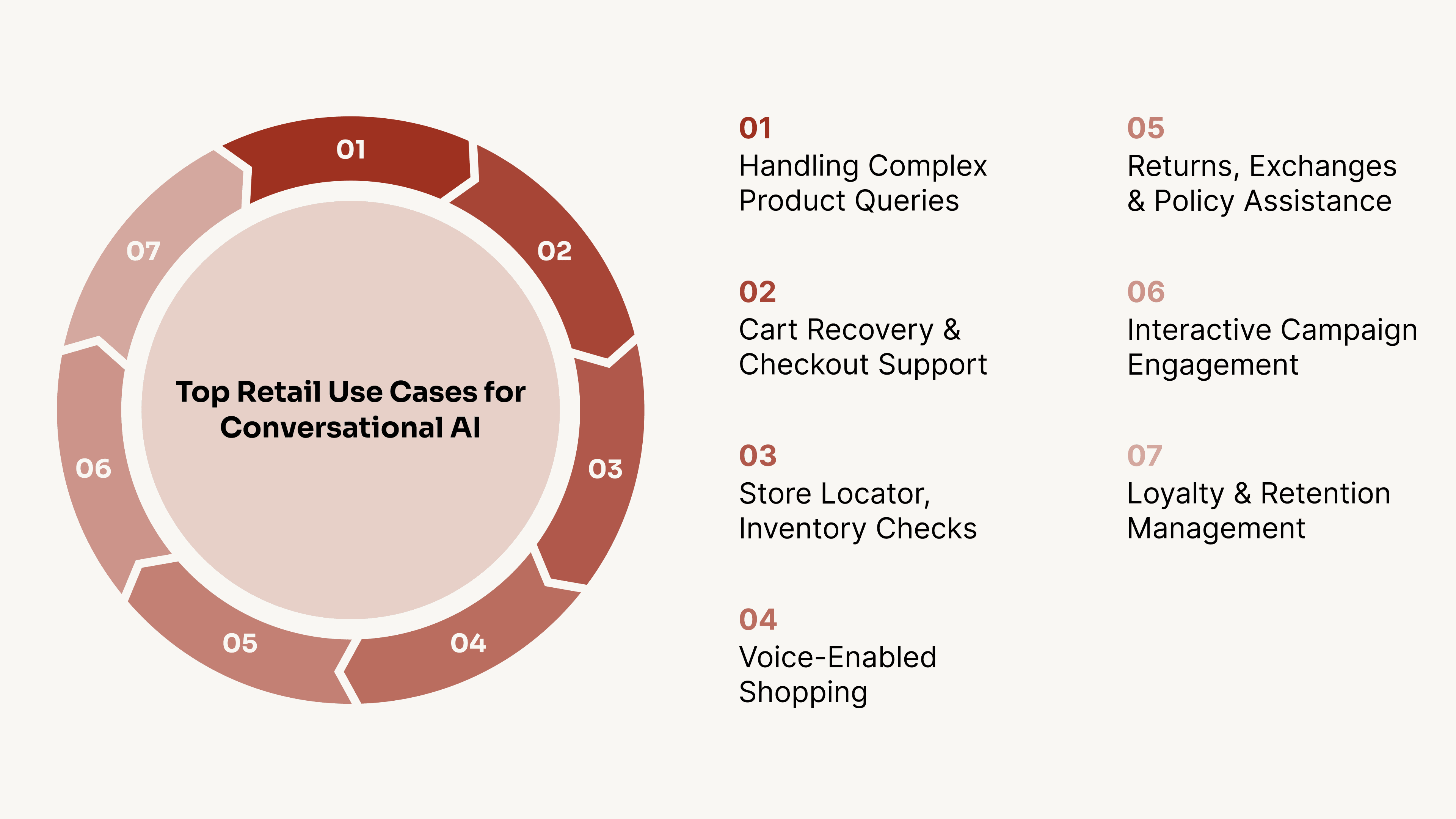
Conversational AI enhances every stage of the retail journey, from discovery and decision-making to post-purchase care. Below is a consolidated list of use cases.
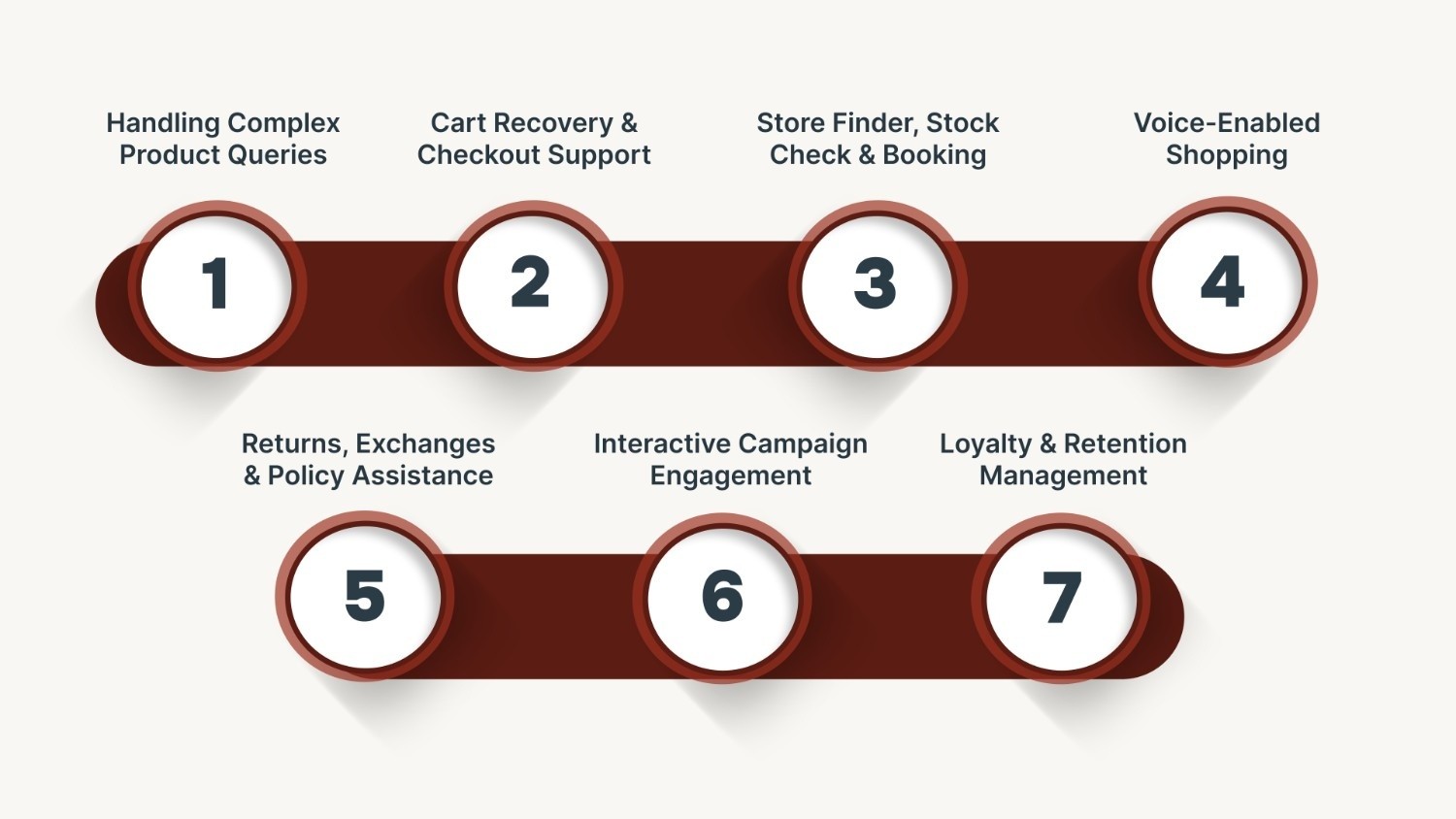
1. Handling Complex Product Queries
Retail product catalogs can be vast and detailed. Conversational AI simplifies this by providing instant, precise answers to questions about specifications, variants, compatibility, or styling.
For instance:
“Does this mixer grinder come with a 5-year warranty plan?”
“Do you have this shirt in XXXL at the Colaba store?”
“Which facewash will be apt for my oily skin?”
2. Cart Recovery & Checkout Support
AI identifies shoppers' hesitation to buy and proactively re-engages them. Instead of waiting for customers to return, conversational AI guides them through completion.
How it helps:
Sends reminders for abandoned products
Offers alternative payment options
Highlights limited-stock alerts or ongoing offers
Answers FAQs that typically stall checkout
Example: A footwear brand can send a timely AI notification: “Your sneakers are almost out of stock, complete your purchase now to avail free delivery and a 5% discount.”
3. Store Locator, Inventory Checks & Appointment Booking
Conversational AI smoothly connects digital browsing with physical retail experiences. It helps customers find the nearest store and book trial sessions, demos, or service appointments, and instantly shares store directions and timings.
4. Voice-Enabled Shopping
Voice AI gives customers a hands-free, intuitive shopping experience that's ideal for multitasking or users with visual limitations.
Common voice commands:
“Order more detergent.”
“Show trending kurtas.”
“Check today’s discounts on groceries.”
Why it matters: Voice-first experiences align well with India’s linguistic diversity.
5. Returns, Exchanges & Policy Assistance
Retailers with broad product ranges often face queries about return/exchange policies. Conversational AI handles them with clarity and consistency.
What it simplifies:
Eligibility checks
Pickup scheduling
Refund or exchange timelines
Policy explanations customized by category
6. Interactive Campaign Engagement
Retailers increasingly run campaigns on WhatsApp, Instagram, and Messenger. Conversational AI turns them into interactive shopping journeys.
Capabilities:
Display product catalogs within chat
Run quizzes, contests, or style finders
Collect leads and drive purchases directly from chat
Share personalized promotions
7. Loyalty & Retention Management
AI makes loyalty programs more engaging and easier to manage. It reminds customers about expiring points, suggests ways to redeem rewards, and tracks loyalty tiers and benefits.
While conversational AI offers clear advantages, implementing it in retail isn’t without its hurdles. Before adopting the technology, it’s essential to understand the key challenges you can face down the line.
The Biggest Roadblocks to Conversational AI Implementation in Retail
As you move toward automation, the real challenge is ensuring the solution functions reliably in data-heavy retail environments. Here are the core obstacles you must keep in mind to achieve consistent, high-quality outcomes.
Maintaining Accurate and Up-to-Date Product Data: AI relies heavily on clean catalogs, current stock levels, and consistent policy information. Any data gap affects answer quality and customer trust.
Handling India’s Diverse Languages and Speech Patterns: Mixed-language queries and regional accents can reduce conversational AI accuracy.
Adapting AI to Category-Specific Retail Journeys: Fashion, electronics, beauty, and home appliances each have unique workflows. Generic AI chatbots often fail without domain-specific training and logic.
Ensuring Smooth Human Escalation: For complex queries, the handoff from AI to a store associate or agent must be smooth. Breaks in context or repeated questions damage the customer experience.
Encouraging Team Adoption and Continuous Optimization: Store teams may resist new automation. Moreover, AI models require ongoing refinement to reflect new products, promotions, and seasonal changes. Without this, performance declines.
Once these challenges are accounted for, you can build a rollout plan that drives consistent, measurable impact.
How to Implement Conversational AI in Retail (Step-by-Step Guide)
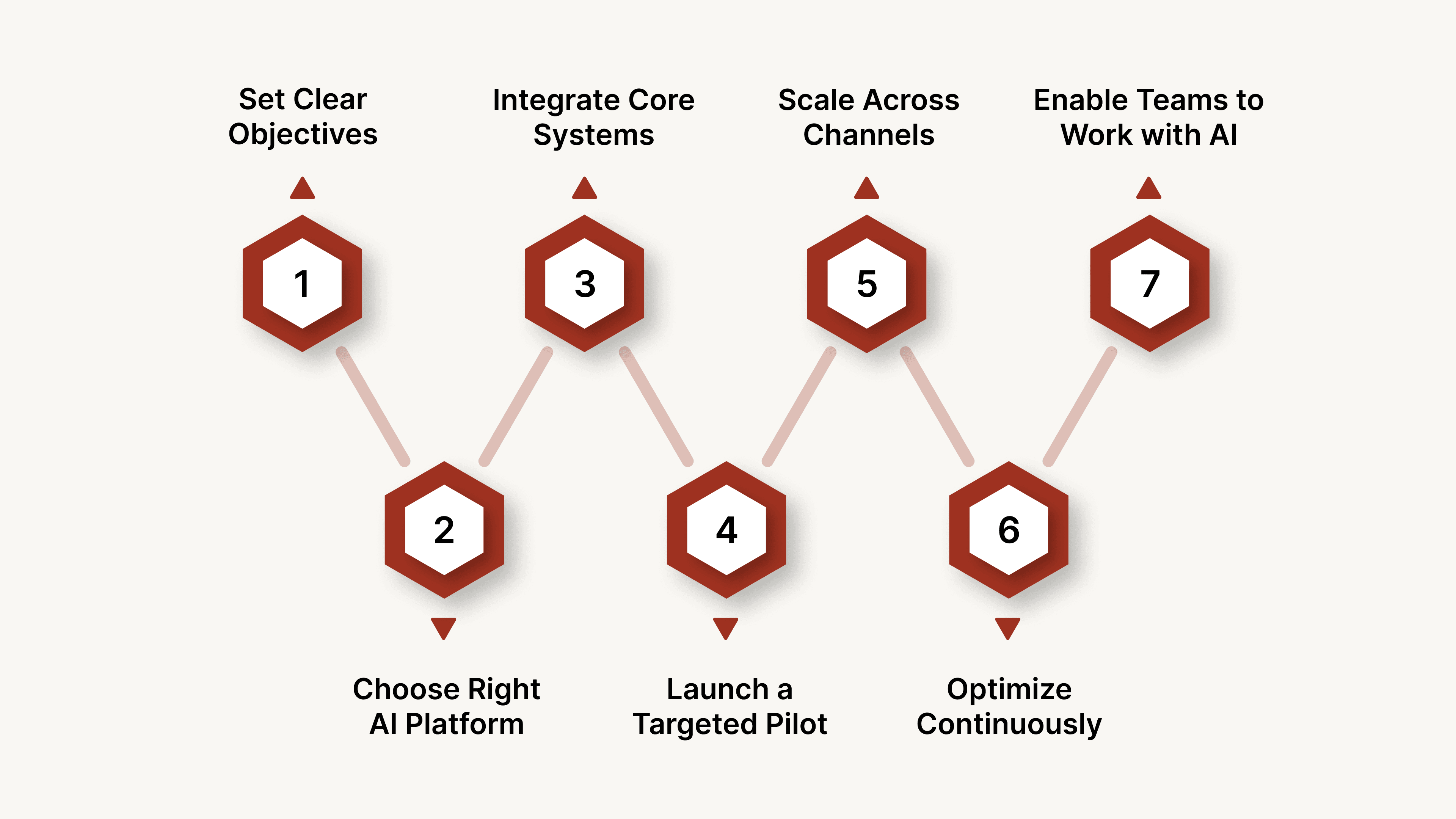
Successful implementation requires more than just deploying a chatbot. Here’s a practical roadmap designed for modern Indian retail operations.
Step 1: Set Clear Objectives and Map Key Customer Journeys
Start by defining what you want conversational AI to achieve: faster customer support, better product discovery, higher conversions, or smoother post-purchase interactions. Then, map the whole customer journey across pre-sale, in-store, checkout, and after-sales touchpoints. This helps you identify where AI can deliver the most value and what dialog flows or escalation rules you need.
Step 2: Choose the Right Retail-Focused AI Platform
Select a platform that understands retail-specific workflows and supports multilingual NLP tailored to Indian shoppers. Look for strong integrations, no-code or API-first deployment, omnichannel compatibility, and domain-trained models. A retail-ready platform ensures your AI responds accurately to product variants, store availability, and other questions.
Step 3: Integrate Core Systems
Connect the AI to your POS, ERP, CRM, inventory, and order management systems. Real-time integration ensures customers always receive up-to-date information.
Step 4: Launch a Targeted Pilot
Test the system with a single well-defined use case, such as a store locator, warranty queries, or guided product discovery, on a single channel. Monitor KPIs like resolution rate, CSAT, engagement, and agent load reduction. This approach helps you validate AI performance and refine conversation flows before expanding.
Step 5: Scale Across Channels
Once the pilot delivers predictable results, gradually expand to additional touchpoints, such as WhatsApp, website chat, in-store kiosks, and voice-based customer care.
Step 6: Optimize Continuously and Ensure Ethical, Secure Governance
Conversational AI requires ongoing improvement, including adding new intents, updating product data, tuning flows for seasonal changes, and refining speech recognition for regional accents. Moreover, you must maintain strict data governance through encryption, transparent disclosures, and routine audits to ensure fairness and compliance.
Step 7: Enable Teams to Work with AI
Train store staff and support agents to collaborate with the conversational AI system. These include understanding when escalations occur, how to use AI-generated insights to improve service, and how the assistant offloads routine tasks.
With the proper implementation plan in place, the final step is to choose a platform capable of delivering this level of scalability and retail-specific intelligence. This is where CubeRoot stands out.
How CubeRoot Enables a Smarter Conversational AI-Driven Retail Experience
Implementing conversational AI in retail is only successful when automation, human expertise, and real-time intelligence work together. CubeRoot makes this possible with an enterprise-grade Voice AI platform explicitly designed for high-volume, fast-moving sectors like retail. Here’s how it helps you deploy and scale conversational AI with confidence:
GenAI-Powered Prompt Builder: CubeRoot’s prompt builder enables your team to launch new use cases, such as product discovery flows, store-level FAQs, or post-purchase follow-ups.
Implementation to Go-Live in 14 Days: Prebuilt retail templates and API-first integration help you go live quickly and achieve 50% faster ticket resolution from day one.
Real-Time Transcription & AI Summaries: Instant call transcriptions and summaries speed up handling time and ensure compliance.
Daily Reports & AI-Driven Insights: Automated insights optimize campaigns, scripts, and team performance, helping you cut support costs.
Human-Like Voices With Sentiment Tracking: Emotion-aware, multilingual voice agents reduce escalations and maintain positive interactions, contributing to up to 25% higher CSAT and brand perception.
Smooth Human Escalation With Full Context: Complex queries route to agents with complete context, reducing repetition and enabling faster, high-quality resolutions.
Enterprise-Grade Security & Data Sovereignty: Data is hosted securely in India (AWS/Azure/GCP), backed by ISO 27001, SOC 2, encryption, and privacy-first controls to protect sensitive retail interactions.
Ready to automate high-volume retail queries, improve CSAT, and scale customer support 24/7? Schedule a demo to see how CubeRoot’s Voice AI boosts resolution speed, reduces support costs, and enhances revenue generation across every retail touchpoint.
FAQs
1. What is the difference between conversational AI and AI in retail?
Conversational AI focuses on automating customer interactions through chat or voice, while AI in retail is broader. It covers demand forecasting, inventory optimization, pricing, and personalization.
2. Can conversational AI handle store-specific variations?
Yes. When integrated with store-level systems, conversational AI can fetch region-specific promotions, inventory differences, and localized service options. This ensures responses reflect each store’s real-time conditions rather than generic information.
3. How does conversational AI maintain accuracy during peak seasons?
Scalable voice infrastructure and intent optimization allow AI systems to manage sudden spikes. Load balancing, cached responses for high-frequency intents, and real-time system sync help maintain response quality.
4. Does conversational AI support customers who mix languages like Hinglish or Tanglish?
Modern NLP models trained on Indian speech patterns can accurately interpret mixed-language queries. They analyze intent rather than depending on exact grammar, enabling smooth conversations across regional accents, dialects, and hybrid language inputs.
5. What if we need to change offers or pricing frequently?
Conversational AI connected to promotion engines or price APIs updates responses instantly. This ensures customers always receive current deals, preventing misinformation.