Dec 26, 2025
Conversational AI in Retail: The Key to Faster, Scalable Customer Support
India’s retail sector is undergoing one of the fastest transformations globally. With the market projected to reach nearly $4 trillion in the coming years, retailers are experiencing unprecedented growth and with it, unprecedented operational pressure. Customers now expect instant answers, seamless support, and real-time visibility across every stage of their shopping journey.
At the same time, AI adoption in retail is accelerating at record speed. Nine out of ten retailers are now adopting or piloting AI, signaling a clear industry-wide shift toward automation-driven customer experience. As consumer expectations rise and operational complexity intensifies, conversational AI has emerged as a foundational technology that helps retailers scale intelligently, deliver consistent CX, and keep costs under control.
This blog explores conversational AI in retail, its benefits, key use cases, adoption challenges, and why modern Voice AI platforms are becoming essential for high-growth retail and e-commerce brands in India.
Key Takeaways
Conversational AI has become essential infrastructure for India’s $4T retail market, enabling brands to handle rising customer expectations for instant, multilingual, 24/7 support at scale.
Enterprise-grade conversational AI is fundamentally different from basic chatbots, offering deep system integrations, contextual understanding, and multi-turn intelligence needed for real retail workflows.
Retailers can automate high-volume interactions such as WISMO queries, returns, COD verification, and delivery coordination, dramatically reducing operational load and cost.
Conversational AI delivers measurable improvements in CX and logistics efficiency, including faster resolutions, fewer escalations, better feedback capture, and lower RTO through proactive engagement.
CubeRoot’s voice-first, India-trained automation layer transforms retail operations end-to-end, providing rapid deployment, sub-10-second response times, multilingual accuracy, and seamless integration with OMS, CRM, and logistics systems.
What Is Conversational AI in Retail? (Voice + Chat + Automation)
Conversational AI refers to the technology that enables machines to understand, interpret, and respond to human language through voice or text. It combines automatic speech recognition (ASR), natural language understanding (NLU), machine learning, and workflow automation to deliver human-like, two-way interactions at scale.
Instead of relying on rigid scripts, conversational AI analyzes intent, context, and past interactions to provide accurate, real-time responses.
In retail, conversational AI automates high-volume customer journeys for order tracking, returns, delivery updates, product inquiries, and post-purchase engagement.
What sets retail-focused conversational AI apart is its deep integration with backend systems such as OMS, CRM, and ERP platforms, allowing it to fetch live data, trigger actions, and resolve queries instantly. It also requires speech recognition tuned to India’s multilingual environment and domain-trained models that understand retail-specific terminology, customer behavior, and workflows.
Difference Between Basic Chatbots and Enterprise-Grade Conversational AI
Basic chatbots and enterprise-grade conversational AI are often conflated, but their underlying technology, intelligence, and operational depth differ fundamentally. Here’s how they diverge at the feature and system level:
1. Rules-Based Logic vs. Intent-Driven Understanding
Legacy chatbots operate on predefined scripts and keyword matching, meaning they can only respond to what they’ve been explicitly programmed to recognize.
Enterprise conversational AI uses intent detection, context modeling, and natural language understanding (NLU) to interpret variations in phrasing, accents, and real-world retail scenarios.
2. Linear Flows vs. Contextual, Non-Linear Conversations
Basic chatbots follow rigid decision trees. If a customer steps outside the script, the chatbot fails.
Conversational AI maintains context across turns, understands interruptions, and adapts to how customers naturally speak, crucial for voice interactions and multilingual markets.
3. Surface-Level Interaction vs. Deep System Integration
Legacy chatbots can only provide surface-level responses (FAQs, static information). Enterprise conversational AI connects with OMS, CRM, ERP, WMS, and logistics APIs, enabling it to fetch live data, update orders, trigger workflows, and complete end-to-end tasks.
4. Limited Language Handling vs. Speech & Text Models Tuned for India
Chatbots rely on generic language models and often struggle with accents, dialects, and code-mixed queries. Conversational AI uses speech recognition and NLU models trained on Indian languages, improving accuracy across Hindi, Tamil, Telugu, Bengali, Kannada, and English.
5. Single-Turn Replies vs. Multi-Turn Conversation Management
Basic chatbots handle isolated questions but fail when conversations span multiple steps.
Conversational AI maintains memory, handles clarifications, verifies details, and continues the flow without forcing the user to start over.
6. No Escalation Logic vs. Human-in-the-Loop Architecture
Legacy bots dead-end when they can’t answer. Enterprise conversational AI includes structured escalation paths that seamlessly transfer context-rich conversations to live agents
Key Benefits of Conversational AI for Retail
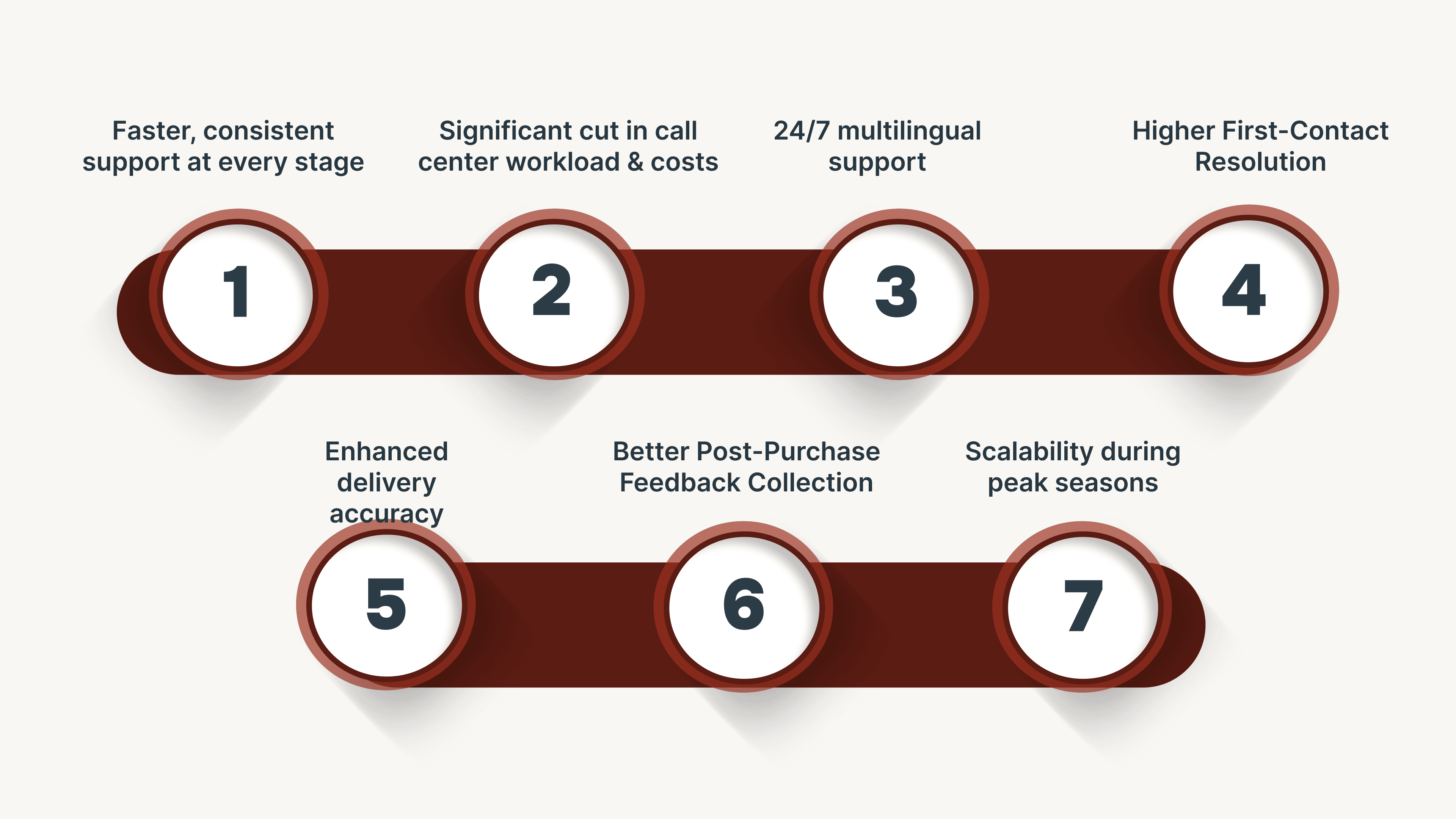
As retail operations grow more complex and customer expectations rise, conversational AI is becoming one of the most future-ready technologies for modern brands.
Conversational AI addresses the changing realities of scale, speed, personalization, and multilingual engagement, capabilities that traditional support models can no longer keep up with. Below are a few benefits of conversational AI in the Retail industry.
1. Faster, Consistent Customer Support Across All Journeys
Conversational AI provides instant responses to routine queries such as order tracking, returns, delivery updates, product information, and payment verification. Every customer receives the same accurate, compliant message, regardless of time or query volume.
2. Huge Reduction in Call Center Workload & Operational Costs
By automating high-frequency tasks such as WISMO calls, COD confirmations, and delivery scheduling, retailers significantly reduce their dependence on agents. This lowers support costs and allows human teams to focus on complex or high-value interactions.
3. 24/7 Multilingual Customer Experience
Retailers can support customers in multiple Indian languages around the clock. This is especially important in markets where voice-first communication and regional languages dominate customer behavior.
4. Higher First-Contact Resolution (FCR)
Because conversational AI integrates with CRM, OMS, and logistics systems, it can resolve many issues instantly, without escalating to agents. This improves customer satisfaction while reducing back-and-forth interactions.
5. Improved Delivery Accuracy & Lower RTO Through Proactive Updates
AI-driven outbound communication helps confirm COD orders, verify addresses, share delivery timelines, and reduce failed delivery attempts. These interventions directly minimize return-to-origin (RTO) costs for retailers.
6. Better Post-Purchase Feedback Collection (NPS/CSAT)
Voice-led feedback automation increases response rates and gathers more accurate customer sentiment. Retailers can identify issues sooner and act before they affect retention.
7. Scalability During Peak Season Surges Without Extra Staffing
During major festivals or sale events, conversational AI can handle thousands of simultaneous interactions without requiring temporary hiring or operational restructuring. This ensures a smooth customer experience even at peak load.
Related: Conversational AI for Customer Service: Benefits and How It Works
7 High-Impact Use Cases of Conversational AI in Retail
Conversational AI is now embedded across multiple stages of the retail customer journey. Some applications replace outdated, agent-heavy workflows, while others reimagine processes entirely to meet the scale, speed, and multilingual needs of India’s retail ecosystem.
Below are some of the most impactful use cases that demonstrate how AI is reshaping customer engagement and operational efficiency for modern retail and e-commerce brands.
1. Order Tracking & “Where Is My Order?” Automation
Order tracking is the single highest-volume query most retailers face, especially during peak seasons. Conversational AI connects directly with OMS and logistics systems to provide instant, accurate delivery updates the moment customers ask.
By automating these interactions through voice or chat, retailers dramatically reduce WISMO calls while ensuring customers receive consistent, real-time information without waiting in support queues.
2. Returns & Refund Processing
Returns are one of the most operationally complex journeys in retail, often involving multiple steps and dependencies. Conversational AI makes this seamless by verifying order details, checking eligibility, initiating the return, and automatically sharing refund timelines.
This reduces human errors, eliminates agent dependency for routine steps, and gives customers a faster, clearer experience from start to finish.
3. COD Confirmation & Fraud Control
Cash-on-delivery orders continue to drive high operational costs due to fraud and failed deliveries. Conversational AI automates COD verification by reaching out to customers, confirming purchase intent, and updating order status in real time.
This ensures orders are shipped only after confirmation, substantially lowering RTO rates, improving delivery efficiency, and protecting margins.
4. Delivery Rescheduling & Address Verification
Missed deliveries often occur because customers are unavailable or their address details are incomplete. Conversational AI proactively manages this by allowing customers to reschedule deliveries or clarify their address via an automated call or chat session.
These updates sync with logistics systems in real time, reducing failed delivery attempts and providing smoother last-mile coordination.
5. Product Discovery & Catalog Queries
Customers frequently seek information on product availability, variants, sizing, pricing, or restock timelines. Conversational AI integrates with catalogs and inventory systems to deliver accurate, up-to-date responses instantly.
It can also recommend alternatives based on preferences, helping customers discover relevant products while reducing the burden on sales and support teams.
6. Post-Purchase Feedback (NPS/CSAT) & Complaint Triage
Collecting feedback at scale is difficult through traditional channels like email or SMS, which often get low response rates. Conversational AI improves this dramatically by reaching out through voice or chat, recording customer sentiment, identifying dissatisfaction early, and routing complex issues to the right teams.
This gives retailers immediate visibility into customer experience gaps and enables proactive resolution.
7. High-Volume Festival Sales Support (Diwali, Big Billion Days, etc.)
Festival seasons can multiply support volumes overnight, pushing human teams beyond their limits. Conversational AI scales instantly to handle tens of thousands of queries at once, covering order updates, cancellations, return requests, product information, and delivery concerns.
Retailers avoid emergency hiring, maintain consistent service quality, and prevent customer frustration even during extreme surges.
Also read: Conversational AI Examples and Use Cases in Various Industries
Common Mistakes Retail Brands Make When Deploying AI (And How to Avoid Them)
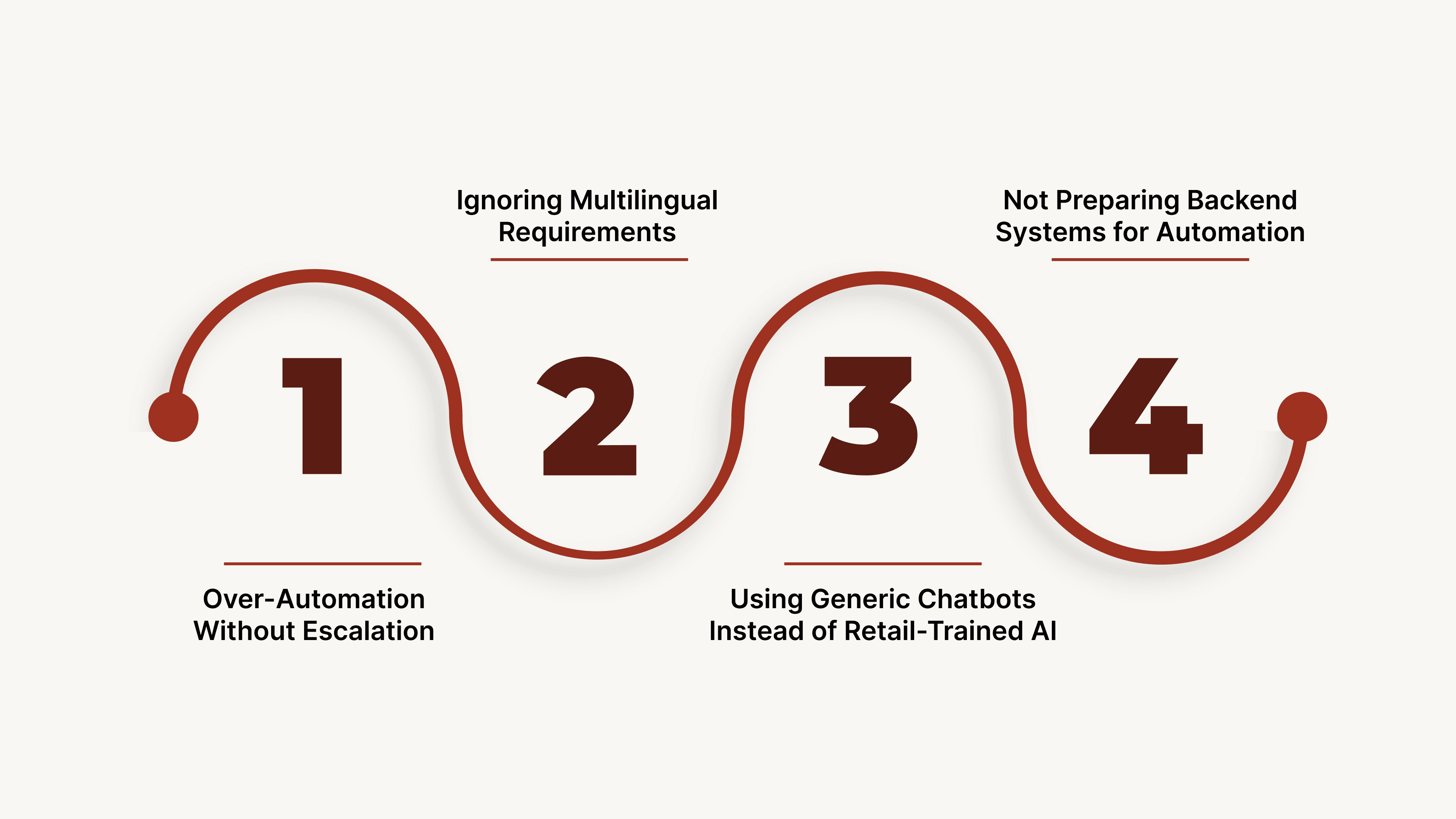
While conversational AI offers massive value to retailers, many brands struggle to unlock its full potential because of avoidable implementation mistakes. These gaps typically arise not because of the technology itself but because of how it is planned, trained, and integrated.
Over-Automation Without Escalation
A frequent mistake is assuming AI can handle every customer scenario end-to-end. When automation is pushed too far, especially in cases involving complex issues, emotional interactions, or exceptions, customers get stuck in loops without a path to a human agent. This results in frustration and poor CX.
A well-designed system includes clear escalation rules, context transfer, and agent handoff mechanisms to ensure that AI and human teams complement each other.
Ignoring Multilingual Requirements
India’s retail audience communicates across a broad mix of languages, dialects, and accents. Retailers often deploy AI systems trained primarily on English or generic datasets, leading to misinterpretation and poor accuracy in real-world conversations.
Effective deployment requires speech recognition and intent models tuned specifically for Indian linguistic patterns, enabling the AI to understand how customers naturally speak across regions.
Using Generic Chatbots Instead of Retail-Trained AI
Some brands start with basic chatbots that rely on fixed scripts or keyword triggers. While they may answer simple FAQs, they cannot handle retail workflows such as order tracking, return initiation, or delivery rescheduling because they lack real-time data access and domain-specific intelligence.
Retail-ready AI needs integrations with OMS, CRM, ERP, and logistics systems and must be trained on retail-specific intents to understand contextual nuances such as SKU names, COD processes, or delivery statuses.
Not Preparing Backend Systems for Automation
Conversational AI is only as effective as the systems it connects to. Retailers sometimes deploy AI without ensuring their OMS, logistics APIs, CRM, or internal databases are standardized, accessible, and updated in real time. This creates inconsistencies in responses and limits automation depth.
Preparing backend infrastructure, like clean data, stable APIs, unified order and customer records, is essential for enabling AI to execute tasks reliably instead of merely answering questions
How CubeRoot Transform Retail Automation

Modern retail requires high-speed, multilingual, and deeply integrated automation, something traditional call centers or basic chatbots cannot deliver.
CubeRoot is explicitly built for high-volume Indian retail and eCommerce environments, where multilingual customer bases, COD-heavy operations, and intense seasonal surges demand automation that is fast, accurate, and deeply integrated into core retail systems.
Prebuilt Retail Workflows Designed for Scale: CubeRoot comes with ready-made workflows for order tracking, returns and refunds, delivery feedback, and COD confirmation. These flows are trained on real retail interactions, allowing brands to automate large volumes immediately.
Multilingual Voice AI for India’s Retail Audience: With natural-sounding voices across Hindi, Tamil, Telugu, Kannada, Bengali, and English, CubeRoot adapts to how India speaks. Customers receive clear, human-like assistance 24/7, without waiting, repeating themselves, or navigating rigid IVR menus.
Fast API Integrations with OMS, CRM & Logistics Systems: CubeRoot integrates directly with retail systems to fetch live order data, update delivery instructions, verify returns, and raise tickets instantly.
Compliance-Ready and Fully Auditable Interactions: Every conversation is recorded, time-stamped, and audit-ready, ideal for payment verification processes, sensitive customer updates, and standardized communication across large teams.
Human-Like Conversations with Real-Time Sentiment Awareness: CubeRoot listens for emotion and intent, adjusts tone naturally, and escalates to human agents when needed, passing full context to avoid repetition.
From order updates to complaints, COD verification to post-purchase engagement—CubeRoot delivers fast, reliable automation that keeps both customers and operations moving.
Request a demo to discover how CubeRoot can automate up to 70% of your retail customer interactions, consistently, securely, and at scale.
FAQs
1. Can conversational AI handle unexpected or unstructured customer queries?
Yes. Modern conversational AI uses intent recognition and contextual understanding to interpret unstructured, free-flowing queries—such as mixed-language requests or incomplete information. It can clarify missing details, guide customers through steps, and escalate to a human agent if the query falls outside automation scope.
2. How quickly can a retail brand deploy conversational AI?
Deployment timelines vary by complexity, but retail-ready platforms with prebuilt workflows can go live in weeks rather than months. Faster deployment is possible when order management, logistics, and CRM systems have stable APIs and clean data structures.
3. Does conversational AI replace human support teams?
No. It automates repetitive, high-frequency tasks so that human agents can focus on complex cases. Most retailers use a hybrid model where AI handles the bulk of routine interactions while humans manage nuanced or high-value scenarios.
4. Can conversational AI support both voice and chat channels simultaneously?
Yes, many platforms support an omnichannel approach. Voice, chat, WhatsApp, and web-based messaging can run on shared intent models, ensuring consistent responses and unified reporting across all customer touchpoints.
5. What kind of analytics can retailers expect from conversational AI?
Retailers gain access to granular insights, including query patterns, peak interaction times, sentiment trends, resolution rates, drop-off points, and channel efficiency. These analytics help optimize workforce planning, improve product and logistics decisions, and refine customer experience strategies.