Dec 26, 2025
Why Indian Enterprises Should Build and Scale Conversational AI
Customer service teams in India know the drill: call volumes spike during payment cycles, festival sales, and product launches, yet you still face long wait times, repeated queries, and frustrated voices on the other end.
You might have tried a chatbot, but the handover to a human agent remains clunky and costly. This is where conversational AI comes into play. In fact, 70 % of large Indian enterprises already engage with at least half of their customers through automated conversational platforms.
The promise of conversational AI is not just fewer agents, but faster resolution, smarter context, and multilingual reach across India’s diversity of languages.
In this guide, you will learn exactly what conversational AI is, how it works, how to build or select it, the real-world use cases across sectors, and where many projects fail. By the end, you will know how to apply it in your enterprise and understand why a voice-first, Indian-ready solution is important.
At a Glance:
Enterprise Need: Indian enterprises rely on conversational AI to handle high-volume, multilingual interactions across voice and text: reducing wait times, errors, and support load.
How It Works: Conversational AI combines ASR, NLU, dialogue flows, backend integrations, and analytics: creating agents that understand, respond, and complete tasks.
Building It: Success depends on clear use cases, labelled domain data, strong architectures, and continuous improvement: not just deploying a chatbot.
Where It Helps: BFSI, retail/eCommerce, SaaS, edtech, and healthcare use conversational AI for reminders, support, onboarding, tracking, and engagement: driving measurable outcomes.
Common Pitfalls: Poor data, weak escalation, no backend integration, and ignoring multilingual needs limit impact: enterprises must design systems carefully.
Why CubeRoot: CubeRoot enables fast (≈14-day) deployment, voice-first multilingual agents, deep integrations, and high-volume automation, helping enterprises scale conversational AI reliably.
Why Conversational AI for Indian Enterprises?
Conversational AI helps Indian enterprises manage high-volume customer interactions with speed, accuracy, and multilingual support. Unlike basic chatbots, it understands intent, keeps context, and adapts to the way people naturally speak across India’s diverse languages.
Customers already use conversational AI in tools like Siri and Alexa, and enterprises can apply the same intelligence through voice agents that handle support calls, payment reminders, lead qualification, and account updates.
These agents connect directly to backend systems, allowing businesses to resolve issues, complete transactions, and deliver consistent service at scale.
In short, conversational AI turns simple queries into intelligent conversations. To understand how it works, let’s look at its core components.
Components of Conversational AI
Each component of Conversational AI handles a specific stage of the interaction, allowing the agent to carry out tasks and maintain context.
Automatic Speech Recognition (ASR): Converts spoken audio into text so the system can process voice input.
Natural Language Understanding (NLU): Identifies user intent, extracts entities, and interprets meaning.
Dialogue Management: Controls the flow of the conversation and decides the next best action.
Natural Language Generation (NLG): Produces context-appropriate responses.
Text-to-Speech (TTS): Converts generated text into natural-sounding speech for voice agents.
Backend Integrations: Connects to CRMs, ERPs, and databases to execute tasks and retrieve information.
Analytics and Learning Layer: Tracks performance, identifies patterns and improves accuracy over time.
Also Read: Automated Calling System for Businesses
Each of these components plays a specific role, but they only create real value when combined inside a working system. This is where conversational AI agents come in.
Understanding Conversational AI Agents
Conversational AI agents are systems designed to handle interactions the way a trained human representative would. They use the core components of conversational AI to listen, interpret, respond, and complete tasks across voice or text channels.
These agents operate in real time, maintain context, and can automate both simple and complex workflows inside an enterprise.
They act as the practical outcome of all the components working together.
What Conversational AI Agents Do:
Interpret intent accurately: Identify what the user means, even if they phrase it differently.
Maintain context: Remember details shared earlier so users don’t repeat themselves.
Complete tasks: Fetch information or update records by connecting to backend systems.
Escalate when needed: Transfer complex cases to human agents with full context.
Improve over time: Learn from interactions to respond more quickly and accurately.
Types of Conversational AI Agents
Enterprises use different conversational AI agents based on how customers interact and what needs to be automated. Knowing these types helps teams choose the right fit for support, sales, collections, or onboarding.
Agent Type | Primary Function | Common Use-Cases |
|---|---|---|
Voice Agents | Handle spoken interactions and calls | Support queries, payment reminders, and lead qualification |
Chat Agents | Text-based assistance on the web or apps | FAQs, account support, and onboarding |
Hybrid Agents | Switch between voice and text | Customer journeys spanning multiple channels |
Generative AI Agents | Use LLMs for flexible responses | Complex problem-solving, contextual dialogue |
Each agent type works differently in practice, which is why it helps to understand the process behind creating conversational AI.
How to Build Conversational AI?
Creating an enterprise conversational AI means building an end-to-end system that hears users, understands intent, acts on backend data, and improves over time. This requires engineering, domain data, integrations, and governance; not just a single model.
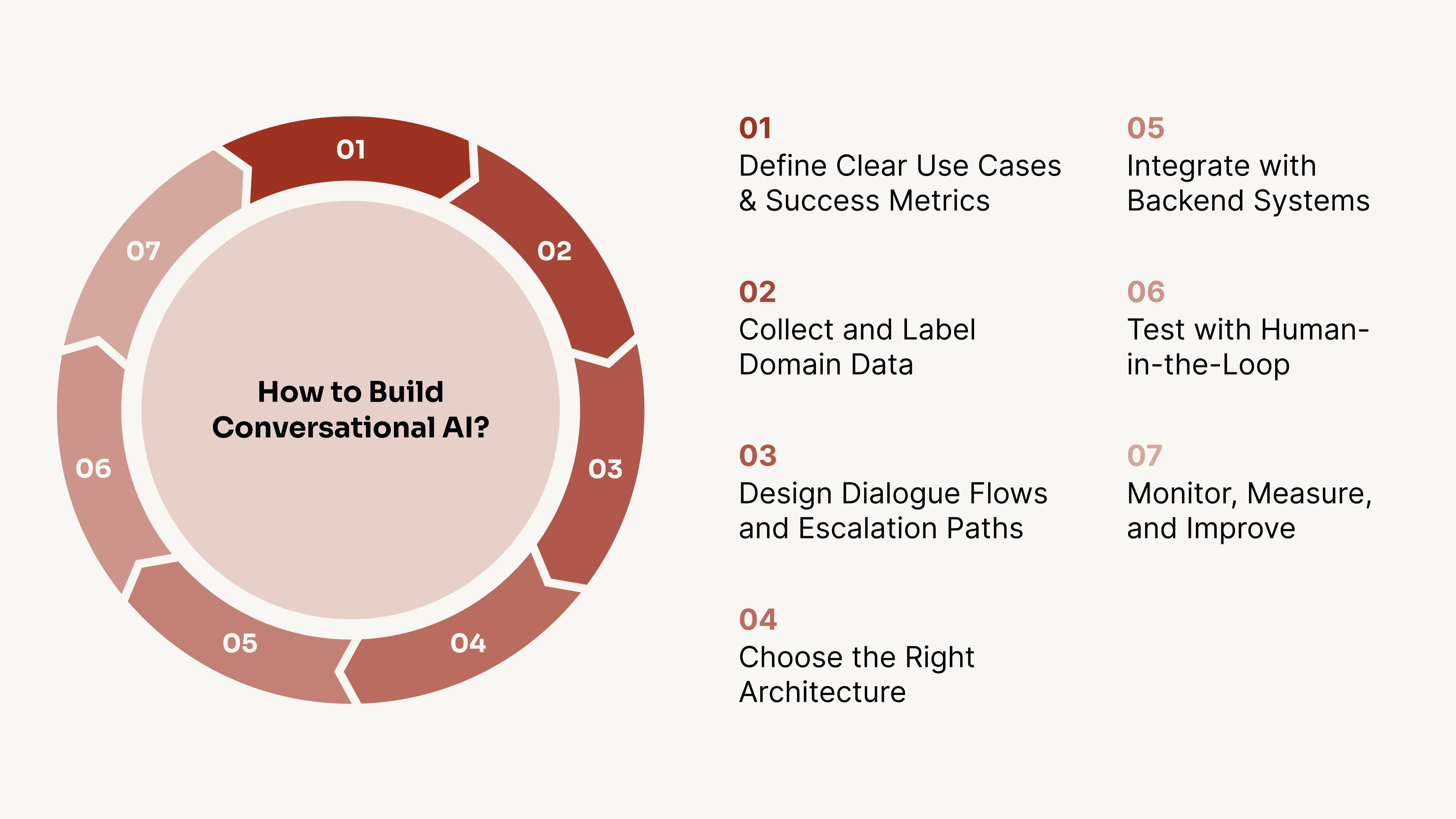
Below are the practical steps enterprises follow to design, build, and operate production-grade conversational agents.
Step 1: Define Clear Use Cases and Success Metrics
Identify specific tasks such as payment reminders, order tracking, or lead qualification. Decide on measurable KPIs, such as completion rates or containment rates.
Step 2: Collect and Label Domain Data
Use real transcripts, call logs, and chat histories. Label intents, entities, and conversation patterns to train accurate models.
Step 3: Design Dialogue Flows and Escalation Paths
Map how each conversation should progress. Include fallbacks, clarifications, and human handover points.
Step 4: Choose the Right Architecture
Combine rule-based logic for compliance with ML/NLU models for intent recognition and LLMs for flexible language.
Step 5: Integrate with Backend Systems
Connect CRMs, ERPs, and databases so the agent can fetch information, update records, or complete transactions securely.
Step 6: Test with Human-in-the-Loop
Run pilot interactions, catch failure cases, and refine intents and flows with human review.
Step 7: Monitor, Measure, and Improve
Track performance, analyze errors, and update training data to maintain accuracy as customer behavior evolves.
If you’re still relying on agents who can’t manage peak volumes or multilingual calls, you’re losing efficiency and revenue. CubeRoot helps you launch voice-first agents in just 14 days, integrate with 50+ systems, and handle 1 million+ conversations monthly at one-tenth the cost.
You now know what goes into creating conversational AI, but the reason these steps are worth the effort becomes clear only when you see the benefits it delivers.
Benefits of Conversational AI
In practice, most organizations already use AI in at least one business function, with 78% reporting some AI use across the enterprise. Below are the practical benefits you should expect when a production-grade conversational AI is deployed.
Lower operating cost per contact: Automated handling reduces agent labour and routine work, cutting cost-per-contact over time.
Higher containment and faster resolutions: More queries resolved without human handoff, reducing average handle times and repeat contacts.
24/7 multilingual availability: Voice and text agents can serve customers across languages and time zones without scaling headcount.
Better agent productivity: AI handles mundane tasks and surfaces customer context, letting humans focus on complex cases.
Improved personalization at scale: Agents use history and real-time signals to personalise responses, increasing conversion and satisfaction.
Stronger compliance & auditability: Enterprise platforms provide logs, consent controls, and auditable trails for regulated sectors like BFSI and healthcare.
Actionable analytics & continuous improvement: Conversation data drives insights, model retraining, and process fixes that improve KPIs over time.
These benefits matter even more when you see how conversational AI solves real problems across different industries.
Sector-Specific Use-Cases of Conversational AI
Conversational AI is delivering measurable outcomes. For instance, Federal Bank deployed an AI-assistant “Feddy” that achieved a near 100% response accuracy, handled over 1.4 million queries per year, and boosted customer satisfaction by 25%.
This illustrates how enterprises can use conversational agents to improve scale, speed, and service quality.
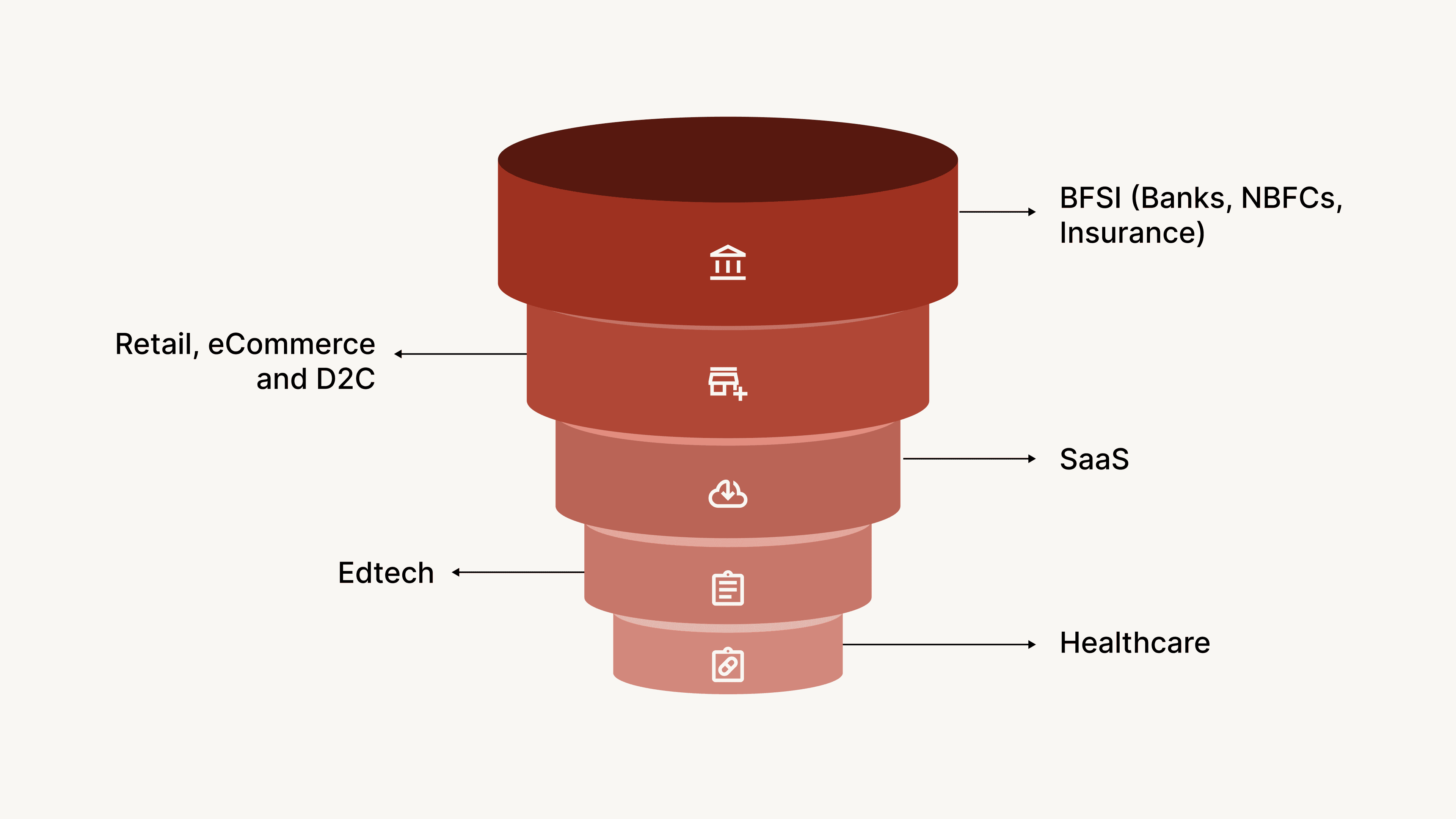
Below are the key use-cases across major enterprise sectors:
1. BFSI (Banks, NBFCs, Insurance)
Conversational AI supports high-volume, compliance-heavy workflows where speed, accuracy, and multilingual capabilities are crucial.
Use-Cases:
Automated EMI reminders and collections follow-ups
Balance, transaction, and claim status self-service
KYC document reminders and verification workflows
Complaint triage and intelligent routing to the right team
Fraud alerts and secure customer verification
Suggested Read: Conversational AI in Banking: Trends and Benefits Guide
2. Retail, eCommerce, and D2C
This sector manages some of the highest customer volumes in India, especially during sales cycles and COD-heavy orders.
Use-Cases:
Order tracking, delivery updates, and COD confirmations
Returns initiation, pickup scheduling, and refund updates
Multilingual customer support for Tier 1 to Tier 3 regions
Product discovery and conversational upsell support
Automated NPS, feedback, and repeat purchase nudges
3. SaaS
SaaS teams rely on fast qualification, guided onboarding, and real-time customer success communication.
Use-Cases:
Lead qualification and demo scheduling
Conversational onboarding for new users
Usage alerts, upgrade triggers, and renewal nudges
Support triage and guided troubleshooting
4. Edtech
Student engagement and admissions workflows benefit from always-on, multilingual conversational support.
Use-Cases:
Admissions and counselling appointment scheduling
Student FAQ support for deadlines, access, and coursework
Engagement nudges, micro-learning reminders, and check-ins
Exam reminders, scheduling, and verification
Healthcare
Conversational AI helps hospitals and health platforms manage patient flow, communication, and adherence at scale.
Use-Cases:
Appointment booking, reminders, and pre-visit instructions
Post-discharge follow-up and medication reminders
Symptom triage and routing to appropriate care
Insurance coverage and claim status automation
Also Read: Conversational AI for Finance: Transforming Financial Services
Seeing where conversational AI works well is helpful, but it’s just as important to understand the common mistakes that can limit its impact.
Common Pitfalls of Conversational AI
Conversational AI can deliver real impact, but many projects fail long before they scale. Gartner predicts that 50% of organizations will abandon plans to reduce customer service workforce because AI initiatives do not perform as expected.
This does not happen due to a lack of technology, but rather because teams overlook foundational requirements such as data quality, integration, and conversational design.
Below is a simple table outlining the most common issues and their corresponding solutions.
Pitfall | What Happens | How to Avoid It |
|---|---|---|
Unclear use cases | The system answers questions but doesn’t deliver outcomes or reduce workload. | Start with one high-volume workflow and define measurable KPIs. |
Poor training data | AI misinterprets user intent, especially with accents or mixed languages. | Use real call transcripts and label data from your customer base. |
No backend integration | The bot gives information but cannot complete tasks. | Connect CRMs, ERPs, and order systems before going live. |
Weak fallback and escalation | Customers get stuck in loops or abandon the interaction. | Build human-in-loop paths with full context transfer. |
Lack of continuous improvement | Accuracy drops over time as customer behavior changes. | Monitor transcripts weekly and retrain on new patterns. |
Ignoring multilingual needs | Users in India switch languages or mix English with regional speech. | Train on multilingual utterances and regional speech samples. |
Over-automation | Critical cases get mishandled or create compliance risk. | Keep rule-based control for regulated tasks and escalate early. |
Suggested Read: Customer Service vs Customer Support: Key Differences Explained
Solving these pitfalls matters today, but the bigger picture lies in how conversational AI is shifting in the market.
Future Outlook: What’s Next for Conversational AI
Enterprises in India are moving from basic automation to systems that can understand context, act independently, and operate across multiple modes. Below are the key trends that will shape what comes next.
According to the McKinsey & Company Global Survey 2025, 23% of organizations say they are scaling “agentic” AI systems that can plan and act, rather than just respond.
Enterprises are shifting toward multimodal conversational agents that combine voice, text, and visual understanding, a trend highlighted across major 2025–26 industry analyzes.
Research shows that real-time, on-device voice agents are now practical, made possible by smaller ASR models, quantised LLMs, and fast streaming TTS.
India is moving quickly, with the conversational AI market projected to grow at a 26.4 percent CAGR through 2033, driven by regional language adoption and high-volume enterprise needs.
The next wave focuses on hybrid architectures, where retrieval-augmented generation (RAG) is paired with foundation models to deliver more accurate and trustworthy conversations.
With the future direction clear, the next step is choosing a partner that can help you apply these advances in real enterprise environments.
Why CubeRoot Is Your Ideal Partner for Conversational AI
CubeRoot helps enterprises deploy conversational AI that works in real customer environments. It handles 1 million+ conversations monthly and connects with 50+ enterprise systems, giving teams the scale and reliability they need.
As enterprises shift to voice automation and multilingual support, CubeRoot provides the technology and expertise to make these journeys successful.
Here’s how CubeRoot strengthens your conversational AI journey:
Voice-first, multilingual agents: Built for India’s mixed-language customer behavior.
Fast deployment (≈14 days): Helps teams move from design to live automation quickly.
Deep backend integrations: Connects with CRMs, ERPs, and order systems for real task execution.
High-volume handling: Manages spikes during payment cycles, sales events, and seasonal surges.
Enterprise-grade compliance: Provides secure logging, audit trails, and controlled workflows.
Unified inbound and outbound automation: Supports support queries, collections, lead outreach, and order updates.
GenAI-powered configuration: Allows rapid updates to prompts, flows, and logic as needs evolve.
If you’re curious how these capabilities fit your use cases, feel free to schedule a quick demo with CubeRoot.
FAQs
1. Howdo I know if my business is ready for conversational AI?
Most enterprises are ready if they handle high call volumes, repeated queries, or multilingual customers and want to cut support costs.
2. What’s the cost of implementing conversational AI in India?
Costs vary by use case and volume, but modern platforms like CubeRoot offer fast deployment with significantly lower per-contact costs.
3. Can conversational AI handle Indian languages and mixed speech?
Yes, advanced voice-first agents can handle Hindi, English, regional languages, and code-mixed speech commonly used by Indian customers.
4. How long does it take to deploy a conversational AI system?
With the right platform, enterprises can go live in about 2–4 weeks, depending on integrations and use case complexity.
5. Will conversational AI replace human agents?
No, AI handles repetitive tasks, while humans take over complex or sensitive issues. The goal is efficiency, not replacement.