Dec 4, 2025

Call Center Agent Strategies 2025: 10 Proven Ways to Scale CX
Call center agents are no longer just service operators; they’re the frontline of customer experience. In India, where customer loyalty often depends on fast, accurate, and local-language support, the pressure on agent teams has never been greater.
From EMI reminders and loan queries in BFSI to order status updates in eCommerce, today’s customers expect real-time, multilingual service on every channel, at every hour. With contact volumes surging and costs rising, Indian enterprises must rethink how their agent teams operate, scale, and deliver outcomes.
What makes one support team deliver trust while another loses customers? And how do you maintain quality when headcount can’t keep growing?
Here are 10 proven strategies Indian enterprises are using to transform their call center agent model in 2025.
Key Takeaways
The call center agent is now central to CX, sales, and compliance, not just support.
Ten practical strategies help enterprises scale voice-based service across BFSI, Retail, SaaS, D2C, EdTech, and Healthcare.
AI voice agents are becoming key enablers, delivering multilingual, compliant, and scalable support while cutting costs and easing team pressure.
Legacy systems, compliance risk, and attrition must be solved with automation, no-code workflows, and human-in-the-loop escalation.
CubeRoot helps enterprises act now, cutting support costs by 50%, resolving 70% of routine queries instantly, and qualifying 80% of leads in minutes.
What Is a Modern Call Center Agent in 2025?
Forget the old image of a script-bound support agent.
Today’s call center agent is expected to be tech-enabled, domain-aware, and outcome-focused, especially in high-stakes sectors like BFSI, Retail, and Healthcare.
Their role isn’t just to answer queries. It’s to:
Resolve issues quickly, often in multiple languages
Follow compliance protocols to the letter
Drive outcomes like collections, NPS, and retention
The challenge? Most enterprises still run on outdated call center playbooks, scaling headcount, not performance.
What’s needed is a smarter model: one that blends human empathy with automation, and equips agents with the tools to succeed at scale.
Here’s how leading Indian enterprises are doing just that.
Also Read: Multilingual Voice Bots For Enhanced Customer Interaction
10 Enterprise-Proven Call Center Agent Strategies for 2025
Transforming the call center doesn’t require massive hiring or costly overhauls. These 10 strategies are already helping Indian enterprises reduce support costs, improve resolution rates, and build CX that scales.
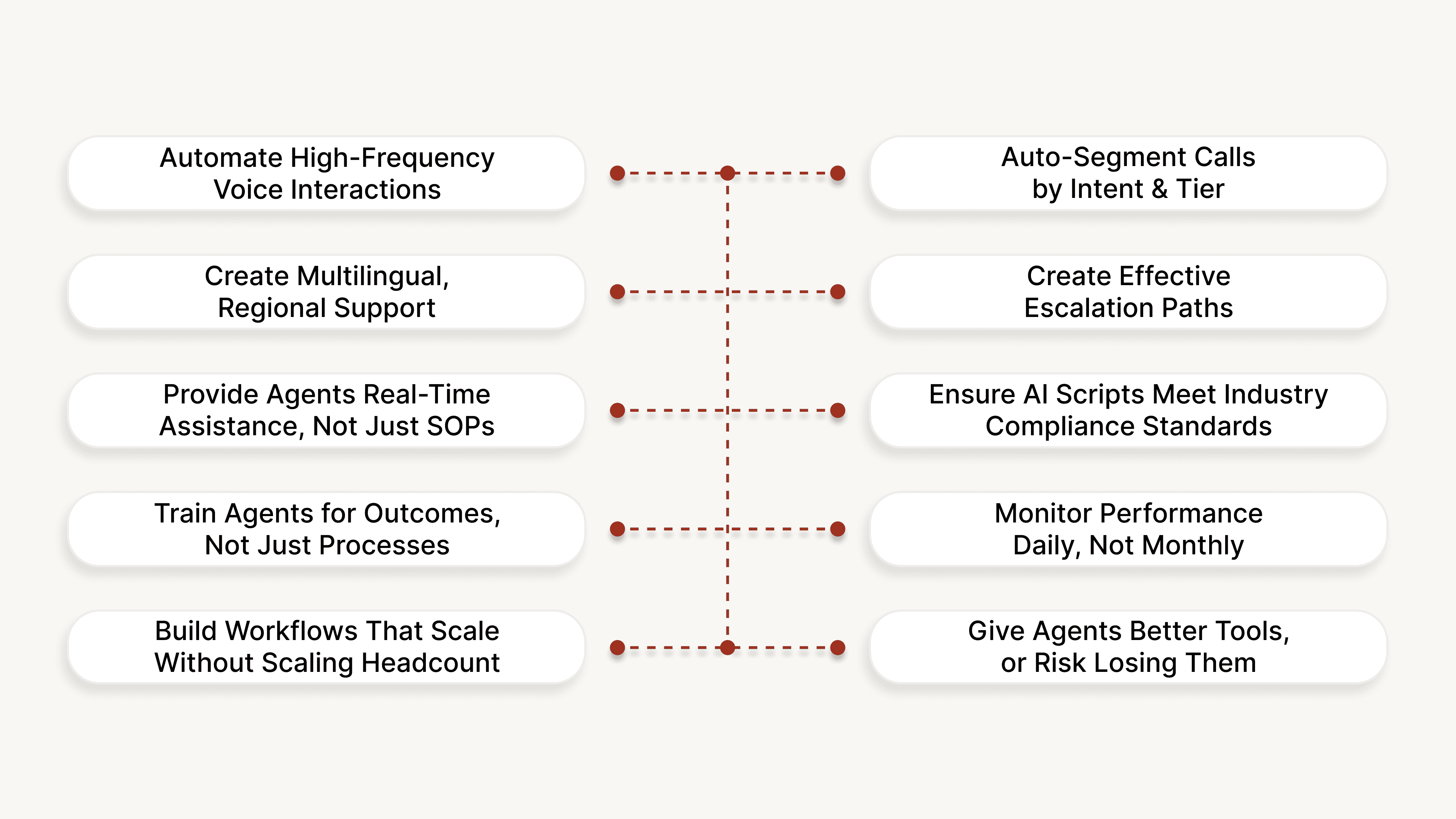
1. Reduce Agent Load by Automating High-Frequency Voice Interactions
Agents spend most of their time repeating answers—EMI reminders, order updates, appointment confirmations. AI voice agents now handle these at scale.
Example: A retail ops manager noticed agents handling the same 4–5 questions daily. Instead of hiring more reps, they automated those queries using voice AI, freeing up the team for more sensitive returns and refund cases.
Value: Reduces burnout and churn. Let's agents focus on collections, renewals, or sensitive queries that move revenue.
2. Segment Calls by Intent and Customer Tier—Automatically
Not all calls deserve equal handling. Routing should reflect intent, urgency, and customer value, not just who picks up first.
Example: In retail, VIP customers with order issues are routed to senior agents, while post-delivery feedback is handled by AI.
Value: Protects high-value relationships while keeping frontline teams lean.
3. Build Regional-Ready Support With Multilingual Voice
India’s customer base isn’t English-first. AI voice agents can speak 10+ Indian languages fluently and handle local nuances far better than generic chatbot flows.
Example: An eCommerce brand saw a 2.4× increase in pickup rates for COD confirmation calls after switching to regional-language voice AI.
Value: Expands reach, improves compliance in collections, and boosts trust in rural and semi-urban markets.
4. Design Escalation Paths That Actually Work
If a call needs a human, the handoff should be seamless. Smart AI-to-agent transitions transfer context, customer history, and voice sentiment.
Example: In healthcare, escalations from AI to human agents for post-discharge queries reduced call handle time by 22%.
Value: Improves CX without disrupting operational flow or increasing escalation overhead.
5. Equip Agents With Real-Time Assist, Not Just SOPs
Call center SOPs get ignored when agents are under pressure. Instead, live agent-assist tools prompt the right scripts, disclosures, and next steps during the call.
Example: A healthcare contact center deployed an assist tool that nudged agents with script prompts during insurance calls. The team said it felt “like a teammate, not a tool.”
Value: Lowers regulatory risk, ensures consistency, and shortens average call duration.
6. Align AI Scripts With Industry Compliance Requirements
Script deviation isn’t just a CX issue; it’s a liability. Voice AI ensures every mandatory line is said, every consent is logged, and every call is auditable.
Example: In insurance, AI-driven premium reminders with script adherence logs helped meet IRDAI audit requirements without added manpower.
Value: Keeps CX compliant without constant supervision.
7. Train Agents for Outcomes, Not Just Processes
Too many teams train agents on software, not scenarios. Sector-specific onboarding—like resolving failed EMI disputes or handling refund delays- makes agents more confident and effective.
Example: A D2C brand redesigned onboarding to simulate angry customer calls. Agents responded better when it happened for real.
Value: Raises agent productivity and reduces repeat calls.
8. Monitor Performance Daily, Not Monthly
Traditional QA is reactive. High-performing teams track agent KPIs, script compliance, and resolution rates in real time.
Example: An edtech platform used real-time dashboards to flag long wait times during enrollment week, automating FAQs and reallocating agents dynamically.
Value: Spot and solve problems before they damage NPS.
9. Build Workflows That Scale Without Scaling Headcount
Seasonal or campaign-related volume spikes are inevitable. But adding 30 agents for 30 days isn’t efficient. Instead, build voice workflows that absorb that spike.
Example: A BFSI team handling loan renewals used voice workflows to absorb repeat queries during March-end without pulling agents from other queues.
Value: Delivers elastic CX while protecting margins.
10. Give Agents Better Tools, or Risk Losing Them
Attrition isn’t just about pay, it’s about pain. Repeating the same FAQ 100 times a day is a quick path to burnout. When automation handles repeat volume, agents stay engaged.
Example: A support lead noticed new hires quitting within three months. After automating basic queries and reducing queue volume, agent retention improved noticeably.
Value: Keeps your experienced agents longer, reducing training and rehiring costs.
Now, let’s break down the specific business problems these strategies solve and what outcomes they drive.
Also Read: Importance Of Customer Service: Key Reasons And Benefits
Why These Strategies Don’t Stick Without the Right Execution Framework?
Every enterprise knows what needs to change: reduce call volumes, automate the repeat stuff, support more languages, and improve agent efficiency.
But most teams stall at execution. Here’s why:
Where It Breaks | Why It Matters |
No voice automation that actually scales | AI that works in a demo often fails at 10,000+ calls/day, across multiple use cases and languages |
Agents deviate from scripts under pressure | Compliance risk, audit flags, and inconsistent customer experience, especially in BFSI and healthcare |
Tools require too much IT dependency | CX teams can’t make changes fast enough; launches are delayed, updates take weeks |
Escalations feel broken | Customers still repeat information; AI-to-agent handoff loses context or drops entirely |
No real-time data on what’s working | Performance gaps go unnoticed, QA becomes reactive, and SLAs suffer silently |
Even well-designed CX strategies collapse under these constraints. To execute at scale, enterprises need a system that’s built for speed, regulation, and Indian customer complexity, not just a patchwork of bots, dashboards, and call scripts.
This is where CubeRoot fits in.
CubeRoot’s Role in Scaling Voice CX for Indian Enterprises
Enterprises need more than chatbots and dashboards to modernize CX. They need voice-first automation that’s scalable, multilingual, and compliant, without adding complexity.
CubeRoot is an enterprise-grade Voice AI platform designed specifically for Indian sectors like BFSI, Retail/eCommerce, SaaS, D2C, EdTech, and Healthcare. It enables teams to automate high-volume, voice-based workflows while keeping human agents focused on what matters most.
What CubeRoot Enables:
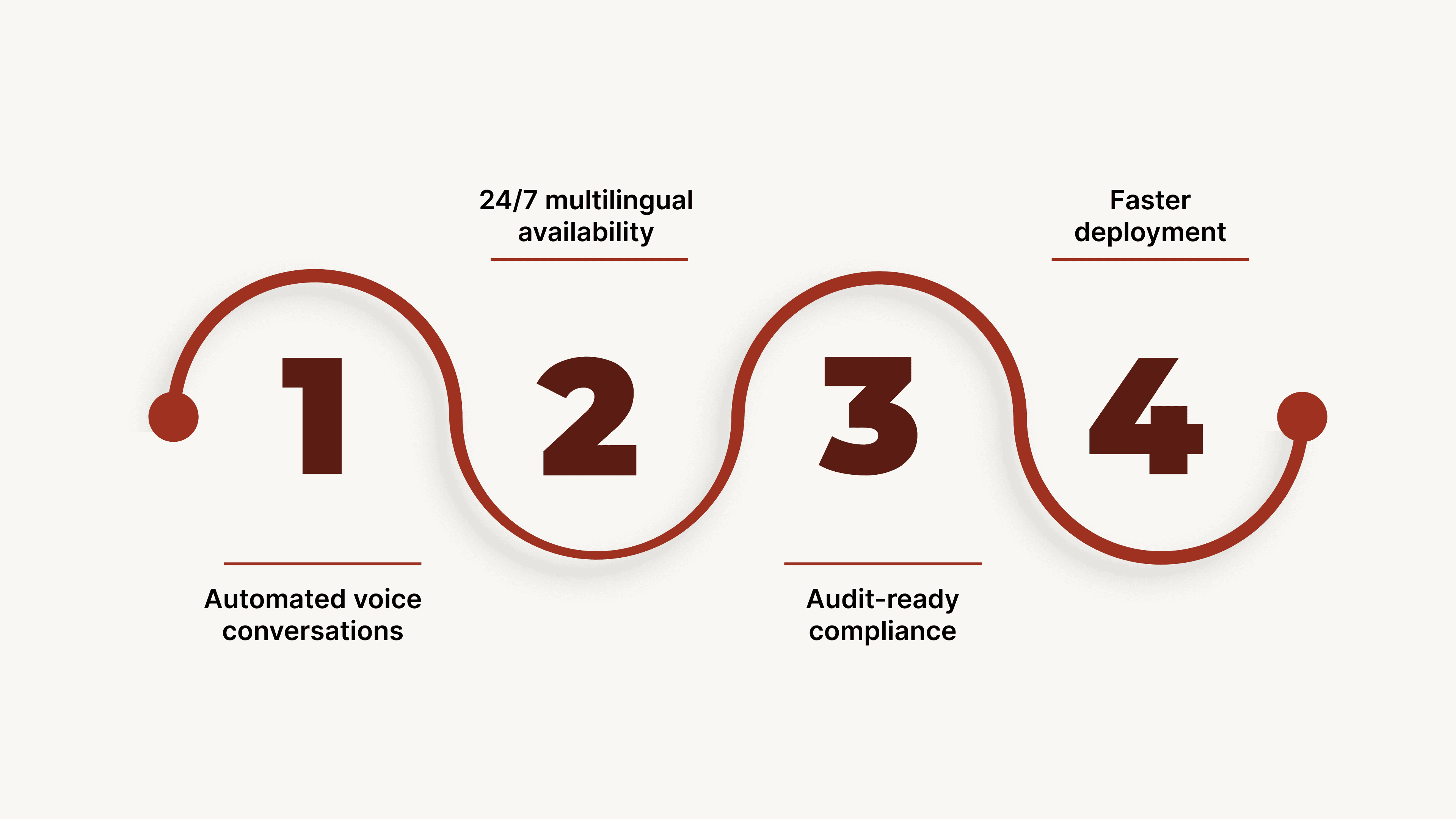
Automated voice conversations for lead gen, collections, onboarding, and support: With natural, human-like engagement that doesn’t sound robotic
24/7 multilingual availability: Across 10+ Indian languages, including Hindi, Tamil, Marathi, Bengali, and English
Audit-ready compliance for sensitive use cases: Including script control, consent capture, and secure voice logs for BFSI and healthcare
Faster deployment with GenAI-powered prompt builder: No complex setup, zero IT overhead, go live in days, not months
Proven Impact Across Enterprise Workflows
Workflow | CubeRoot Advantage | Measurable Impact |
Lead Generation | 24/7 AI-driven outbound calling | Reach 3× more prospects daily without hiring extra staff |
Lead Qualification | Filters high-intent leads automatically | Qualify 80% of leads in minutes, reduce manual effort by 60% |
Collections | Personalized, script-compliant payment reminders | Reduce overdue accounts by 35%, cut collection costs by 50% |
Customer Support | Multilingual AI agents + human-in-the-loop escalation | Resolve 70% of queries instantly, slash support wait times |
Feedback Collection | Voice-first post-sale surveys with smart triage | Capture 5× more feedback, lift CSAT by 25% |
Data-Backed CX, Delivered at Scale
150+ integrations with CRMs, ERPs, and ticketing systems
Real-time transcription + sentiment detection to flag issues early
Human escalation paths built into every workflow
What could your team achieve if 70% of customer queries were resolved instantly? Connect with CubeRoot today and find out. |
Conclusion
Call center agents now impact revenue, retention, and regulatory risk. In sectors like BFSI, Retail, SaaS, D2C, EdTech, and Healthcare, they’re not just resolving queries; they’re driving outcomes.
Is your team ready to serve customers who expect instant responses, multilingual support, and zero repeat explanations without scaling headcount or cost?
The future belongs to agent strategies powered by voice AI where automation handles volume, humans handle complexity, and compliance is built into every interaction. CubeRoot enables this future today through multilingual, regulation-ready, and human-in-the-loop voice automation that transforms the way enterprises engage customers.
For Indian enterprises, the time to rethink the role of the call center agent and rebuild around scale, precision, and sustainability is now.
Book a demo with CubeRoot today and empower your team to resolve 70% of routine queries instantly, qualify 80% of leads in minutes, and reduce support or collection costs by up to 50%—all while keeping your human agents focused on what matters most. |
FAQs
Q: What does a modern call center agent handle in 2025?
A: Modern agents manage service, collections, onboarding, renewals, and retention across channels, using live guidance and multilingual tools to deliver fast, compliant resolutions.
Q: How does AI actually help call center agents perform better?
A: AI handles repetitive calls, prompts next best actions, and enforces approved scripts, which reduces errors, shortens handle time, and lifts first-call resolution.
Q: What is the fastest way to scale support without hiring more agents?
A: Automate high-frequency interactions like status updates and reminders, with clear escalation paths that pass full context to skilled agents for complex cases.
Q: Why is multilingual voice support critical for Indian enterprises?
A: Native-language conversations improve connect rates, trust, and payment outcomes across Tier 1–3 markets, while reducing misunderstandings and repeat contacts.
Q: How can enterprises reduce compliance risk during live customer calls?
A: Use script control, consent capture, and recorded logs with real-time deviation alerts, making every conversation audit-ready by design.
Q: What metrics should leaders track daily to improve results?
A: Track first-call resolution, average handle time, abandonment and escalation rates, verified script adherence, sentiment trends, and repeat contact drivers.
Q: How do AI systems decide when to escalate to a human agent?
A: Rules evaluate intent, account status, sentiment, and risk signals, then hand off with full history and disclosures so customers never repeat themselves.
Q: What change management steps help new voice solutions succeed?
A: Start with one high-volume workflow, define success metrics, pilot with weekly adjustments, train supervisors first, and publish clear escalation rules.