Dec 4, 2025

Maximize Efficiency and CX with Power Virtual Agents in 2025
How much revenue, efficiency, or customer loyalty could your organization be losing to delayed responses, repetitive queries, or overwhelmed support teams? In sectors like BFSI, Retail/eCommerce, SaaS, D2C, EdTech, and Healthcare, even small delays in customer interactions can translate into significant operational costs and reduced satisfaction.
For enterprise leaders, the challenge is clear: scale support without scaling costs, maintain compliance across complex regulations, and deliver fast, consistent customer experiences. Meeting these expectations with traditional call centers alone is increasingly difficult.
This blog explores the tangible benefits of adopting Power Virtual Agents in enterprise operations. You’ll see how they streamline high-volume interactions, improve first-contact resolution, reduce operational overhead, and provide actionable insights.
Key Takeaways
Operational Efficiency at Scale: PVAs handle high-volume, repetitive interactions, freeing human agents for complex tasks.
Faster Response and Resolution: Automated interactions reduce wait times and improve first-call resolution, enhancing customer satisfaction.
Multilingual and Compliance-Ready: PVAs support regional languages and built-in regulatory frameworks, essential for BFSI and Healthcare.
Seamless Integration: Connects with existing CRM, ERP, and ticketing systems to provide context-rich, efficient interactions.
Data-Driven Insights: PVAs generate analytics on customer behavior and interaction trends, informing strategic decisions.
What Are Power Virtual Agents?
Power Virtual Agents (PVAs) are AI-driven tools that automate routine customer interactions while supporting complex queries.
Unlike traditional chatbots, PVAs use natural language understanding and context awareness to deliver accurate, consistent, and scalable support across channels.
For BFSI, Retail, SaaS, D2C, EdTech, and Healthcare, PVAs streamline high-volume workflows, reduce operational costs, and maintain service quality during peak demand.
They integrate seamlessly with CRM, ERP, and other enterprise platforms, ensuring each interaction is logged and actionable.
Next, we’ll explore the specific benefits enterprises gain by deploying Power Virtual Agents, from efficiency to enhanced customer experience.
What Are the Key Benefits of Power Virtual Agents?
Power Virtual Agents (PVAs) help enterprises streamline operations, enhance customer satisfaction, and drive cost efficiency. Here’s how PVAs deliver real business value:
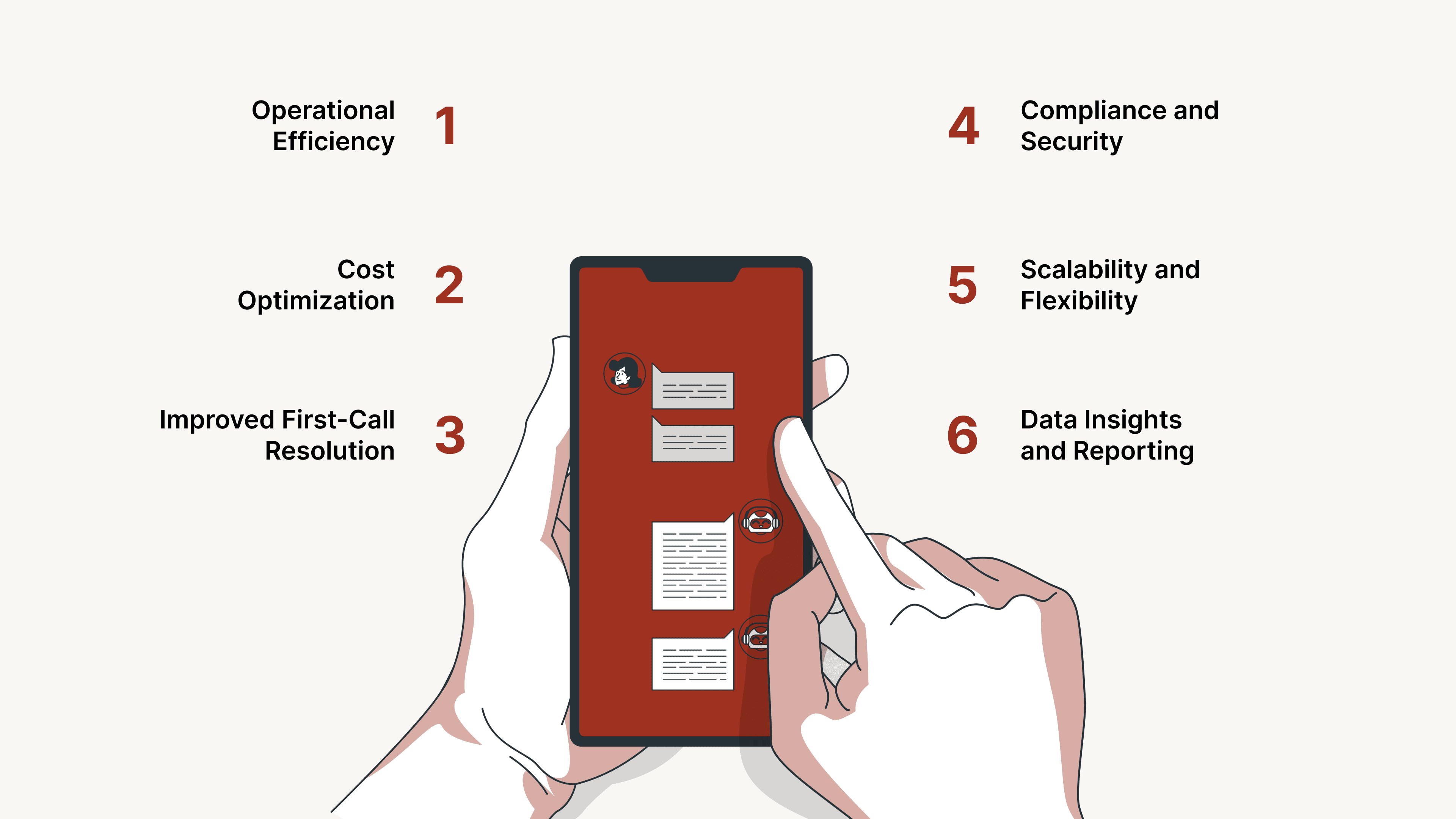
Operational Efficiency: PVAs automate routine customer queries and tasks, like order status or appointment scheduling, reducing agent workload. This allows agents to focus on more complex issues, improving overall efficiency and speeding up response times.
Cost Optimization: By managing high volumes of interactions, PVAs reduce the need for large call centers, optimizing staffing. This leads to significant cost savings, especially in sectors with fluctuating demand, such as BFSI and Retail.
Improved First-Call Resolution (FCR): PVAs provide instant, accurate responses to customer queries, reducing repeat calls and transfers. Faster issue resolution and higher customer satisfaction, as issues are resolved on the first contact.
Compliance and Security: PVAs are equipped with built-in compliance features, ensuring secure data handling and audit trails for regulated industries. Organizations can meet stringent regulatory requirements, particularly in sectors like BFSI and Healthcare, while maintaining service efficiency.
Scalability and Flexibility: PVAs can handle thousands of interactions simultaneously, adapting to sudden spikes in customer demand. This scalability ensures uninterrupted service during high-traffic periods without increasing overhead or compromising quality.
Data Insights and Reporting: PVAs track customer interactions, providing valuable insights into behavior, pain points, and trends. Real-time analytics inform data-driven decisions, enabling continuous improvement in customer service strategies.
Now that we’ve covered the key benefits, let’s explore the AI and automation features that enable Power Virtual Agents to deliver fast, efficient, and accurate customer interactions.
Also Read: What Is Customer Satisfaction And How To Improve It?
How Do AI and Automation Power Virtual Agents?
Power Virtual Agents (PVAs) are equipped with advanced AI and automation capabilities that enable enterprises to deliver faster, more accurate customer interactions at scale. Here’s how these features work:
Natural Language Processing (NLP): PVAs use NLP to understand and respond to customer queries in a conversational, human-like manner. This ensures more accurate responses, improving customer satisfaction and reducing the need for agent intervention.
Sentiment Analysis: AI-driven sentiment analysis enables PVAs to detect customer emotions and respond appropriately. This leads to a more personalized experience, where customers feel heard and understood, improving overall engagement.
Proactive Engagement: PVAs can initiate conversations based on predefined triggers, like abandoned carts or upcoming payment reminders. Proactively addressing customer needs increases engagement, reduces call volume, and drives higher conversions.
Multilingual Support: PVAs support multiple languages, allowing enterprises to serve a diverse customer base across India and beyond. This enhances customer inclusivity and satisfaction, particularly in multilingual markets, without adding complexity.
Human-in-the-Loop (HITL) Escalation: For complex issues, PVAs escalate interactions to human agents with all necessary context. This reduces customer frustration by ensuring smooth transitions and faster resolutions for complex cases.
Continuous Learning and Improvement: PVAs continuously learn from past interactions, improving their responses and adapting to evolving customer needs. Over time, this leads to better performance, fewer errors, and higher levels of automation in handling customer queries.
With a solid understanding of AI and automation features, let’s now look at the challenges and considerations enterprises should keep in mind when implementing Power Virtual Agents.
Key Challenges to Consider When Implementing Power Virtual Agents
While Power Virtual Agents provide significant benefits, enterprises should be mindful of a few key challenges when implementing them. Understanding these considerations ensures successful adoption and maximum impact.
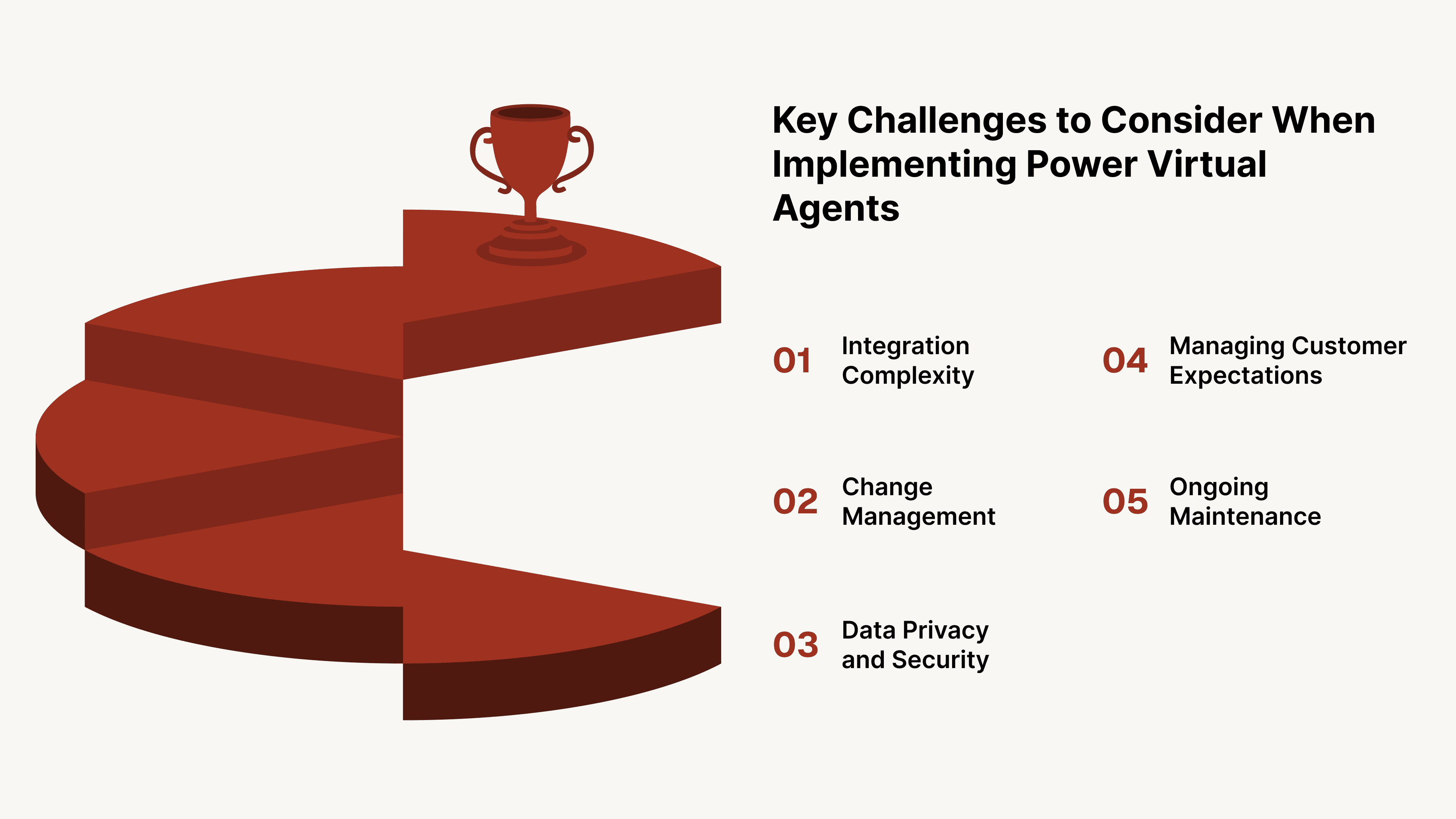
1. Integration Complexity
Integrating PVAs with existing enterprise systems like CRM, ERP, or ticketing platforms can be complex. Ensuring seamless data flow across departments is crucial for performance optimization.
Consideration: Collaborate with IT teams early to ensure smooth integration for a seamless customer experience.
2. Change Management
Shifting from traditional call centers to automated solutions requires a cultural shift within the organization. Employees need time to adapt to new tools and workflows.
Consideration: Provide clear training and leadership support to ensure agents and teams are fully on board with the transition.
3. Data Privacy and Security
Handling sensitive customer data requires strict adherence to privacy laws, particularly in highly regulated industries like BFSI and Healthcare.
Consideration: Ensure the PVA platform complies with local and international data privacy regulations to protect customer information.
4. Managing Customer Expectations
While PVAs excel in handling routine queries, more complex or emotional customer issues may require human intervention.
Consideration: Implement a human-in-the-loop system to escalate complex cases to human agents and maintain service quality.
5. Ongoing Maintenance and Improvement
PVAs need continuous updates to remain effective. As customer expectations and business needs evolve, so must the virtual agents.
Consideration: Establish a feedback loop to analyze customer interactions and use insights to refine and optimize the PVA’s performance over time.
Having discussed the key challenges, let’s now look at how CubeRoot can help optimize Power Virtual Agents and assist enterprises in overcoming these hurdles.
Also Read: How To Handle Customer Complaints Effectively?
CubeRoot’s Role in Optimizing Power Virtual Agents
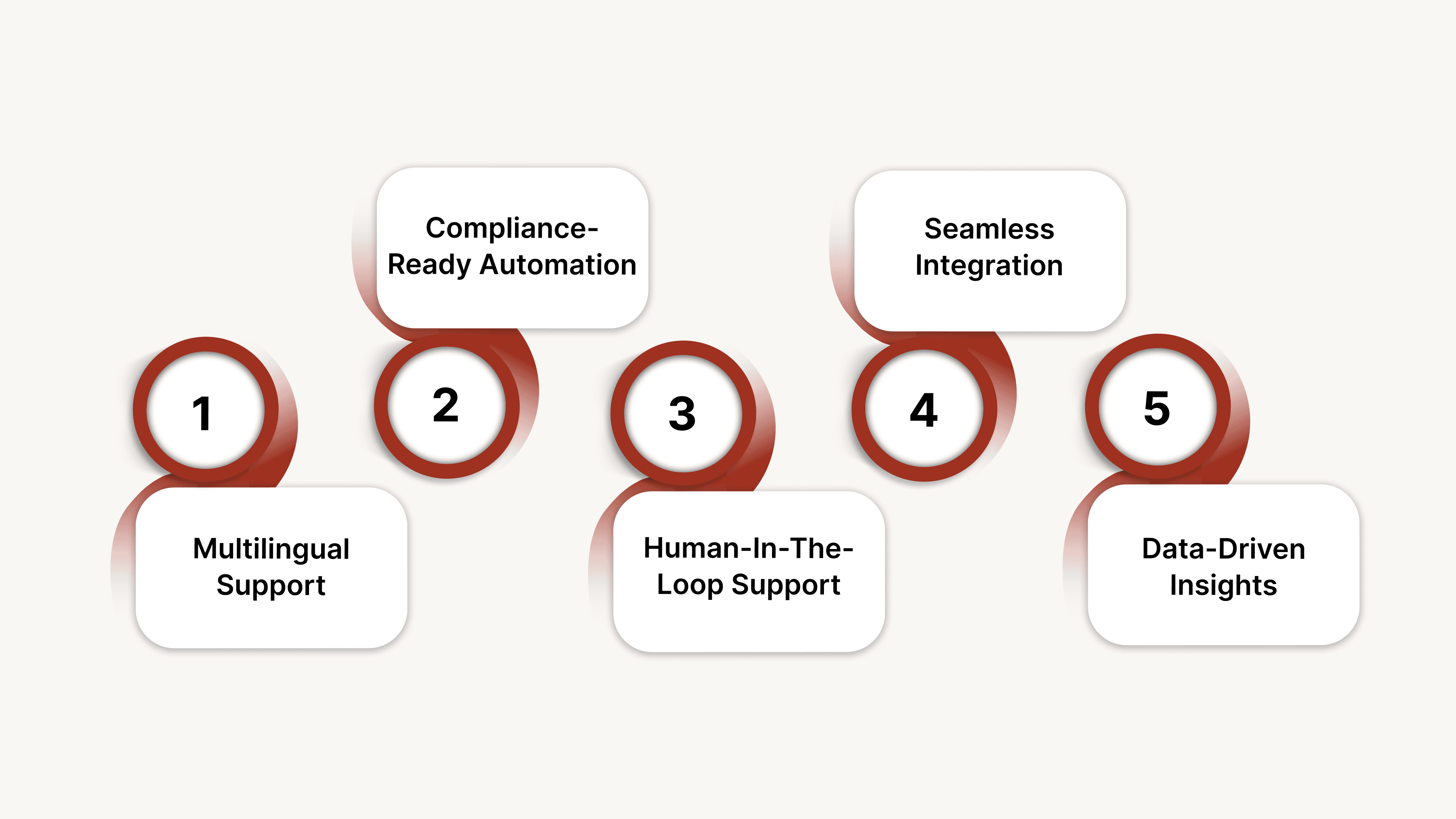
While Power Virtual Agents (PVAs) are powerful tools for automating customer interactions, CubeRoot enhances their capabilities to deliver smarter, more scalable customer engagement. Here's how CubeRoot adds value:
Multilingual Support for Diverse Markets: CubeRoot’s AI-powered voice agents support multiple languages, enabling enterprises to engage with customers across India’s diverse linguistic environment. Extends reach and improves customer satisfaction in multilingual markets without added complexity.
Compliance-Ready Automation: CubeRoot’s voice agents come with built-in compliance features, ensuring secure data handling and regulatory adherence, crucial for sectors like BFSI and Healthcare. Reduces compliance risks and meets regulatory standards effortlessly.
Human-in-the-Loop Support for Complex Cases: CubeRoot’s seamless human escalation feature ensures that complex or sensitive cases are handed over to human agents with all necessary context. Improves customer experience by ensuring smooth transitions and faster resolution of complex queries.
Seamless Integration with Existing Systems: CubeRoot integrates easily with CRM, ERP, and ticketing systems, enabling smooth data flow between platforms and eliminating silos. Simplifies implementation and reduces operational friction while enhancing efficiency.
Data-Driven Insights for Continuous Improvement: CubeRoot provides real-time analytics on customer interactions, offering actionable insights that guide optimization strategies. Empowers enterprises to refine processes, reduce AHT, and boost first-call resolution over time.
Conclusion
Power Virtual Agents (PVAs) are no longer just an option, they are a crucial driver of efficiency, scalability, and customer satisfaction across sectors like BFSI, Retail, SaaS, D2C, EdTech, and Healthcare. Every interaction that can be automated frees up human agents to focus on higher-value, complex tasks that directly impact the bottom line.
Enterprises that adopt PVAs, intelligently balancing automation with human oversight, can optimize customer support, reduce operational costs, and ensure compliance with minimal effort. By using CubeRoot’s AI-powered voice agents, businesses can automate routine interactions, scale support effortlessly, and enhance customer experience, all while meeting regulatory standards.
For Indian enterprises, the time to invest in Power Virtual Agents is now. It’s not just about automating processes; it’s about gaining a strategic advantage that drives growth and improves service delivery.
Book a demo with CubeRoot today to automate 70% of routine queries, qualify 80% of leads in minutes, and cut support or collection costs by up to 50%—while keeping your human agents focused on what truly matters. |
FAQs
Q: What are Power Virtual Agents?
A: Power Virtual Agents (PVAs) are AI-driven chat and voice bots that automate customer interactions, offering intelligent, scalable solutions for routine queries and high-volume tasks.
Q: How do Power Virtual Agents benefit enterprises?
A: PVAs improve efficiency, reduce operational costs, enhance first-call resolution, and enable businesses to scale customer support without adding headcount.
Q: Are Power Virtual Agents suitable for regulated industries like BFSI and Healthcare?
A: Yes, PVAs are designed with compliance in mind, featuring built-in frameworks for secure data handling, regulatory adherence, and real-time logging.
Q: Can Power Virtual Agents support multiple languages?
A: Yes, PVAs are multilingual, enabling enterprises to support customers in various languages, enhancing service inclusivity and customer satisfaction across diverse regions.
Q: How do Power Virtual Agents integrate with existing systems?
A: PVAs seamlessly integrate with CRM, ERP, and ticketing systems, ensuring a smooth data flow and improving efficiency across enterprise operations.
Q: What is the role of CubeRoot in optimizing Power Virtual Agents?
A: CubeRoot enhances PVAs by adding multilingual support, compliance features, AI-driven voice agents, and human-in-the-loop escalation, enabling smarter, scalable customer interactions.
Q: How can Power Virtual Agents help with seasonal surges or high-volume interactions?
A: PVAs are highly scalable, capable of handling thousands of interactions simultaneously without compromising service quality or response time during peak demand periods.