Dec 31, 2025

The Rise of AI Voice Agents in Shaping Modern E-commerce Experiences
For a fast-growing e-commerce brand in Bengaluru, it's a customer wanting real-time updates on a delayed shipment. For a high-volume marketplace in Mumbai, it's a buyer trying to initiate a return during a peak sale rush. Every interaction carries such moments of truth, where speed, clarity, and convenience shape the customer's perception of your brand.
Yet, as order volumes rise and service expectations shift, traditional support setups struggle to keep pace. Long wait times, inconsistent responses, and high operational costs can quickly erode trust and impact repeat purchases. This is where AI voice support for e-commerce becomes a transformational advantage.
In this blog, we'll explore how an e-commerce AI voice agent transforms every stage of the customer journey. You'll also learn how AI-driven voice support is redefining the future of enhanced e-commerce experiences in India.
In a Nutshell
AI voice agents are becoming essential for high-volume e-commerce. It delivers instant, multilingual, human-like conversations that handle everything from discovery and order tracking to returns, payments, and loyalty engagement, at scale.
You can benefit from faster resolutions, lower service costs, and higher conversion rates. That's because AI voice agents handle repetitive queries, reduce drop-offs, and provide contextual responses to customers across markets.
Voice-led interactions outperform traditional screen-based e-commerce, offering frictionless navigation, hands-free convenience, emotional nuance, and consistent personalization across the entire shopping journey.
Future trends, such as multimodal discovery, predictive personalization, and voice-first shopping, will redefine customer expectations.
CubeRoot provides the infrastructure to easily implement all of this, with no-code deployment, multilingual intelligence, 150+ integrations, secure compliance, and continuous learning.
What Are AI Voice Agents for E-commerce?
AI voice agents are intelligent, voice-powered systems that conduct natural, human-like conversations with customers via phone, websites, and mobile apps. Unlike rigid IVR menus or basic chatbots, these agents use advanced technologies such as:
Automatic Speech Recognition (ASR): to accurately capture what the customer is saying
Natural Language Processing (NLP): to interpret meaning and intent
Text-to-Speech (TTS): to respond in a natural, human-like voice
Using these capabilities, an e-commerce AI voice agent can understand queries, think contextually, and respond instantly, just like a trained support representative, but much quicker. For fast-growing Indian e-commerce brands, these agents act as virtual sales associates and support executives.
Also Read: What is a Voice Bot and How to Use It?
Together, these strengths make AI voice agents invaluable across multiple high-impact e-commerce use cases.
Key Use Cases for AI Voice Agents in E-commerce

AI voice agents are transforming how India's e-commerce leaders manage discovery, orders, returns, payments, and post-purchase support. Below is a consolidated breakdown of the most impactful use cases.
1. Frictionless, Conversational Product Discovery
Modern shoppers want instant answers and easy decision-making without having to scroll through multiple menus. AI voice agents act as conversational personal shoppers, helping customers discover the right products faster.
What they can do:
Understand detailed queries ("Show me eco-friendly running shoes under ₹5,000")
Filter products by price, brand, color, style, or features
Reduce decision fatigue by guiding customers in cluttered categories
Compare products side by side
Example: A shopper browsing a fashion marketplace may ask, "Help me find a birthday gift for my sister who is into fitness." The voice agent will instantly recommend smartwatches, yoga mats, and accessories matched to her preferences and budget.
2. Always-On Order Management
Order-related queries dominate e-commerce support. AI voice agents resolve them instantly through real-time, automated voice interactions available around the clock.
Key capabilities:
Fetch real-time order tracking ("Where's my order?")
Modify shipping addresses or delivery preferences
Initiate cancellations or reorder past items
Provide proactive delivery updates
Example: Consider a high-volume beauty marketplace. A customer calls at 11:30 pm and asks, "Where's my order?" The AI voice agent quickly identifies the keyword 'order', fetches tracking details from the order management system, and responds:
"Your package has reached your nearest delivery hub and will reach you by 2 pm tomorrow."
Did You Know? Gartner predicts that conversational AI will reduce contact center agent labor costs by nearly $80 billion by 2026, as enterprises increasingly adopt voice automation.
3. Simplified Returns & Refund Processing
Returns can drain cost and time, especially during high-volume seasons. AI voice agents simplify the entire workflow through interactive, voice-guided steps or repurchase suggestions.
How they help:
Verify order details
Schedule pickup or drop-off
Trigger refund workflows
Offer alternative product suggestions to reduce return rates
4. Multilingual, 24/7 Support Across India
AI Voice agents make support inclusive and accessible at scale. With voice agents fluent in multiple Indian languages, ensure every customer feels understood, day or night.
What multilingual AI offers:
Conversations in Hindi, Tamil, Telugu, Kannada, Bengali, Marathi, English, and more languages
Accent adaptation for regional customers
Why It Matters: Localized support builds trust, especially in Tier-2 and Tier-3 markets. This feature also enables you to expand global reach without proportionally increasing staffing costs.
Also Read: Multilingual Voice Bots for Enhanced Customer Interaction
5. Smarter Upselling & Cross-Selling
Shoppers often need helpful prompts during buying decisions. Voice agents identify the right moment to suggest relevant add-ons without sounding sales-driven.
They can:
Recommend bundles or accessories
Propose add-ons at checkout
Cross-sell based on customer goals or product type
6. Recovering Abandoned Carts
Cart drop-offs hurt revenue. Voice AI re-engages customers with timely reminders, clarifications, or offers that nudge them back to checkout.
Capabilities:
Call or message customers to re-engage
Answer any doubts that caused hesitation
Share offers or clarifications ("Cash-on-delivery available", "Free return policy")
Help complete payment through guided steps
7. Post-Purchase Engagement & Feedback
Post-purchase moments shape customer loyalty. Voice agents deliver proactive updates and quick, conversational feedback collection, strengthening retention.
Use cases:
Delivery confirmation calls
CSAT/NPS surveys
Product care instructions
Flagging issues early before sending them to a human agent
Warranty reminders
8. Faster Conflict Resolution Through Context Retention
Repetition frustrates customers. Unlike basic bots, AI voice agents retain context from previous interactions, allowing issues to be resolved faster and more smoothly.
Benefits:
No repeated information
Faster issue resolution
Reduced frustration
Example: A customer calls for the second time about a refund. The agent says, "I see you contacted us last week. Your refund has now been processed and should reflect within 24 hours."
9. Intelligent Payment Reminders & COD Confirmations
Automated voice reminders and confirmations help enterprises reduce defaults and avoid fraudulent orders, thereby protecting margins.
Key Capabilities:
Pre-due and post-due payment nudges
Subscription renewal reminders
COD delivery confirmations
Fraud prevention by verifying high-value orders
10. Voice-Driven Marketing & Loyalty Engagement
Voice AI agents deliver targeted offers, loyalty updates, and reminders in a friendly, conversational manner. They make promotions feel personal, not spammy.
Capabilities:
Launch announcements
Loyalty point reminders
Invitations to exclusive events
Personalized holiday greetings
11. Easy Checkout & Payments
Complicated checkouts lead to drop-offs. Voice agents simplify the journey with guided steps, secure verifications, and instant confirmations.
What it enables:
Voice-led purchase confirmations
Secure, encrypted payment flows
Applying coupons and offers
Also Read: Conversational AI for Customer Service: Benefits and How It Works
As brands shift toward faster, more intuitive customer experiences, it's essential to understand how voice-led interactions differ from traditional e-commerce.
Traditional E-commerce vs. AI Voice Agent-Driven E-Commerce: A Granular Comparison
Seeing both models together makes it easier to understand how voice AI agents change the customer journey. The table below breaks down the key distinctions and highlights their implications for modern Indian e-commerce enterprises.
Dimension | Traditional E-commerce (Screen-Based) | Voice Commerce (AI Voice Agents) | Why It Matters |
|---|---|---|---|
User Interaction | Requires tapping, scrolling, filtering, and typing | Driven entirely through natural conversation | Reduces friction for shoppers across Tier-1 to Tier-3 cities |
Navigation Effort | Multi-step product discovery across pages | Direct answers ("Find waterproof backpacks under ₹5,000") | Lower drop-offs, faster decision-making |
Personalization | Relies on cookies, past sessions, or manual inputs | Dynamic, real-time recommendations based on intent and history | Builds relevance and brand trust |
Emotional Context | Limited; text and visuals only | Human-like tone, empathy, reassurance | Creates a deeper connection, especially for new online shoppers |
Support Workflow | Manual ticket raising or chatbot menus | Natural queries ("Track my refund") with instant resolution | Reduces support load and improves customer satisfaction scores |
Barrier to Entry | Confusing for elderly, less tech-savvy, or visually impaired users | Voice-led, intuitive, and inclusive | Expands total addressable customer base |
Operational Efficiency | High dependency on human agents during peak load | Automated, scalable, and consistent | Prevents service bottlenecks during festive spikes |
With these distinctions in mind, it's easier to see how AI voice agents are shaping the next phase of e-commerce innovation.
Where AI Voice Support E-commerce Is Headed Next
Voice AI is rapidly shifting from a support channel into a core engine powering end-to-end shopping experiences. Smarter predictions, richer interactions, and automation across touchpoints will define the next wave of innovation.
The Trends Defining Tomorrow's Voice-Led E-commerce
Multimodal Discovery: Customers will soon be able to snap a photo, describe what they want, and receive curated recommendations instantly.
Example: A customer uploads a picture of a handbag and says or types, "Show me similar options under ₹2,000." The voice agent analyzes the image, filters the inventory, and presents the best matches while explaining features in voice.
Predictive Personalization will become the standard: Voice agents will anticipate customer needs rather than wait for queries.
Example: "Your skincare essentials are almost due for a refill. Should I reorder them?"
Voice-First Shopping will go mainstream: With the global voice commerce market projected to reach $395.53 billion by 2029, customers will increasingly complete full purchase journeys solely via voice.
Example: "Order my monthly groceries and apply available coupons."
Market Momentum: AI Voice Agent Adoption Is Accelerating
Industry data shows that enterprises are shifting from testing voice AI to embedding it into mission-critical workflows. Here's a quick adoption snapshot:
Stage | % of Organizations |
|---|---|
Exploring active use cases | |
Running live pilots | |
Fully scaled deployments |
Given these shifts, adopting best practices becomes essential for delivering consistent, high-quality voice experiences.
Best Practices for Implementing Voice AI in E-commerce
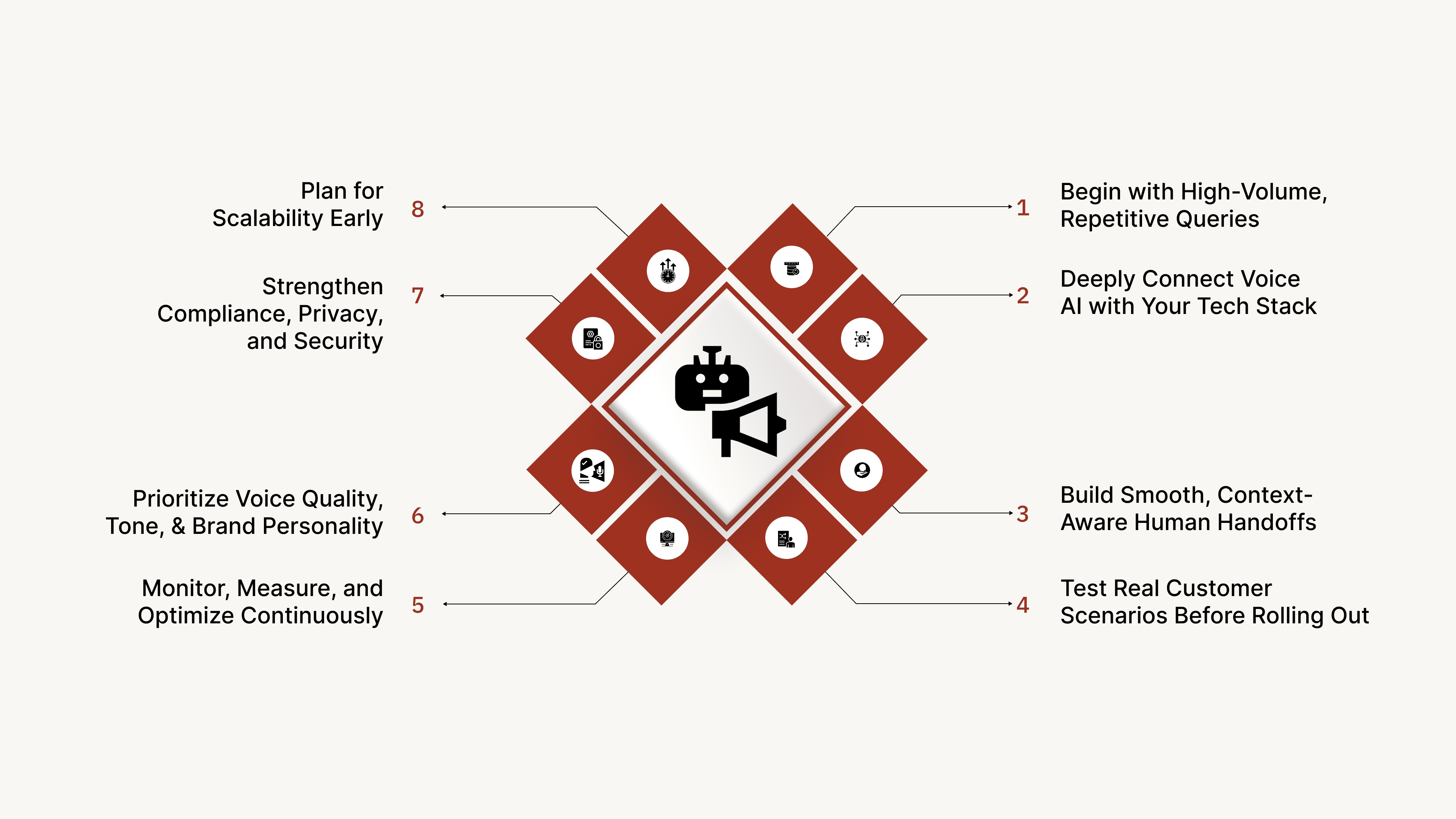
Deploying voice AI successfully requires more than switching on automation. It demands thoughtful planning, tight integrations, and continuous refinement. Below are the most effective practices to ensure smooth adoption.
Begin with High-Volume, Repetitive Queries: Automate your top 5–10 daily queries, such as order tracking, returns, delivery delays, and COD checks. This quickly reduces the support load and builds a strong foundation for expansion.
Deeply Connect Voice AI with Your Tech Stack: Integrate with your OMS, CRM, ERP, and payment systems so the voice agent can pull real-time order, inventory, and customer data for accurate responses.
Build Smooth, Context-Aware Human Handoffs: Enable smooth escalation by passing full conversation history to human agents and routing cases by priority or issue type.
Test Real Customer Scenarios Before Rolling Out: Validate performance using genuine accents, background noise, emotional callers, fragmented speech, and edge-case queries.
Monitor, Measure, and Optimize Continuously: Track containment rates, first-contact resolution, call success, drop-offs, and conversion lift. Use weekly reviews to refine prompts and improve workflows.
Prioritize Voice Quality, Tone, and Brand Personality: Choose voices that match your brand style, regional audience, and clarity needs to ensure the agent sounds natural and trustworthy.
Strengthen Compliance, Privacy, and Security: Use PCI DSS–aligned processes, tokenized payment flows, and secure data practices to protect customer information.
Plan for Scalability Early: Ensure your system can scale instantly during Diwali, Big Billion Days, and other peak events, maintaining accuracy and low latency.
Implementing these principles becomes far easier with the proper foundation. That's where the right partner can accelerate your entire Voice AI e-commerce journey.
How CubeRoot Supports Your Voice AI E-commerce Journey
Managing rising customer volumes, multilingual queries, and fast post-purchase expectations can be difficult, especially when shoppers demand instant, personalized responses without delays. CubeRoot's enterprise-grade Voice AI platform is built to solve these challenges, enabling e-commerce brands like yours to deliver human-like support at scale.
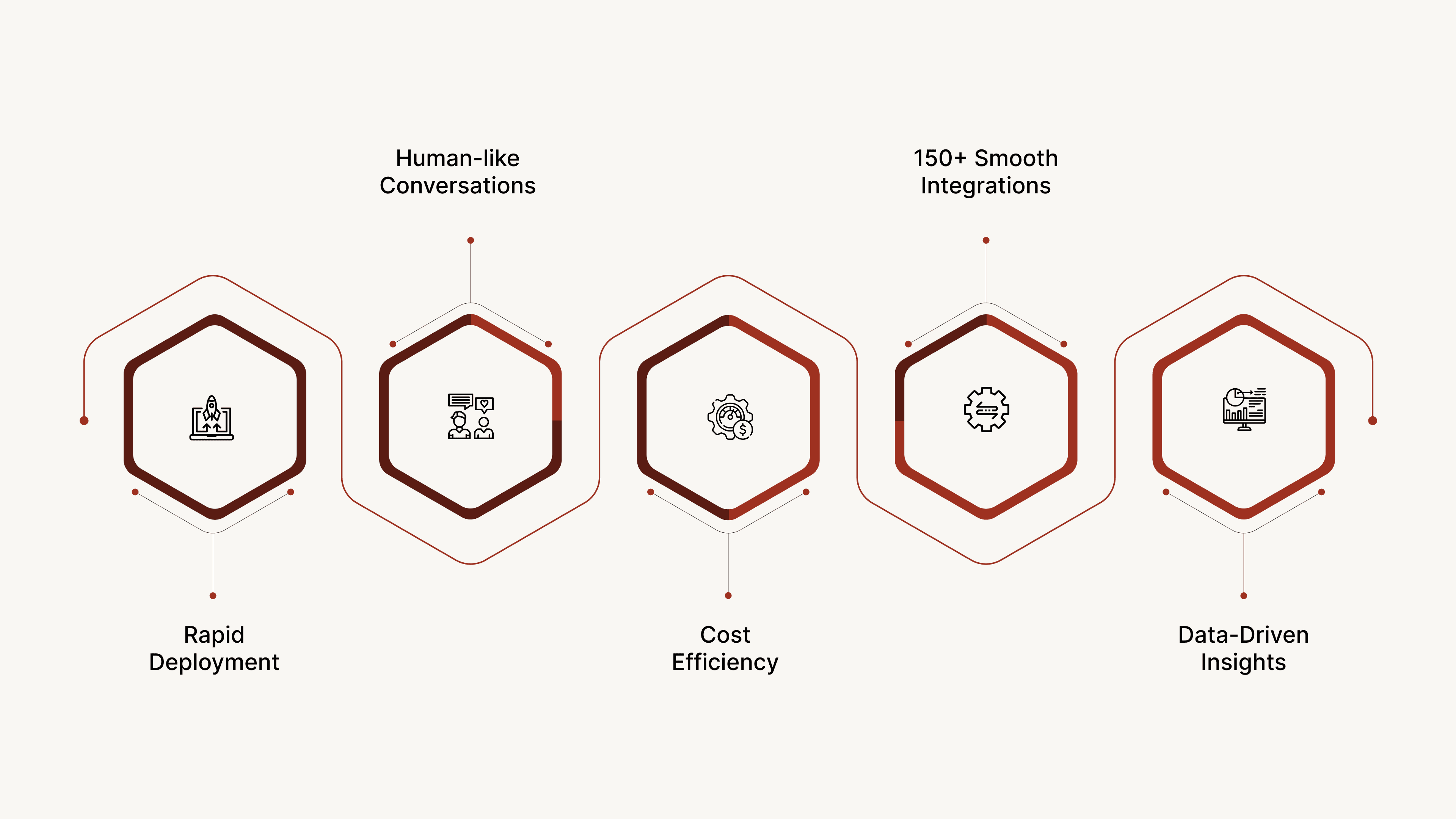
Here's how CubeRoot helps you overcome common e-commerce challenges:
Rapid Deployment: Launch your e-commerce voice agents quickly using our no-code builder and prebuilt workflows for order tracking, returns, delivery updates, and COD confirmations. Go live in days, not months.
Human-like Conversations: Deliver natural, context-aware interactions with sentiment-aware voice AI agents that support multiple Indian languages and regional accents. Resolve 70% of queries 24/7 with Voice AI.
Cost Efficiency: Reduce operational expenses by automating high-volume calls, including order status inquiries, return processing, delivery feedback, and seasonal surge handling.
150+ Smooth Integrations: Easily connect CubeRoot to your CRM, OMS, ERP, logistics systems, and payment gateways to enable real-time access to order details, customer history, and delivery information.
Data-Driven Insights: Track live call metrics, containment rates, and customer sentiment while gaining actionable insights to improve performance and maximize ROI continuously. Turn insights into action, lifting CX scores by 25%.
Deliver faster responses, reduce operational costs, and provide human-like support at scale. Book a demo today to explore how CubeRoot simplifies AI voice support for e-commerce.
FAQs
1. How do AI voice agents handle ambiguous or unclear customer queries?
They use fallback strategies like clarifying questions, intent rechecks, and context inference from past interactions. If confusion persists, they route the query to a human agent with full context for faster resolution.
2. What happens if a customer uses product-specific terminology or slang?
Advanced intent engines are trained on domain vocabulary and regional slang. When unfamiliar terms appear, the agent uses semantic matching to interpret meaning accurately or seeks quick clarification without breaking flow.
3. Can voice agents manage mid-conversation changes, like switching from tracking an order to initiating a return?
Yes. Conversational state management lets the agent shift tasks instantly without restarting the interaction. The system maintains context, enabling smooth transitions across multiple requests within the same call.
4. How do voice agents maintain accuracy when handling complex order issues?
Through deep OMS integration, the agent retrieves granular order details, such as item-level tracking, refund stages, and pickup statuses. Then, it responds with precise, situation-specific information rather than generic updates.
5. Can voice agents personalize responses for first-time shoppers with no prior history?
Yes. They adjust recommendations based on real-time inputs, including query type, category behavior, device, language preference, and location. Even without history, the agent tailors the conversation based on contextual cues.