Dec 31, 2025
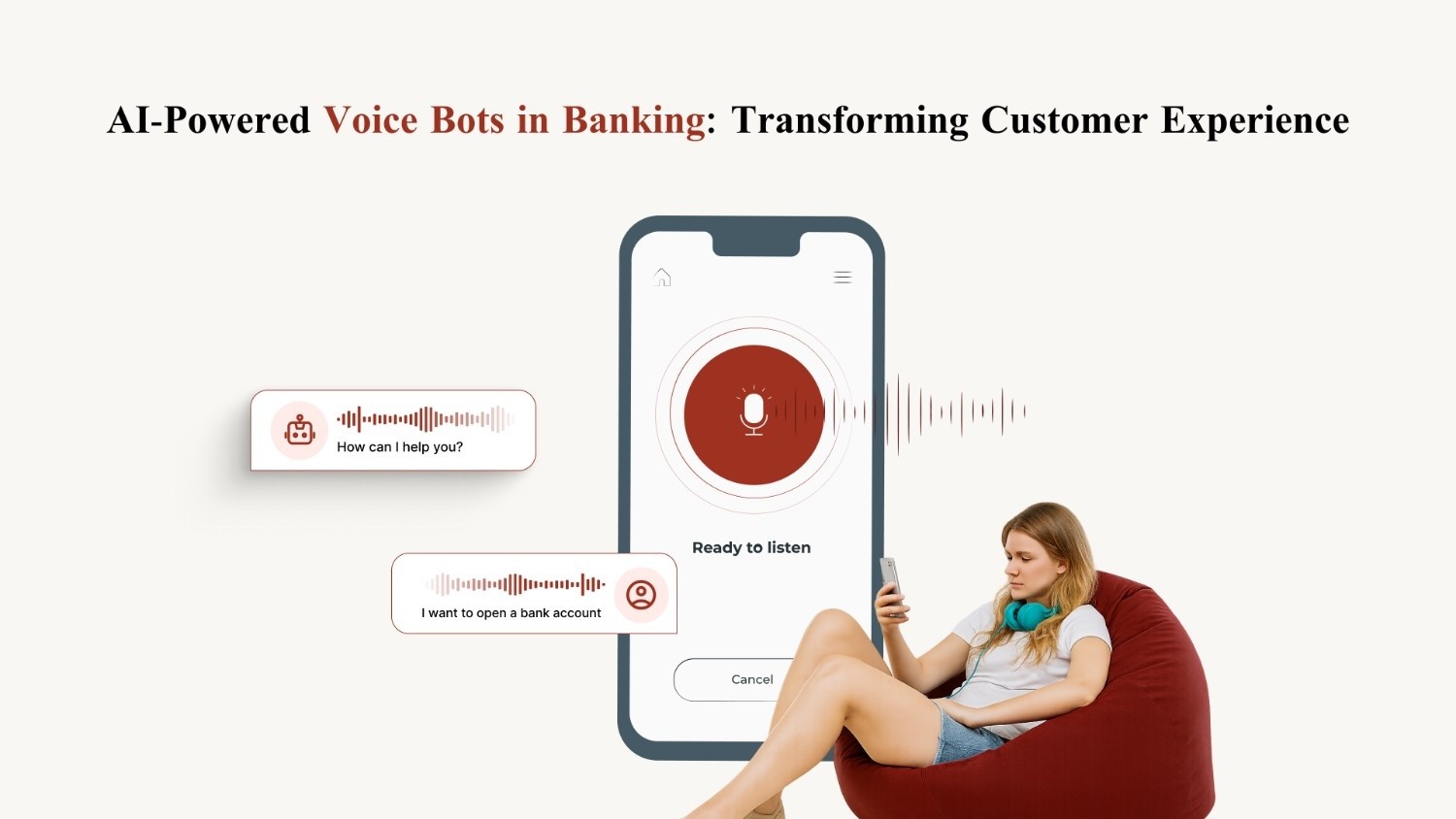
AI-Powered Voice Bots in Banking: Transforming Customer Experience
A customer is calling their bank to check a transaction dispute. A borrower is trying to confirm a repayment schedule. These routine interactions occur every minute across India’s BFSI sector and highlight a reality that many institutions struggle with. Traditional call centers face mounting pressure from high call volumes, rising service costs, and strict compliance requirements.
When these requests aren’t met, the impact is immediate. Long wait times lead to drop-offs, inconsistent responses erode trust, and unresolved queries affect everything from payment recovery to customer retention. For banks and NBFCs, these missed moments translate into higher operational overhead and weakened customer relationships.
That’s why understanding the role of an AI-powered voice bot in banking has become critical. With intelligent automation, multilingual conversations, and domain-trained accuracy, voice AI is redefining how financial institutions deliver timely, compliant, and scalable customer experiences across India.
At a Glance
AI-powered voice bots transform banking CX with multilingual, human-like conversations, real-time support, and automation for FAQs, onboarding, collections, compliance, and handling urgent issues.
Banks gain measurable impact through higher call containment, faster resolutions, improved repayment efficiency, and reduced dependency on overburdened call centers.
Key use cases span critical workflows, including loan recovery, investment guidance, KYC updates, dispute checks, payment reminders, and 24/7 support.
Common deployment challenges include accent variability, weak intent handling, compliance risks, limited integrations, and poor scalability during peak load.
A structured implementation roadmap, covering use case selection, tech setup, voice UX, integrations, testing, and omnichannel rollout, ensures a successful AI voice bot deployment.
Why Banks Need AI-Powered Voice Bots
For banks in India, staying competitive in this digital era depends heavily on delivering exceptional customer experience. Over the years, customer support has shifted from traditional call centers to IVR systems.
Furthermore, India’s shift toward voice-first digital interactions is accelerating. The Voice Assistant Market is growing at a 35.7% CAGR and is projected to reach nearly $1 billion by 2030. This rapid adoption shows why banking customers increasingly expect natural, conversational support instead of rigid IVR systems.
Fundamentally, a voice bot is intelligent software that enables computers to communicate with people in natural language. It uses a combination of:
Automated Speech Recognition (ASR)/Speech to Text (STT) to convert spoken words into text
Natural Language Understanding (NLU) to interpret intent and key markers
Text-to-Speech (TTS) to respond in a clear, human-like voice
These systems process voice queries in the same language the customer speaks, whether English, Hindi, or other Indian languages. This makes interactions more intuitive.
Example: An NBFC in Pune can automate thousands of daily repayment reminder calls, where borrowers can ask questions like “Mera next EMI kab due hai?” They can receive instant, accurate answers without waiting for an agent.
With these capabilities in place, AI voice bots are transforming real banking workflows. Here’s where they deliver the most impact.
High-Impact Use Cases of AI-Powered Voice Bots in Banking
AI voice automation is transforming how Indian banks and NBFCs handle everyday interactions. Here are the most impactful sector-specific applications.
1. Multilingual FAQ Support
Customers across India ask similar routine questions, often in their native languages. A multilingual voice bot answers these instantly, without long wait times or dependence on agents.
Typical Queries in Multiple Languages
Customer Query | Language | Meaning |
|---|---|---|
“What is my bank balance?” | English | Self-explanatory |
“मैं अपना पता कैसे बदल सकता हूँ?” | Hindi | How can I change my address? |
“আমার পেন্ডিং লোন স্ট্যাটাস কী?” | Bengali | What is my pending loan status? |
“ಹತ್ತಿರದ ಎಟಿಎಂ ಎಲ್ಲಿದೆ?” | Kannada | Where is the nearest ATM? |
2. Voice-Powered Financial Advisor
Instead of generic IVR menus, voice bots act as personalized financial advisors based on customer intent, spending patterns, and history. Here's a sample interaction.
Customer: “I want to increase my investments. What SIP options can I start with ₹2,000 per month?”
Bot: “You can begin with equity or hybrid SIPs based on your risk profile. Would you like a quick comparison?”
Customer: “Yes, compare both and tell me the expected returns.”
Bot: “Here’s a summary. Equity SIPs show higher long-term returns but higher risk. Hybrid SIPs balance stability and growth. Should I help you set up a SIP mandate?”
3. Debt Collection & Recovery
AI voice bots automate reminders, follow-ups, and promise-to-pay confirmations with high accuracy and consistency.
Collections Automation Overview
Function | Benefit |
|---|---|
Pre-due & post-due reminders | Increases on-time payments |
Payment link sharing | Removes friction for customers |
Promise-to-pay capture | Improves tracking accuracy |
Re-engagement of overdue accounts | Boosts recovery rates |
Also Read: AI in Debt Collection: Transforming Recovery Efficiency
4. Customer Onboarding Made Simpler
Opening a new bank account or applying for a credit product often feels confusing due to paperwork, verification steps, and delayed follow-ups. Voice bots simplify the entire journey.
What a voice bot can do:
Explain eligibility, required documents, and timelines
Guide customers step-by-step through onboarding
Trigger document upload links
Provide live onboarding status updates
Pro Tip: Use voice-first onboarding for rural and semi-urban segments where app literacy is low but mobile phone usage is high.
5. Personalized Banking at Scale
Voice bots use past interactions, customer history, and behavioral patterns to deliver hyper-personalized conversations. Here are some significant personalization opportunities.
Personalization Type | Example |
|---|---|
Product recommendations | Tailored credit card suggestions |
Behavioral insights | Targeted savings nudges |
Accessibility enhancements | Voice-first support for visually impaired customers |
Did You Know? 72% of customers say personalization influences their bank choices.
6. Outbound Customer Engagement
Voice bots proactively reach customers with personalized messages at scale, without sounding robotic. Some common outbound voice bot use cases include:
Bill/EMI reminders
Pre-qualification for credit products
Renewal notifications
Cross-sell and upsell opportunities
Survey and feedback collection
Example: A major private bank may launch a 2-day outbound campaign via voice bots to pre-qualify customers for pre-approved credit lines.
Also Read: Outbound Calls Explained: What They Are and How They Work?
7. Compliance & Security Enhancement
Financial institutions operate in tightly regulated environments. AI voice bots help reinforce compliance across every interaction. Here's how voice bots can help:
Provide accurate policy & regulatory information
Reduce human error in disclosures and scripts
Securely authenticate users
Detect anomalies using behavior analytics
8. Instant Resolution of Urgent Issues
For urgent matters, customers need immediate support. When customers face security threats, failed transactions, or account risks, waiting in a long IVR queue can worsen the situation. AI voice bots enable immediate, accurate, and compliant support, without human dependency.
Here's a quick list of typical urgent banking issues that AI voice bots simplify.
Immediate Requests | Why It Matters |
|---|---|
Block lost/stolen card | Prevents unauthorized transactions within seconds |
Reset passwords | Avoids branch visits and long helpline delays |
Suspicious transaction verification | Rapid authentication to boost customer confidence |
Fetch recent statements | Helps with quick verification or dispute checks |
Stop payment requests | Prevents unwanted withdrawals or incorrect transfers |
Also Read: 10 Proven Ways to Improve Customer Experience Management in Banking
While these use cases deliver high impact, banks often encounter real-world hurdles when deploying voice bots at scale.
Key Challenges Banks Face When Deploying AI Voice Bots
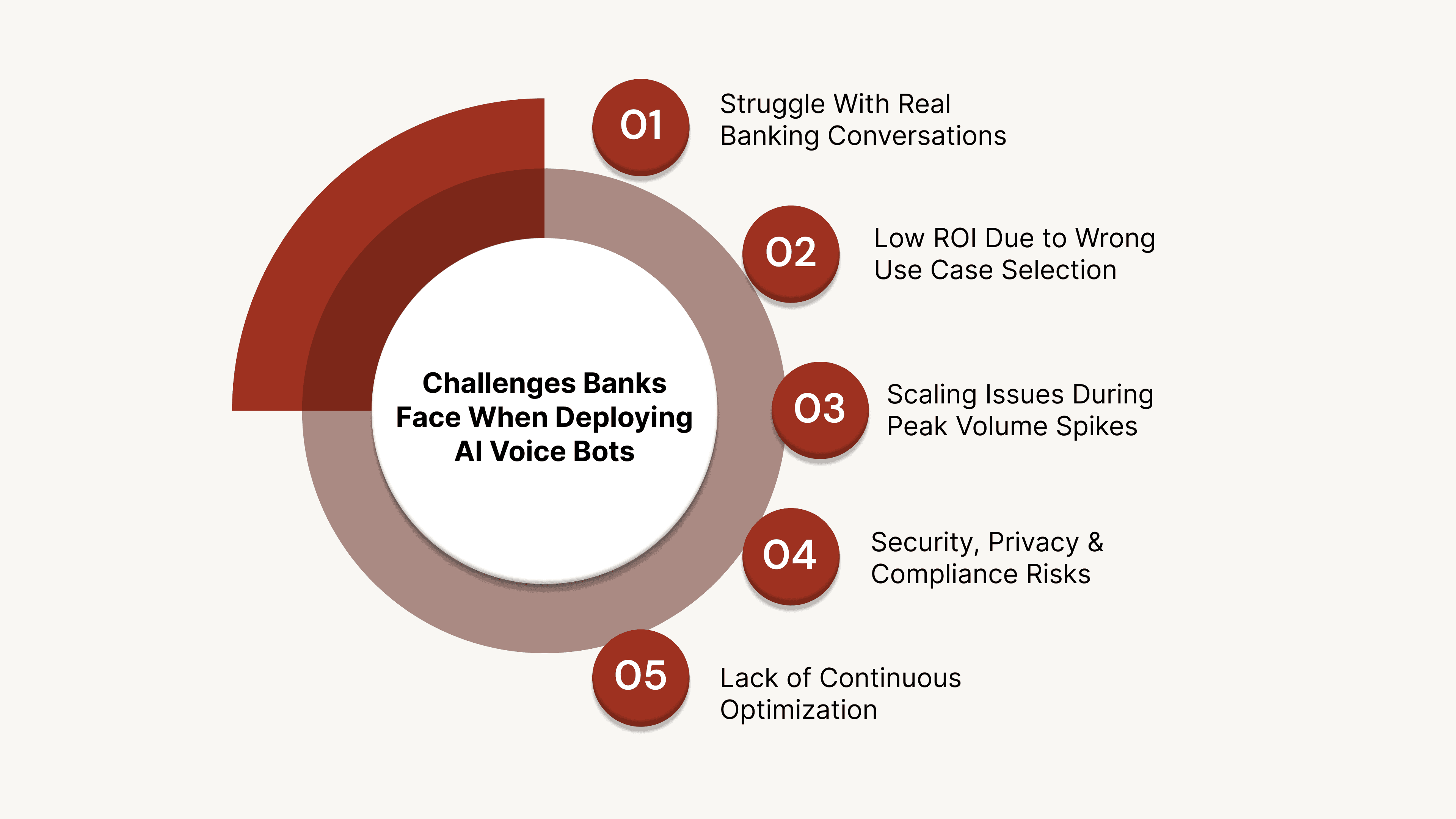
Even with rising adoption, many financial institutions discover that implementing an AI-powered voice bot in banking is more complex than expected. Understanding these challenges upfront ensures smoother deployment.
1. Struggle With Real Banking Conversations
Multi-intent queries (“Transfer my salary to savings and check expenses”) often confuse generic voicebots.
Context loss leads to wrong responses and low first-call resolution.
Fix: Utilize intent chaining (linking multiple intents) + contextual memory.
2. Low ROI Due to Wrong Use Case Selection
Banks often automate low-value FAQs that don’t reduce agent load.
No linkage to KPIs like Average Handle Time (AHT), Net Promoter Score (NPS), containment, or collections efficiency.
Fix: Start with high-ROI, measurable workflows, such as KYC appointment scheduling, priority routing for high-value customers, etc.
3. Scaling Issues During Peak Volume Spikes
Salary days, EMI cycles, and festive seasons overload generic systems.
Leads to latency, call drops, or robotic responses.
Fix: Adopt cloud-native voice platforms that auto-scale to handle peak spikes without impacting call quality.
4. Security, Privacy & Compliance Risks
Missing consent prompts, weak authentication, and poor data logging create exposure under RBI/PCI-DSS norms.
Many bots skip proper encryption or don’t audit conversations end-to-end.
Fix: Enforce MFA, encrypted voice logs, consent tracking, and privacy-by-design architecture with routine audits.
5. Lack of Continuous Optimization
Many bots stagnate post-launch; no fresh intents, no feedback loops, no compliance updates.
Fix: Implement Reinforcement Learning from Human/AI Feedback (RLHF/RLAIF)-led ongoing training and quarterly flow reviews.
With these challenges in mind, successful implementation becomes just as important as the technology itself.
Steps to Implement an AI-Powered Voice Bot in Banking
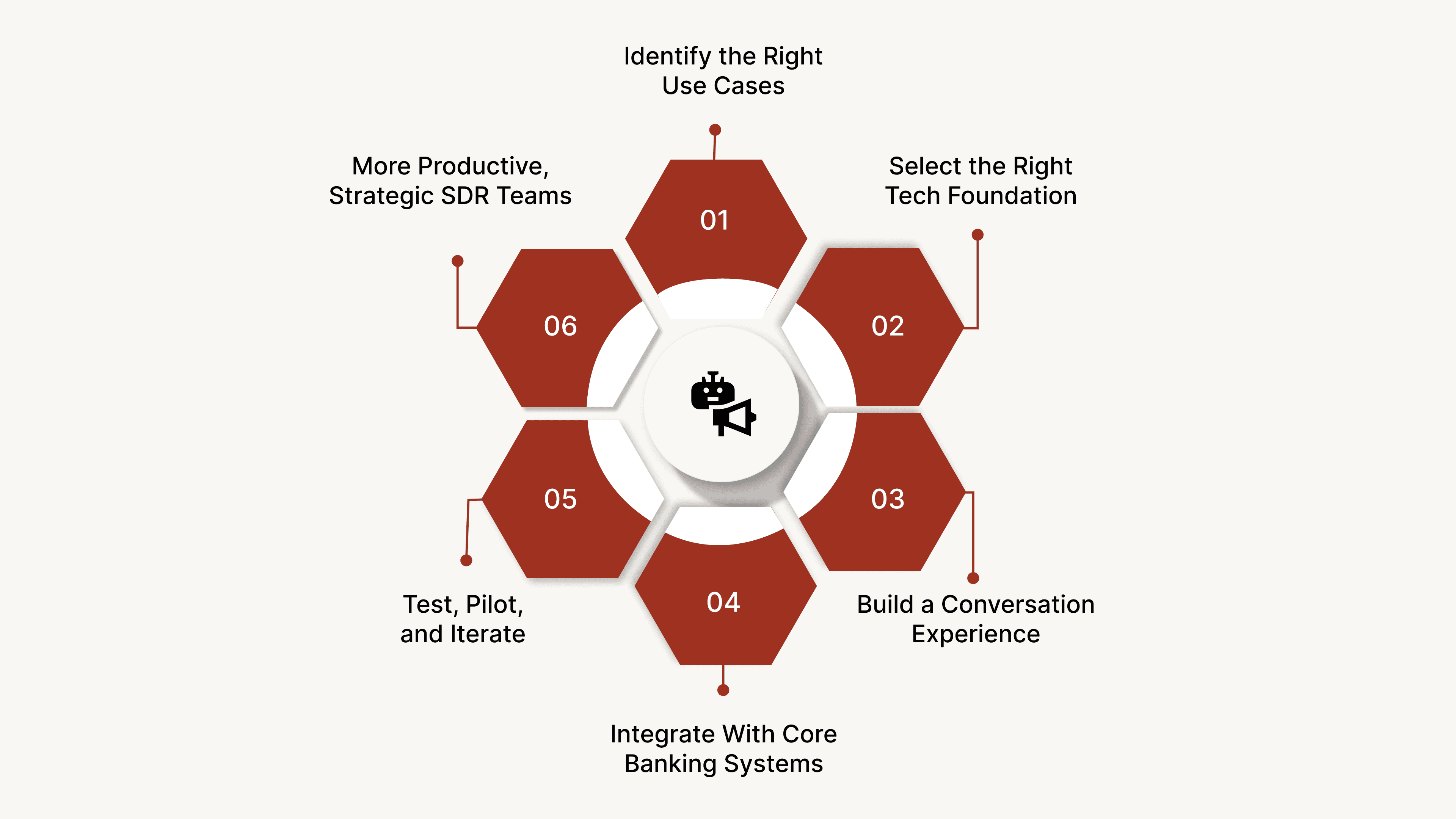
Building an effective banking voice bot requires aligning customer intent patterns, system readiness, compliance rules, and operational constraints. Here’s a simple, proven roadmap to deploy an AI-powered voice bot in banking.
Step 1: Identify the Right Use Cases
Before building anything, you must understand where a voice bot can drive the highest value. This means analyzing the following:
High-volume, repetitive queries (balance check, EMI dates, card status)
Workflows that cause long wait times
Tasks that don’t need human judgment
Languages customers commonly use
Why it Matters: A clearly defined scope prevents over-engineering and ensures your voice bot supports measurable KPIs, such as cost reduction and higher call containment.
Step 2: Select the Right Tech Foundation
For banking, technology selection must emphasize accuracy, security, and regulatory compatibility. Below are the key components to set up:
Domain-trained NLP models for banking terminology
Indian-accent optimized speech recognition
Secure TTS (text-to-speech) for multilingual responses
Bias-mitigated datasets
Compliance with RBI, PCI-DSS standards
Step 3: Design the Conversation Experience
This step defines how the bot sounds and behaves, which directly affects customer trust. Here's what you need to design:
Bot persona (formal, friendly, micro-empathetic) based on user segments
End-to-end flows for priority services
Human escalation paths for complex cases
Fallback responses for unrecognized queries
Step 4: Integrate With Core Banking Systems
A voice bot is only as good as its integrations. To move beyond basic FAQs, it must connect securely to backend systems.
Critical Integrations:
Core Banking System (CBS)
CRM and ticketing platform
Payment gateway/loan management system
Fraud detection engine
KYC & onboarding systems
Step 5: Test, Pilot, and Iterate
A controlled rollout ensures the bot performs well under real conditions. A pilot launch identifies gaps early (e.g., accent misrecognition, incorrect routing, compliance misses) and enables smooth adoption through minor improvements.
What to Validate During Testing:
Speech accuracy across accents and noise levels
Compliance prompts (pre-disclosures, consent flows)
Response speed and latency
Handoff to human agents
STT/TTS quality in multilingual scenarios
Pro Tip: Launch a limited-functionality version (e.g., FAQ, balance check, card status) to a small user group.
Step 6: Deploy Omnichannel Access
Once validated, deploy and extend the bot beyond a single channel. This approach provides a smooth, unified customer experience and broad accessibility, which are critical for Indian enterprises serving diverse demographics.
Where to Deploy:
IVR phone banking
Mobile app voice interface
Website mic-activated support
WhatsApp/OTT voice channels
For banking enterprises aiming to execute this reliably and at scale, the right platform becomes crucial. That’s where CubeRoot delivers a clear edge.
Why CubeRoot Is the Ideal Voice AI Platform for Modern Banking
Long wait times, rising call volumes, and strict compliance requirements make it difficult for Indian banks and NBFCs to deliver fast, consistent customer support. CubeRoot solves this challenge with an enterprise-grade Voice AI platform. It helps you automate high-volume interactions while maintaining the accuracy, empathy, and regulatory compliance customers expect. Here's how:
Rapid, No-Code Deployment: Launch AI voice bots in days using CubeRoot’s no-code builder and API-first setup. Accelerate automation across banking departments without heavy IT effort.
Prebuilt BFSI Workflows: Use ready-made voice flows for EMI reminders, loan status, fraud alerts, repayment confirmations, and onboarding updates.
Smooth Systems Integration: Integrate effortlessly with CBS, CRM, ERP, payment systems, and dialers, and enable unified workflows for both AI bots and human agents.
Human-Like, Emotion-Aware Conversations: Deliver natural, empathetic interactions with real-time sentiment tracking. Ensure fewer escalations and consistently higher CSAT.
High-Impact Collections Automation: Boost recovery efficiency by up to 70% and cut cost per collection by 30% with automated Promise-to-Pay capture.
Compliance-Ready Infrastructure: Benefit from encrypted logs, audit trails, consent tracking, and strict script adherence, and ensure meeting all compliance requirements.
AI-to-Agent Escalation With Full Context: Route complex queries to human agents instantly, with real-time transcription and summaries. This ensures faster resolution and zero customer repetition.
Continuous Learning & Optimization: Improve accuracy and relevance over time through human and AI feedback loops that refine intents, responses, and compliance flows.
Automate high-volume banking workflows and achieve higher compliance accuracy with CubeRoot’s enterprise-grade Voice AI. Book a demo to see how an AI-powered voice bot in banking can transform your customer operations end-to-end.
FAQs
1. What is the difference between AI voice bots and chatbots in banking?
AI voice bots handle spoken queries using speech recognition and natural language processing, enabling hands-free, conversational banking. Chatbots rely on text-based inputs to support typed interactions across channels.
2. How do voice bots treat sensitive actions like fund transfers or account changes?
These tasks require additional verification layers such as OTP, voice biometrics, or device verification. Bots initiate the workflow, authenticate the user, and trigger the final step through secure APIs managed by your bank’s core systems.
3. Can voice bots assist our internal banking teams as well?
Yes. Banks increasingly use voice bots for internal workflows, such as IT help desk calls, employee onboarding support, and policy lookups. This reduces internal ticket load and provides employees with faster access to operational information.
4. Are AI voice bots expensive for smaller banks or NBFCs?
Costs scale with usage. Many platforms offer pay-per-interaction models, allowing smaller institutions to start with limited workflows and expand gradually. This ensures predictable operating expenses.
5. Can voice bots integrate with older banking systems that don’t have modern APIs?
Yes. Middleware layers or integration adapters can bridge legacy core systems with modern voice AI. These connectors translate bot requests into system-compatible formats, enabling banks with older infrastructure to adopt voice automation smoothly.