Dec 31, 2025
AI Voice Assistants for Care Navigation: Streamline Patient Journeys With Ease
Long patient hold times and front-desk overload are common in clinics and hospitals across India. Your staff spends hours on routine calls for appointments and follow-ups, which delays care for patients who need immediate attention.
This administrative burden reduces your team's capacity for critical clinical tasks. An AI voice assistant for care navigation automates these routine conversations, freeing your staff to focus on direct patient care.
This technology manages scheduling, sends reminders, and answers frequent questions without human intervention, and industry studies indicate AI agents can cut healthcare paperwork by 30%. It ensures every patient receives timely information and support.
This guide explains how AI voice technology transforms patient coordination. You will learn implementation steps, success metrics, and specific use cases for your healthcare practice.
Quick Look
Automated voice systems reduce patient wait times by handling multiple inquiries simultaneously without requiring additional human staff.
Voice assistants support several Indian regional languages to ensure that healthcare is accessible to diverse populations across the country.
Successful implementation requires mapping specific patient journey touchpoints before technical integration.
Integrating AI with hospital management systems allows for real-time appointment booking and instant updates on medical test results.
Strict adherence to data privacy regulations ensures that all voice interactions remain secure and fully auditable for compliance purposes.
What is an AI Voice Assistant for Care Navigation?
An AI voice assistant for care navigation is a sophisticated software program that uses natural language processing to guide patients through healthcare systems. It handles tasks like scheduling appointments, providing medical instructions, and answering common questions about hospital services using human-like speech.
By integrating with existing databases, these agents offer personalized support that helps patients move through their clinical journey with much less friction.
Also read: How to Handle Customer Complaints Effectively?
Health systems can achieve better results by understanding the specific reasons why automation is necessary for modern medical facilities.
Why Healthcare Needs an AI Voice Assistant for Patient Journeys
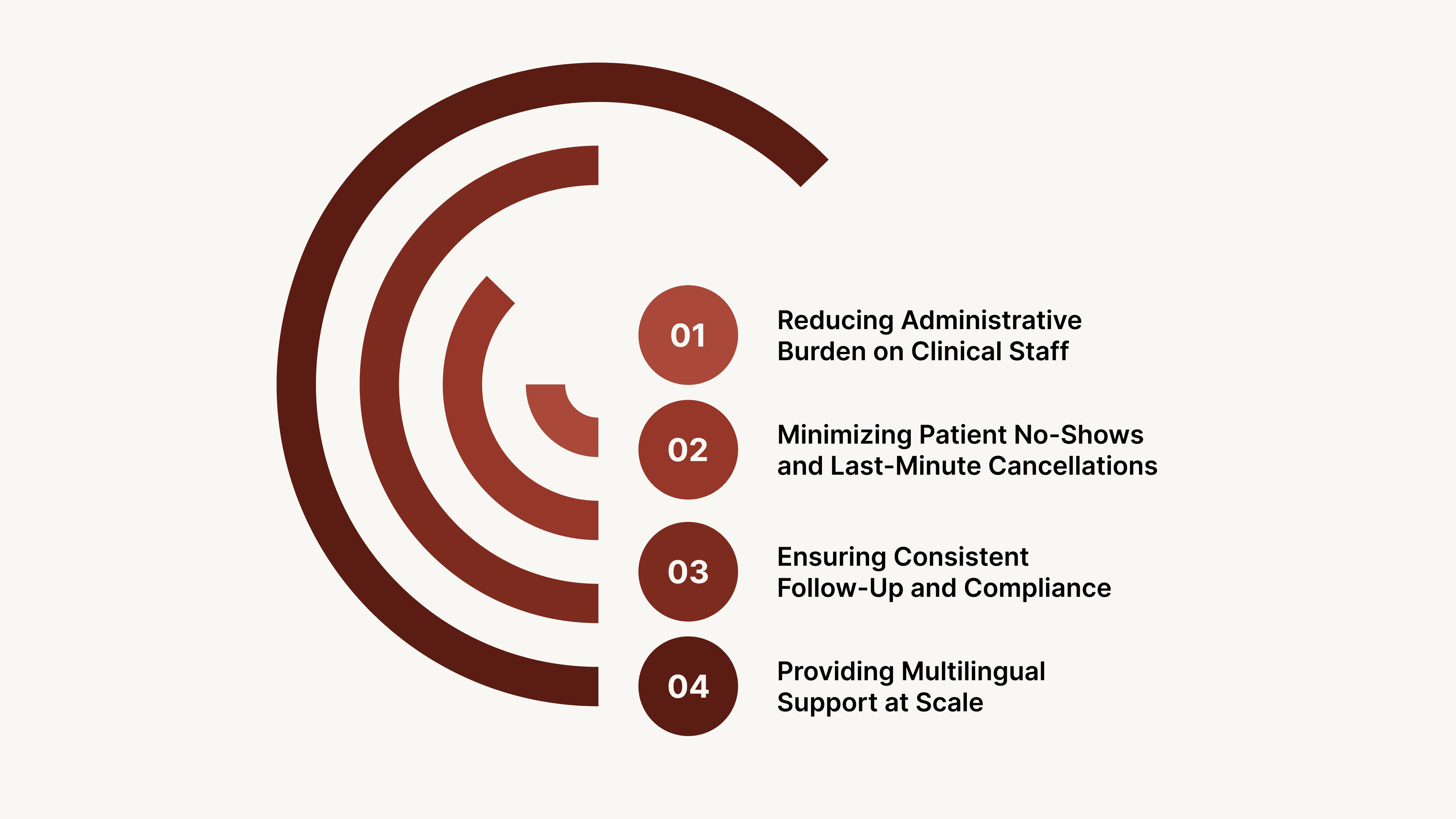
Manual patient navigation creates bottlenecks that affect both care quality and clinic efficiency. AI voice technology addresses these systemic issues by providing a scalable, always-available channel for patient communication.
It turns repetitive coordination into an automated, consistent process. Here are the critical operational challenges this technology solves:
1. Reducing Administrative Burden on Clinical Staff
Your doctors and nurses should focus on clinical work, not phone calls. An AI assistant manages the high volume of routine inquiries about clinic hours, prescription refills, and appointment rescheduling. This reallocates hundreds of staff hours back to patient care each month.
2. Minimizing Patient No-Shows and Last-Minute Cancellations
Missed appointments disrupt schedules and cause revenue loss. An AI assistant automatically calls patients with confirmation and reminder calls. It can also reschedule cancellations instantly by offering alternative slots, protecting your clinic's daily capacity.
3. Ensuring Consistent Follow-Up and Compliance
Post-discharge instructions often get misunderstood or forgotten. An AI assistant conducts follow-up calls to check recovery, confirm medication adherence, and identify warning symptoms. This creates a safety net that improves outcomes and prevents readmissions.
4. Providing Multilingual Support at Scale
Patients may hesitate to communicate in English. An AI assistant converses in Hindi, Tamil, Bengali, and other Indian languages. This removes language barriers, ensures understanding, and makes your services accessible to a wider community.
Ready to reduce your team's administrative load and improve patient follow-up? See how a CubeRoot voice assistant can be configured for your clinic's specific workflows in a personalized demo.
To implement this solution effectively, you must define clear measurements for its impact.
Key Metrics to AI Voice Assistant Track Success
Measuring the impact of your AI assistant requires data points that reflect operational efficiency and patient outcomes. Move beyond basic call volume stats to track metrics that link directly to clinical and business goals.
Focus on these specific indicators to evaluate performance:
1. Patient Outreach Success Rate
This metric tracks the percentage of patients successfully reached by the AI for reminders or follow-ups. A high rate indicates the system effectively connects with your patient population across different demographics and languages.
2. Appointment Adherence Rate
Compare no-show and cancellation rates before and after AI implementation. Measure the direct improvement in schedule utilization. This shows the system's financial impact by quantifying recovered revenue from previously missed appointments.
3. Administrative Cost Reduction
Calculate the decrease in man-hours spent by staff on call management and scheduling. Factor in the AI solution cost to determine net savings. This proves the return on investment and justifies scaling the system to other departments.
4. Patient Satisfaction (CSAT) Score for Navigation
Use short voice surveys after AI interactions to gauge patient satisfaction. Track scores specifically for the ease of scheduling and clarity of information provided. This isolates the AI's contribution to the overall patient experience.
Also read: Outbound Calls Explained: What They Are and How They Work?
Metric | What It Measures | Why It Matters |
Patient Outreach Success Rate | Effectiveness of automated patient contact | Ensures critical information (reminders, instructions) is delivered |
Appointment Adherence Rate | Improvement in show-rates & reduced no-shows | Directly increases clinic revenue and optimizes resource use |
Administrative Cost Reduction | Savings from automated call handling | Frees budget for clinical resources and improves staff morale |
Patient Satisfaction (CSAT) | Patient perception of the AI interaction | Indicates adoption comfort and highlights areas for improvement |
With clear goals set, a structured implementation plan is your next critical step.
Step-by-Step AI Voice Assistant Implementation Guide
A phased rollout minimizes disruption and allows for continuous improvement. Follow this sequence to integrate the AI assistant into your existing patient workflows.
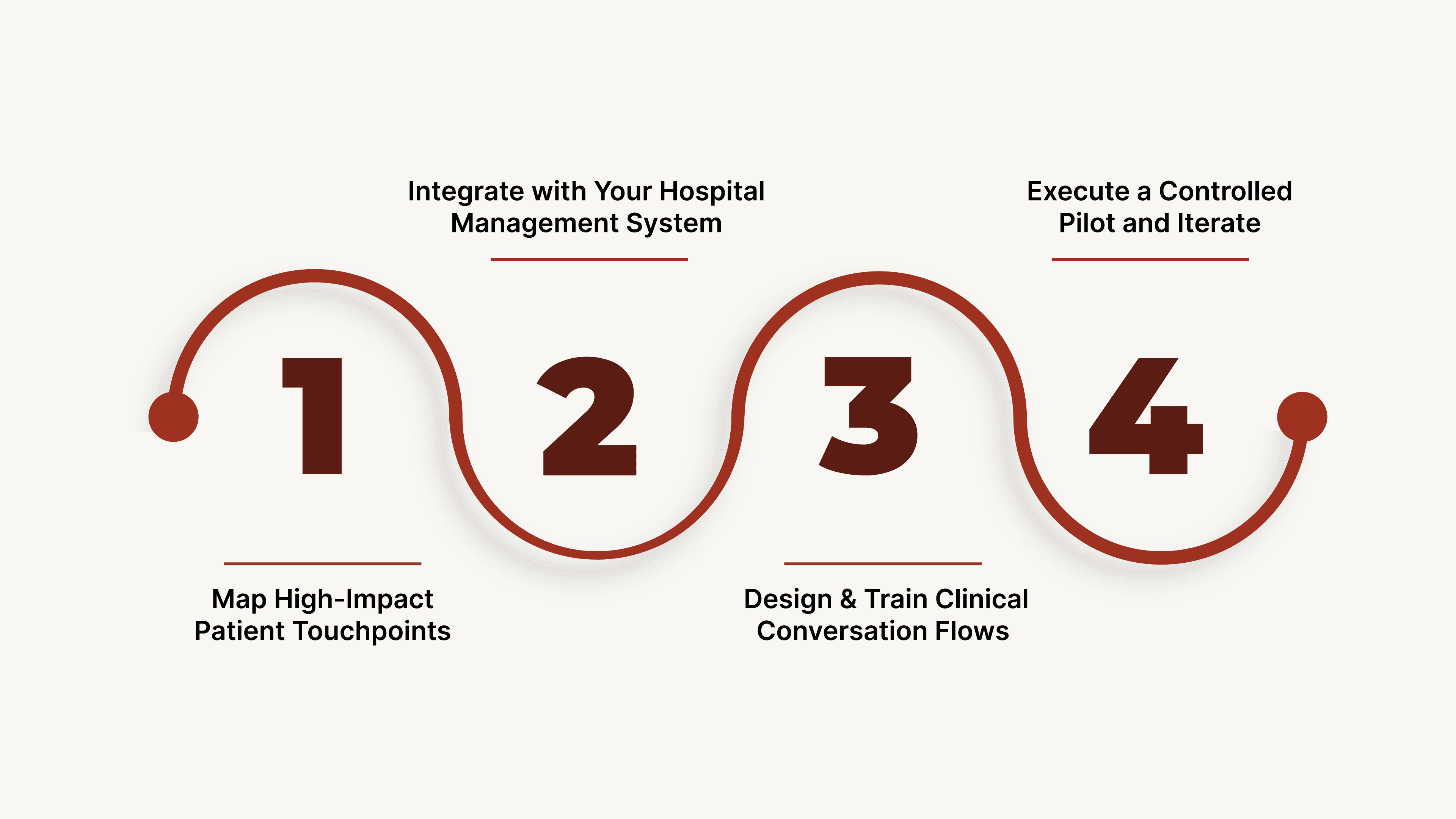
1. Map High-Impact Patient Touchpoints
Why it matters: Automating the wrong process wastes resources. You must identify the patient interactions that cause the most staff workload and have clear, rule-based outcomes.
Instructions: Gather your front-desk and nursing staff. List every phone call type they handle daily. Prioritize processes with high volume and low complexity, like appointment confirmations and medication refill requests.
Expected Outcome: You will have a prioritized list of 2-3 use cases (e.g., post-discharge follow-up, OPD reminder calls) for your pilot project.
2. Integrate with Your Hospital Management System (HMS)
Why it matters: The AI needs real-time data to be useful. Without access to live appointment schedules or patient records, it cannot provide accurate information or update records.
Instructions: Work with your IT team and the AI provider to establish a secure API connection between the AI platform and your HMS. Ensure data flows for appointment details, patient phone numbers, and follow-up statuses.
Expected Outcome: The AI assistant can read and write data to your central system, enabling personalized, accurate conversations.
3. Design and Train Clinical Conversation Flows
Why it matters: Medical conversations require precision, empathy, and compliance. A poorly designed script can confuse patients or provide incorrect clinical information.
Instructions: Write detailed dialogue trees with clinical supervisors. Include approved medical terminology, triage pathways, and escalation rules. Train the AI with these scripts and relevant patient FAQs.
Expected Outcome: The AI assistant interacts in a medically accurate and professional manner, safely handling defined scenarios.
4. Execute a Controlled Pilot and Iterate
Why it matters: A full-scale launch risks patient frustration if issues arise; a pilot allows you to test real-world performance in a limited, manageable environment.
Instructions: Launch the AI for a single department or patient group (e.g., diabetic follow-ups). Monitor the key metrics closely for two weeks. Collect feedback from both patients and staff.
Expected Outcome: You obtain performance data and user feedback to refine conversations before a hospital-wide rollout, ensuring a polished final product.
Awareness of common mistakes will help you navigate the implementation process more smoothly.
Also read: What Is Customer Satisfaction and How to Improve It?
Common Pitfalls With AI Voice Assistant for Care Navigation
Avoid these errors to ensure your project delivers its intended value without negative consequences.
1. Overlooking Patient Data Privacy (HIPAA/DPDPA Compliance)
Using a generic AI tool can risk sensitive patient health information. You may violate data protection laws like India's Digital Personal Data Protection Act (DPDPA).
Solution: Select an enterprise-grade platform like CubeRoot, designed with healthcare compliance. Ensure it offers secure data hosting, encrypted voice logs, and signed BAAs (Business Associate Agreements).
2. Implementing Without Clinical Staff Involvement
Deploying a tool that your doctors and nurses find unhelpful or intrusive leads to low adoption. They may bypass the system, rendering it useless.
Solution: Involve clinical teams from the planning stage. Let them co-design escalation protocols and approve messaging. Their buy-in is essential for the AI to become a true assistant.
3. Neglecting Multilingual and Low-Tech Patient Access
Assuming all patients are comfortable with English or smartphones excludes a significant population. This creates a digital divide in care access.
Solution: Implement a voice-first system that works on any basic phone. Choose a platform supporting major Indian languages and trained to understand regional accents for inclusive access.
Adhering to proven best practices will maximize your chances of a successful deployment.
Best Practices to Ensure AI Agent Implementation Success
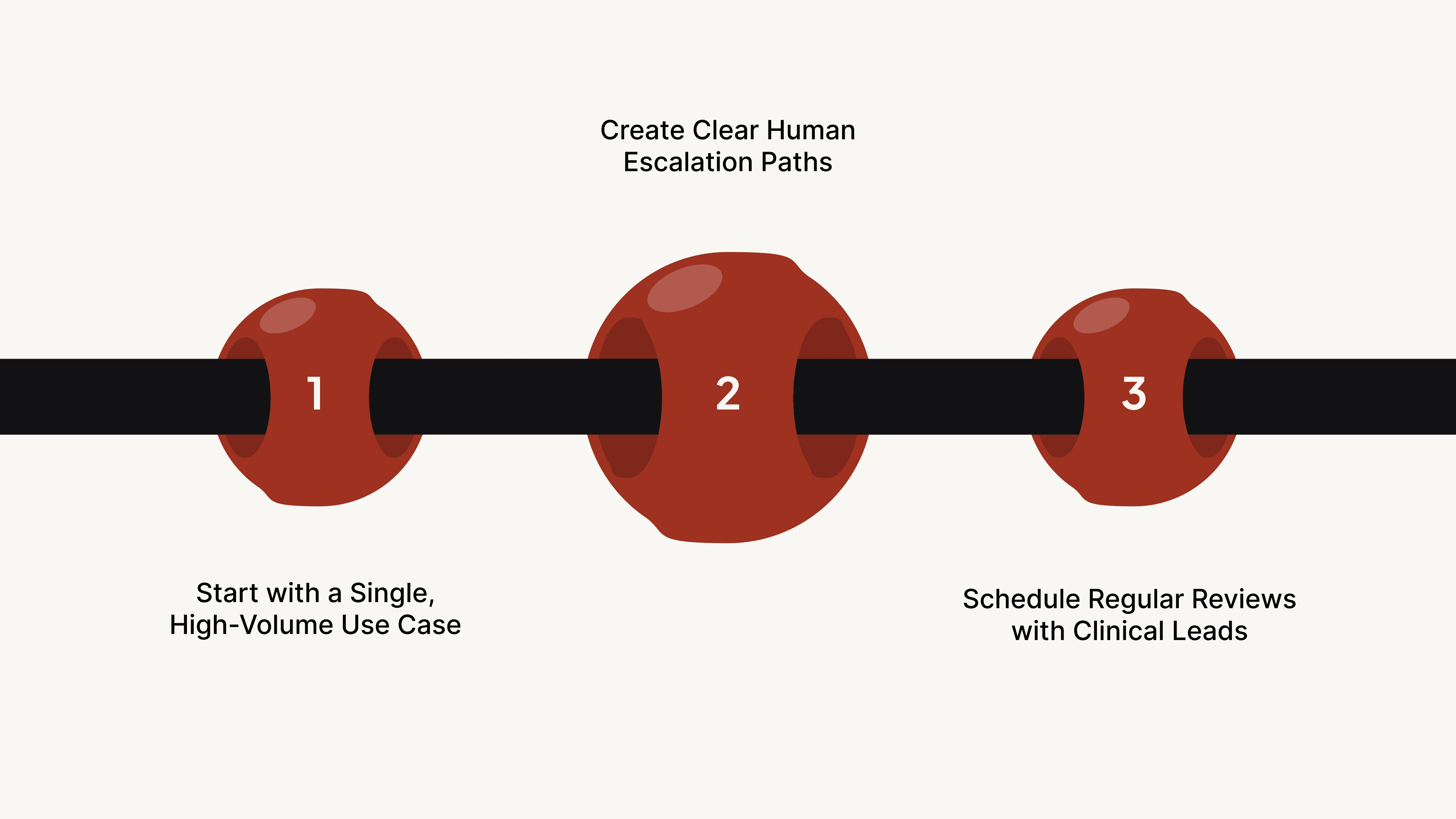
Incorporate these strategies from the outset to build an effective and sustainable AI navigation system.
1. Start with a Single, High-Volume Use Case:
Focus your initial rollout on one well-defined workflow, such as radiology appointment reminders. This allows for focused testing, easier troubleshooting, and a clear win to demonstrate before expanding.
Impact: You achieve a quick, measurable success that builds internal confidence and secures support for broader implementation.
2. Design Clear and Immediate Human Escalation Paths:
Program the AI to detect patient distress, confusion, or complex queries. It should immediately transfer the call to a live agent with full context.
Impact: Patients feel safe and supported, knowing they can reach a human. This builds trust in the automated system and prevents critical issues from being missed.
3. Schedule Regular Performance Reviews with Clinical Leads:
Establish a monthly meeting with department heads to review metrics, discuss feedback, and plan workflow additions. Treat the AI as a continuous quality improvement project.
Impact: The system evolves with your clinic's needs, maintains high relevance, and its benefits compound over time through iterative optimization.
These principles apply directly to specific, high-value scenarios within hospital and clinic settings.
Also read: Inbound vs Outbound Call Difference Explained
Top Use Cases of AI Agents in Hospitals and Clinics
AI voice assistants deliver concrete ROI by automating these specific interaction points in the patient journey.
1. Automated Appointment Scheduling and Reminders
Patients call to book, confirm, or reschedule OPD appointments. The AI accesses real-time slot availability, books appointments, and makes reminder calls. It reduces front-desk call volume significantly.
2. Post-Discharge Follow-Up and Recovery Tracking
After a patient leaves the hospital, the AI conducts scheduled check-in calls. It asks standardized recovery questions, confirms medication understanding, and flags concerning answers for nurse follow-up.
3. Pre-Appointment Instructions and Preparation
For procedures like surgeries or scans, specific preparations are required. The AI calls patients ahead of time to deliver precise instructions (e.g., fasting requirements), improving procedure success rates.
4. Chronic Disease Management and Medication Adherence
For outpatient cohorts (e.g., diabetes, hypertension), the AI makes regular check-in calls. It reminds patients about medication, asks about symptoms, and encourages lifestyle adherence, extending care between clinic visits.
For healthcare providers in India, a platform must address local infrastructure and regulatory requirements.
How CubeRoot Powers Care Navigation Workflows
Indian healthcare providers struggle with high patient volume, multilingual communication needs, and stringent data compliance. Generic AI solutions often fail to address the nuance of clinical conversations and India's diverse linguistic landscape.
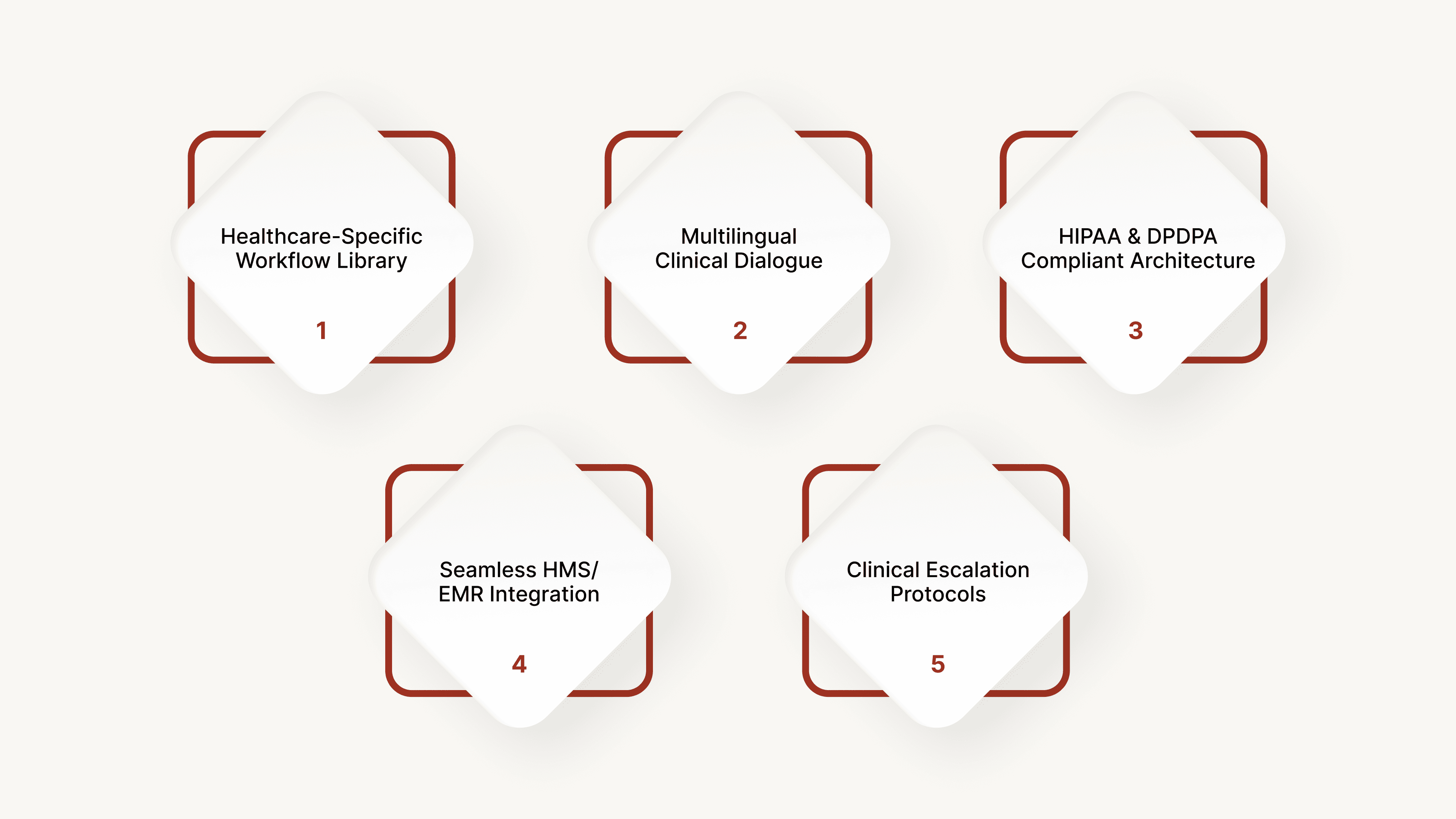
CubeRoot provides an enterprise Voice AI platform built specifically for these challenges. Our healthcare-trained voice assistants deliver secure, compliant, and natural patient interactions that scale across your organization.
Healthcare-Specific Workflow Library: Deploy faster with prebuilt, compliant templates for appointment scheduling, post-discharge follow-ups, and chronic disease management.
Multilingual Clinical Dialogue: Interact with patients in English, Hindi, and other Indian languages using medically accurate terminology and a compassionate tone.
HIPAA & DPDPA Compliant Architecture: Ensure full data privacy with secure, encrypted voice logging, audit trails, and compliant data storage.
Seamless HMS/EMR Integration: Connect via APIs to major Hospital Management Systems for real-time access to schedules and patient records.
Clinical Escalation Protocols: Built-in rules detect urgent patient responses and enable immediate transfer to live staff with full conversation context.
CubeRoot transforms patient navigation from an administrative task into a consistent, scalable, and insightful component of care delivery.
Also read: What Is A Voice Chatbot: A Complete Guide
Conclusion
AI voice assistants redefine efficiency and consistency in healthcare patient navigation. They solve critical problems like administrative overload, patient no-shows, and inconsistent follow-up. Success depends on careful implementation, clear metrics, and choosing the right technology partner.
For hospitals and clinics in India, the right platform must combine linguistic diversity with rigorous compliance. CubeRoot's specialized voice AI meets these needs, enabling you to enhance patient care without increasing administrative costs.
See how CubeRoot's healthcare-specific voice AI can streamline your patient journeys. Schedule a personalized demo to discuss your top use case.
FAQs
Q. Is an AI voice assistant secure for discussing patient health information?
Yes, if you choose a compliant platform. CubeRoot is built with healthcare data privacy laws in mind. It features end-to-end encryption, secure voice logging, and signs necessary data processing agreements to protect patient information.
Q. How well does it understand regional Indian accents and languages?
Advanced platforms train their models on diverse Indian language datasets. CubeRoot's assistants understand mixed language (Hinglish) and regional accents in Hindi, Tamil, Bengali, and more, ensuring clear communication with most patients.
Q. Can it integrate with our existing hospital software like e-Hospital or Practo?
Yes. Enterprise AI platforms offer API-based integration. You can connect them to most major Hospital Management Systems (HMS) and Electronic Medical Records (EMR) to enable real-time data exchange for appointments and patient details.
Q. What happens if a patient is distressed or the AI cannot answer a question?
The system is programmed with escalation protocols. When it detects confusion, complexity, or patient distress, it immediately transfers the call to a designated human agent. The agent receives a summary of the conversation so the patient does not repeat themselves.
Q. What is the typical ROI timeline for implementing an AI care navigation assistant?
You can expect to see operational efficiencies, like reduced call volumes, within the first 1-2 months post-pilot. Tangible financial ROI, such as net cost savings from reduced administrative workload and increased revenue from fewer missed appointments, typically becomes clear within one fiscal quarter. The ROI compounds over 6-12 months as the system handles more volume and expands to additional use cases.