Dec 31, 2025

AI Voice Agents vs IVR: ROI Breakdown and Key Differences
If you’ve ever been trapped in an endless “Press 1 for support” loop, you know the frustration of traditional IVR (Interactive Voice Response) systems. Once a breakthrough in automation, IVR now struggles to meet modern expectations for fast, personalized, and natural service.
The global voice AI market is projected to grow from $2.4 billion in 2024 to $47.5 billion by 2034 (CAGR 34.8%). That surge reflects a clear shift from rigid, menu-based IVR toward intelligent voice agents that understand intent, context, and emotion.
For businesses, this shift goes beyond convenience; it delivers measurable returns. Faster resolutions, lower operating costs, and higher customer satisfaction directly improve financial performance.
This article breaks down the ROI of AI voice agents vs. IVR systems, analyzing their differences in cost efficiency, scalability, and experience, and explains why AI is the smarter investment for customer-focused organizations.
TL;DR
Traditional IVR systems are rigid, slow to update, and fail to deliver the fast, natural experiences customers now expect.
AI voice agents use real-time intent recognition, contextual understanding, and continuous learning to resolve queries more efficiently.
Cloud-native architecture enables scalability, integration with CRMs, and adaptive updates within hours instead of weeks.
The benefits extend beyond cost reduction, driving higher retention, better insights, and greater operational agility.
Success requires strong infrastructure, data integration, and governance to ensure performance, compliance, and ongoing improvement.
How IVR and AI Voice Agents Work
The architecture behind each system explains why its ROI outcomes differ so sharply. Their technical design defines how efficiently they handle conversations, adapt to change, and scale.
Traditional IVR Systems
IVR (Interactive Voice Response) automates inbound calls using DTMF inputs or limited speech recognition within static decision trees.
Core traits:
Rule-based design: Fixed, hierarchical menus (“Press 1 for billing”).
Minimal intelligence: Keyword detection without contextual understanding.
On-prem dependence: Runs on legacy telephony hardware, restricting scalability.
Manual updates: Every change requires re-recordings and engineering effort.
AI Voice Agents
AI voice agents combine speech-to-text (STT), natural-language understanding (NLU), and text-to-speech (TTS) within cloud microservice architectures. They interpret intent, context, and sentiment to resolve queries naturally.
Core traits:
Intent-driven conversation: Understands open language and manages multi-turn dialogue.
Personalized responses: Pulls real-time data from CRM, ERP, or knowledge bases.
Adaptive architecture: Uses model training and edge inference to lower latency.
Continuous learning: Improves accuracy and tone from interaction feedback.
Functional Comparison
The way these systems are structured directly impacts performance, adaptability, and cost. Let’s see how it helps to compare their functional differences side by side.
Aspect | Traditional IVR | AI Voice Agents | Strategic Insight |
Interaction | Menu-based | Conversational, intent-led | Defines containment potential |
Language Understanding | Keyword matching | Contextual NLP with entity recognition | Drives accuracy in real use-cases |
Personalization | Generic flows | Dynamic CRM/API responses | Builds stronger customer loyalty |
Architecture | On-prem telephony | Cloud-native API-first | Determines scalability and speed |
Learning | Static logic | Continuous model updates | Reduces maintenance cost over time |
Latency | Routing-dependent | Edge or hybrid inference | Shapes real-time conversation quality |
CX Outcome | Rigid and repetitive | Fast and contextual | Directly affects CSAT and ROI |
These structural and functional contrasts translate into measurable differences in ROI, scalability, and customer satisfaction.
Also Read: How AI Is Transforming Call Centres And Customer Service
ROI and Performance Comparison: IVR vs AI Voice Agents
The real difference between IVR and AI voice agents lies in operational efficiency, scalability, and financial impact. Here’s how each performs across key business metrics.
1. Containment and Resolution Efficiency
IVR: Usually resolves only 20–40% of calls, with the rest routed to human agents. Complex queries exceed its menu limits, increasing transfers and queue time.
AI Voice Agents: Resolve 50–75% of calls independently. Contextual understanding and backend access enable faster, first-contact resolutions.
Impact: Higher containment directly reduces cost per call and agent workload, the most significant contributor to ROI in high-volume operations.
2. Handle Time and Customer Effort
IVR: Menu navigation and repeated inputs extend calls and frustrate users.
AI Voice Agents: Context memory and real-time data retrieval shorten interactions, reducing average handle time significantly.
Impact: Fewer transfers and faster resolutions improve throughput without increasing infrastructure or staffing costs.
3. Cost and Total Ownership
IVR: Hardware-based, with high setup and maintenance costs. ROI plateaus as systems age.
AI Voice Agents: Subscription-based, scalable, and self-updating. Learning models reduce manual maintenance.
4. Scalability and Reliability
IVR: Expansion requires new lines and hardware, making it slow and costly to scale.
AI Voice Agents: Cloud-native systems scale instantly, maintaining performance even during traffic spikes.
5. Customer Satisfaction and Retention
IVR: Frustrating menus and long wait times lower CSAT and NPS.
AI Voice Agents: Natural conversations and faster outcomes lift satisfaction and loyalty scores.
6. ROI Timeline
AI voice agents typically reach payback within 6–12 months, delivering 150–200% ROI within the first 18 months through cost reduction and improved retention.
AI voice agents outperform IVR on every key metric, delivering measurable cost savings, faster service, and higher satisfaction.
Where Traditional IVR Still Makes Sense
Voice AI isn’t automatically the right choice for every scenario. Legacy IVR still holds value when:
Call volume is low, and interactions are simple and predictable (e.g., basic info retrieval, account balance, store hours).
Business prefers predictable, deterministic behaviour without risk of misinterpretation or “hallucination.” No ML/NLP = no surprises.
Infrastructure constraints: business may lack cloud/edge capabilities, integration readiness, or resources to support continuous improvement.
Desire to minimise latency or ensure near-instant routing when speed and determinism matter more than conversational flexibility.
If your needs are narrow, stable, and simple, IVR remains viable. The uplift from voice AI may not justify the cost or complexity.
Performance metrics tell part of the story, but the underlying technology determines how consistently these results can be achieved in real-world conditions.
Also Read: Top AI Voice Assistants In 2025
Engineering Responsiveness and Reliability in Voice AI
Two factors define the quality of any conversational system: how quickly it responds and how accurately it understands. Both depend on architecture, not scale.
1. Building for Real-Time Responsiveness
Low latency is what makes an AI conversation feel natural—sustaining that requires reducing processing distance and computational drag at every stage.
Key design levers include:
Local or regional inference to shorten transmission paths.
Model optimization to make responses concise and context-aware rather than computationally heavy.
Concurrent processing pipelines where speech recognition, intent mapping, and synthesis occur in parallel instead of in sequence.
Responsiveness is not just a technical metric—it shapes perceived intelligence and customer trust.
2. Maintaining Precision Across Unpredictable Speech
Accuracy challenges stem from how people actually speak: overlapping intent, diverse accents, and environmental noise. These inputs break traditional IVR grammars but are manageable through adaptive language models and continuous tuning.
A resilient system combines adaptive learning with clear fallback logic. The AI interprets most interactions autonomously, while human agents step in seamlessly when context is uncertain. The result is a layered design that prioritizes fluency without sacrificing reliability.
Technical architecture influences customer experience, but its broader impact extends to retention, brand perception, and business agility.
Business Impact That Extends Beyond Cost
Comparing Voice AI and IVR is not just about efficiency. It defines how organizations shape loyalty, adaptability, and brand strength.
1. Experience Drives Retention
Friction in service interactions damages trust faster than pricing or product issues. Voice AI reduces that friction by recognizing intent naturally and resolving issues quickly. Speed of resolution becomes an experience advantage that directly improves retention.
2. Data as a Feedback Engine
IVR captures limited button inputs, while Voice AI captures context: tone, sentiment, and phrasing. This creates a feedback loop that informs product design, customer strategy, and churn prevention. The intelligence gathered across interactions becomes a source of continuous improvement.
3. Agility as a Competitive Variable
Traditional IVR updates are slow and resource-heavy. Voice AI allows prompt and model changes in hours. This responsiveness enables organizations to adjust to policy changes, new offers, or market conditions with minimal delay.
4. Adaptability Over Static Efficiency
Efficiency matters, but adaptability sustains advantage. Voice AI systems learn and improve continuously, giving businesses the flexibility to respond to customer behavior and environmental change without major rework.
Capturing these advantages requires more than technology; it demands readiness across infrastructure, data, and operational governance.
Implementation Readiness: What to Plan For
Replacing IVR with Voice AI is not a one-time transition. It requires planning across infrastructure, integration, and operational governance. Here is what you plan for:
1. Infrastructure
Voice AI performance depends on where processing occurs. Assess whether your environment can support low latency and consistent throughput. Responsiveness is built into architecture, not tuning.
2. Integration
Meaningful outcomes require access to context. Connect Voice AI to CRM, support tools, and data systems to enable automated actions and informed responses. Integration complexity often determines the real cost and long-term ROI.
3. Security and Compliance
Every call contains personal information. Secure design includes encryption, access controls, and regulatory compliance across privacy frameworks. Security should evolve alongside model updates.
4. Operational Readiness
AI platforms need ongoing refinement. Assign clear ownership for prompt design, model management, and quality monitoring. Optimization should be treated as a core operational process.
5. Governance as a Strategic Function
Governance maintains consistency and accountability as AI evolves. Defining review cycles, success metrics, and escalation paths ensures the system continues to align with organizational standards and customer expectations.
How CubeRoot’s AI Voice Agents Outperform IVR
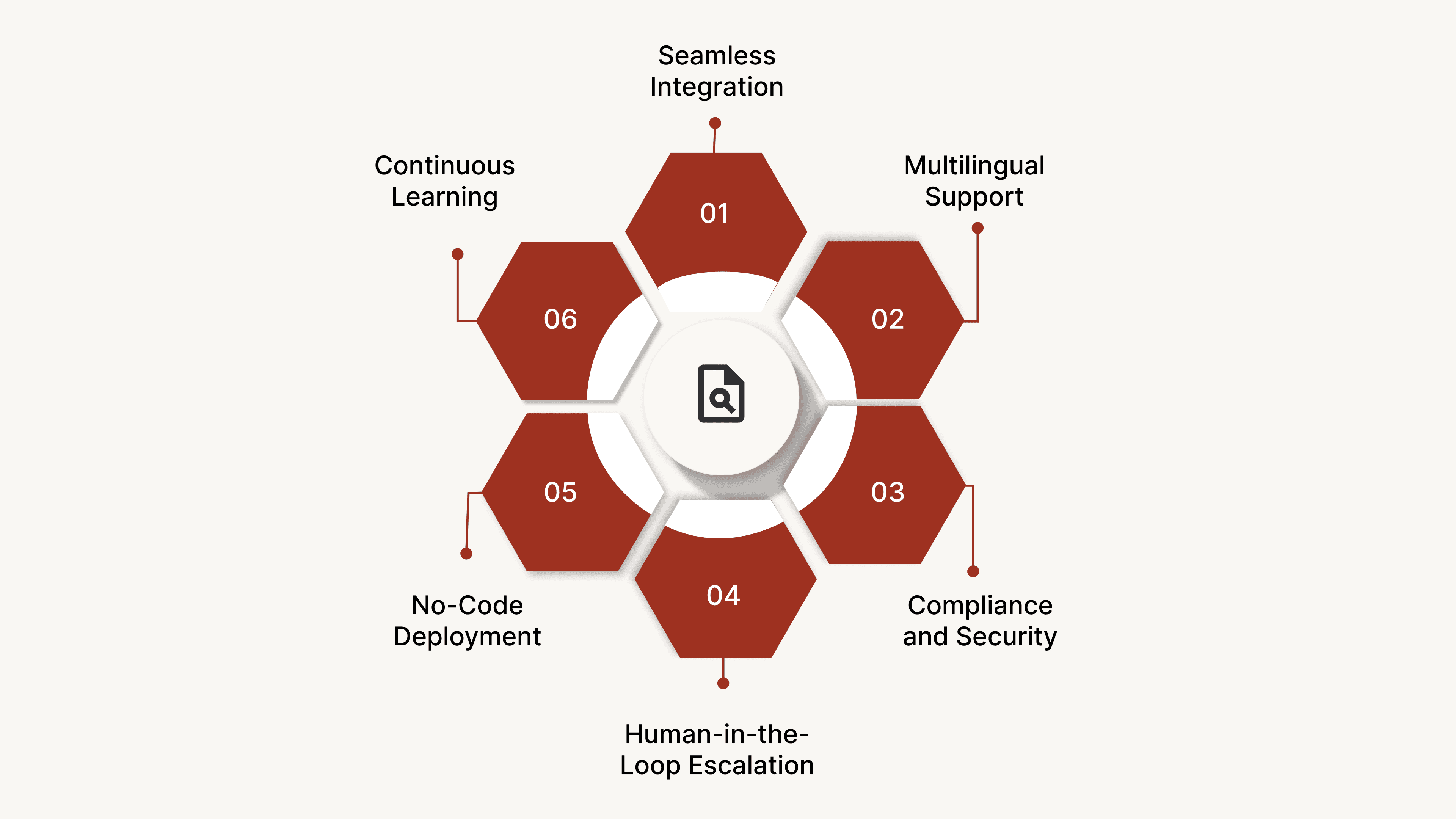
CubeRoot’s AI-powered voice agents go beyond the capabilities of traditional IVR systems, offering advanced features designed to address modern business challenges. Here’s how CubeRoot’s platform outperforms IVR systems:
Seamless Integration: CubeRoot’s AI voice agents integrate effortlessly with your existing systems (CRMs, ERPs, fraud detection platforms), enabling real-time, personalized customer interactions without disrupting your workflow.
Multilingual Support: CubeRoot supports multiple languages, enabling businesses to cater to diverse customer bases and making AI voice agents accessible and effective across regions.
Compliance and Security: CubeRoot ensures that all interactions meet stringent industry regulations such as GDPR, PCI-DSS, and HIPAA, providing both data privacy and security while managing sensitive customer information.
Human-in-the-Loop Escalation: For complex cases that require human intervention, CubeRoot’s AI voice agents can seamlessly transfer the interaction to a live agent, ensuring a smooth transition without losing context.
No-Code Deployment: CubeRoot enables businesses to deploy AI voice agents with minimal IT intervention, enabling rapid scaling and faster go-live.
Continuous Learning and Improvement: CubeRoot’s AI voice agents learn from every interaction, constantly improving in accuracy and efficiency. The more they interact with customers, the better they become at predicting needs and providing personalized responses.
CubeRoot’s AI voice agents are built to scale, offering businesses a flexible, secure, and highly effective solution for modern customer service challenges.
Conclusion
AI voice agents are replacing traditional IVR systems, providing businesses with a more efficient way to manage customer interactions. Unlike IVR, AI voice agents offer real-time, natural conversations that improve customer experience and boost operational efficiency.
Adopting AI enhances personalization, reduces operational costs, and scales customer service. With the ability to handle high traffic, automate tasks, and continuously improve, AI voice agents are the future of customer service.
Ready to move beyond IVR? CubeRoot’s AI-powered solutions provide seamless integration, security, and scalability to elevate your customer service.
Book a demo with CubeRoot today to discover how our AI voice solutions can elevate your customer service. |
FAQs
1. How can AI voice agents integrate with existing CRM and ERP systems?
AI voice agents integrate seamlessly with CRM and ERP systems through API-first platforms like CubeRoot. These integrations provide real-time data access, enabling AI agents to deliver personalized responses based on up-to-date customer information without disrupting current workflows.
2. How do AI voice agents handle complex, multi-turn customer interactions?
AI voice agents use natural language processing (NLP) to understand and track the context of conversations. This allows them to manage complex, multi-turn interactions, maintaining relevance and coherence throughout the dialogue.
3. How do AI voice agents improve fraud detection in real-time?
AI voice agents employ voice biometrics and behavioral analysis to verify identities and detect fraudulent activity. They analyze voice patterns and speech nuances in real-time, flagging suspicious behavior instantly while maintaining a smooth customer experience.
4. What are the costs associated with transitioning from IVR to AI voice agents?
The transition involves initial setup, integration, and training costs, but the long-term savings from automating routine tasks and improving efficiency often outweigh these. Additionally, AI voice agents scale easily, reducing the need for additional staffing and improving ROI over time.
5. How does AI voice agent technology improve over time?
AI voice agents continuously learn from interactions through machine learning, refining their accuracy and ability to handle diverse queries. This ongoing learning ensures better personalization and more efficient customer service as the system gathers more data.