Dec 31, 2025
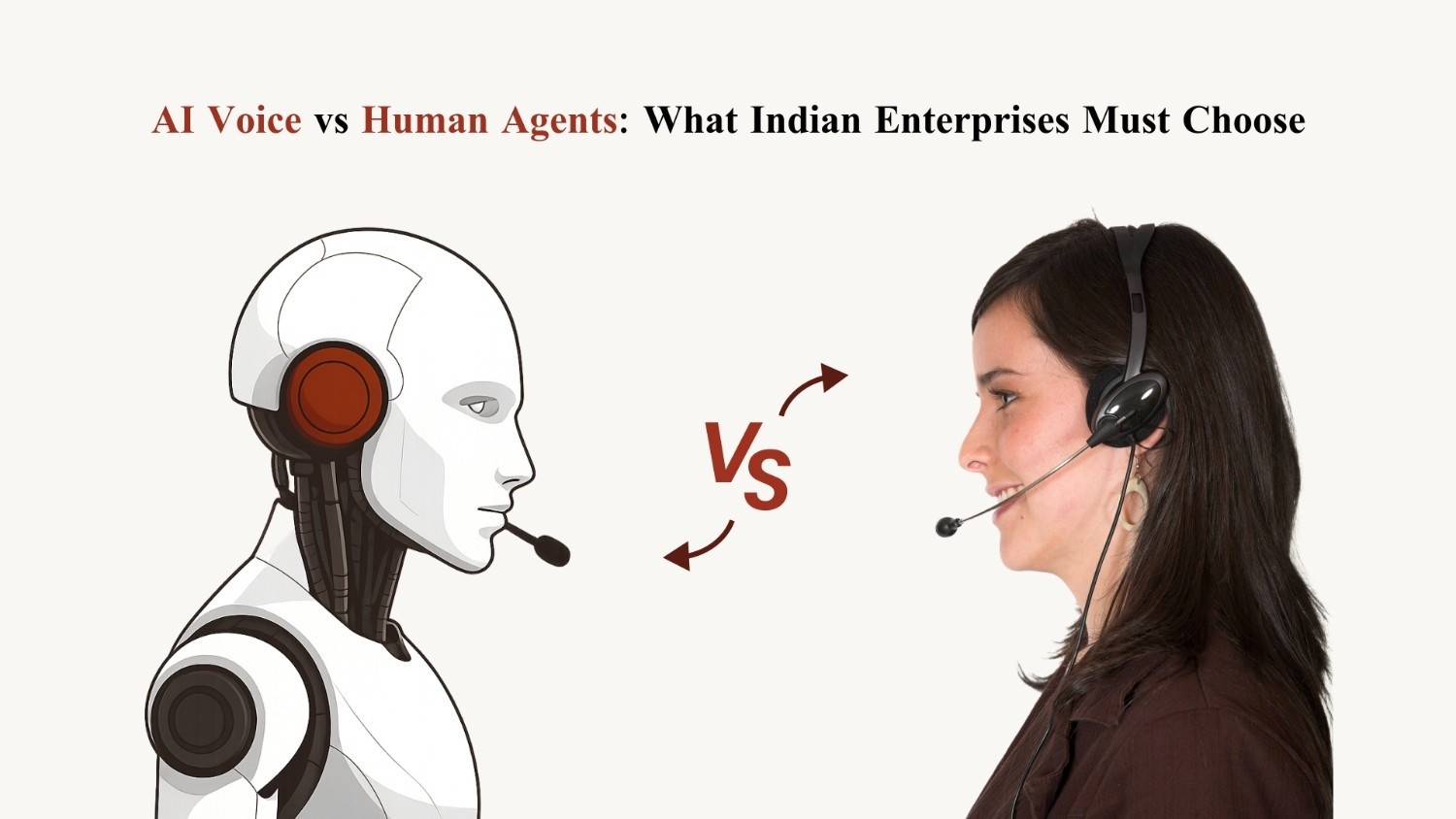
AI Voice vs Human Agents: What Indian Enterprises Must Choose in 2026
In every Indian enterprise, customer conversations are getting harder to manage. A lending team in Pune must handle thousands of reminder calls. A fast-growing e-commerce brand in Noida needs instant updates shared with shoppers. In each case, one question keeps coming up: "Are AI voice agents better than human agents?"
With customer expectations rising fast, quick and accurate answers in their language have become the norm. Human teams often struggle with volume spikes, cost pressures, and inconsistent performance. AI agents promise speed, scale, and 24/7 availability. While these attributes enhance customer service, humans bring in empathy, context, and judgment that improve the quality of resolutions.
This blog breaks down how the two compare in real enterprise scenarios in India. You'll see where AI voice agents excel, where human agents are still essential, and how you can combine both to deliver improved customer experiences.
Key Takeaways
AI voice agents excel at scale, speed, and consistency, making them ideal for high-volume, rule-based tasks such as reminders, order updates, and account inquiries.
Human agents outperform AI in emotionally sensitive, ambiguous, or negotiation-heavy situations, bringing empathy, contextual reasoning, and real-time judgment.
AI's limitations include poor emotional detection, difficulty with vague inputs, and challenges in multi-step issues. These highlight the ongoing need for human involvement, especially when clarity, reassurance, or personalization are not negotiable.
A hybrid AI-human model delivers the strongest outcomes, with AI handling triage and repetitive tasks while humans step in for complex escalations. This results in better efficiency, stronger CX, and balanced workloads.
The ideal mix depends on task complexity, customer sentiment, and business objectives, allowing you to reduce costs, maintain compliance, and improve agent productivity.
How AI Voice Agents Stack Up Against Human Agents
AI voice agents are now part of everyday interactions. You speak to them when Alexa sets a reminder, when Siri answers a quick question, or when Google Assistant helps you plan your day. The same technology is transforming how Indian enterprises handle large volumes of customer calls. That too, faster, more consistently, and without the operational strain of scaling human teams.
Voice AI agents rely on voice recognition, natural language processing (NLP), and machine learning to simulate natural, human-like conversations. These agents improve with every call and adapt to customer behavior. They can:
Understand customer questions in real time
Respond instantly with accurate, contextual answers
Classify intent and route calls intelligently
Handle back-and-forth conversations
Personalize conversations using past interactions
Example: An e-commerce marketplace can use an AI voice agent to confirm several cash-on-delivery orders daily, share delivery updates, and escalate complex cases to human teams.
That said, human agents still play an essential role. There are times when a customer's concern goes beyond simple queries. These include disputing a disputed loan charge, expressing frustration, or needing support that requires understanding emotions and context. In such scenarios, human expertise becomes indispensable.
Also Read: Contact Center AI Solutions and Trends for Tomorrow
To choose the right approach, you need a clear view of what AI does exceptionally well and where it falls short compared to human support.
Where AI Voice Agents Shine, and Where They Still Lag
AI voice agents are becoming a go-to option for Indian enterprises managing high call volumes and needing fast, reliable responses. While they excel at scale and consistency, they also have apparent limitations that make human agents essential in specific situations. Let's explore their pros and cons minutely.
A. Where AI Voice Agents Deliver the Most Impact
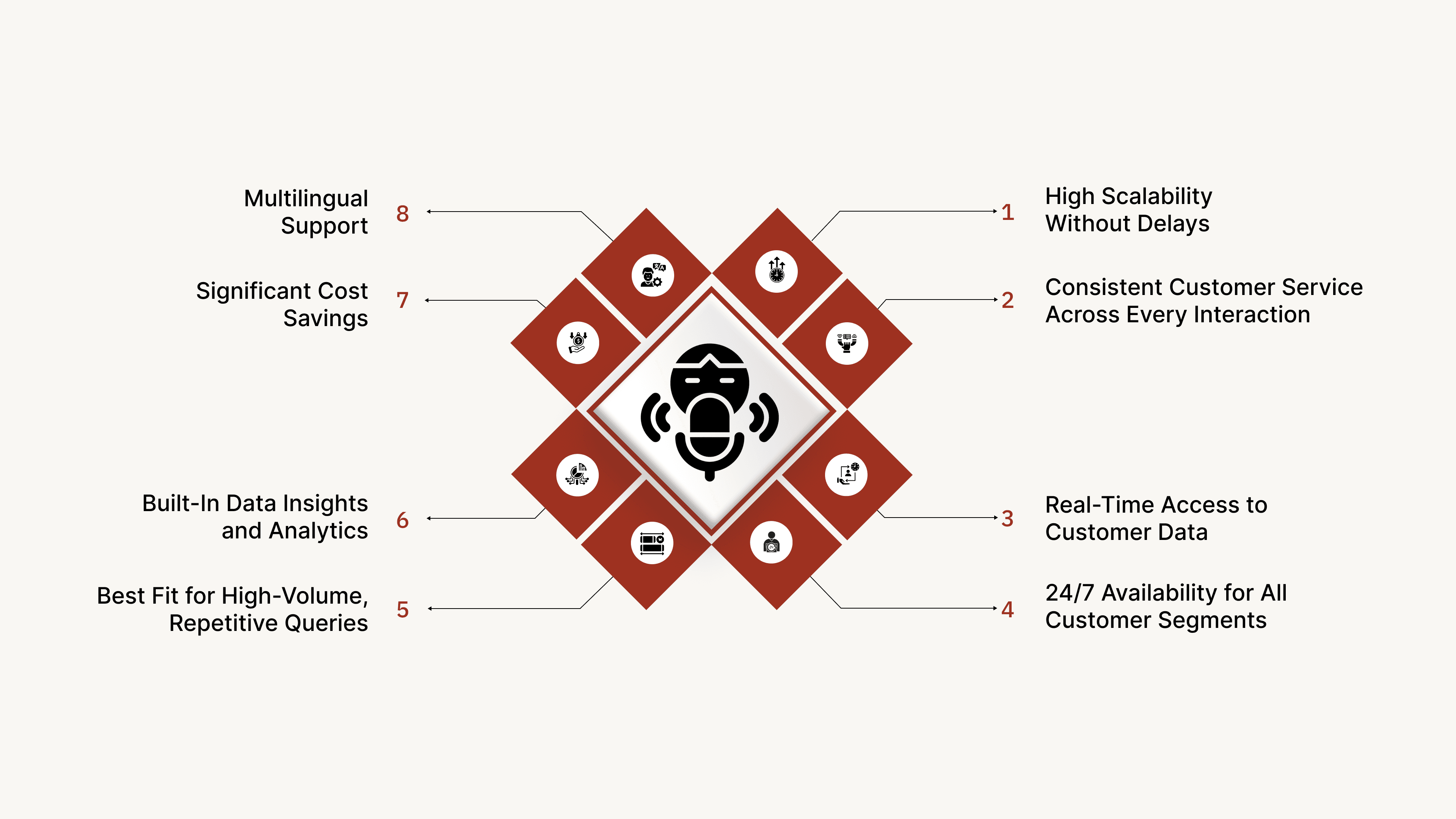
AI agents transform customer operations when you need scale and speed. They work best in high-volume environments where customers expect quick resolutions and predictable outcomes.
1. High Scalability Without Delays
AI agents scale instantly, regardless of call volume. This matters most for businesses that face unpredictable spikes. They enable you to handle demand peaks without hiring, training, or stretching your team. That, in turn, helps you avoid long queues, missed calls, and operational slowdowns.
Example: A major NBFC in Chennai handles over one lakh EMI reminder calls during the first week of every month. An AI voice agent can handle these calls in parallel, log responses instantly, and update the CRM without bottlenecks.
Did you know? 85% of customer service leaders plan to deploy customer-facing conversational AI solutions. This highlights how rapidly enterprises are shifting routine queries away from human teams.
2. Consistent Customer Service Across Every Interaction
Voice AI agents deliver the same tone, language, accuracy, and script adherence every time. They do not experience fatigue, mood fluctuations, or lapses in compliance.
Impact examples:
Retail/e-commerce brands keep refund/exchange scripts uniform.
Insurers maintain IRDAI-compliant communication across all outbound calls.
3. Real-Time Access to Customer Data
AI voice agents retrieve account information, past interactions, and behavioral insights in real time. This allows your customers to receive quick and precise answers.
Example: When a user calls about onboarding steps, the AI agent can reference their last login, pending actions, or recent support tickets and respond accordingly.
Why it matters:
No need to "put customers on hold."
More relevant, personalized answers at scale
4. 24/7 Availability for All Customer Segments
74% of consumers now expect customer service to be available 24/7. Since AI does not depend on shifts, breaks, or regional holidays, it offers uninterrupted service across time zones. For India's geographically dispersed customer base (Tier 1 to Tier 4), this ensures accessibility at any hour.
5. Best Fit for High-Volume, Repetitive Queries
If your agents repeatedly answer the same 10-20 questions every day, AI agents offer a better option. Here's a quick list of the typical AI-handled tasks:
Order tracking updates
Delivery confirmations
Balance inquiries
Appointment bookings
Loan status checks
Payment reminders
6. Built-In Data Insights and Analytics
AI captures and analyzes every customer interaction: intent, sentiment patterns, drop-off points, and call outcomes. You can use these insights to refine workflows, improve training, and upgrade customer experience.
Example: A D2C brand in Mumbai can review AI-generated reports to reduce return-related calls and improve product descriptions on its website.
7. Significant Cost Savings
AI voice agents help you reduce operational costs by automating repetitive tasks and minimizing the workload of human teams. This reduces your hiring and training expenses and increases the cost efficiency of your support operations.
8. Multilingual Support
AI voice agents communicate in multiple Indian languages without requiring separate regional teams. This helps you serve customers across diverse markets with the same level of consistency and accuracy. It doesn't matter whether they speak Hindi, Tamil, Kannada, Bengali, or English.
Also Read: Multilingual Voice Bots for Enhanced Customer Interaction
B. Limitations of AI Voice Agents
AI offers tremendous value, but it cannot replace human expertise in every scenario. Understanding these constraints helps you use AI responsibly and strategically.
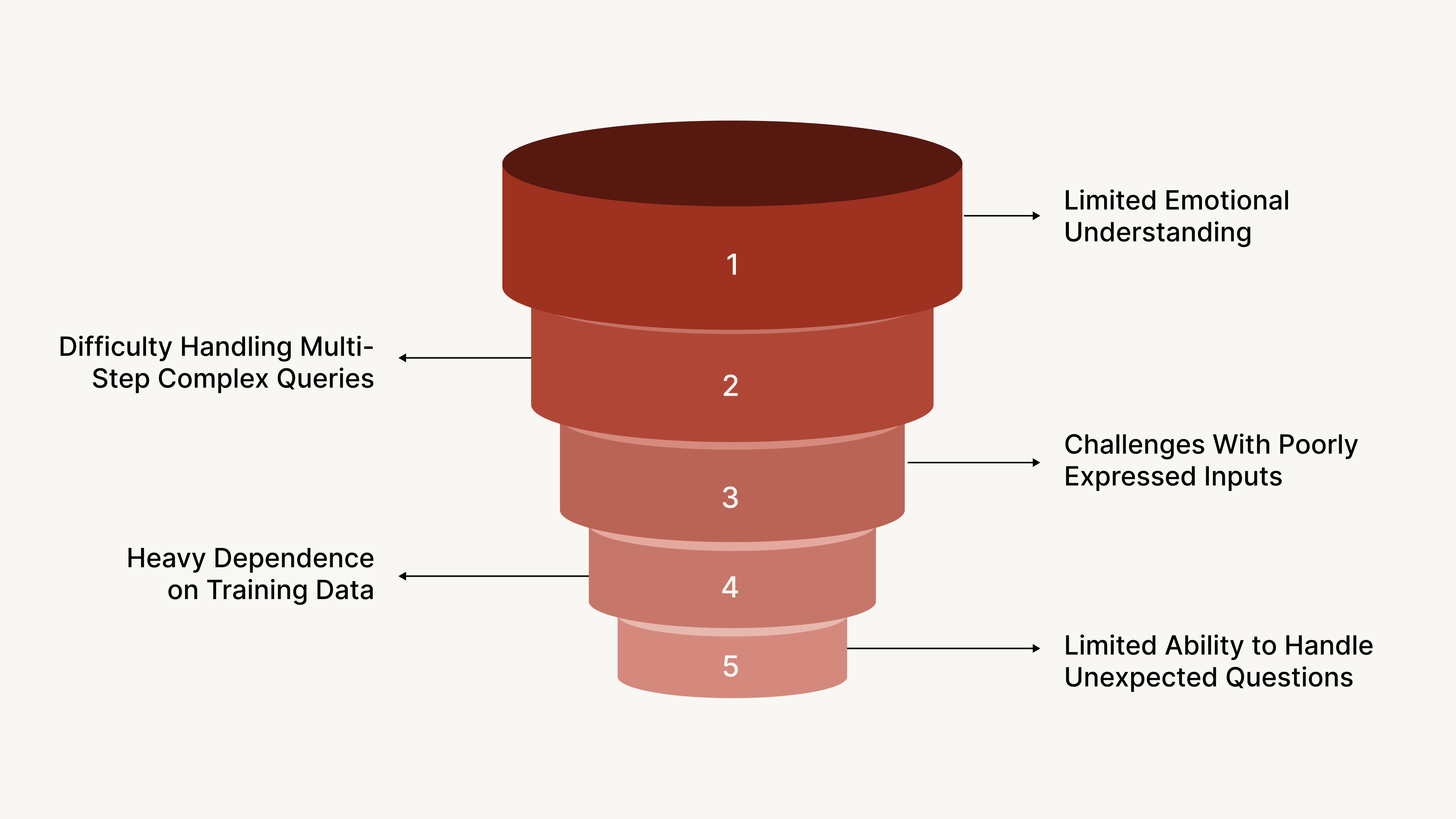
1. Limited Emotional Understanding
AI cannot pick up on emotional cues the way humans can. It struggles to detect subtle frustration, hesitation, anxiety, fear, or sarcasm.
Example: A customer calling about a rejected health insurance claim often needs empathy and reassurance, which AI cannot fully provide. This requires a human touch.
2. Difficulty Handling Multi-Step Complex Queries
AI performs best when your workflows are clear and structured. It may fail when a customer's issue spans multiple systems or requires negotiation.
Example: A SaaS client reporting a software downtime needs live troubleshooting that requires human reasoning, not generic, automated responses.
3. Challenges With Poorly Expressed Inputs
Customers do not always explain their problems clearly. They may use incomplete sentences, colloquial language, or vague descriptions. AI agents often find these patterns difficult to interpret, leading to irrelevant responses.
Examples:
"I didn't get the thing I ordered … you know what I mean?"
"That guy said something last time about a refund."
"It's not working again."
4. Heavy Dependence on Training Data
AI quality depends on how well you train it. Voice AI agents require updated knowledge bases and FAQs, clean workflows, and correct CRM integration.
Why this matters: If your data is messy or outdated, call quality will suffer.
Pro Tip: Start with 2-3 high-volume use cases, train the AI thoroughly, then scale.
5. Limited Ability to Handle Unexpected Questions
AI voice agents may struggle when customers ask questions beyond their scope of training. In such cases, the system may escalate or provide incomplete answers.
Example: A student requesting a one-time fee waiver or notable exception requires flexibility that AI cannot offer.
Also Read: How AI is Transforming Call Centres and Customer Service
To decide whether AI agents are better than human agents, you should also consider the scenarios where humans deliver greater value.
Where Human Agents Excel and Fall Short
While voice AI agents efficiently manage high-volume queries, there are several areas where only a human can deliver the nuance customers expect.
A. Strengths of Human Agents
Human agents play a critical role in scenarios where customer expectations extend beyond structured workflows and require deeper interpretation or personalized guidance.
1. Emotional Intelligence and Human Empathy
Human agents understand tone, urgency, and emotional cues in ways AI cannot. They pick up on hesitation, dissatisfaction, confusion, or frustration and adjust their responses accordingly. This helps you build a stronger rapport and reassure customers during stressful or unclear situations.
Example: A customer disputing unexpected transaction charges prefers speaking to a human who listens patiently, acknowledges the concern, and resolves the issue with empathy.
2. Creative and Complex Problem-Solving
Human agents think beyond predefined workflows. They interpret ambiguous statements, understand unstated concerns, and connect information across multiple systems or policies. This ability helps them arrive at solutions that require reasoning rather than simple rule-based execution.
Example: A borrower seeking a loan restructure needs a human agent who doesn't just follow a fixed script. Instead, the agent can review previous payment behavior, understand the context behind delayed EMIs, and negotiate a feasible alternative.
3. Brand Representation With Personality
Human agents carry your brand's voice through their tone, conversational style, and cultural understanding. They can adapt their communication to match your company's values, whether that means being formal, friendly, concise, or consultative.
Key Insight: This helps you build trust and create memorable engagement moments that automated systems cannot fully replicate.
4. Ability to Manage Multi-Layered or Sensitive Issues
Human agents excel in scenarios where policies overlap, stakes are high, or the outcome depends on negotiation, judgment, and on-the-spot improvisation.
Common scenarios include:
Fraud alerts that require verification and critical thinking
Legal compliance queries that demand precise interpretation
High-value customer retention calls where personalization matters
Multi-step service escalations that rely on cross-team coordination
B. Limitations of Human Agents
Human agents offer empathy and contextual judgment, but they also face operational and performance challenges that can affect scale and consistency. These limitations become more visible as customer expectations grow and call volumes fluctuate across India's fast-moving sectors.
1. Limited Scalability
Human teams cannot expand quickly when demand spikes. New agents need time to understand your products, processes, systems, and compliance rules. Even trained staff require refreshers when workflows change. This makes it challenging to respond to sudden increases in call traffic.
Example: A Bengaluru-based e-commerce marketplace may see a massive surge in order-related calls during festive sales. The support team cannot scale from 50 agents to 300 overnight, leading to long queues and abandoned calls.
2. Higher Cost per Interaction
Human-led operations are expensive due to salaries, training, infrastructure, and ongoing workforce management. Repetitive queries consume valuable bandwidth that could be spent on higher-priority customer issues, such as retention calls or upsell opportunities.
3. Fatigue and Burnout
High call volumes, long shifts, and repetitive questions can lead to mental fatigue. Over time, this affects tone, patience, and the quality of decision-making. Burnout increases attrition, slows service delivery, and forces continuous rehiring and retraining.
Example: A loan servicing team handles customer payment queries throughout the day. By the end of the shift, agents become slower and less empathetic, which affects both compliance and customer satisfaction scores.
4. Inconsistent Service Delivery
Human performance varies. Two agents may interpret policies differently or convey information in different tones. Experience, communication ability, and stress levels all impact the customer experience.
Example: A customer calling an insurer receives a clear explanation of premium calculations in the morning. However, they may receive a rushed, unclear explanation from a different agent later in the day.
These fundamental contrasts set the stage for a practical question: in which situations should your business use AI, humans, or both?
Choosing Between AI Voice Agents and Human Agents: What Works Best and When
The right balance between voice AI agents and human agents depends on the task's complexity, the conversation's emotional context, and the type of customer. Here's a practical, decision-ready breakdown in real operational scenarios.
Task Complexity: Simple vs. Multi-Layered Queries: AI voice agents perform best when tasks follow clear rules and predictable workflows. Billing disputes, failed deliveries, canceled payments, or multi-step troubleshooting need human intuition and real-time decision-making.
Emotional Tone: Empathy vs. Efficiency: AI responds quickly and consistently, but it lacks the emotional depth needed in sensitive or high-frustration situations. Human voices de-escalate tension, rebuild trust, and read subtle cues in ways machines cannot.
Pro Tip: Route high-frustration keywords, such as "angry," "refund not processed," and "I want to speak to a manager," directly to a human.
Volume and Urgency: Scale vs. Crisis Handling: AI shines when call volume spikes beyond your team's capacity. It processes thousands of routine queries instantly, without breaks or backlogs. Human agents, however, perform better when conversations involve high-stakes or rapidly changing situations, such as service disruptions, delayed shipments, or policy exceptions.
Customer Tier: General vs. High-Value Accounts: AI is ideal for frontline assistance and day-to-day customer needs. Human agents are better suited for VIP customers, enterprise clients, or high-lifetime-value segments.
The Hybrid Advantage: Why Most Indian Enterprises Use Both
The most efficient model blends AI speed with human intelligence. This approach ensures responsiveness, accuracy, and emotional depth in a single experience.
Intelligent Frontline Automation With Human Backup: AI voice agents manage the first level of interaction, capture intent, and resolve routine queries instantly. When the issue requires empathy, negotiation, or deeper reasoning, the system escalates smoothly to a human agent, preserving the conversation context. This ensures faster responses without compromising on quality for complex or sensitive cases.
Continuous Human Oversight: Your teams can monitor AI behavior, adjust prompts, and refine workflows to maintain accuracy, compliance, and a brand-aligned tone across interactions.
Smarter Division of Workload: AI handles predictable, rule-based tasks while humans focus on high-value conversations. This improves agent utilization, lowers operational load, and boosts customer satisfaction.
Turning this hybrid model into a real competitive advantage requires infrastructure that supports both automation and human intervention without friction.
How CubeRoot Enables a Smarter AI-Human Model
Balancing automation with human expertise can be challenging, especially as customer expectations, compliance needs, and call volumes continue to rise. CubeRoot helps you bridge this gap with an enterprise-grade Voice AI platform that combines both AI-driven efficiency and human-led service quality.
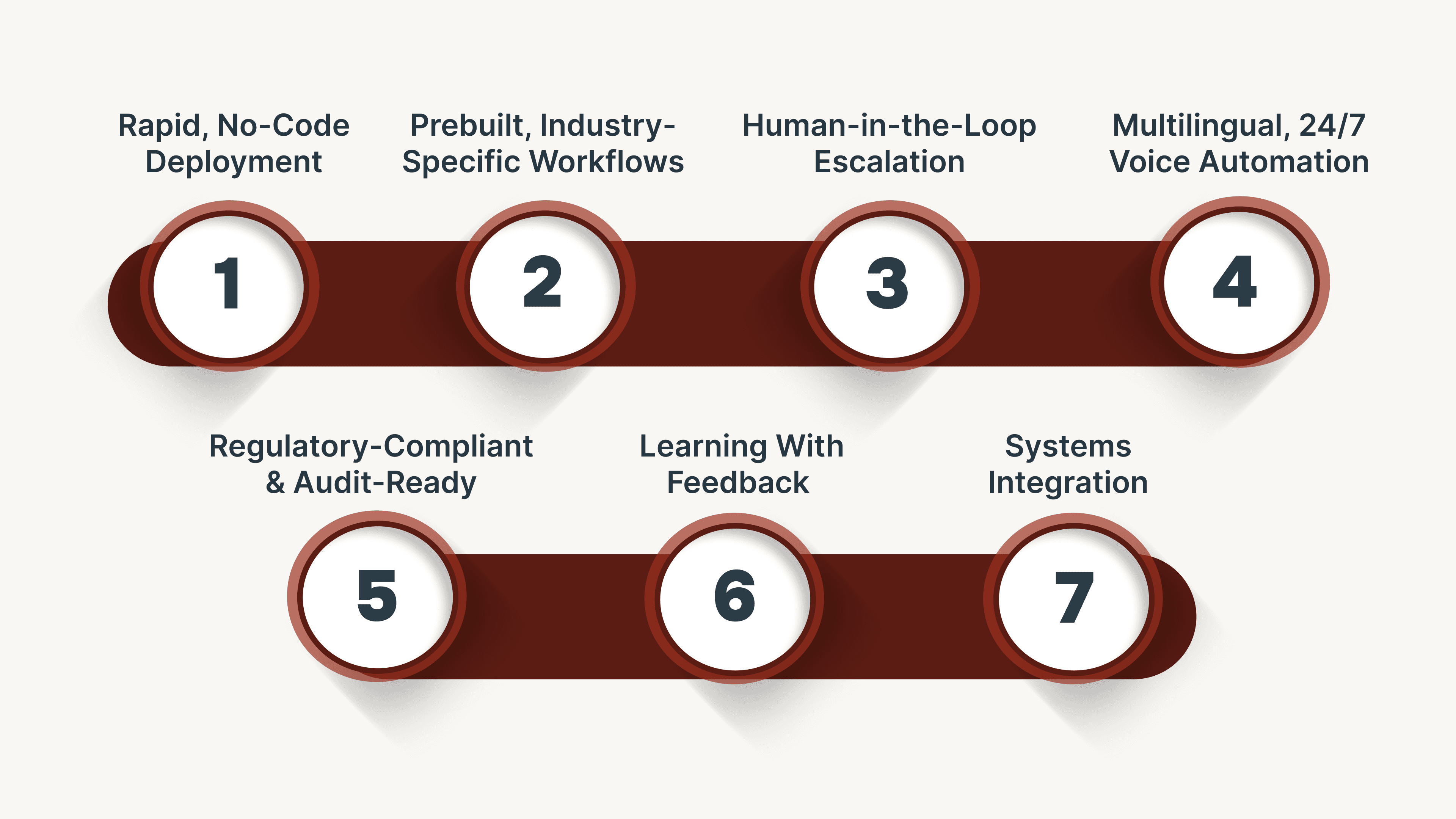
Here's how CubeRoot supports your transition to a high-performing hybrid model:
Rapid, No-Code Deployment: You can launch AI agents in days using CubeRoot's no-code builder and API-first architecture. This speeds up implementation across BFSI, retail, D2C, SaaS, and edtech workflows without increasing IT dependency.
Prebuilt, Industry-Specific Workflows: We provide ready-to-use voice workflows for everyday use cases like loan collections, EMI reminders, order tracking, COD confirmations, lead qualification, and post-sale feedback. This shortens your go-live time.
Human-in-the-Loop Escalation: Complex or sensitive queries are automatically routed to human agents without disrupting the customer experience. The platform ensures that agents receive full context, reducing repetition and improving resolution speed.
Multilingual, 24/7 Voice Automation: Our voice AI agents communicate naturally in multiple Indian languages and English, helping you serve diverse regional audiences around the clock with consistent quality.
Regulatory-Compliant and Audit-Ready: With secure voice logging, encryption, and audit trails, CubeRoot meets strict BFSI and enterprise compliance requirements.
Continuous Learning With Human Feedback: Human and AI-feedback models help your AI agents improve over time. They learn from real customer interactions, agent corrections, and past outcomes to deliver sharper, more relevant responses.
Systems Integration: CubeRoot integrates smoothly with your existing CRM, ERP, OMS, and dialer systems. This ensures that your AI and human agents work from the same data and operate within unified workflows.
Gain complete visibility into customer conversations, improve response accuracy, and reduce operational bottlenecks with CubeRoot. Schedule a demo to unlock the full power of enterprise-grade voice AI.
FAQs
1. How long does it take to see value after deployment?
Most enterprises see a measurable impact within weeks because automation immediately reduces call load. Improvements in responsiveness, consistency, and operational throughput appear quickly, especially when large volumes are involved.
2. What resources do we need to deploy AI voice agents successfully?
You mainly need clear workflows, access to existing scripts or FAQs, and basic system integration. The technical complexity is low compared to traditional automation projects.
3. What if our processes change frequently? Will AI keep up?
Modern AI voice agents update quickly when workflows, policies, or scripts evolve. With proper configuration, new rules can be reflected immediately, helping teams maintain accuracy without training large groups of agents each time.
4. Is customer satisfaction higher with AI or human agents?
It depends on the query type. AI boosts satisfaction for routine tasks by reducing wait times. Humans score higher for emotional, contested, or urgent issues where empathy and understanding influence the customer experience.
5. Are voice AI agents better for outbound or inbound calls?
AI tends to deliver higher efficiency in outbound use cases: reminders, confirmations, follow-ups, because they rely on structured scripts. Inbound calls vary more, so humans remain essential for complex or highly contextual issues.