Dec 29, 2025
How AI Voice Agents Are Redefining Enterprise CX in 2026
Customer expectations have outgrown traditional support playbooks. Indian consumers no longer tolerate long wait times or inconsistent answers. They expect immediate, accurate, and multilingual assistance whether they’re checking a loan status, confirming an order, or booking a follow-up appointment.
The shift is unmistakable: more enterprises are discovering that AI voice agents aren’t experimental anymore. They’re operational, compliant, and delivering measurable results across BFSI, retail, D2C, and healthcare. With every answered call, these agents are redefining what scale and service quality look like in 2026.
In this blog, we’ll explore how AI voice agents are transforming enterprise communication, what capabilities now make them reliable for real-world deployment, and why Indian businesses are rapidly adopting them to stay ahead of customer expectations.
Key Takeaways
AI voice agents now handle enterprise-scale conversations with accuracy, empathy, and multilingual fluency.
They automate inbound and outbound calls across BFSI, retail, D2C, healthcare, and SaaS sectors.
Voice remains the most trusted customer channel in India, now powered by real-time AI intelligence.
Enterprises gain faster resolution, stronger compliance, and lower operational costs.
In 2026, AI-driven voice automation is becoming the foundation of scalable, always-on customer engagement.
Why Voice Still Matters in the AI Era
Digital channels have multiplied, but when decisions, urgency, or emotions enter the picture, people still pick up the phone. Across India’s banking, healthcare, and retail sectors, voice remains the channel of trust where intent and empathy meet in real time.
A chatbot can process queries, but a voice can reassure. That difference defines why enterprises continue to rely on live or automated calls for meaningful conversations.
Here’s why voice continues to dominate even in the AI era:
Human connection still wins: Tone, pacing, and emotion convey empathy that text interfaces cannot replicate.
Linguistic reality: Indian service calls include code-mixed languages like Hinglish, Tamlish, or Benglish, which voice handles naturally.
Accessibility advantage: For first-time digital users, speaking is easier than navigating menus or apps.
Compliance readiness: BFSI and healthcare players need verifiable consent and audit trails, and voice conversations automatically create compliant, timestamped records.
Cultural habit: From insurance renewals to medical confirmations, Indian consumers associate trust with hearing another voice rather than reading another message.
The difference today is intelligence. AI voice agents now understand intent, detect sentiment, and respond contextually in multiple languages while maintaining accuracy and tone consistency across thousands of conversations.
Voice has not been replaced by AI; it has evolved through it, setting the stage for what these agents can now handle in real enterprise environments.
Also Read: How Voice Assistants Enhance Delivery Updates for Businesses?
What AI Voice Agents Can Actually Do Today
AI voice agents have moved beyond scripted responses. They now perform full-scale customer interactions that once required large call center teams. Their strength lies in blending natural speech, domain logic, and instant data retrieval, all while scaling across regions and time zones.
Core Capabilities Across Industries
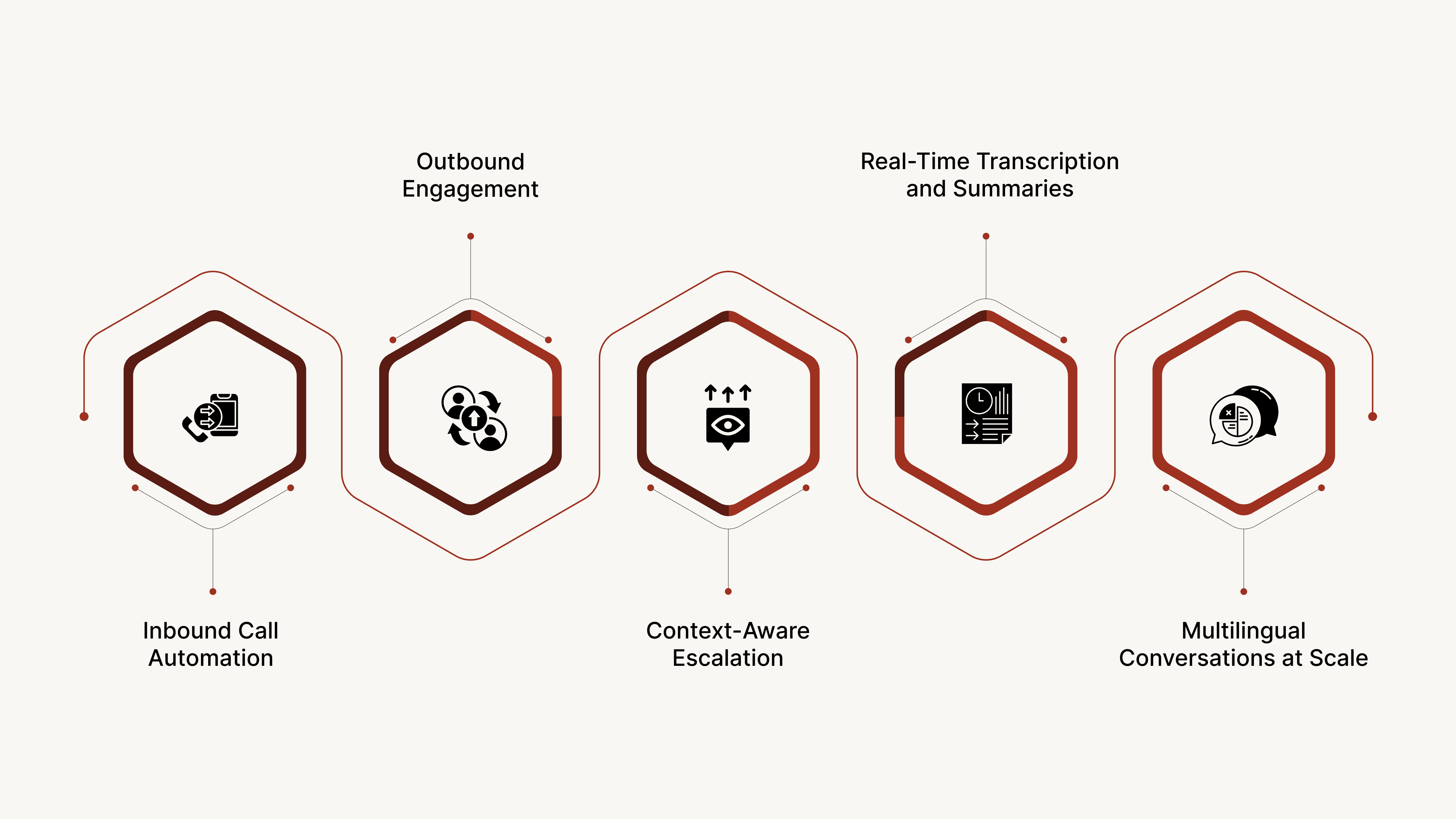
Inbound Call Automation
Handles recurring requests like account balance checks, policy renewals, appointment scheduling, and order tracking.
Example: A healthtech platform can automatically confirm lab test appointments and send voice reminders in the patient’s preferred language.Outbound Engagement
Executes proactive campaigns such as payment reminders, loan follow-ups, and product feedback collection.
Example: An NBFC can automate thousands of repayment reminder calls daily while maintaining compliance and audit trails.Context-Aware Escalation
Recognizes when customer queries exceed predefined logic and transfers them to live agents with full context, avoiding repetition.
Example: A telecom provider can route plan-change requests to a specialist only when the customer’s intent requires manual approval.Real-Time Transcription and Summaries
Converts voice calls into searchable text, tagging intent, sentiment, and key details for reporting and analytics.
Example: A retail CX manager can view daily summaries of all delivery feedback calls to identify recurring logistics issues.Multilingual Conversations at Scale
Supports multiple Indian languages and mixed-language speech to reach wider demographics.
Example: A regional D2C brand can run the same voice campaign in Hindi, Tamil, and Marathi without separate teams.
These capabilities show that AI voice agents are no longer limited to simple responses; they function as operational extensions of enterprise workflows, bridging automation with human-like conversation quality.
As their capabilities expand, understanding what powers this new generation of voice agents becomes the next logical step.
The Technology Stack Behind Modern AI Voice Agents
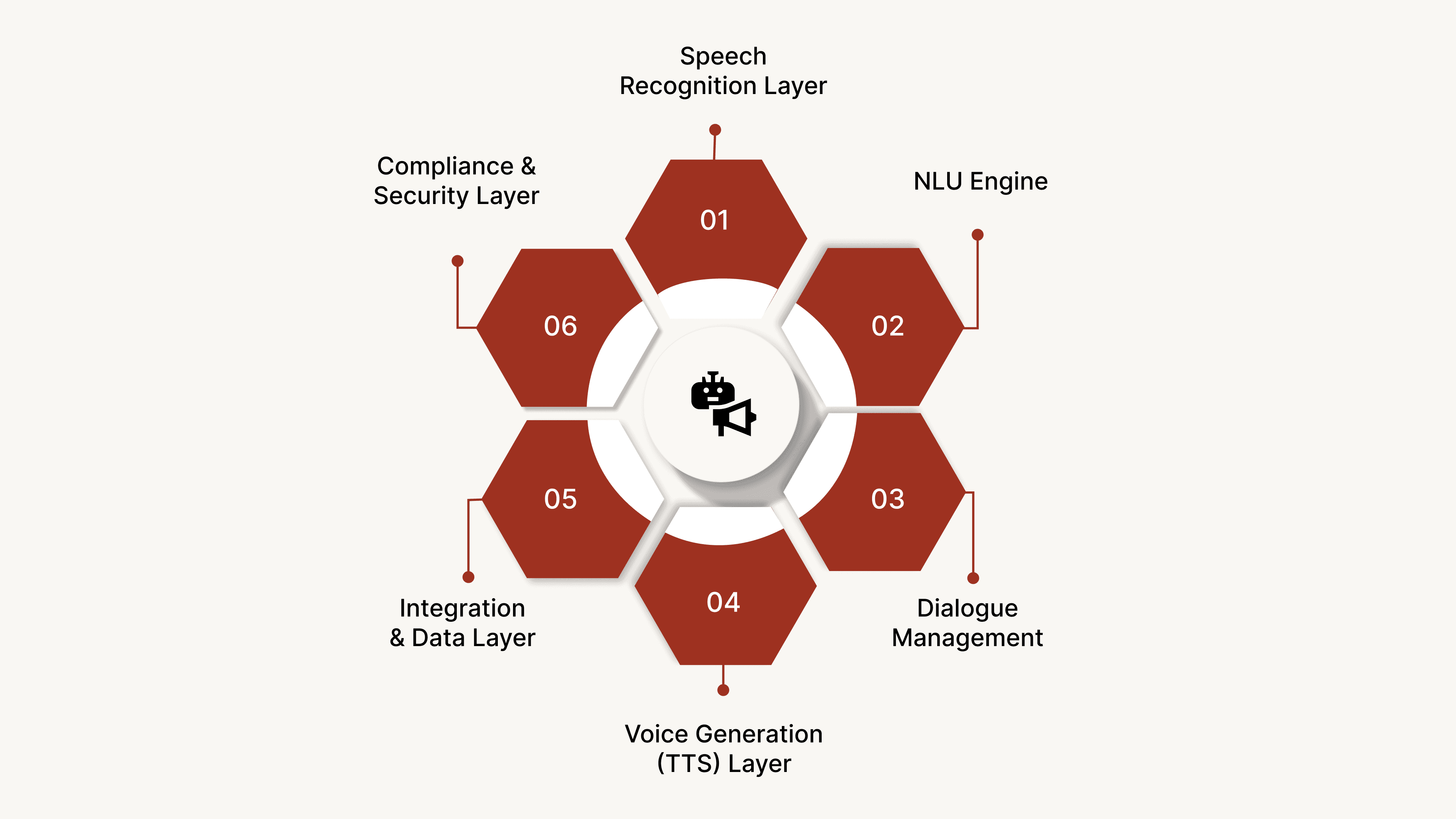
Behind every seamless AI voice interaction is a carefully layered system that combines speech science, automation logic, and enterprise integration. Each layer ensures that the conversation feels natural while staying compliant, traceable, and fast.
1. Speech Recognition Layer (ASR)
Automatically converts spoken language into text in real time.
Trained on Indian accents and mixed-language inputs for accuracy.
Detects speech interruptions, tone shifts, and background noise to interpret meaning correctly.
Result: Clear transcription and faster intent identification across diverse callers.
2. Natural Language Understanding (NLU) Engine
Processes text to determine user intent and extract key entities like names, transaction IDs, or policy numbers.
Adapts to domain-specific vocabularies in BFSI, healthcare, or retail.
Learns continuously through Reinforcement Learning with Human Feedback (RLHF).
Result: Context-aware understanding that improves with every conversation.
3. Dialogue Management & Business Logic Layer
Orchestrates responses and decision flows based on business rules.
Custom workflows can validate inputs, trigger CRM lookups, or escalate to agents.
No-code builders let CX teams create or update conversation flows without engineering help.
Result: Rapid deployment and easy scaling of new use cases.
4. Voice Generation (TTS) Layer
Transforms AI responses into lifelike, human-sounding speech.
Uses neural Text-to-Speech models with emotional tone control.
Adjusts pitch, pace, and inflection for regional authenticity.
Result: Natural, trustworthy voice interactions across demographics.
5. Integration & Data Layer
Connects AI agents with enterprise systems like CRM, ERP, and telephony platforms.
Real-time APIs enable live data validation and updates.
Supports secure, India-hosted cloud environments (AWS, Azure, GCP).
Result: Seamless synchronization between voice automation and existing business systems.
6. Compliance & Security Layer
Ensures every call is recorded, timestamped, and auditable.
Adheres to ISO 27001 and SOC 2 standards.
Encrypts voice and text data end-to-end for BFSI and healthcare use cases.
Result: Confidence that automation aligns with enterprise-grade governance.
Together, these layers enable AI voice agents to deliver precision, empathy, and compliance qualities once thought possible only with human agents.
With this foundation in place, enterprises can now measure tangible results from AI-driven conversations.
Also Read: What is Conversational AI Analytics?
Enterprise-Grade Impact: Measurable Business Outcomes
AI voice agents have shifted from experimental pilots to operational enablers across India’s core industries. Their impact is visible in how enterprises manage scale, compliance, and customer relationships every day.
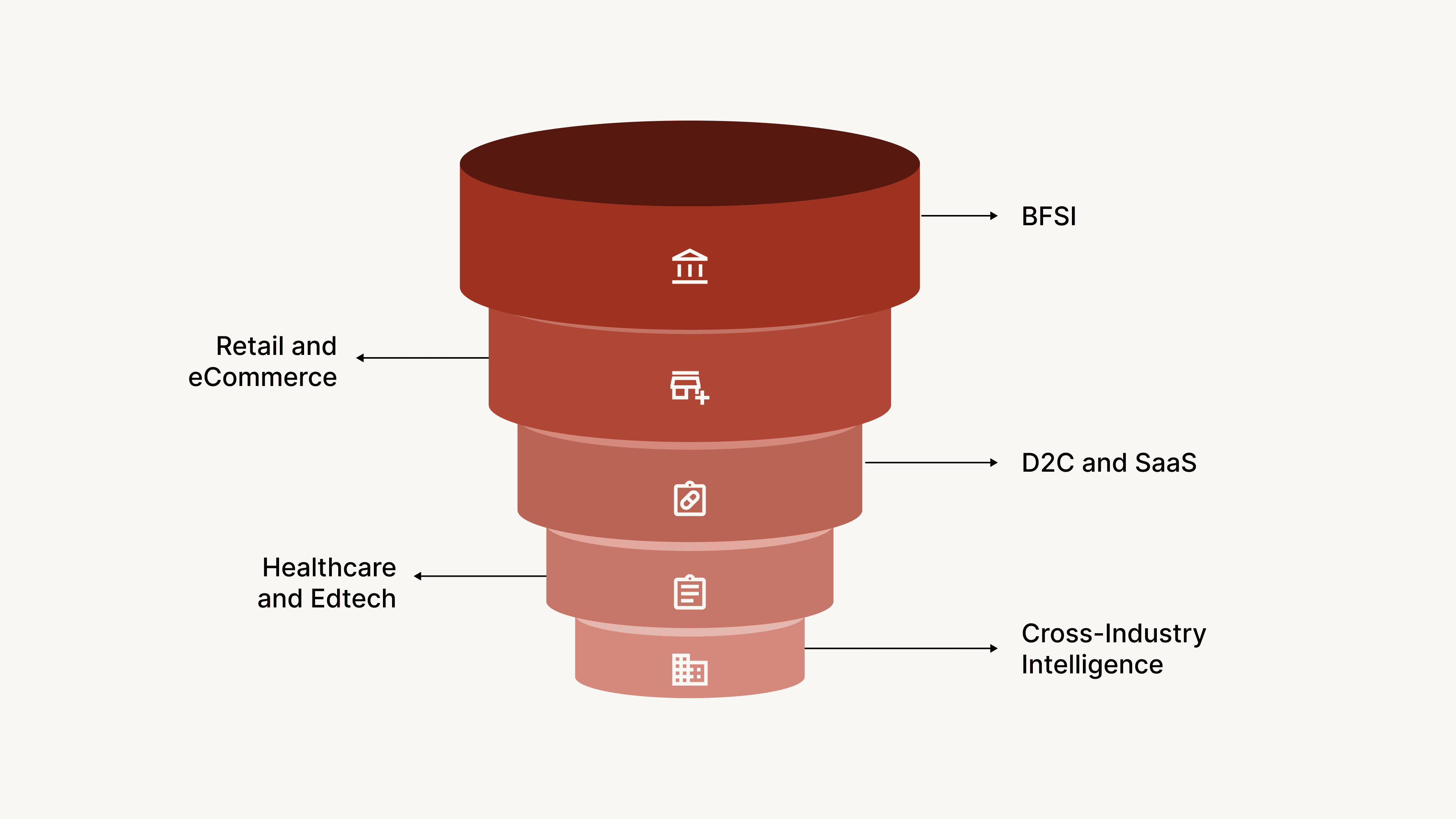
1.BFSI
Voice agents handle collections and payment reminders uniformly across regions. They maintain script compliance, capture consent, and record complete audit trails for every interaction. This consistency builds regulatory confidence and shortens resolution cycles, even during peak billing periods.
2.Retail and eCommerce
Seasonal demand no longer overwhelms service teams. AI voice agents absorb order updates, delivery confirmations, and returns without delays or missed calls. Customers experience reliable service even when transaction volumes multiply overnight.
3. D2C and SaaS
Voice automation identifies genuine intent and engages prospects through timely follow-ups. Managing the initial contact layer helps human sales teams focus on closing deals rather than qualifying them. The result is a leaner funnel with faster conversions.
4.Healthcare and Edtech
Appointment confirmations, reminders, and feedback calls are automated, reducing dependence on manual outreach. Patients and students receive consistent, multilingual communication, improving adherence and trust in service quality.
5.Cross-Industry Intelligence
Every conversation contributes to institutional learning. Voice data, once transient, becomes a structured source of sentiment, journey patterns, and process gaps. These insights refine future campaigns, product updates, and customer strategies.
AI voice agents are helping enterprises replace reactive communication with proactive, data-driven engagement.
This evolution works best when automation and human teams operate as one, complementing each other across every customer touchpoint.
The Human + AI Collaboration Model
AI voice agents are not here to eliminate human roles; they redefine how teams allocate their attention. The most effective enterprises treat automation as a frontline filter and humans as strategic problem solvers.
What AI Handles Best
Repetitive communication: Routine inquiries, confirmations, and reminders that don’t require judgment.
High-volume bursts: Campaigns or seasonal surges where scalability matters more than improvisation.
Data accuracy: Recording, transcribing, and tagging each call for compliance and analytics.
Consistency: Delivering the same tone, timing, and information across all customer segments.
Where Humans Add Distinct Value
Complex cases: Nuanced negotiations, escalations, and exception handling that rely on context or empathy.
Emotional intelligence: Reading subtle cues and restoring confidence after a service issue.
Process improvement: Using AI-generated insights to redesign workflows or messaging.
Strategic judgment: Making informed decisions that go beyond predefined logic.
How Collaboration Works in Practice
AI Initiates: Handles the first layer of contact, gathers details, and completes routine actions.
Human Intervenes: Steps in when sentiment drops, compliance risk arises, or intent falls outside scripted rules.
Feedback Loop: Post-call data trains the AI to recognize similar cases faster next time.
Continuous Learning: Operations teams review AI performance dashboards to fine-tune prompts and flows.
This partnership creates a self-improving system where automation scales reach, and humans sustain quality.
Once collaboration is in place, the next challenge is implementing it reliably across complex enterprise environments.
Overcoming Implementation Hurdles
Deploying AI voice agents at scale is not just a technical task; it is an organizational shift. Enterprises that succeed approach it as a managed transition, anticipating risks early and addressing them through process design and governance.
1. Accent and Speech Variability
Risk: Diverse accents and regional pronunciations can reduce speech recognition accuracy.
Mitigation: Train models on multilingual and mixed-language data, using real customer recordings from target regions. Periodically recalibrate models to reflect changing speech patterns.
2. System Integration Complexity
Risk: Disconnected CRM, ERP, and telephony systems cause broken data flows and inconsistent responses.
Mitigation: Use an API-first architecture and test integrations in sandbox environments before scaling. Prioritize real-time data sync for customer verification, order tracking, and payment workflows.
3. Data Governance and Compliance
Risk: Sensitive customer information may be mishandled if governance is unclear.
Mitigation: Implement encryption at rest and in transit, restrict access through role-based controls, and store data in India-based cloud environments that meet regulatory standards.
4. Model Drift and Accuracy Decline
Risk: AI responses become less accurate as products, policies, or scripts evolve.
Mitigation: Schedule regular retraining cycles using updated datasets and feedback logs. Involve domain experts to review prompts and ensure relevance.
5. Change Management and Team Adoption
Risk: Frontline teams may resist automation or misunderstand escalation protocols.
Mitigation: Include them early in pilot stages, define clear handoff rules, and communicate how AI reduces workload rather than replacing roles.
6. Ethical and Transparency Concerns
Risk: Customers may feel uncomfortable engaging with automated voices if disclosure is unclear.
Mitigation: Begin every call with transparent identification and allow opt-outs or escalation to human support. Transparency strengthens trust.
When each of these challenges is managed through structure and iteration, AI voice agents become reliable, compliant extensions of enterprise communication systems.
With operational barriers addressed, enterprises can focus on the broader momentum driving voice automation across India.
Why 2026 Is the Year of Voice AI in India
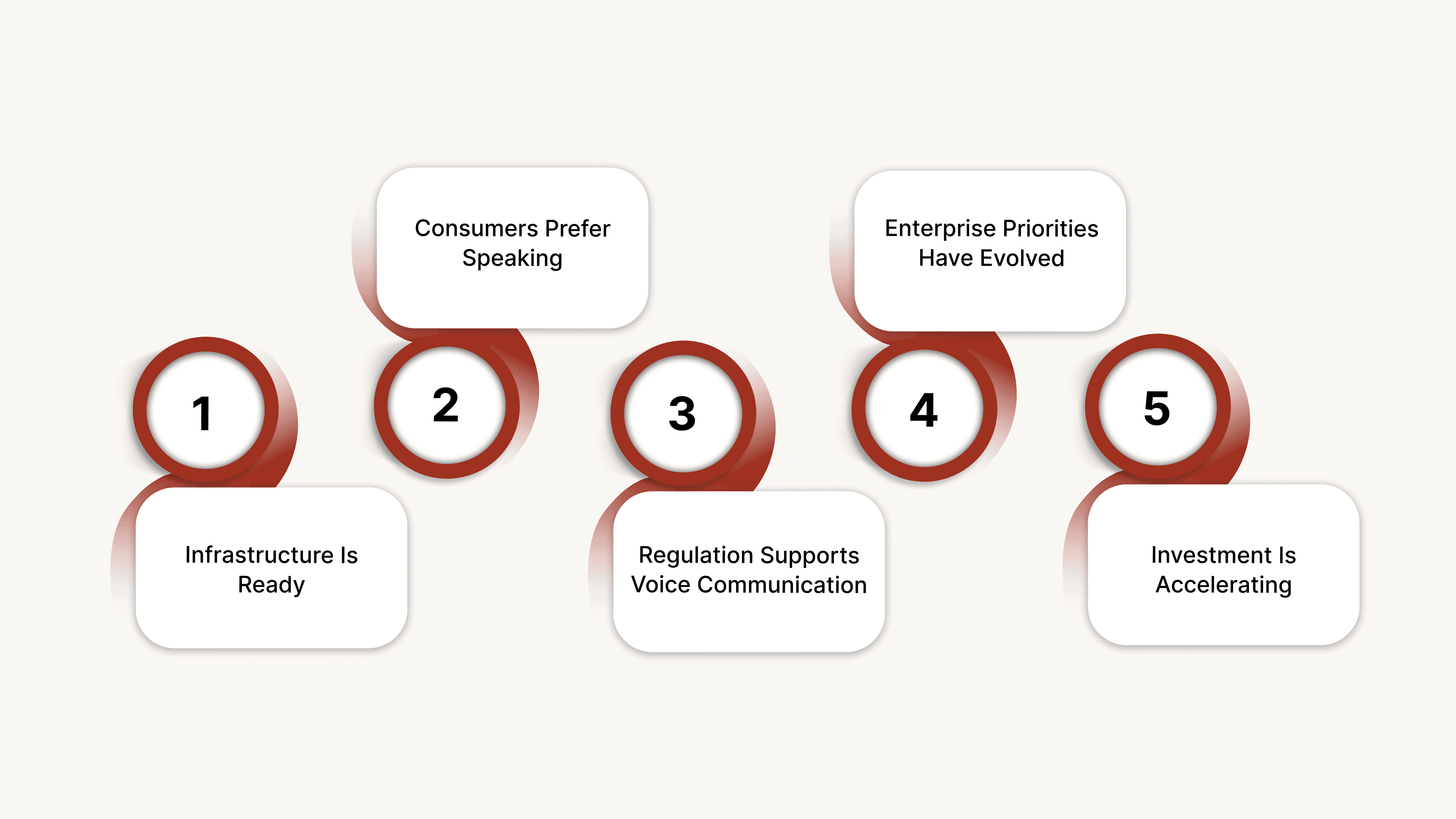
India’s market, infrastructure, and regulation are now aligned for large-scale voice automation. What was once experimental has become practical, measurable, and enterprise-ready.
1. Infrastructure Is Ready
Faster networks and improved speech models have made real-time voice processing stable and affordable. Enterprises can now deploy multilingual systems without latency or heavy infrastructure costs.
2. Consumers Prefer Speaking
Most new digital users communicate through regional or mixed languages. Talking feels easier and more personal than typing, making voice the most natural interface for service engagement.
3. Regulation Supports Voice Communication
Compliance bodies in banking, insurance, and healthcare now expect verifiable consent and audit trails. Voice AI simplifies this by recording and transcribing every call, creating built-in accountability.
4. Enterprise Priorities Have Evolved
Organizations are moving beyond cost reduction to focus on reliability, consistency, and customer trust. Voice automation delivers all three at once.
5. Investment Is Accelerating
With proven use cases and measurable outcomes, enterprises are dedicating automation budgets to voice-first initiatives and scaling them rapidly.
The ecosystem is ready, the technology is proven, and the business case is clear. Voice AI has moved from curiosity to necessity.
The next step is understanding how enterprises can bring this shift to life through the right implementation approach.
How CubeRoot Accelerates Enterprise Voice Automation
Enterprises adopting AI voice at scale need platforms that combine speed, accuracy, and compliance. Cuberoot provides modern systems that make this possible through practical, ready-to-use capabilities that fit existing operations.
Pretrained Industry Workflows: Ready templates for BFSI, retail, D2C, and healthcare support faster deployment with domain-trained logic and compliant dialogue structures.
Quick Implementation: No-code setup and API-first design help enterprises launch pilots and go live within weeks, not months.
Multilingual Human-Like Agents: Emotion-sensitive voice models handle conversations in major Indian languages, keeping interactions natural and context-aware.
Real-Time Transcription and Analytics: Every call generates structured data on intent, sentiment, and outcomes, helping teams improve processes continuously.
Data Security and Compliance: Interactions are encrypted, logged, and stored within India-based cloud environments for full regulatory alignment.
Seamless Human Escalation: AI hands off complex queries to live agents with complete context, ensuring smooth transitions and uninterrupted service.
Together, these features create an ecosystem where automation feels personal, operations stay compliant, and scaling customer communication becomes effortless.
Ready to automate high-volume interactions, enhance customer satisfaction, and scale your support operations 24/7? Schedule a demo with cuberoot to experience how AI voice agents boost response speed, lower operational costs, and create lasting customer impact.
FAQs
1. How are AI voice agents different from traditional IVR systems?
IVR systems follow rigid menu paths. AI voice agents, on the other hand, understand intent, context, and natural language. They can hold two-way conversations, adapt tone, and resolve queries without forcing users through predefined options.
2. Can AI voice agents manage multilingual and mixed-language queries?
Yes. Modern speech recognition and NLU models are trained on Indian linguistic patterns. They can accurately process hybrid speech such as Hinglish or Tamlish and respond in the caller’s preferred language.
3. How does voice automation support compliance-heavy sectors like BFSI or healthcare?
Every AI-managed call is recorded, transcribed, and time-stamped for full auditability. The data is encrypted and stored in India-based secure cloud environments to meet local regulatory standards.
4. What metrics indicate a successful AI voice implementation?
Key measures include first-call resolution rate, sentiment accuracy, reduced agent load, and improved response time. Over time, enterprises also track insights like intent patterns and customer satisfaction trends derived from conversation analytics.
5. Can AI voice agents work alongside human agents without disruption?
Yes. AI handles repetitive or routine communication, while humans focus on high-value tasks. When escalation is required, the system transfers the call with complete context, ensuring a smooth customer experience.