Dec 31, 2025
AI Voice Agents vs SDRs in Lead Qualification: Differences That Matter
Across Indian enterprises, qualifying leads has quietly become one of the toughest daily challenges. A fintech team in Mumbai may need to screen thousands of loan applicants daily. A D2C brand in Bengaluru could struggle to verify genuine purchase intent before looping in sales. And at the center of it all lies one pressing question: How do you qualify more leads accurately without overloading your sales development representatives (SDRs)?
Moreover, when the qualification is slow or inconsistent, the consequences show up quickly. SDR teams lose time on low-quality leads, conversion rates fall, and marketing budgets fail to create a real pipeline. Missed follow-ups, manual errors, and capacity limits make it harder to capture intent at the right moment. This often causes hot leads to slip away before your sales team can engage.
This is why comparing AI voice agents vs SDRs in lead qualification matters more than ever. You need to know where each one performs best, how they complement each other, and what approach drives faster, more reliable revenue outcomes.
In a Nutshell
Manual SDR-led qualification alone can’t keep pace with high-volume enterprise funnels, causing slow responses, inconsistent scoring, and missed revenue opportunities.
AI-led qualification improves pipeline health, reduces cost per qualified lead, and boosts SDR productivity through automation, multilingual calls, and real-time insights.
Humans still excel in nuanced, high-context conversations, while AI handles repetitive first-touch tasks. Together, they form the ideal hybrid lead qualification model.
Implementing AI Voice SDRs requires following a simple, phased roadmap. Align criteria, integrate systems, run a pilot, refine flows, expand across channels, and optimize continuously.
Why Manual Lead Qualification Alone Doesn't Work
Every business wants a clean, predictable pipeline filled with ready-to-buy prospects. Yet for most Indian enterprises, the reality is far messier. This friction directly affects monthly revenue targets.
The traditional manual approach may have worked years ago, but today’s sales environment moves too quickly for those processes to keep pace. Most teams struggle with:
Slow response cycles: A prospect requests a discovery call in the morning but receives the meeting details the following evening. By that time, a competitor might already be in their inbox or on a call.
Limited ability to scale: Lead spikes during campaigns, festive seasons, or product launches overwhelm SDR teams, resulting in missed opportunities.
Burnout and rising attrition: Repeating the exact script multiple times a day drains motivation, and when high performers leave, their hard-earned process knowledge leaves with them.
Uneven qualification standards: No two SDRs run the same discovery flow. Some ask about budget, others probe for authority or intent, and this inconsistency makes forecasting and prioritization difficult.
To solve these gaps, enterprises need a faster, more dependable way to qualify leads at scale. That’s precisely where AI voice agents step in.
What Exactly Are AI Voice SDRs?
AI Voice SDRs are AI-powered voice agents that handle the core responsibilities of an SDR virtually via natural, human-like phone conversations. These include the following:
Call new leads immediately after a form submission
Ask pre-defined qualification questions
Understand natural speech (pauses, hesitations, accents)
Record and score responses
Update the CRM automatically
Transfer high-intent leads to sales in real time
Unlike basic chatbots or IVR systems, AI Voice SDRs sound like genuine callers, follow your qualification playbook consistently, and handle unlimited conversations in parallel. Hence, instead of depending solely on human SDRs, Indian enterprises are now deploying such AI voice agents.
Also Read: How AI Cold Calling Transforms Sales Strategies in 2025
With the definition clear, let’s explore how AI Voice SDRs actually compare to human SDRs across speed, scale, cost, and qualification accuracy.
AI Voice Agents vs Human SDRs: The Real Difference Explained
For Indian enterprises handling high lead volumes, the debate centers on understanding where AI delivers the greatest value and where human SDRs remain irreplaceable. This comparison breaks down exactly how both perform across every critical stage of lead qualification.
Evaluation Area | AI Voice Agents | Human SDRs |
|---|---|---|
Speed & Response Time | Calls every new lead within seconds, 24/7 functionality. | Limited to working hours; delays are common during peak periods. |
Coverage & Capacity | Handles unlimited parallel conversations, ideal for campaigns and seasonal spikes. | Capacity tied to team size; overwhelmed during volume surges. |
Consistency of Playbook | Executes the exact qualification script every time with zero deviation. | Varies by rep; questions skipped or reordered, affecting data quality. |
Data Capture & Accuracy | Auto-records and logs all responses into CRM with 100% completeness. | Manual note-taking leads to gaps, errors, and inconsistent documentation. |
Scalability | Scales instantly without extra hiring, training, or infrastructure. | Scaling requires recruiting, onboarding, and management. |
Cost Efficiency | Low cost per call; high ROI for Fintech, D2C, SaaS, and real estate brands. | Higher recurring costs (salary, incentives, overheads). |
Follow-Up Management | Executes follow-up sequences reliably: no delays, no missed callbacks. | Follow-ups are often missed during hectic periods. |
Emotional Intelligence | Handles basic objections and structured responses using trained dialog models. | Way more skilled at empathy, persuasion, and nuanced communication. |
Complex Discovery & Selling | Ideal for first-touch qualification and scoring. | Best for multi-layer discovery, nurturing, and deal strategy. |
Where AI Voice SDRs Are Ideal
Scenario: A Chennai-based SaaS company runs a paid campaign that generates 3,000 demo requests over a weekend.
AI voice agents instantly call every lead.
Capture company size, use case, and purchase timeline
Auto-score leads in the CRM
Pass only the high-intent leads to a sales rep by Monday morning
Where Human SDRs Are Essential
Scenario: A real estate developer in Hyderabad receives inquiries about premium residential projects.
AI voice agents complete first-level qualification (budget, location preference, buying timeline).
Human SDRs take over to address emotional factors, such as family needs, customizations, and financing discussions.
They build trust, nurture the relationship, and schedule on-site visits.
Understanding the contrast sets the stage for the next question: what specific benefits do AI Voice SDRs unlock in lead qualification?
Benefits of AI Voice SDRs in Enhancing Lead Qualification
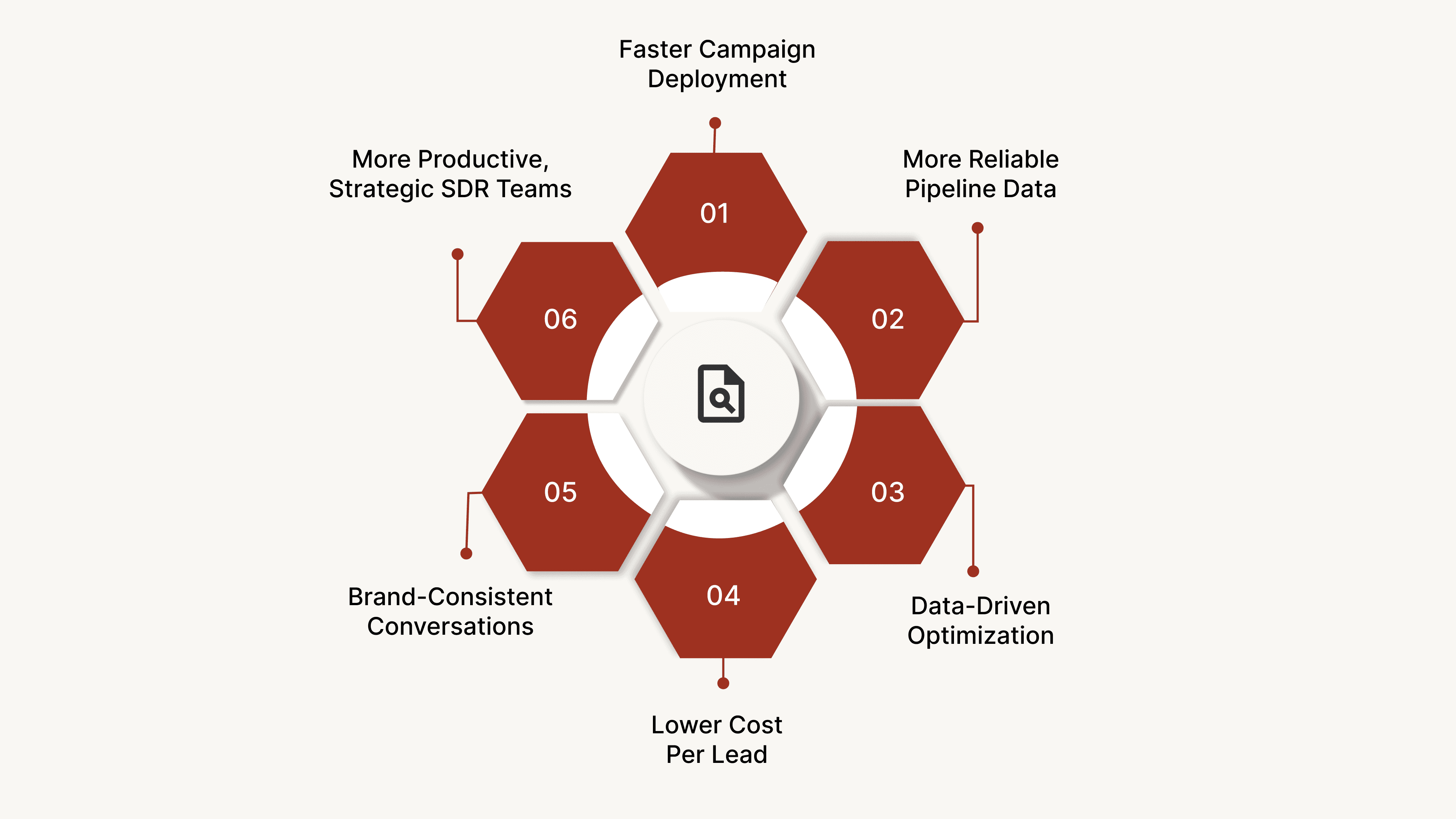
AI-led qualification adds advantages that go far beyond speed. Global benchmarks already show its impact. IBM Watson, for instance, recorded a 35% improvement in qualification accuracy and a 15% increase in sales efficiency after adopting AI-first workflows. Below are the unique benefits that improve qualification accuracy and funnel efficiency.
1. Faster Campaign Deployment
Traditional qualification workflows require script building, SDR training, and coordination between sales and marketing, often delaying campaign rollout. AI agents flip this completely. They are:
Deployable in a few hours using pre-trained NLP models
Customizable qualification workflows ready out-of-the-box
Perfect for short-notice marketing pushes or festive bursts
2. Cleaner, More Reliable Pipeline Data
AI Voice SDRs collect structured, uniform lead data every time: no missing fields, no vague notes. This creates a healthier pipeline that sales and leadership can actually rely on. They ensure the budget, industry, team size, purchase timeline, and product interest are always complete and consistent:
Why It Matters: Forecasting becomes easier, SDR prioritization improves, and sales teams get full context before the first human touch.
3. Data-Driven Optimization With Every Call
Voice agents improve over time. With every call, you identify common objections, discover trending queries, detect drop-off points, and refine scripts and intent logic. This enables you to optimize qualification flows continuously.
Example: A SaaS company in Mumbai may notice through AI call analytics that most leads ask about integration capabilities. They can update the conversation flow and landing page messaging the same week.
Also Read: What is Conversational AI Analytics?
4. Significantly Lower Cost Per Qualified Lead
AI SDRs eliminate the need to increase headcount every time lead volume grows. Common benefits include:
Better cost control during demand spikes
Lower staffing and training expenses
5. Multilingual, Brand-Consistent Conversations
In India’s diverse market, brand consistency matters. AI Voice SDRs maintain the same tone of voice, phrasing, pace, and brand messaging across every call, in multiple Indian languages.
6. More Productive, Strategic SDR Teams
Once AI Voice SDRs handle repetitive first-touch calls, human SDRs can focus on high-value work. These include personalized follow-ups, more profound discovery, influencing buyer decisions, pipeline strategy, and account research.
Key Insight: This improves both performance and job satisfaction, hence reducing burnout.
To unlock these gains consistently, you need a clear roadmap for deployment, which begins with a focused pilot.
From Pilot to Scale: The Proven Path to Implementing AI Voice SDRs
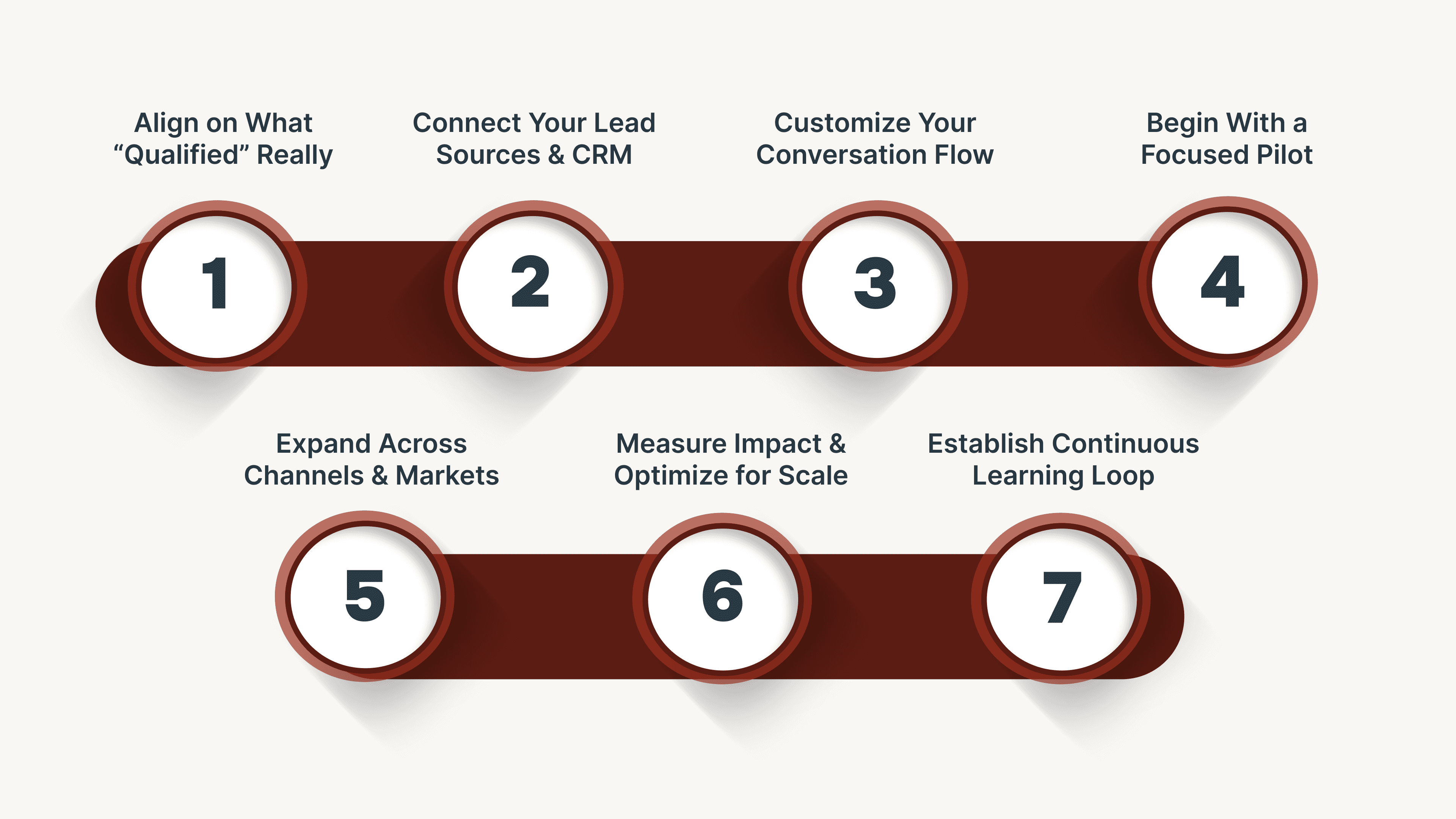
Implementing AI Voice SDRs doesn’t require a long transformation cycle. Most enterprises follow a similar, phased, predictable path that helps them test quickly, refine continuously, and scale confidently.
Step 1: Align on What “Qualified” Really Means
Before call automation begins, your sales and marketing teams need a shared definition of a qualified lead. This includes clarity on essentials such as budget, decision-maker roles, the current solution or pain points, intended use case, geography, and buying timeline. Once both teams agree on these criteria, you can train the AI voice agent to follow the same logic.
Step 2: Connect Your Lead Sources and CRM
The next step is to plug your existing lead system into the AI Voice SDR platform. This typically involves connecting web forms, paid/social campaign landing pages, WhatsApp lead forms, marketplace listings, and your CRM. When this is done well, every lead, no matter where it originates, is automatically pushed into the AI-led qualification flow.
Step 3: Customize Your Conversation Flow
Start with an industry-ready template and tailor it to your brand’s tone and qualification logic. This includes adjusting greetings, adding or removing qualification questions, shaping objection prompts, and defining scoring thresholds and escalation rules.
Step 4: Begin With a Focused Pilot
Rather than deploying AI across the entire funnel, begin with a targeted pilot: one campaign, one region, or one lead source. During this phase, listen to real calls, examine qualification reports, and collect feedback from SDRs and managers. This pilot helps refine logic, identify friction points, and ensure teams are comfortable with the AI’s tone and flow before scaling further.
Step 5: Expand Across Channels and Markets
Once the pilot shows measurable improvement in qualification accuracy and speed, extend the AI Voice SDR to additional channels. This may include adding multilingual workflows (Hindi, Tamil, Kannada, Bengali), covering evening and weekend leads, or onboarding new product lines and campaigns.
Step 6: Measure Impact and Optimize for Scale
Finally, track the metrics that matter most.
Metric | Why It Matters |
|---|---|
Speed-to-lead | Shows how quickly prospects hear from you |
Cost per qualified lead | Measures efficiency gains |
Conversion to a meeting | Indicates qualification accuracy |
SDR productivity | Reflects time saved for your team |
Pipeline velocity | Shows how fast qualified leads move forward |
These insights guide how you expand automation, which campaigns you scale, and where AI can replace manual effort without compromising quality.
Step 7: Establish a Continuous Learning Loop
AI voice agents improve significantly with feedback. Set a regular cadence for reviewing call transcripts, fine-tuning scripts based on common objections, and updating qualification rules as your ICP changes.
Also, ensure that sales feedback flows directly into the refinement process. For example, if reps notice that many AI-qualified leads convert quickly, raise the scoring threshold to push more similar leads their way.
And when it comes to actually putting this plan into action, the technology behind your AI voice agents becomes the real differentiator. CubeRoot’s Voice AI platform is designed to handle this complexity with ease.
Also Read: Outbound Calls Explained: What They Are and How They Work?
How CubeRoot Powers a High-Performance AI Voice SDR Engine
Deploying voice agents is only half the journey. To truly transform lead qualification, you need a Voice AI platform that delivers speed, accuracy, compliance, and deep sales readiness, without adding technical complexity. CubeRoot is built precisely for this need. Here's how CubeRoot unlocks the full value of AI Voice SDRs for high-growth teams:
GenAI-Powered Prompt Builder: Using the in-built GenAI-driven prompt builder, you can create and refine AI SDR scripts, questions, and scoring logic within minutes. This accelerates campaign launches and makes iteration incredibly fast.
AI-Driven Insights & Daily Performance Reports: Every qualification call feeds into our analytics engine, giving teams daily insights into lead behavior, funnel drop-offs, agent performance, and campaign effectiveness.
Real-Time Transcription & Smart Summaries: We provide instant call transcripts and automated summaries for every AI-led conversation. This equips SDRs with full context before engaging hot leads.
Qualification at Scale: With CubeRoot’s AI Voice agents, enterprises qualify up to 80% of inbound leads within minutes. This reduces manual SDR workload by nearly 60% while doubling conversion efficiency.
Integration With Your Tools: The platform connects smoothly with CRMs, ERPs, marketing automation systems, and lead sources.
Enterprise-Grade Security, Privacy & Compliance: You get ISO 27001 and SOC 2 compliance, role-based access, encrypted call logs, and data sovereignty on AWS, Azure, or GCP.
CubeRoot helps you automate first-touch conversations, capture intent instantly, and route only sales-ready prospects to your team. Book a demo to see how our AI voice agents can transform your lead qualification routine.
FAQs
1. How do AI agents interpret unclear or incomplete responses from leads?
The AI uses intent detection and contextual follow-up prompts to clarify ambiguous answers. If uncertainty persists, the system flags the lead for human review.
2. How frequently should we update AI-driven qualification scripts?
High-growth teams often review scripts weekly or bi-weekly, especially when objections shift or new offers are launched. A monthly cadence is usually sufficient for stable use cases.
3. Can different product lines or regions have separate qualification rules?
Absolutely. Voice AI agents support multiple workflows, each with its own scoring logic, tone, and routing rules. This helps teams maintain accuracy across complex, multi-product funnels.
4. How do AI SDRs handle leads who prefer WhatsApp or SMS over calls?
AI SDRs can trigger follow-ups through alternate channels when a prospect doesn't answer a call. They can log the preference and ensure future qualification attempts happen through the lead’s preferred channel.
5. What if qualification criteria change frequently due to changing go-to-market strategies?
AI-driven flows can be updated within minutes. You can add new fields, modify thresholds, or reorder questions without retraining a team. This makes it ideal for dynamic sales environments.