Dec 31, 2025
AI Voice Agents for E-commerce: The Complete Guide
The Indian e-commerce market is expected to reach $550 billion by 2035. With this expansion comes a sharp rise in daily customer interactions across order tracking, returns, exchanges, delivery updates, and COD-related queries. High-growth brands face pressure to handle these conversations quickly and consistently as customer expectations continue to increase.
Relying only on manual support teams creates bottlenecks. Agents struggle during peak seasons, wait times increase, responses become inconsistent, and operational costs rise.
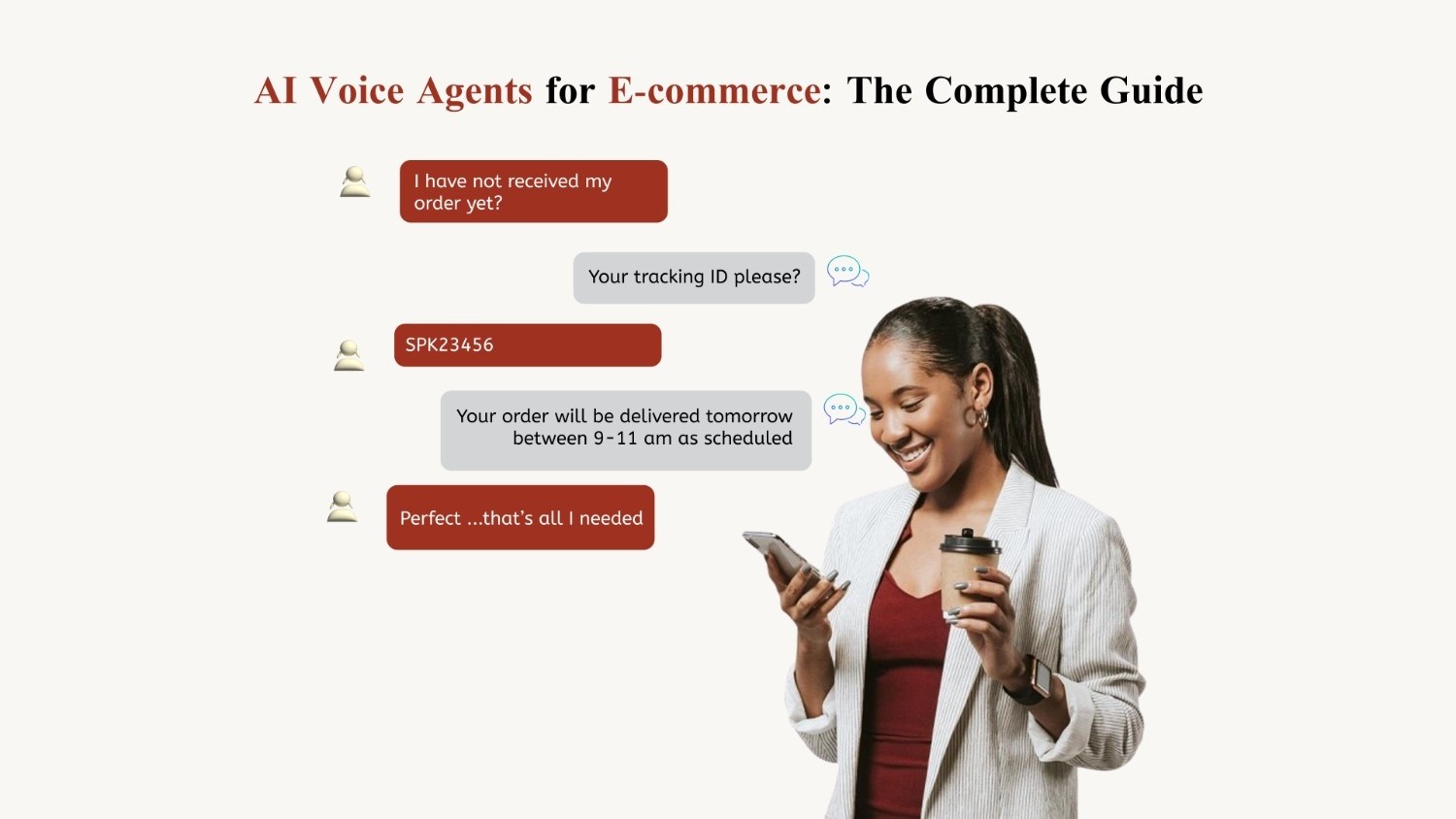
AI voice agents address these challenges by automating routine interaction flows through natural, human-like conversations. They offer real-time updates, verify orders, manage returns, and collect feedback without depending on large support teams.
This blog explains what AI voice agents are, why e-commerce brands need them, the top use cases, benefits, integration challenges, and how they improve customer operations for high-volume online businesses in India.
Key Takeaways
India’s e-commerce boom drives massive interaction volumes across order tracking, returns, exchanges, delivery issues, and COD verification—far beyond what manual teams can handle.
With 72% of customers expecting immediate service, Voice AI has become essential for delivering fast, consistent responses at scale.
Voice AI agents automate high-frequency tasks such as shipment updates, delivery follow-ups, COD intent checks, and return initiation, reducing operational workload and improving customer experience.
Successful adoption requires solving core integration gaps like fragmented order data, unstable logistics updates, multilingual accuracy, and the need for seamless human escalation.
What Are AI Voice Agents for E-commerce?
AI voice agents are AI-driven systems designed to understand spoken input, process intent, and respond with natural, human-like conversations. They combine speech recognition, language models, and decision engines to carry out tasks without relying on scripted IVR menus. These agents can interpret context, manage back-and-forth dialogue, and complete actions based on the customer’s request.
When adapted for e-commerce, AI voice agents are trained on the operational flows that support online retail. They map how orders move through a system, how returns get initiated, how delivery statuses are updated, and how customer interactions transition between automated handling and human involvement.
Human agents still play a role in reviewing edge cases, supervising quality, and stepping in for complex exceptions, but the core repetitive interaction layer runs through automated voice systems.
This creates a structured, predictable process where AI handles high-volume conversations, while human teams focus on judgment-driven scenarios.
Why E-commerce Needs AI Voice Agents
The ongoing e-commerce boom has made it harder for brands to keep up with rising customer expectations. Shoppers expect real-time clarity, instant support, and frictionless resolution. According to a report, 72% of customers want immediate service, and support teams can no longer meet this demand with manual workflows alone.
This is driving a shift toward automation, with 64% of CX leaders planning to increase investments in AI technologies to stabilize service quality and reduce operational load.
E-commerce teams are facing deeper, more complex challenges, such as:
Fragmented inquiry load across the order lifecycle: Customers raise questions at multiple touchpoints, such as post-purchase, in transit, doorstep delivery, and return pickup, which creates unpredictable workload spikes.
Operational drag from repetitive, deterministic tasks: Status updates, delivery confirmations, return initiation, and basic troubleshooting consume a majority of agent time despite requiring minimal judgment.
Low success rate of asynchronous channels: SMS, email, and push notifications often go unnoticed, resulting in repeated outbound attempts and higher operational effort.
Escalation backlog during peak demand: High-volume sale periods overload teams, causing unresolved tickets, longer queues, and missed SLAs.
Inconsistent agent performance: Variations in tone, accuracy, or process adherence affect customer experience and create quality overhead for supervisors.
High cost-to-serve for Tier 2 and Tier 3 markets: Expanding support coverage to multiple languages and regions significantly increases hiring and training costs.
Dependency on manual verification: COD confirmation, address validation, and delivery follow-ups require timely responses, but manual teams struggle to maintain speed at scale.
Impact of RTO and failed deliveries on margins: Delays in confirming customer intent or availability translate directly into lost revenue and higher logistics costs.
Inability to maintain real-time responsiveness: As order volumes grow, teams cannot consistently deliver sub-minute responses across thousands of daily customer requests.
These operational realities make AI voice agents a strategic requirement. They provide immediate, consistent, and scalable interaction handling, reducing the burden on human teams while improving service reliability.
Also read: Top AI Voice Assistants in 2025
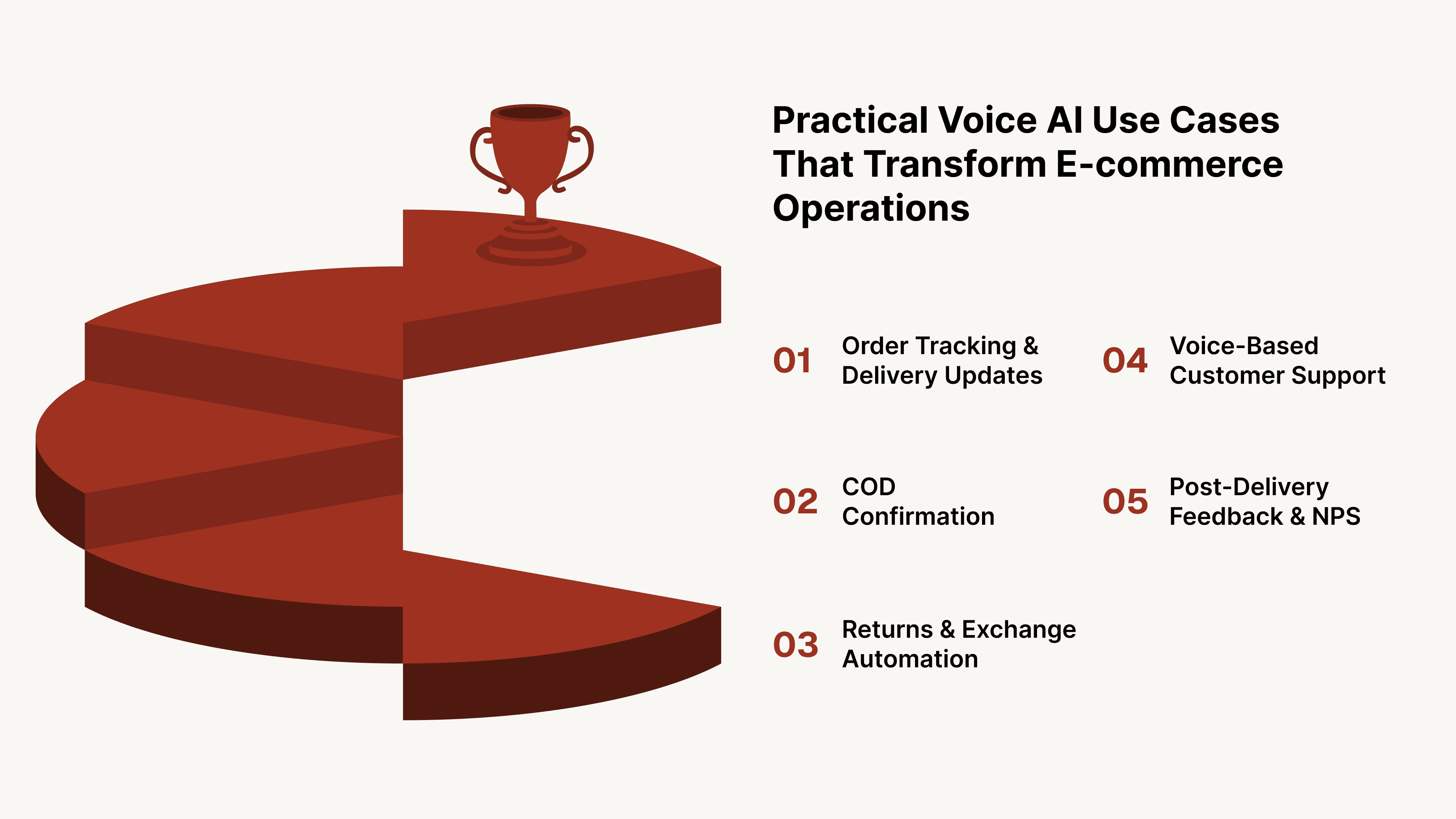
Practical Voice AI Use Cases That Transform E-commerce Operations
Use cases vary across e-commerce categories, order volumes, and customer workflows. With Voice AI, you can align automation to any operational process—order updates, verifications, delivery checks, or feedback loops. Below are practical examples of how voice agents streamline key interactions in an online retail environment.
1. Order Tracking & Delivery Updates
Voice agents provide real-time shipment and delivery information by pulling live status from the OMS, then proactively call customers for delivery confirmations or to address failed attempts. This reduces WISMO-related workload and ensures customers receive timely updates without depending on manual callbacks.
2. COD Confirmation
For cash-on-delivery orders, voice agents verify customer intent and availability before dispatch by asking confirmation questions and recording responses automatically. This process screens out low-quality or fraudulent orders and directly reduces RTO losses for high-volume categories.
3. Returns & Exchange Automation
When a customer wants to return or exchange an item, the voice agent collects the reason, checks eligibility rules, and records pickup availability. This structured automation shortens the return initiation cycle and reduces friction for customers while keeping human teams free for exception handling.
4. Voice-Based Customer Support
Voice agents handle common queries such as payment clarifications, delivery delays, cancellations, or product-related questions by understanding the query intent and pulling data from connected systems. Complex or sensitive cases are routed to human agents, creating a balanced model of automation and human oversight.
5. Post-Delivery Feedback & NPS
After an order is delivered, the agent calls customers to capture feedback through structured questions and logs responses into CRM or analytics dashboards. This helps brands detect delivery issues early, measure sentiment accurately, and improve NPS and CSAT without manual effort.
Related: Top Use Cases of E-commerce Voice Bots
8 Integration Challenges of Voice AI in E-commerce (How to Solve Them)
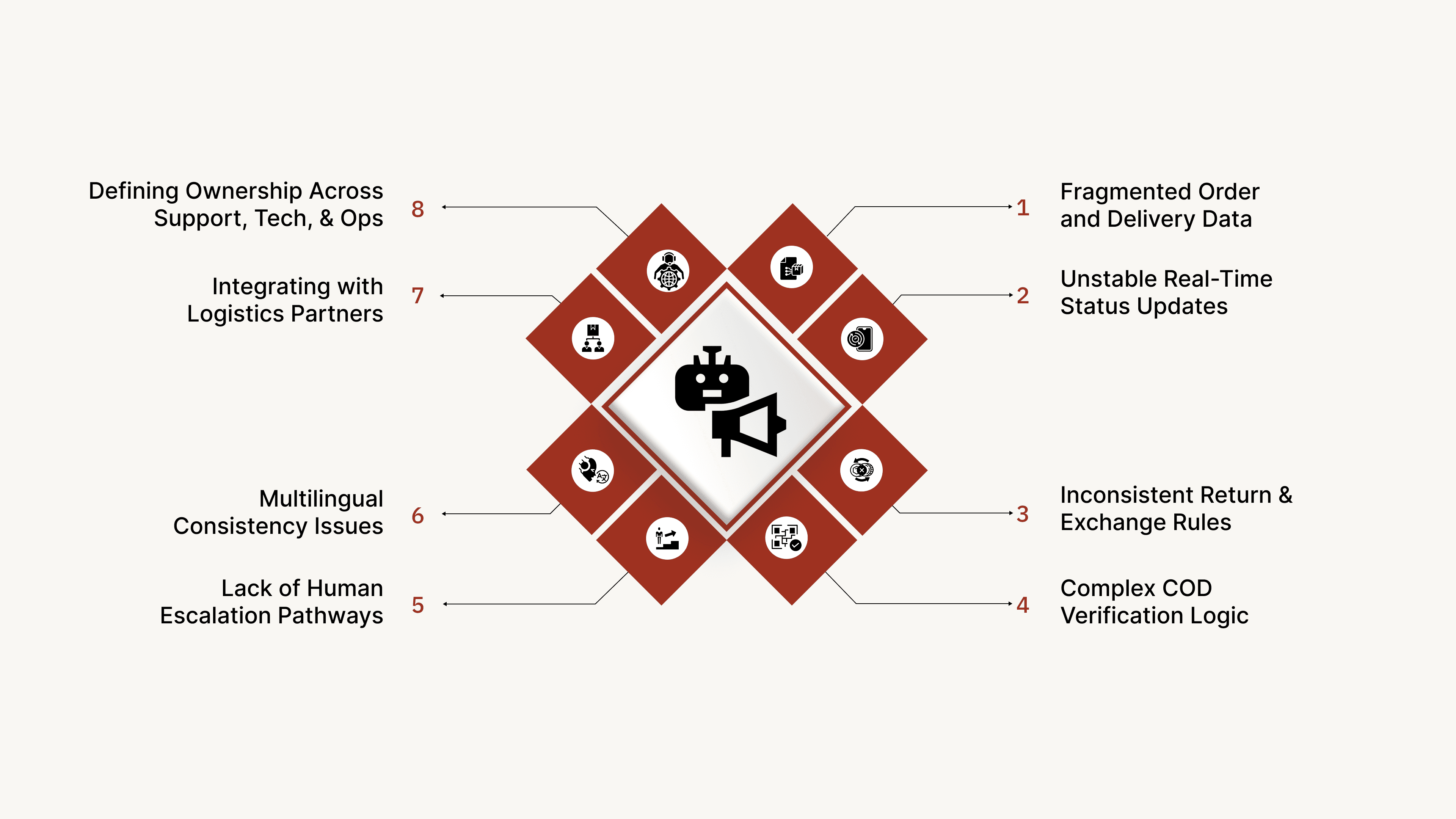
Most teams struggle when introducing AI into their customer operations because they overlook critical dependencies between data, systems, and workflow logic. Voice AI requires more than plugging in an API. It depends on real-time accuracy, consistent process definitions, and clean operational handoffs.
Here are the key challenges you may face when integrating voice AI into e-commerce, along with how to address them effectively.
1. Fragmented Order and Delivery Data
Challenge: E-commerce platforms often pull order, delivery, and inventory data from multiple systems li, like OMS, WMS, logistics partners, and payment gateways. This fragmentation leads to incomplete or outdated information during automated calls.
Solution: Use a unified API layer or middleware to consolidate order and delivery data so the voice agent always reads from a single, accurate source.
2. Unstable Real-Time Status Updates
Challenge: Delivery statuses change frequently, and delays in syncing these updates cause incorrect or confusing customer responses.
Solution: Implement event-driven architecture or webhook-based notifications to push real-time updates directly to the voice AI system.
3. Inconsistent Return & Exchange Rules
Challenge: Return policies vary by category, seller, region, and price band. If these rules are not mapped correctly, automated workflows break.
Solution: Create structured rule mapping for each return type and maintain a centralized logic file that the AI agent references during every interaction.
4. Complex COD Verification Logic
Challenge: COD flows depend on region, risk profiles, product type, and customer history. Hardcoding these rules makes AI brittle.
Solution: Build a modular verification engine where logic can be updated dynamically without altering the voice workflow.
5. Lack of Human Escalation Pathways
Challenge: Without proper fallback routing, the system fails when customers provide unexpected responses or request human support.
Solution: Integrate a human-in-the-loop escalation layer that activates when triggers such as customer frustration, repeated misunderstandings, or high-risk scenarios are detected.
6. Multilingual Consistency Issues
Challenge: E-commerce teams often deploy voice AI across multiple Indian languages, but vocabulary differences lead to inconsistent experiences.
Solution: Train language models on domain-specific terms (SKU names, delivery statuses, product variants) and run periodic linguistic QA across regions.
7. Integrating with Logistics Partners
Challenge: Third-party logistics APIs differ widely in format, reliability, and refresh frequency, causing gaps in communication.
Solution: Use a standardized integration layer that normalizes data from all logistics partners before passing it to the AI agent.
8. Defining Ownership Across Support, Tech, and Ops
Challenge: AI projects fail when teams treat integration as a tech-only effort. Support, operations, and QA must all contribute to the workflow logic.
Solution: Build a cross-functional task force that defines workflows, updates logic, manages exceptions, and monitors quality.
Transform Your E-commerce Operations With CubeRoot’s Voice AI Platform
Most e-commerce teams know that voice automation can handle high volumes of customer interactions, but deploying it effectively becomes challenging when order systems are fragmented, logistics updates are inconsistent, workflows differ across categories, and compliance requirements tighten.
CubeRoot eliminates these gaps with a Voice AI platform engineered for high-scale online retail, enabling accurate, real-time conversations across every order milestone without increasing operational overhead.
Why Leading E-commerce Teams Choose CubeRoot
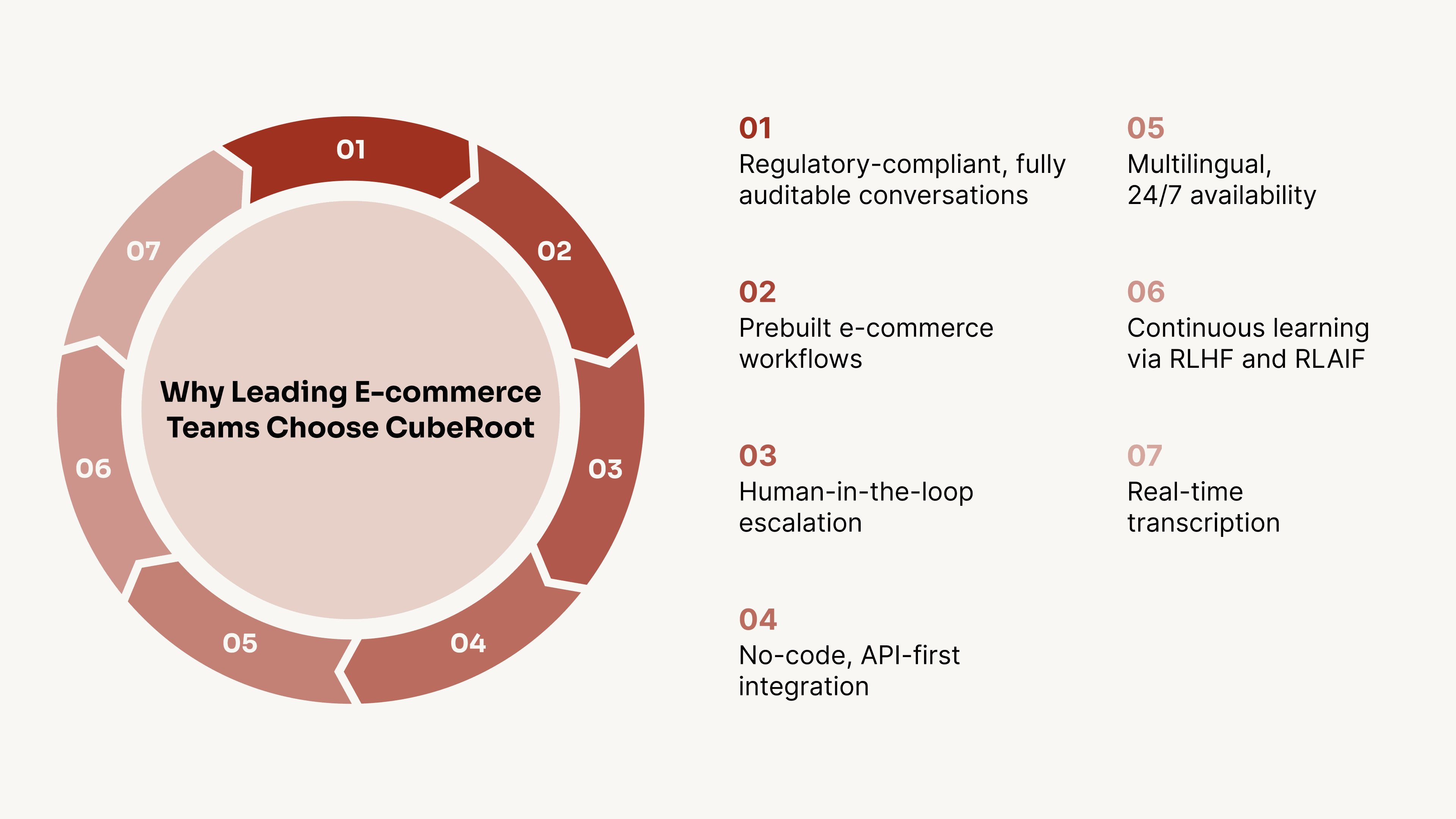
Regulatory-compliant, fully auditable conversations that store every interaction with secure logs and transcripts, giving teams complete visibility into order confirmations, delivery disputes, and return decisions, resulting in faster resolution cycles and reduced investigation time.
Prebuilt e-commerce workflows for order tracking, returns, COD checks, and delivery follow-ups that allow brands to go live far quicker; these structured flows typically reduce WISMO and return-initiation load by up to 70 percent in high-volume operations.
Human-in-the-loop escalation that hands off complex or sensitive issues, such as refund disputes or incorrect deliveries, to agents with full context preserved, improving first-contact resolutions and reducing avoidable escalations.
No-code, API-first integration with OMS, CRM, ERP, and logistics systems to ensure customers always receive real-time, accurate information during calls; this prevents misinformation and cuts repeat inquiries across the delivery lifecycle.
Multilingual, 24/7 availability that supports major Indian languages and ensures consistent service across Tier 1, Tier 2, and Tier 3 markets, enabling automated resolution for nearly 70 percent of routine queries with wait times under ten seconds.
Continuous learning via RLHF and RLAIF that improves accuracy, intent detection, and natural conversation flow as interaction volume grows, driving higher pickup rates and smoother COD and return journeys.
Real-time transcription, call summaries, and sentiment tracking that give teams immediate insight into delivery challenges, product complaints, or courier performance; this helps brands detect patterns early and improve CSAT across post-purchase touchpoints.
CubeRoot brings together retail-specific expertise, workflow intelligence, and enterprise-grade infrastructure to help fast-growing e-commerce brands manage millions of customer conversations with precision.
Book a demo today and see how India’s leading e-commerce brands automate millions of customer conversations with CubeRoot.
FAQs on Voice AI Agents for E-commerce
1. How do Voice AI agents differ from traditional IVR systems?
IVR menus rely on fixed button-based inputs and cannot understand intent or context. Voice AI agents interpret natural speech, process multi-step queries, and provide real-time answers from connected systems. This makes customer interactions faster, more accurate, and less frustrating.
2. Can Voice AI agents reduce WISMO (“Where is my order?”) volume?
Yes. Voice AI agents automatically pull the latest status from the OMS or logistics API and proactively notify customers about shipments, delays, or failed attempts. This can reduce WISMO-related workload by a significant margin for high-volume brands.
3. Are Voice AI agents suitable for COD-heavy e-commerce businesses?
Yes. Voice AI can verify COD intent, confirm address availability, and screen high-risk orders before dispatch. This helps brands lower RTO losses and manage fraud more effectively.
4. How accurate are Voice AI agents in multilingual scenarios?
Modern Voice AI models, especially those trained for Indian languages, can handle major regional languages with high accuracy. CubeRoot’s domain-trained models are optimized for retail vocabulary, courier terms, product names, and local speech patterns.
5. Can Voice AI handle returns and exchange requests?
Yes. The agent can collect return reasons, assess eligibility rules, check pickup availability, and log request details in real time. Exceptions or disputes are transferred to human agents through a structured escalation path.