Dec 29, 2025
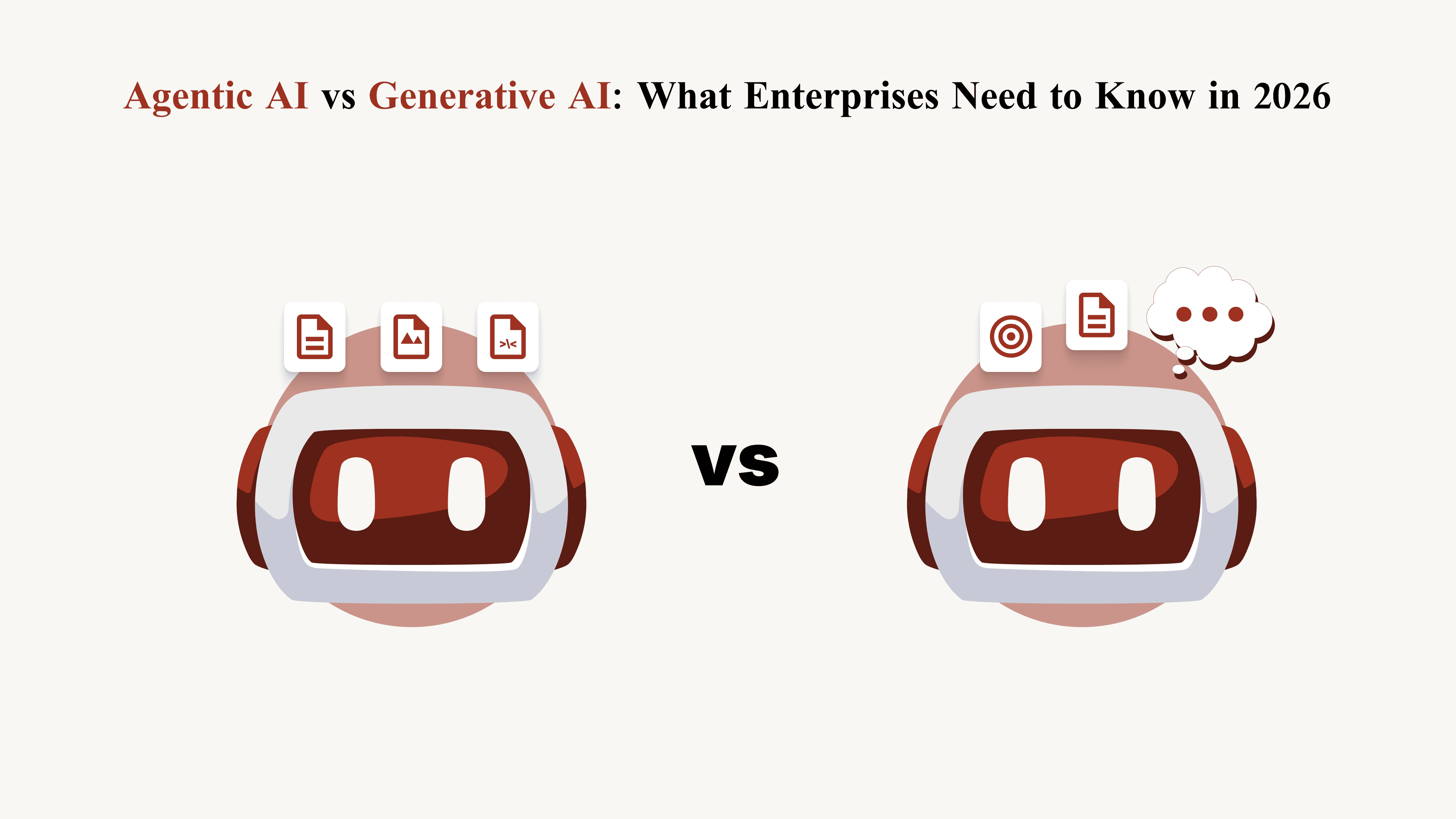
Agentic AI vs Generative AI: What Enterprises Need to Know in 2026
Artificial intelligence now operates through two powerful approaches: generative AI and agentic AI. Generative AI creates content, patterns, and insights from data. Agentic AI plans, decides, and executes real tasks across systems. Both are reshaping enterprise technology, but they serve fundamentally different purposes.
Many enterprise leaders still use both terms interchangeably, assuming they represent the same capability. This confusion often leads to mismatched expectations when choosing AI tools for automation or customer engagement.
The global agentic AI market is projected to surpass $150 billion by 2033, reflecting growing enterprise demand for autonomous systems that can act intelligently and independently.
In this blog, we’ll explore how agentic AI differs from generative AI, where each creates value, and why understanding their roles is critical for enterprise strategy in 2026.
Key Takeaways
Generative AI creates content (text, images, etc.) and automates tasks like drafting emails, but requires human oversight for execution.
Agentic AI autonomously plans, decides, and executes tasks, integrating with systems like CRMs and ERPs for operational efficiency.
Generative AI focuses on content creation, while agentic AI drives decision-making and task execution.
The two technologies complement each other—generative AI provides insights, and agentic AI acts on them.
Future enterprise AI will merge both, enabling seamless, autonomous automation.
What Is Generative AI?
Generative AI creates new content based on patterns learned from large datasets, such as text, images, or code. It automates tasks like drafting emails or generating product descriptions. However, it requires human review for execution and lacks decision-making capabilities.
Key Points:
Automates content creation
Limited to generating outputs, not executing actions
Requires human oversight for decisions
This is where agentic AI comes in, systems designed not just to generate information but to think, decide, and act on it.
What Is Agentic AI?
Agentic AI goes beyond content creation, autonomously reasoning, planning, and executing tasks to achieve goals. It integrates with enterprise systems like CRMs and ERPs to perform real-time actions and improve decision-making over time.
Key Features:
Autonomy: Initiates actions based on goals
Context Awareness: Remembers past interactions
Goal-Oriented: Focuses on achieving outcomes
System Integration: Executes tasks across connected systems
Adaptive Learning: Improves through feedback
Example: In a customer support workflow, a generative system might write a helpful response, while an agentic AI voice agent would analyze the issue, update the ticket, trigger a follow-up call, and close the loop all autonomously.
Agentic AI shifts automation from answering to doing. It forms the operational backbone of the next generation of enterprise intelligence.
Now that we understand both, it’s time to look at how they differ side by side, from intent and capability to enterprise impact.
Key Differences Between Agentic AI and Generative AI
Generative AI and agentic AI both rely on advanced models, but their goals, behavior, and business value differ entirely. One creates, the other acts.
Dimension | Generative AI | Agentic AI |
Primary Function | Creates content such as text, images, or insights | Executes tasks and workflows autonomously |
Objective | Creativity and information generation | Decision-making and outcome delivery |
Context Handling | Limited to single interactions | Retains and applies context across sessions |
Autonomy Level | Reactive — depends on user prompts | Proactive — initiates and completes tasks |
Integration Depth | Minimal; external execution required | Deep integration with enterprise systems (CRM, ERP, APIs) |
Learning Style | Predictive, pattern-based | Reinforcement and goal-oriented |
Enterprise Value | Boosts productivity and creativity | Drives operational efficiency and scale |
Generative AI provides the ideas; agentic AI turns them into results. Enterprises need both to inform and to act, but understanding their boundaries is key to avoiding technology overlap.
These systems are not competitors. In fact, their combined use unlocks the most powerful automation workflows for modern enterprises.
Also read: Conversational AI Examples and Use Cases in Various Industries
How Agentic AI and Generative AI Work Together
Generative AI and agentic AI function best when used together. Generative AI provides intelligence and creativity, while agentic AI converts that intelligence into measurable action.
How They Complement Each Other
Generative AI produces the “what.” It creates messages, content, and contextual responses.
Agentic AI delivers the “how.” It interprets intent, executes actions, and updates systems.
Example: In a customer service setup, a generative model drafts a personalized follow-up message. The agentic system then sends it, updates the CRM, schedules a callback, and monitors response rates, completing the workflow without manual intervention.
Together, they form a continuous loop where generative systems create knowledge, and agentic systems apply it. This pairing builds the foundation for self-improving enterprise ecosystems, where AI no longer stops at insight but drives execution.
To understand their impact more clearly, let’s look at how each technology transforms enterprise operations across sectors in 2026.
How Enterprises Are Using Generative and Agentic AI in 2026
By 2026, both agentic and generative AI will be integral to enterprise operations. Each plays a distinct role: one creates intelligence, the other operationalizes it.
Generative AI in the Enterprise
Marketing and Sales: Generates personalized content, campaign messages, and product recommendations.
Documentation and Training: Drafts policy documents, user manuals, and onboarding materials.
Analytics and Research: Summarizes large data sets or market reports for faster decision-making.
Agentic AI in the Enterprise
Customer Support and Voice Automation: Handles inbound and outbound interactions, updates records, and follows up autonomously.
Finance and Operations: Executes repetitive workflows such as invoice verification, payment reminders, and reconciliation.
Healthcare and BFSI: Schedules appointments, verifies compliance scripts, and maintains auditable communication trails.
When They Work Together
Generative AI creates the content or insight.
Agentic AI uses it to act, sending responses, updating systems, or triggering next steps.
This integration helps enterprises scale both creativity and execution without expanding their teams, creating an ecosystem where knowledge and action reinforce each other.
Understanding these applications also means recognizing the challenges and misconceptions that come with deploying both technologies.
Related: Conversational AI for Customer Service: Benefits and How It Works
Challenges and Ethical Considerations in Using Generative and Agentic AI
Enterprises adopting advanced AI often face the same pattern of challenges: overestimation of capability, unclear accountability, and gaps in compliance. Understanding these risks upfront ensures responsible and sustainable AI integration.
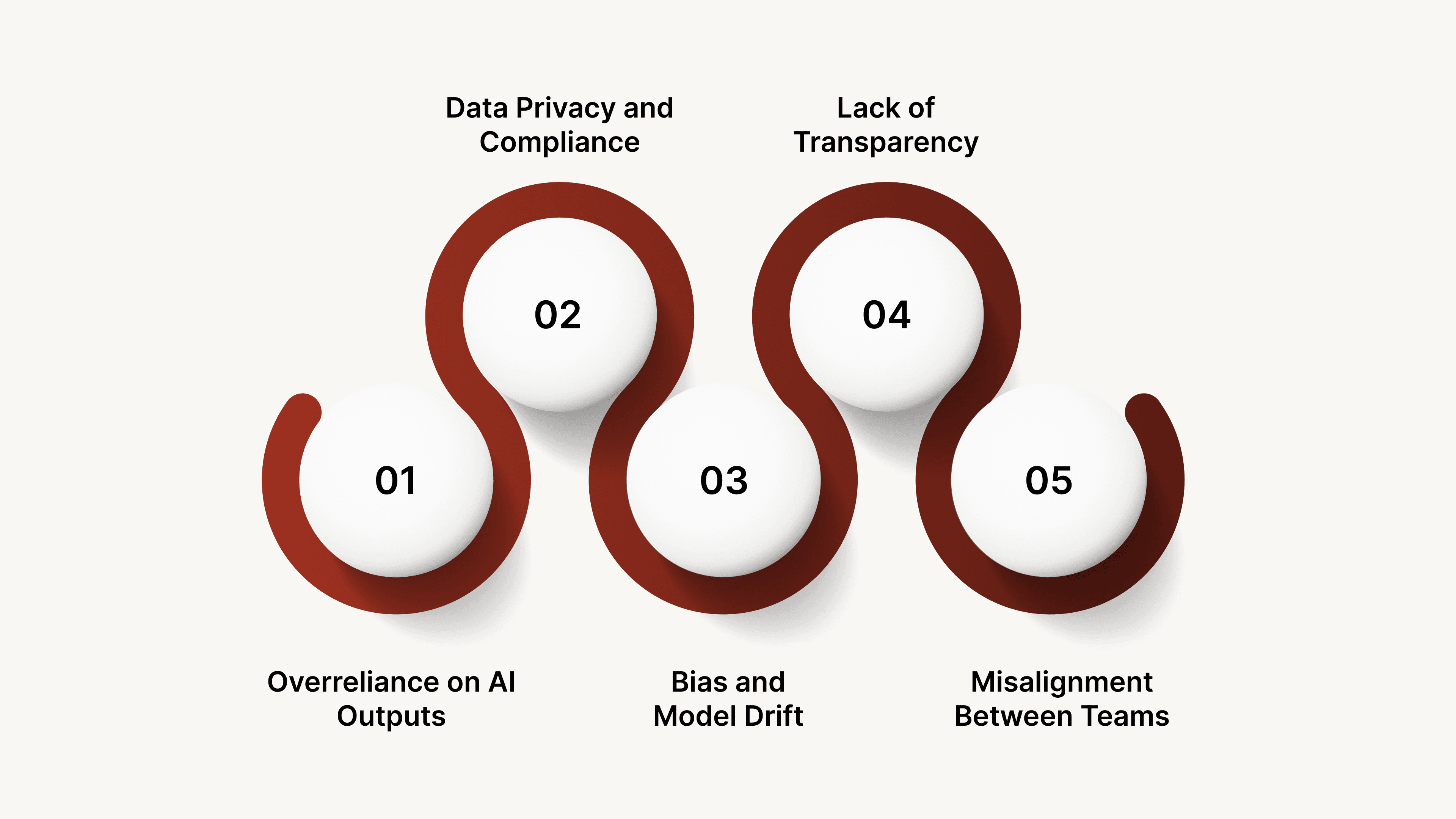
1. Overreliance on AI Outputs
Risk: Teams may accept AI-generated or AI-executed outcomes without validation.
Mitigation: Maintain human checkpoints for quality assurance, especially in financial, medical, or legal workflows.
2. Data Privacy and Compliance
Risk: Generative models can inadvertently expose or reuse sensitive data, while agentic systems can act on incomplete or non-compliant information.
Mitigation: Use secure, enterprise-grade environments with encryption, audit logs, and data masking.
3. Bias and Model Drift
Risk: AI systems may reflect historical bias or lose accuracy over time as language and behavior evolve.
Mitigation: Retrain models regularly, use diverse datasets, and monitor for performance drift.
4. Lack of Transparency
Risk: Stakeholders may not understand why the AI made a specific decision or action.
Mitigation: Implement explainable AI frameworks and clear documentation for every automated decision.
5. Misalignment Between Teams
Risk: Business, compliance, and tech teams may interpret AI capabilities differently, causing rollout friction.
Mitigation: Establish shared governance between CX, data, and IT teams to manage accountability.
AI maturity comes not just from deploying technology but from creating the guardrails that make it dependable and auditable.
Once these challenges are addressed, enterprises can make a clear, strategic choice about which AI model fits their goals best.
Deciding Between Agentic and Generative AI
Enterprises rarely adopt AI for novelty; they do it for measurable outcomes. Choosing between agentic and generative AI depends on the type of value your business wants to create: insight or execution.
Decision Factor | Best Suited for Generative AI | Best Suited for Agentic AI |
Primary Objective | Content creation, communication, and knowledge generation | Workflow automation, task execution, decision-making |
Core Users | Marketing, research, and content teams | CX, operations, finance, and support teams |
Infrastructure Needs | Light integration; standalone tools are sufficient | Requires APIs, connected systems, and secure environments |
Output Type | Text, visuals, recommendations | Completed actions, transactions, and logged outcomes |
Compliance Level | Moderate; depends on review layers | High: supports traceable and auditable actions |
Scalability | Model reuse and creative diversity | Process automation and operational replication |
Time to Value | Short-term productivity gains | Long-term efficiency and CX transformation |
The smarter choice depends on where your enterprise stands. If creativity and speed are priorities, generative AI fits best. If efficiency, compliance, and operational scale are goals, agentic AI creates a deeper impact.
In mature ecosystems, the real advantage comes from blending both: letting generative intelligence guide communication and agentic intelligence drive execution.
This convergence is already shaping the next generation of enterprise AI systems, where creativity and autonomy coexist seamlessly.
The Future of AI: Where Creativity Meets Autonomy
The evolution of enterprise AI is moving toward convergence. Generative and agentic systems are no longer separate categories but complementary forces reshaping how organizations create and execute decisions.
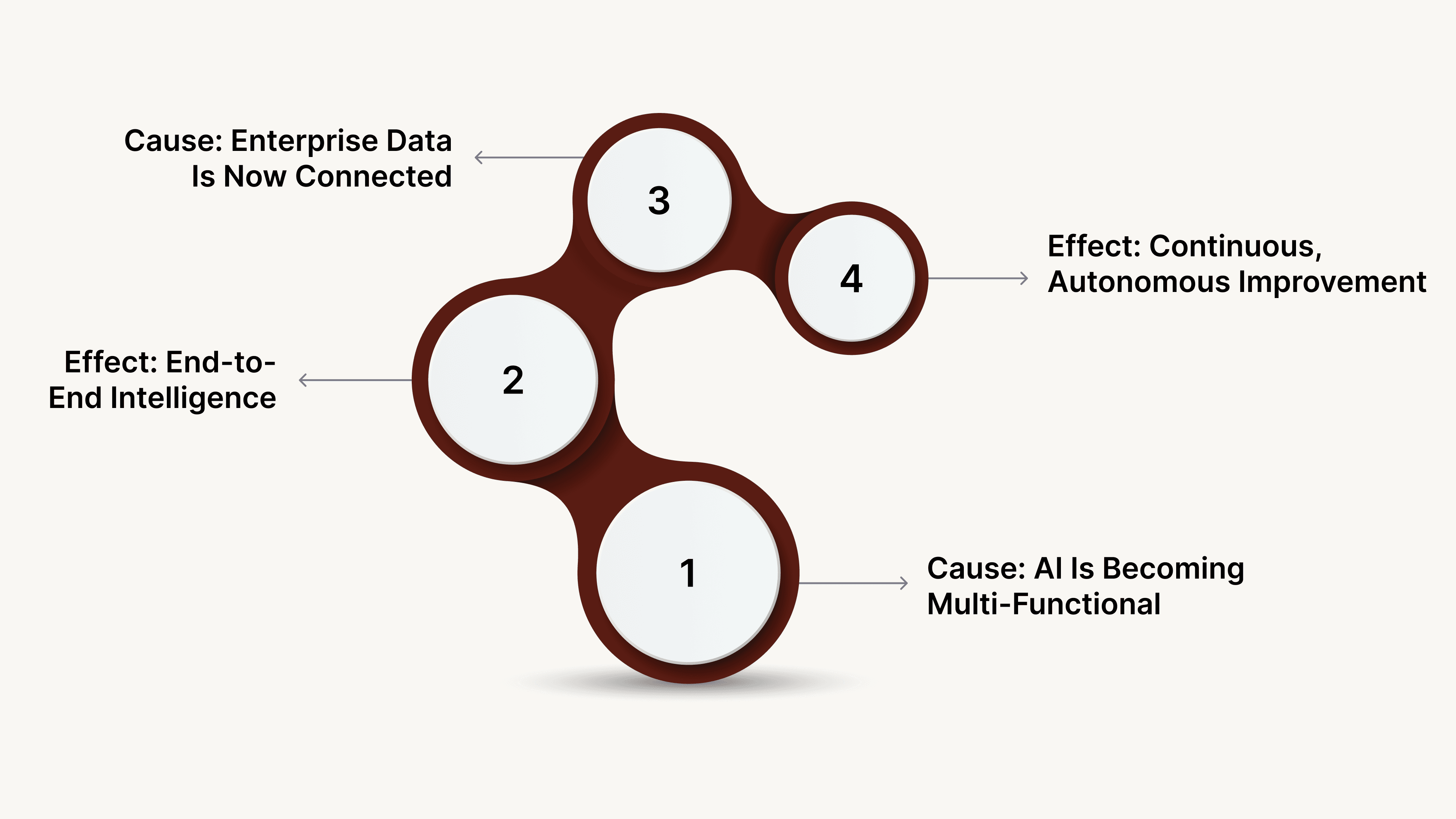
1. Cause: AI Is Becoming Multi-Functional
Enterprises are demanding systems that not only produce insights but also act on them. Generative AI creates information, while agentic AI operationalizes it. The growing need for speed and closed-loop decisioning is bringing both together in unified architectures.
2. Effect: End-to-End Intelligence
Future AI platforms will combine both layers: the generative model for ideation, summarization, and personalization, and the agentic layer for execution, verification, and record-keeping. This fusion will eliminate the manual gap between insight and action.
3. Cause: Enterprise Data Is Now Connected
API-first ecosystems, unified data lakes, and secure cloud platforms allow AI to move seamlessly from reasoning to doing. As system interoperability improves, the boundary between generative output and agentic execution becomes invisible.
4. Effect: Continuous, Autonomous Improvement
These integrated systems will learn from every completed task, adapt to new goals, and optimize themselves. The result is an enterprise environment where intelligence drives measurable outcomes, not just reports or predictions.
The direction is clear: the future of AI isn’t just about thinking or doing. It’s about systems that can do both, responsibly and intelligently.
With this trajectory in mind, let’s close by understanding what actions enterprises should take now to prepare for this new wave of AI capability.
How CubeRoot Bridges Generative and Agentic AI
CubeRoot is an enterprise-grade Voice AI platform that automates large-scale inbound and outbound calls across sectors such as BFSI, NBFCs, consumer durables, and real estate. Its voice agents engage customers naturally, handle lead qualification, collections, ticket resolution, and appointment scheduling.
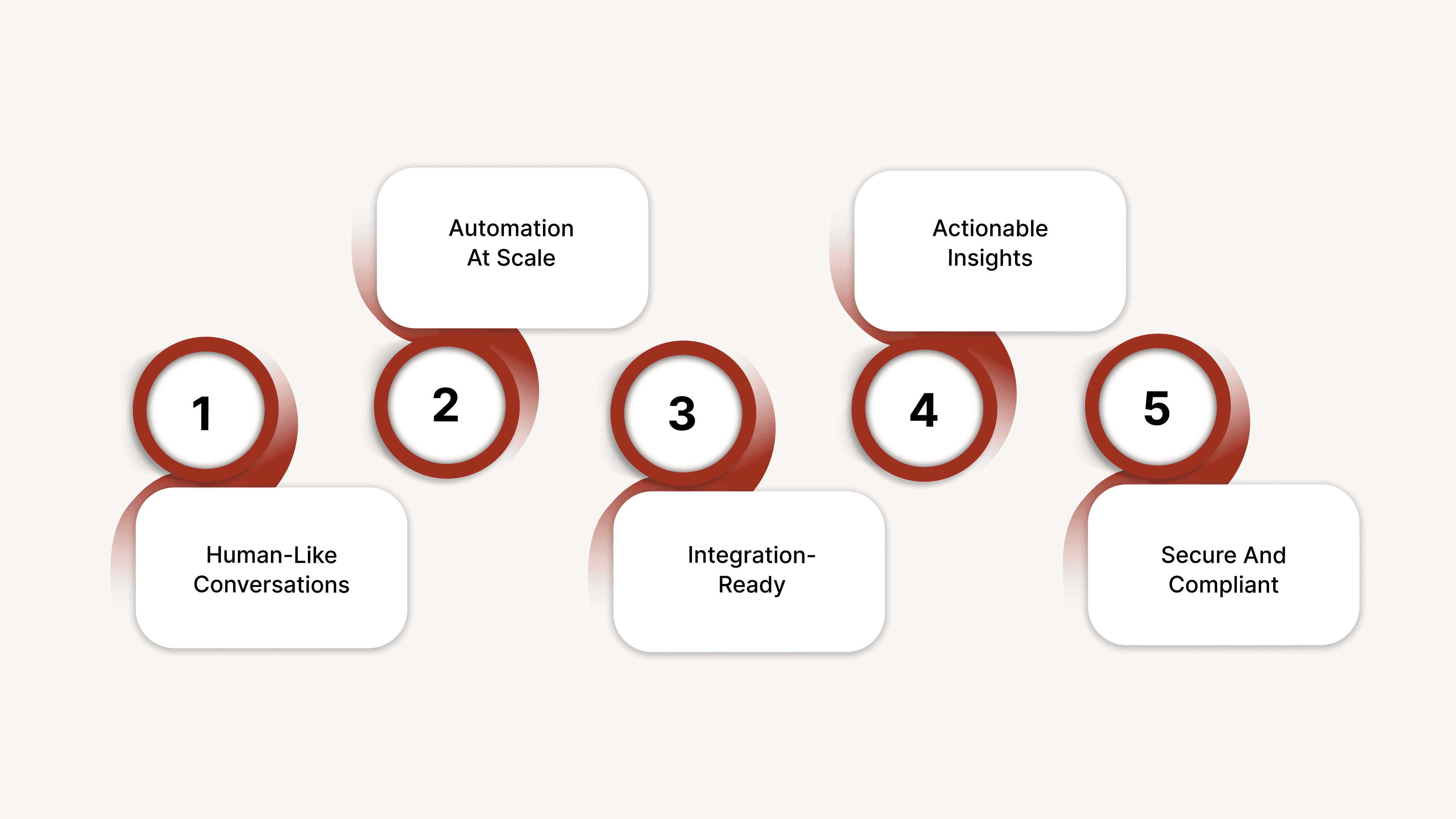
Human-like Conversations: Voice agents understand context and intent to deliver natural, multilingual interactions.
Automation at Scale: Automates high-volume workflows like repayment reminders and post-sale engagement.
Integration-Ready: Connects seamlessly with CRMs and enterprise systems for real-time data updates.
Actionable Insights: Provides call analytics and dashboards to monitor performance and optimize workflows.
Secure and Compliant: Built for enterprise standards with encrypted data handling and audit-ready records.
CubeRoot combines the content intelligence of generative AI with the action capability of agentic systems, enabling enterprises to automate voice workflows end-to-end while maintaining a human touch.
Ready to modernize your enterprise voice operations with intelligent automation? Request a demo to see CubeRoot’s Voice AI in action.
FAQs
1. What is the key difference between agentic AI and generative AI?
Generative AI creates content such as text, visuals, or insights. Agentic AI acts on information to plan, decide, and execute multi-step tasks to achieve defined goals.
2. Can an AI system be both generative and agentic?
Yes. Many enterprise-grade AI systems now combine both capabilities. The generative layer creates or interprets information, while the agentic layer uses that output to perform real actions like sending updates or triggering workflows.
3. Which industries benefit most from agentic AI?
Sectors with high-volume, process-heavy operations such as BFSI, healthcare, retail, and logistics gain the most from agentic AI. It automates repetitive decisions while maintaining compliance and auditability.
4. Is agentic AI replacing human roles?
Not entirely. It automates repetitive, rule-based processes so that human teams can focus on complex decisions, empathy-driven interactions, and creative problem-solving.
5. What’s the future of agentic and generative AI integration?
The next generation of enterprise systems will merge the two generative models to create insights, while agentic systems will act on them autonomously, forming intelligent loops that both think and execute in real time.